South Dakota Revocation of Statutory Living Will
About this form
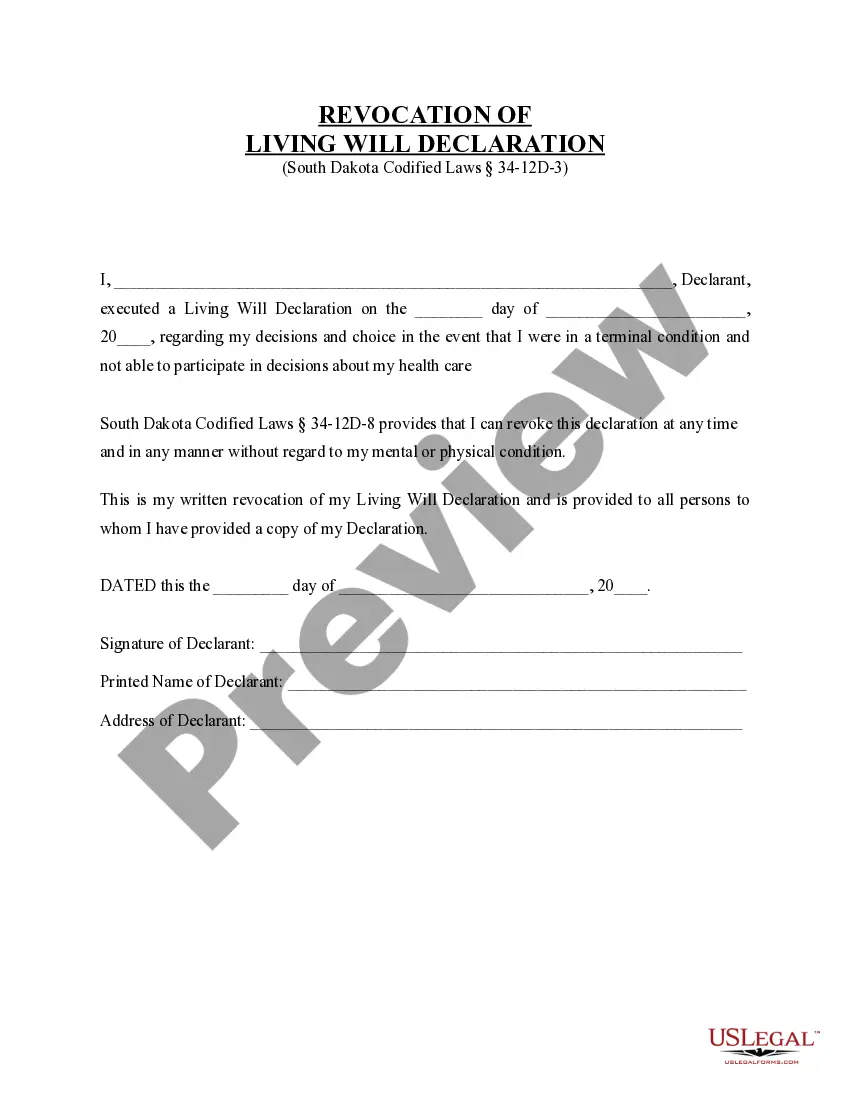
The Revocation of Statutory Living Will form is a legal document that allows individuals to revoke a previously executed living will. This form is important for those who wish to change their preferences regarding end-of-life medical care and ensures that past directives do not apply. Unlike a standard living will, this document explicitly cancels any previously stated wishes concerning life-sustaining procedures in the event of terminal illness or inability to make health care decisions.
Form components explained
- Name of the declarant who executed the original living will.
- Date of the original living will declaration.
- The declarant's statement revoking the earlier living will.
- Date of the revocation.
- Signature and printed name of the declarant.
- Address of the declarant.
When this form is needed
This form should be used when an individual desires to change or withdraw their previously made decisions regarding life-sustaining medical treatment. It is particularly relevant in scenarios such as recovery from a serious illness, changes in personal beliefs about medical care, or after a discussion with family or medical professionals that leads to a different perspective on one's end-of-life preferences.
Who should use this form
- Individuals who have previously executed a living will and wish to revoke it.
- People who have experienced a change in their health care preferences.
- Anyone wanting to ensure clarity about their health care decisions with family and healthcare providers.
Steps to complete this form
- Enter your name as the declarant in the specified section.
- Fill in the date when the original living will was executed.
- Clearly state your intention to revoke the previous living will.
- Sign and print your name on the designated lines.
- Provide your address as the declarant.
- Date the revocation for record-keeping purposes.
Notarization guidance
This form does not typically require notarization to be legally valid. However, some jurisdictions or document types may still require it. US Legal Forms provides secure online notarization powered by Notarize, available 24/7 for added convenience.
Get your form ready online
Our built-in tools help you complete, sign, share, and store your documents in one place.
Make edits, fill in missing information, and update formatting in US Legal Forms—just like you would in MS Word.
Download a copy, print it, send it by email, or mail it via USPS—whatever works best for your next step.
Sign and collect signatures with our SignNow integration. Send to multiple recipients, set reminders, and more. Go Premium to unlock E-Sign.
If this form requires notarization, complete it online through a secure video call—no need to meet a notary in person or wait for an appointment.
We protect your documents and personal data by following strict security and privacy standards.

Make edits, fill in missing information, and update formatting in US Legal Forms—just like you would in MS Word.

Download a copy, print it, send it by email, or mail it via USPS—whatever works best for your next step.

Sign and collect signatures with our SignNow integration. Send to multiple recipients, set reminders, and more. Go Premium to unlock E-Sign.

If this form requires notarization, complete it online through a secure video call—no need to meet a notary in person or wait for an appointment.

We protect your documents and personal data by following strict security and privacy standards.
Avoid these common issues
- Failing to date the revocation properly, which could cause confusion.
- Not informing healthcare providers or family members about the revocation.
- Using a different version of the living will without revoking the previous one.
Advantages of online completion
- Instant access to the legal document from anywhere, at any time.
- Convenient editing options to personalize the form according to your specific needs.
- Reliable and up-to-date templates drafted by licensed attorneys, ensuring legal compliance.
Legal use & context
- The revocation is legally binding, provided it adheres to the state laws governing living wills.
- It allows for the updated expression of your healthcare decisions without ambiguity.
- Ensure you notify all relevant parties, including healthcare providers, of the revocation.
What to keep in mind
- The Revocation of Statutory Living Will form cancels any previous living will declarations.
- It is essential for maintaining current wishes regarding medical treatment at the end of life.
- Completing this form accurately ensures your healthcare preferences are respected.
Looking for another form?
Form popularity
FAQ
No. You can make your own will in South Dakota, using Nolo's do-it-yourself will software or online will programs. However, you may want to consult a lawyer in some situations. For example, if you think that your will might be contested or if you want to disinherit your spouse, you should talk with an attorney.
Age: The testator must be at least 18 years old. Capacity: The testator must be of sound mind. Signature: The will must be signed by the testator or by someone else in the testator's name in his conscious presence, by his direction.
Living Wills are Binding Legal Documents You need to legally outline your wishes in compliance with state law. Your living will needs to cover what you wish to happen if you become terminally ill, permanently unconscious, or unable to convey your own wishes.
Living will. A living will is a written, legal document that spells out medical treatments you would and would not want to be used to keep you alive, as well as your preferences for other medical decisions, such as pain management or organ donation. In determining your wishes, think about your values.
Will my living will ever expire? Your living will remains effective for as long as you live, unless you intentionally revoke it or the courts get involved (e.g., someone challenges whether you had capacity to make the document, or a court questions whether your document meets the state's requirements).
Two witnesses and a notary are required for a living will. Medical power of attorney for health care also requires two witnesses and a notary. Declaration to physicians (living will) requires two witnesses, but is not valid if pregnant. Power of attorney for health care requires two witnesses.
A living will becomes effective when your primary physician decides that you can no longer make your own healthcare decisions. If you are ill or injured and cannot express your healthcare wishes, and your doctor certifies this fact in writing, your living will takes effect.
As long as it was properly signed and witnessed by two adult independent witnesses who are present at the time you sign your will, it should be legally binding.Using the wrong wording could mean that your instructions aren't followed, or even that your will isn't valid.
A living will is a vital part of the estate plan.But your family cannot override your living will. They cannot take away your authority to make your own treatment and care plans. In fact, you always retain the right to override your own decisions.