Pennsylvania Small Estate Affidavit
Overview of this form
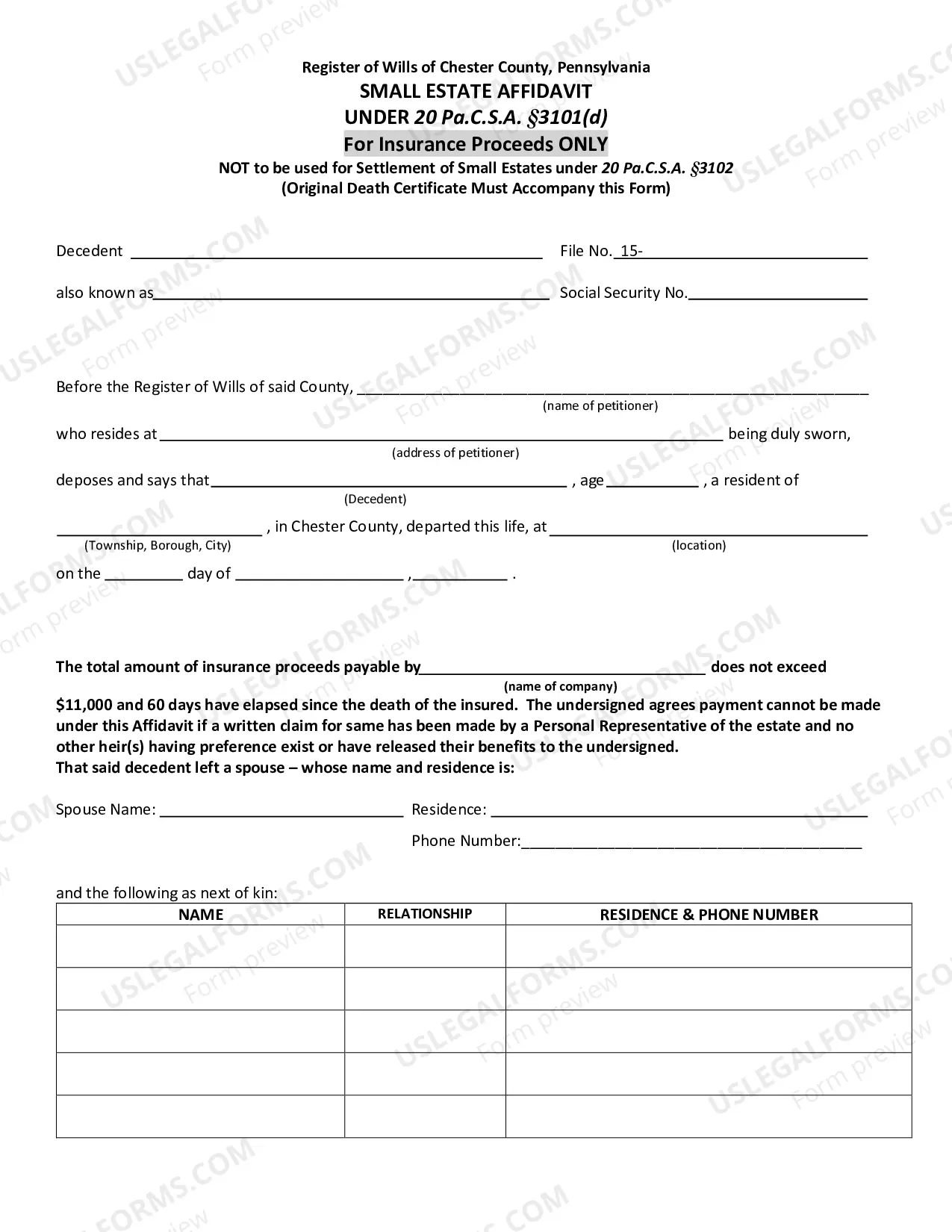
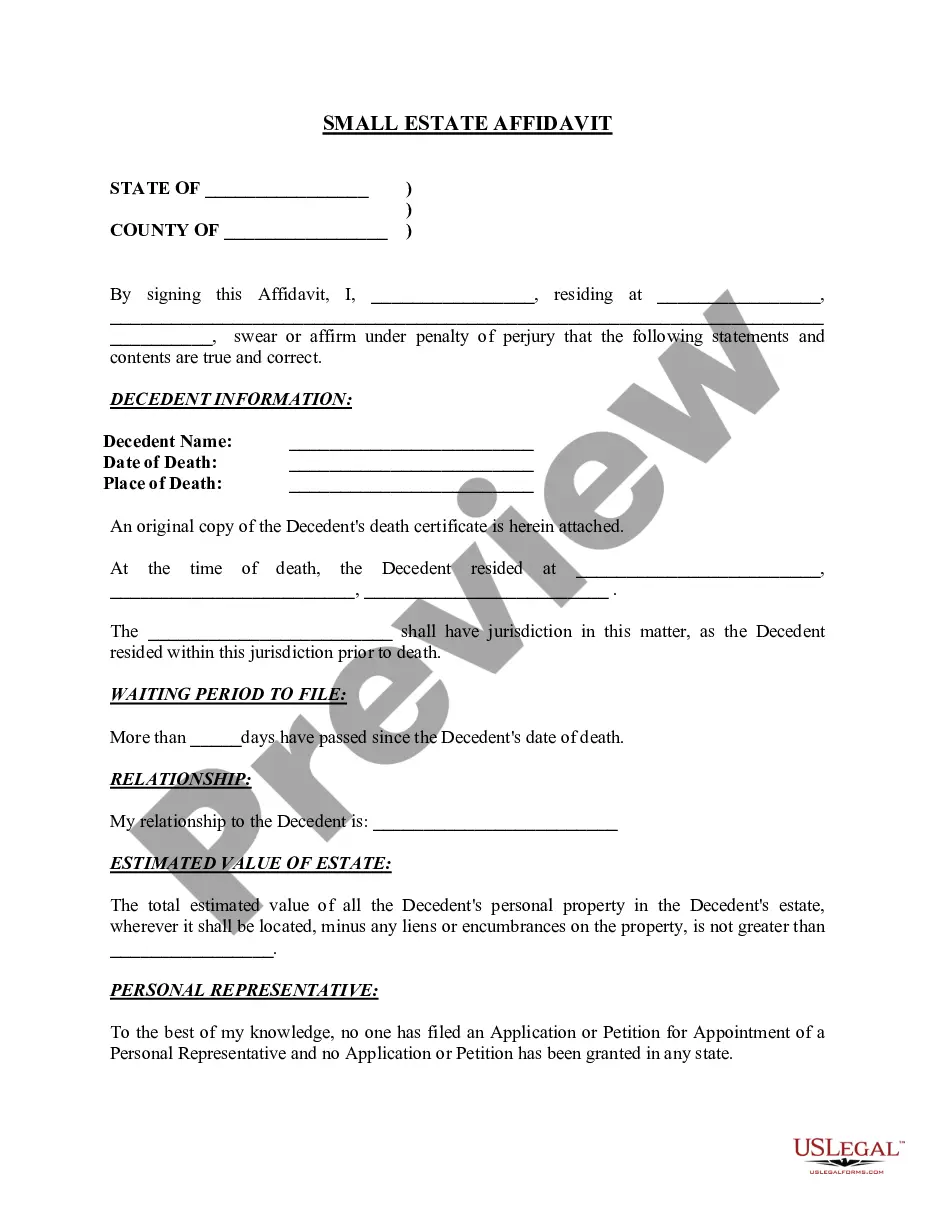
The Small Estate Affidavit is a legal document used to claim insurance proceeds under Pennsylvania law for estates with limited assets. Unlike other estate forms, this affidavit is specifically for instances where the total insurance benefits do not exceed $11,000. It facilitates faster access to funds without the need for a formal estate proceeding when certain conditions are met.
Main sections of this form
- Petitioner's name and address.
- Decedent's name, age, and details of their passing.
- Total amount of insurance proceeds claimed.
- Information regarding the decedent's spouse and next of kin.
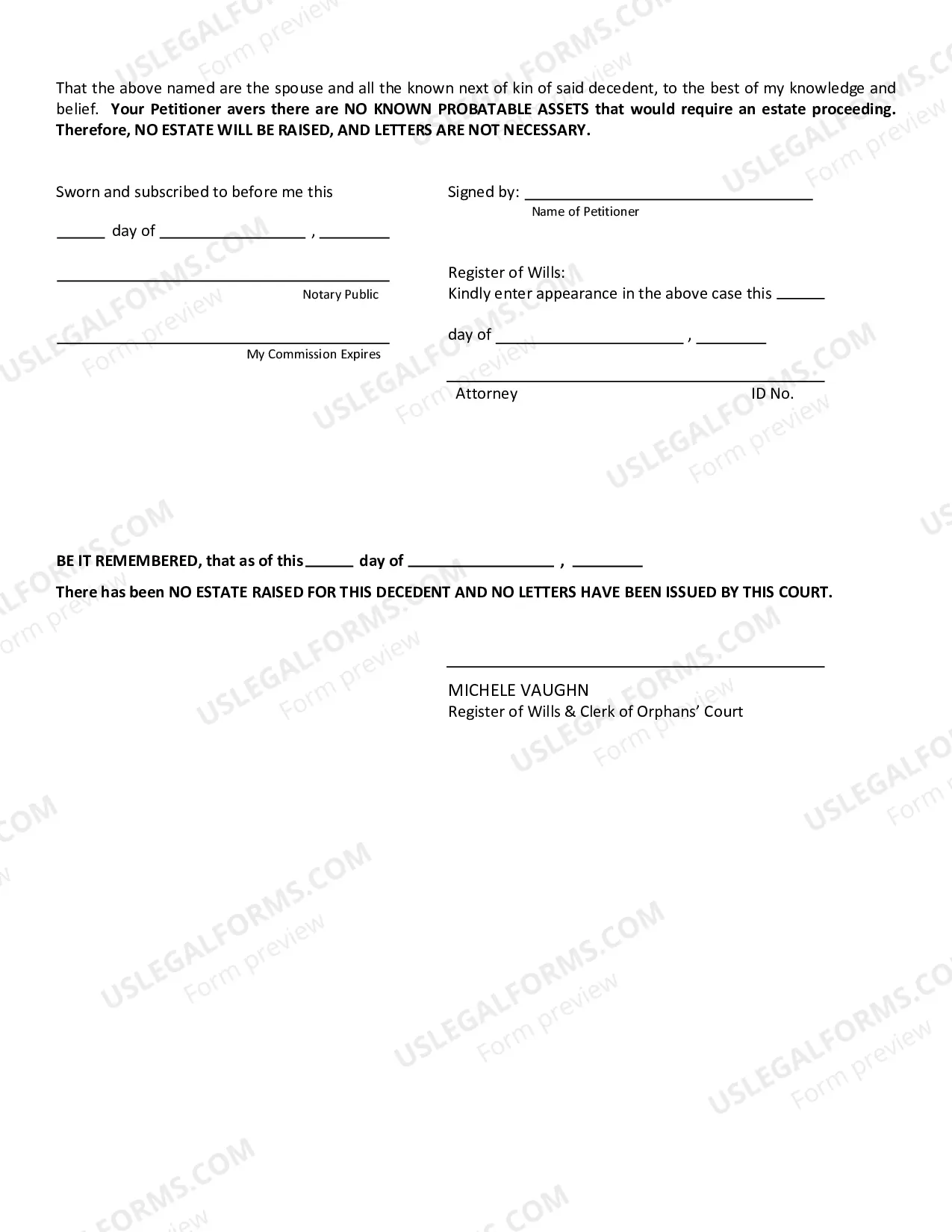
- Declaration regarding the absence of known probatable assets.
- Signature section for notary acknowledgment.
When this form is needed
This form should be used when a deceased person has left behind a small amount of insurance proceeds and no estate will be raised. If the total amount of insurance benefits is $11,000 or less, and at least 60 days have passed since the decedent's death, this affidavit allows for direct payment of the proceeds to the rightful claimant without the need for formal probate proceedings.
Who this form is for
- Beneficiaries of insurance proceeds from a decedent's policy.
- Individuals who are next of kin to the deceased.
- Survivors of a decedent with no probatable assets.
- Petitioners who need to facilitate a claim quickly and affordably.
Completing this form step by step
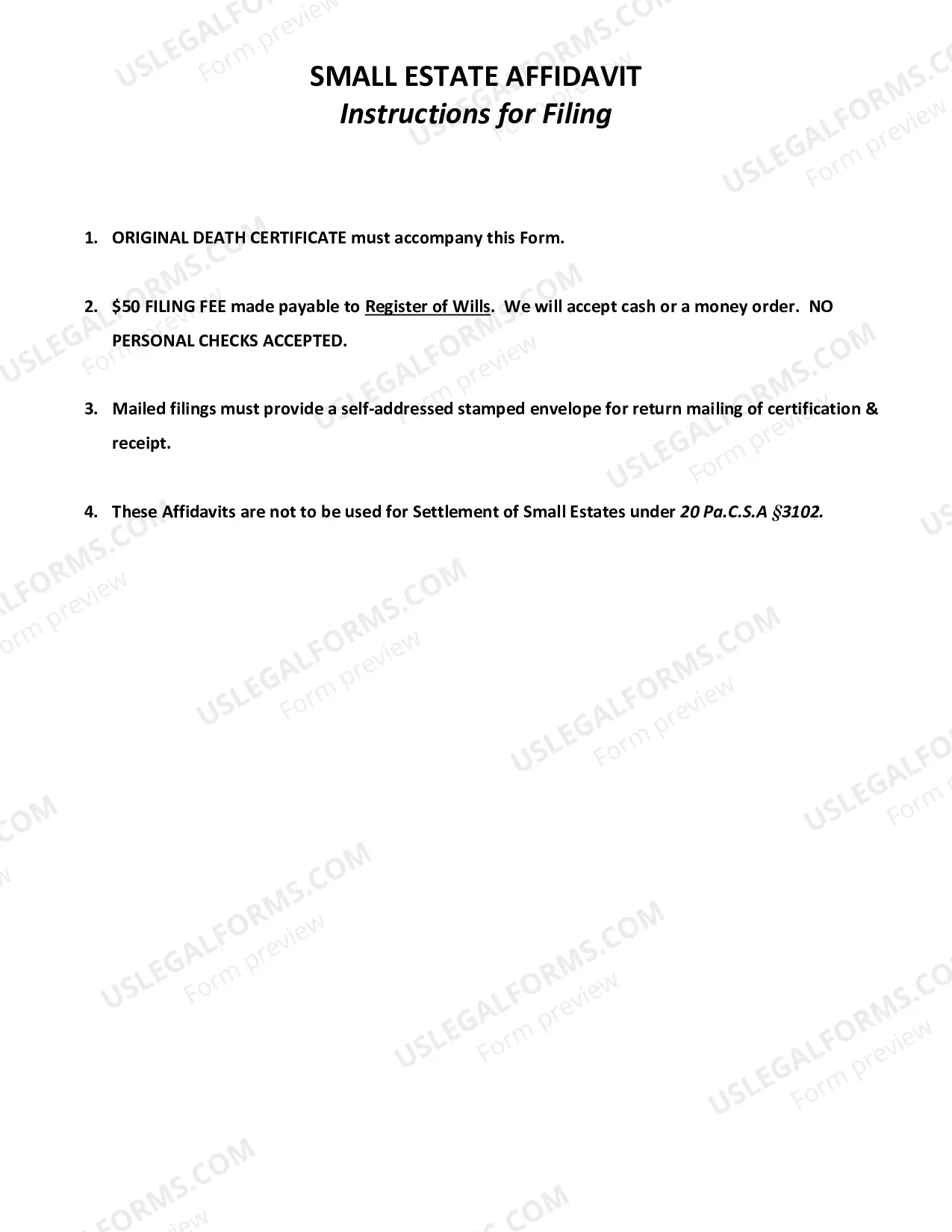
- Obtain the original death certificate of the decedent.
- Complete the petitionerâs and decedentâs information accurately.
- Provide details of the insurance company and the total amount of the proceeds.
- List all known next of kin and their relationship to the decedent.
- Sign the affidavit in front of a notary public to finalize it.
Does this document require notarization?
Yes, this form must be notarized to be legally valid. The notarization confirms the identity of the person signing the affidavit and provides an additional layer of verification for the document.
Get your form ready online
Our built-in tools help you complete, sign, share, and store your documents in one place.
Make edits, fill in missing information, and update formatting in US Legal Forms—just like you would in MS Word.
Download a copy, print it, send it by email, or mail it via USPS—whatever works best for your next step.
Sign and collect signatures with our SignNow integration. Send to multiple recipients, set reminders, and more. Go Premium to unlock E-Sign.
If this form requires notarization, complete it online through a secure video call—no need to meet a notary in person or wait for an appointment.
We protect your documents and personal data by following strict security and privacy standards.

Make edits, fill in missing information, and update formatting in US Legal Forms—just like you would in MS Word.

Download a copy, print it, send it by email, or mail it via USPS—whatever works best for your next step.

Sign and collect signatures with our SignNow integration. Send to multiple recipients, set reminders, and more. Go Premium to unlock E-Sign.

If this form requires notarization, complete it online through a secure video call—no need to meet a notary in person or wait for an appointment.

We protect your documents and personal data by following strict security and privacy standards.
Avoid these common issues
- Failing to include the original death certificate.
- Incorrectly reporting the amount of insurance proceeds.
- Not listing all next of kin or their correct details.
- Omitting the notary's signature and seal.
Advantages of online completion
- Convenient access to the form anytime, reducing time and effort.
- Edit and customize the form easily before finalizing.
- Ensures that the latest legal language is used to enhance validity.
- Accessible resources provide guidance for completion.
Summary of main points
- The Small Estate Affidavit is used to claim insurance proceeds after the decedent's passing.
- Total insurance proceeds must not exceed $11,000.
- Original death certificate and notarization are required for submission.
- The form facilitates a quicker resolution for heirs compared to standard probate processes.
Looking for another form?
Form popularity
FAQ
Simplified Probate for Small Estates Not all estates must go through a long and expensive probate process. Pennsylvania offers a simplified probate process for small estates, which state law defines as estates that contain no more than $50,000 in assets.
Some states may require a lawyer for submitting them to probate court, but Pennsylvania doesn't. A lawyer will save you time and headaches. A lawyer can make sure you don't make big tax mistakes or miss any deadlines.
A Pennsylvania small estate affidavit is a document used to petition the Orphans' Court for appointment as the personal representative over a deceased individual's small estate. It can only be used for estates valued at less than $50,000.
Pennsylvania Probate Fee Schedule ? Attorney Fees For Estate Settlement In PA Value of Estate% of EstateFee$0.01 to $25,000.007%$1,750.00$25,000.01 to $50,000.006%$1,500.00$50,000.01 to $100,000.005%$2,500.00$100,000.01 to $200,000.004%$4,000.005 more rows
The process of settling an estate involves naming a personal representative, collecting estate assets, filling appropriate forms with the Register of Wills, notifying heirs, providing a public notice, paying all debts and taxes, and distributing the remaining assets to heirs named in the will or under the laws of
When Can You Use a Settlement of Small Estate in Pennsylvania? Pennsylvania's small estate proceeding is called a "settlement of small estate on petition." This procedure is available if all of the property left behind is worth $50,000 or less. But these types of property don't count in the tally: real estate.
In Pennsylvania, it is only necessary to probate if the decedent owned assets, whether financial or real estate holdings, solely in their name which did not already have a beneficiary designated. Such assets are called probate assets, and in order to convey ownership of them it is necessary to probate.
In Pennsylvania, there is no set deadline for filing probate. However, the law requires that the inheritance tax be wholly paid within nine months after the person's passing unless there has been a request for an extension.