Pennsylvania Framing Contractor Package
What is this form package?
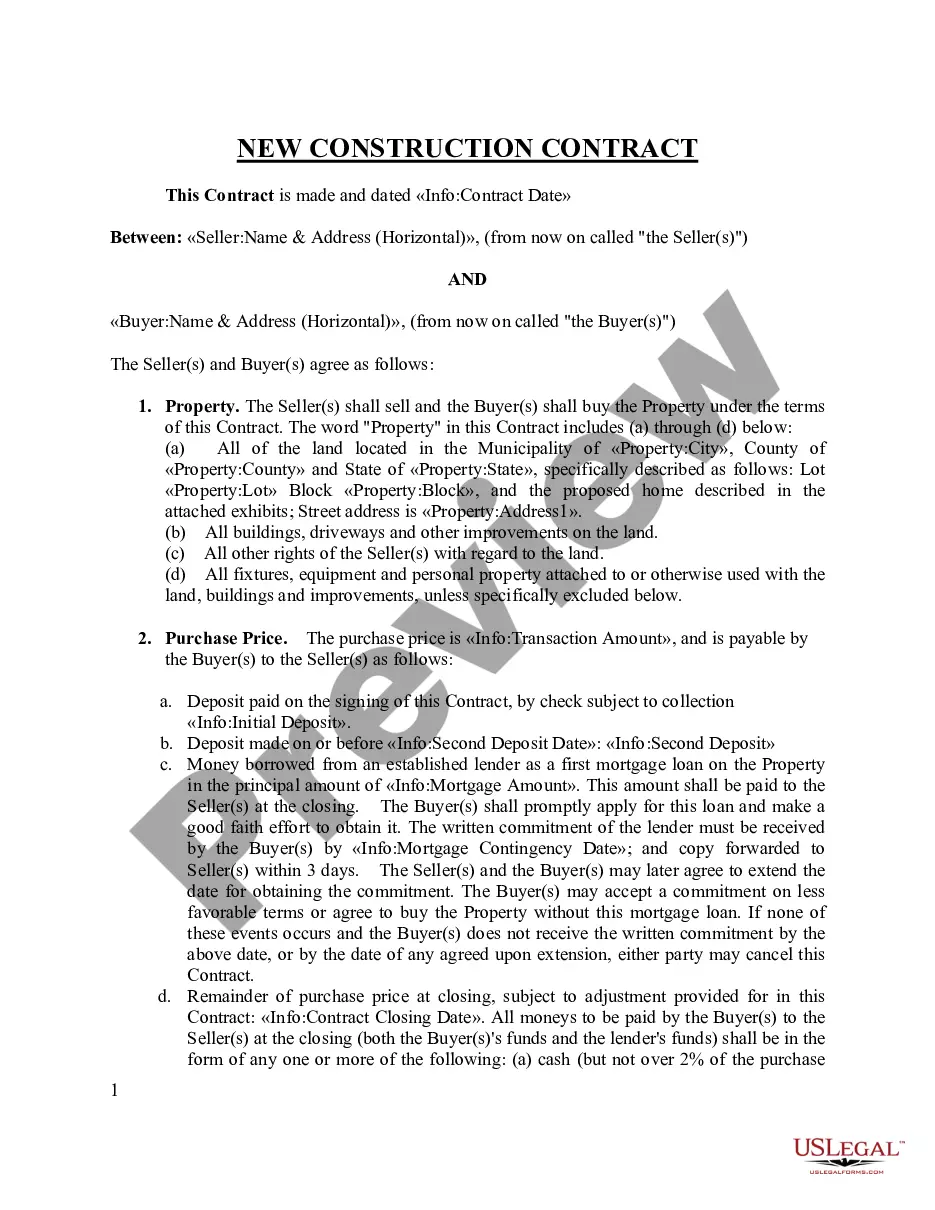
The Pennsylvania Framing Contractor Package contains essential legal documents specifically designed for framing contractors, owners, and subcontractors. This package helps users assert their legal rights and manage legal issues related to framing projects. The core of this package is a framing contract that adheres to Pennsylvania state law, ensuring all included forms meet local legal requirements.
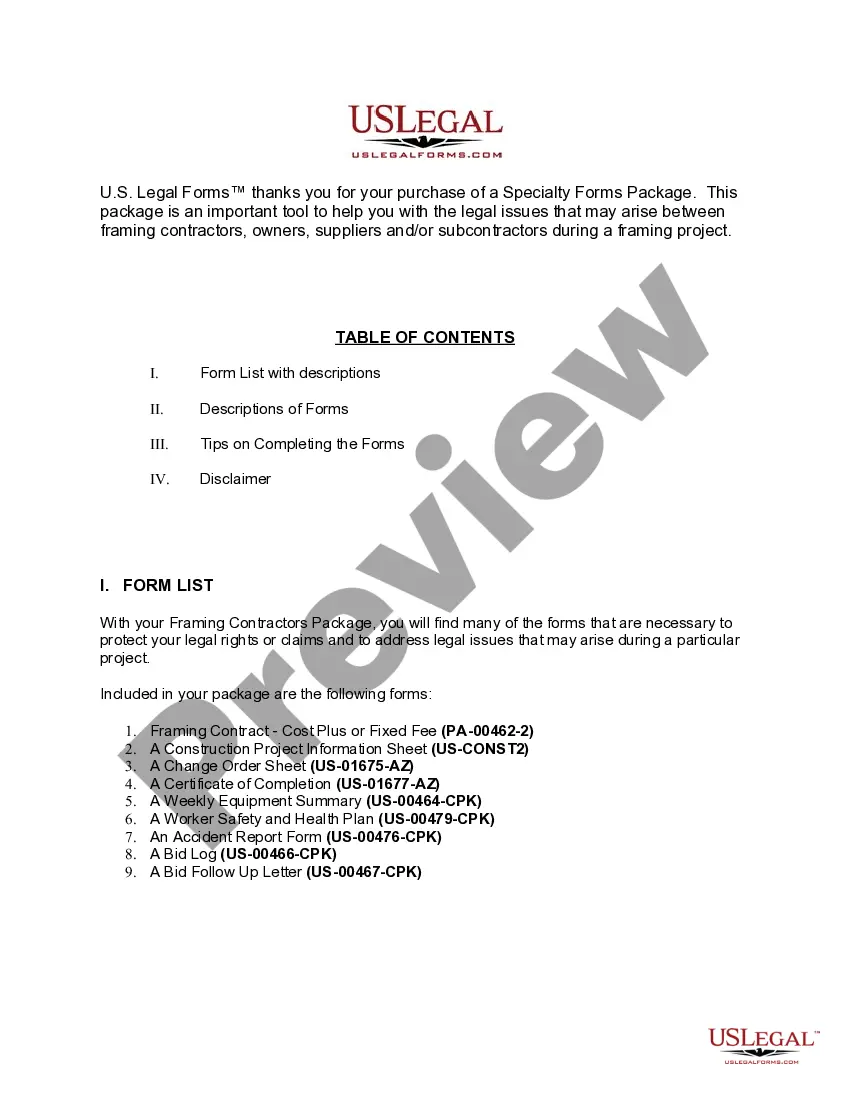
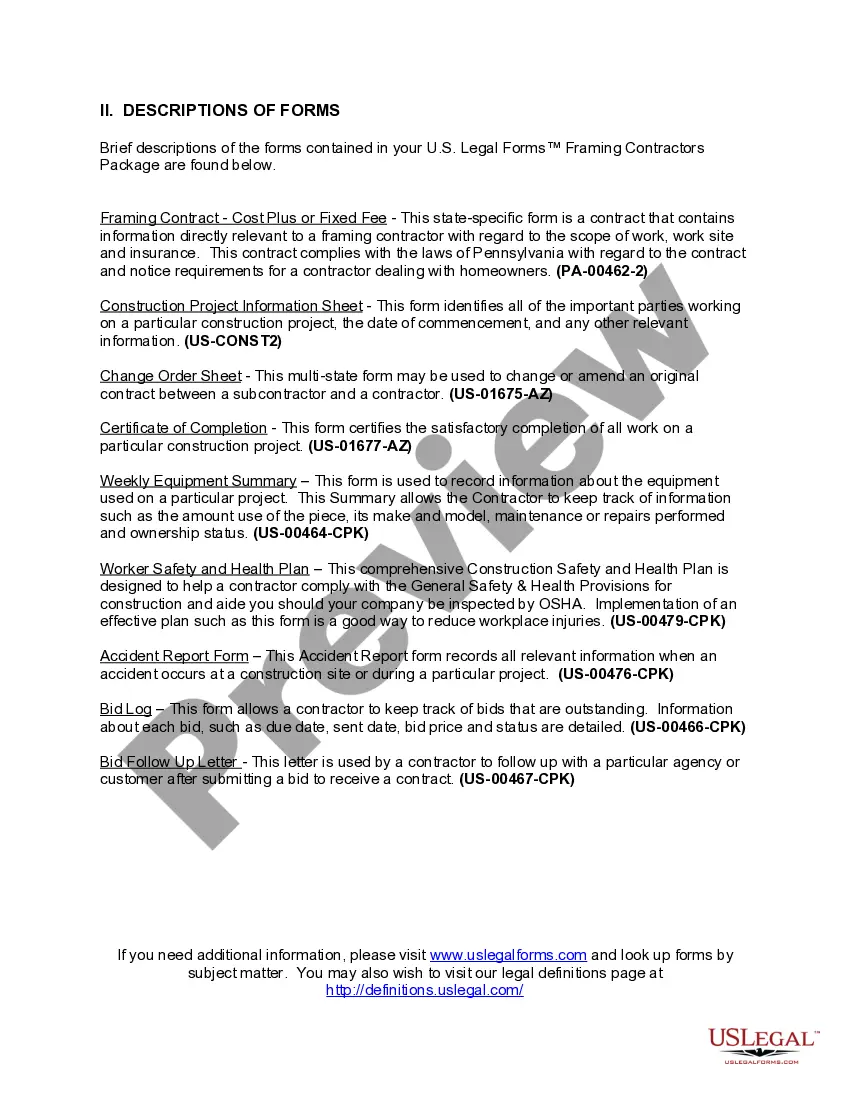
What’s included in this form package
- Framing Contract for Contractor
- Contractor's Weekly Equipment Summary
- Contractor's Bid Log
- Contractor's Bid Follow Up Letter
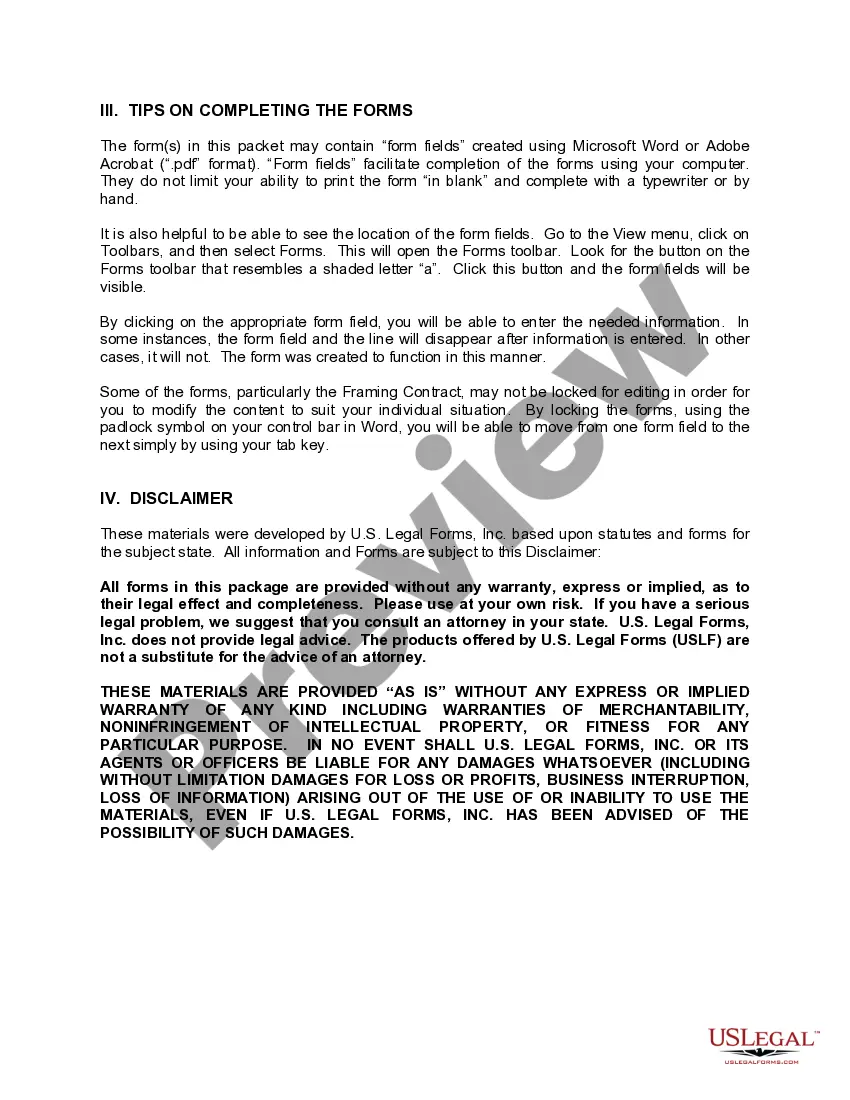
- Construction Accident Report
- Construction Safety and Health Plan
- Change Order for Construction or Repairs by Contractor
- Certification of Completion by Contractor
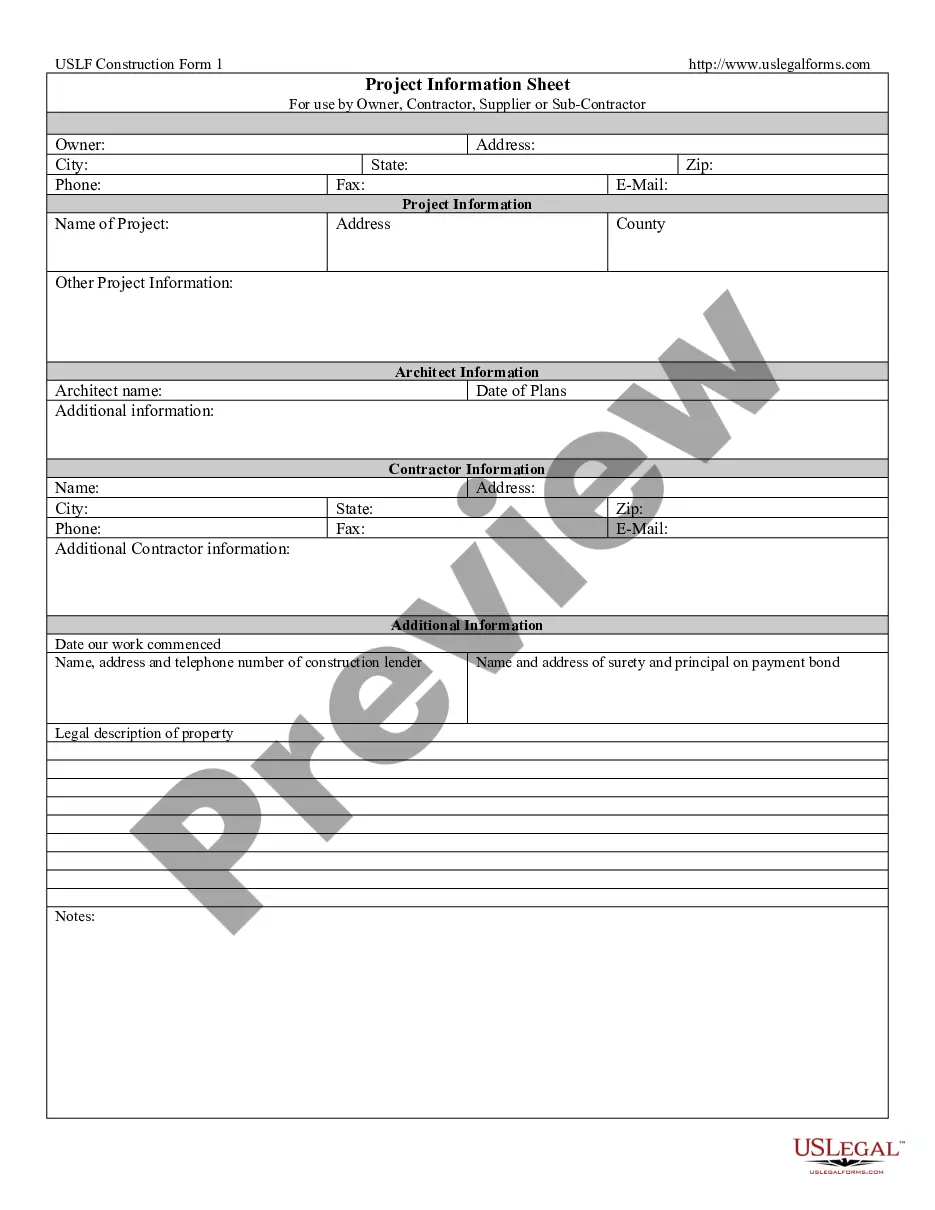
- Construction Project Information Sheet
Common use cases
This form package is beneficial in various situations, including:
- Starting a new framing project and needing a legally binding contract.
- Making amendments to existing contracts through change orders.
- Completing a construction project and requiring formal certification of completion.
- Managing project details, tracks equipment use, and ensuring compliance with safety regulations.
Who should use this form package
- Framing contractors seeking to protect their legal interests.
- Construction project owners who need formal agreements with contractors.
- Subcontractors involved in framing projects.
- Anyone needing to document safety protocols and equipment usage on construction sites.
Steps to complete these forms
- Review each form included in the package.
- Identify all parties involved in the framing project.
- Fill in necessary details such as dates, contracts, and project specifics.
- Enter signatures where required to make the documents legally binding.
- Maintain copies for your records and submit completed forms as needed.
Notarization details for included forms
Notarization is generally not required for forms in this package. However, specific circumstances or local laws may require it. You can complete notarization remotely through US Legal Forms, powered by Notarize, with 24/7 availability.
Get your form ready online
Our built-in tools help you complete, sign, share, and store your documents in one place.
Make edits, fill in missing information, and update formatting in US Legal Forms—just like you would in MS Word.
Download a copy, print it, send it by email, or mail it via USPS—whatever works best for your next step.
Sign and collect signatures with our SignNow integration. Send to multiple recipients, set reminders, and more. Go Premium to unlock E-Sign.
If this form requires notarization, complete it online through a secure video call—no need to meet a notary in person or wait for an appointment.
We protect your documents and personal data by following strict security and privacy standards.

Make edits, fill in missing information, and update formatting in US Legal Forms—just like you would in MS Word.

Download a copy, print it, send it by email, or mail it via USPS—whatever works best for your next step.

Sign and collect signatures with our SignNow integration. Send to multiple recipients, set reminders, and more. Go Premium to unlock E-Sign.

If this form requires notarization, complete it online through a secure video call—no need to meet a notary in person or wait for an appointment.

We protect your documents and personal data by following strict security and privacy standards.
Common mistakes
- Failing to include all necessary signatures on contracts and forms.
- Not clearly identifying all parties and their roles in the project.
- Overlooking the importance of safety documentation.
- Using outdated forms that may not comply with current laws.
Advantages of online completion
- Convenience: Easily download and access forms from anywhere.
- Editability: Customize contracts and forms to fit your specific project needs.
- Reliability: All forms are drafted by licensed attorneys to ensure legality.
Looking for another form?
Form popularity
FAQ
Contractors can legally only ask for 1/3 of the contract price up front. It's considered fraud if a substantial portion of the work is not performed in the time requested, or more than 45 days go by without work being done.
In California, the state limits advance payment at the time of contract signing to 10% of the total estimated job cost or $1,000, whichever amount is lower! All payments thereafter are supposed to be made for work performed or for materials delivered to the job site.
A: It's not uncommon for contractors to ask for a down payment up front to secure your spot on their schedule or purchase some of the job materials in advance. Asking for more than half of the project cost up front, though, is a big red flag.I recommend tying payments to progress made during the job.
Once the permit is issued, different jurisdictions will have different time requirements, but it is a common rule-of-thumb that a building permit will expire if the work it covers does not begin within 6 months or is not completed within one year of the date it is issued.
If the contractor requests a large sum of money before work has begun, Mozen says you should ask specifically what types of work or materials those payments are covering.Contractors sometimes have other motives, other than purchasing materials, when they ask for large amounts of money in advance, Fowler says.
Building permits are written authorizations issued by a city or county to construct a project. They are required for most construction or remodeling projects, in order to ensure the safety of the work and its compliance with building, construction, and zoning codes.
Also, occupying any structure without a Certificate of Occupancy issued by the Building Code Official is a serious violation and will also result in enforcement action. Please do not occupy or begin using any structure without a Certificate of Occupancy!
Estimates, generally, must be professionally reasonable. A 10-20% overage might be considered reasonable, especially if the contractor discovered issues along the way that he couldn't have been aware of initially (for example, mold or flooding).
These pages provide information regarding Pennsylvania's statewide building code, generally known as the Uniform Construction Code (UCC).