Oklahoma Acknowledgment By Employee Of Receipt Of Compensation Payment
Understanding this form
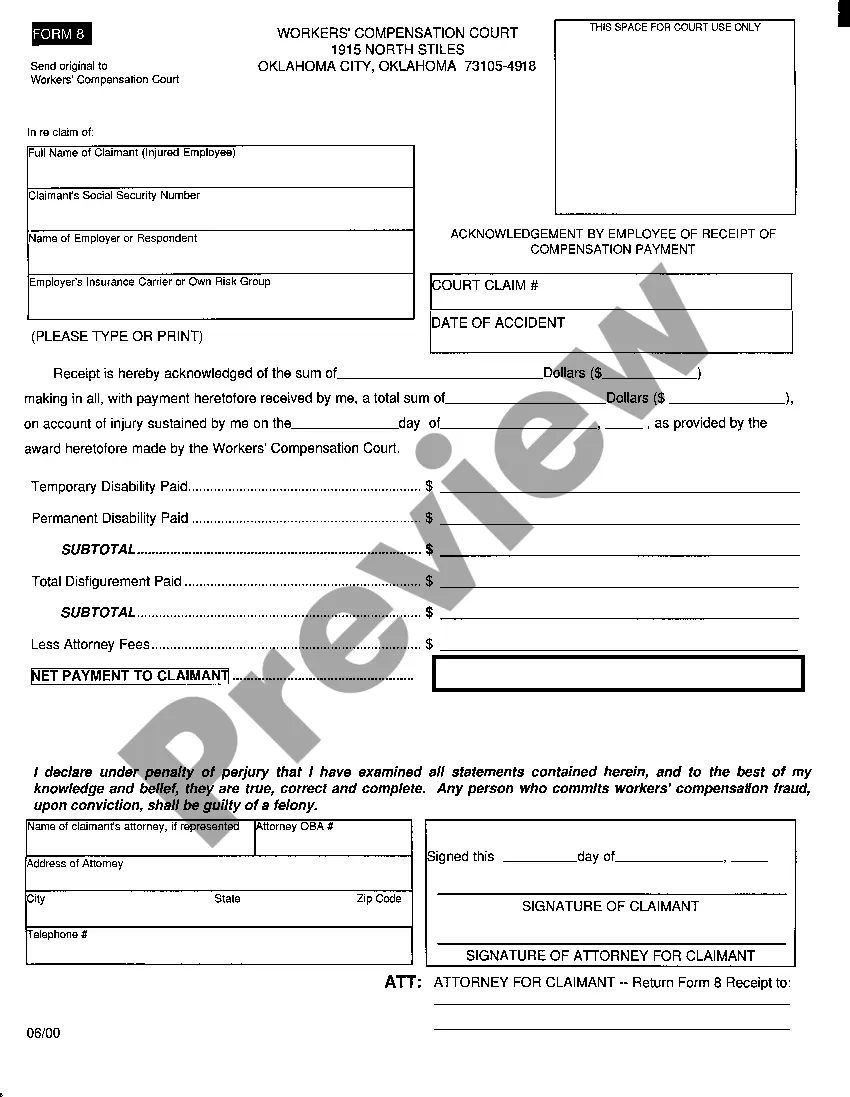
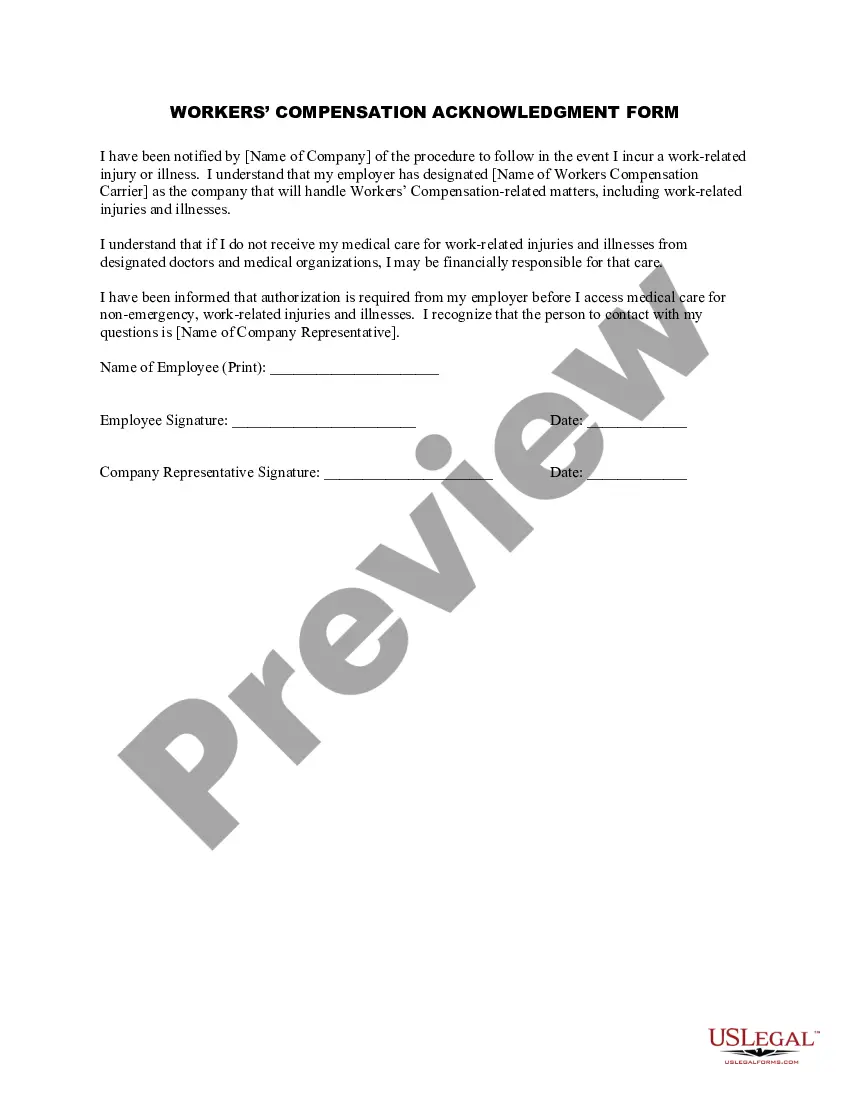
The Acknowledgment By Employee Of Receipt Of Compensation Payment is a legal document used in Oklahoma where an employee confirms the receipt of compensation payments related to workers' compensation claims. This form is tailored to comply with Oklahoma laws and statutes, ensuring that your acknowledgment is both official and recognized by the Oklahoma Workers Compensation Court.
Key parts of this document
- Employee's name and signature to confirm receipt.
- Date of receipt of the compensation payment.
- Details of the compensation payment received.
- Declaration ensuring compliance with applicable laws.
- Space for any additional comments or notes by the employee.
When this form is needed
This form is necessary when an employee receives compensation payments for work-related injuries or illnesses under Oklahoma's workers' compensation scheme. It serves as proof that the employee has acknowledged receiving the payment, which can be vital for both the employee and employer should any disputes arise later regarding payment status.
Who needs this form
- Employees receiving compensation payments for work-related injuries or illnesses.
- Employers providing compensation under Oklahoma's workers' compensation laws.
- Legal representatives or advocates working on behalf of injured employees.
Steps to complete this form
- Enter the employee's full name in the designated field.
- Fill in the date when the compensation payment was received.
- Specify the details of the compensation payment being acknowledged.
- Have the employee sign the form to confirm their acknowledgment.
- Include any additional comments if necessary before submission.
Notarization requirements for this form
This form does not typically require notarization unless specified by local law.
Get your form ready online
Our built-in tools help you complete, sign, share, and store your documents in one place.
Make edits, fill in missing information, and update formatting in US Legal Forms—just like you would in MS Word.
Download a copy, print it, send it by email, or mail it via USPS—whatever works best for your next step.
Sign and collect signatures with our SignNow integration. Send to multiple recipients, set reminders, and more. Go Premium to unlock E-Sign.
If this form requires notarization, complete it online through a secure video call—no need to meet a notary in person or wait for an appointment.
We protect your documents and personal data by following strict security and privacy standards.

Make edits, fill in missing information, and update formatting in US Legal Forms—just like you would in MS Word.

Download a copy, print it, send it by email, or mail it via USPS—whatever works best for your next step.

Sign and collect signatures with our SignNow integration. Send to multiple recipients, set reminders, and more. Go Premium to unlock E-Sign.

If this form requires notarization, complete it online through a secure video call—no need to meet a notary in person or wait for an appointment.

We protect your documents and personal data by following strict security and privacy standards.
Typical mistakes to avoid
- Failing to include the date of receipt.
- Missing the employee's signature.
- Not providing clear details of the compensation payment.
- Submitting the form without reviewing it for completeness.
Why complete this form online
- Convenience of immediate access without needing to visit a legal office.
- Easy editing to tailor the form to individual circumstances.
- Reliability with updated templates reflecting current laws.
Summary of main points
- The form acknowledges the receipt of compensation payments by an employee.
- It is essential for record-keeping and dispute resolution in workers' compensation cases.
- Follow Oklahoma's specific legal requirements when utilizing this form.
Looking for another form?

Form popularity
FAQ
The Four Major Types of Direct Compensation: Hourly, Salary, Commission, Bonuses. When asking about compensation, most people want to know about direct compensation, particularly base pay and variable pay. The four major types of direct compensation are hourly wages, salary, commission and bonuses.
The Four Major Types of Direct Compensation: Hourly, Salary, Commission, Bonuses. When asking about compensation, most people want to know about direct compensation, particularly base pay and variable pay. The four major types of direct compensation are hourly wages, salary, commission and bonuses.
Base Pay. Commissions. Overtime Pay. Bonuses, Profit Sharing, Merit Pay. Stock Options. Travel/Meal/Housing Allowance. Benefits including: dental, insurance, medical, vacation, leaves, retirement, taxes...
INSIGHTS OVERVIEW. Compensation is the combination of salaries, wages and benefits that employees receive in exchange for them doing a particular job. It can include an annual salary or hourly wages combined with bonus payments, benefits, and incentives.
Calculating the benefit load the ratio of perks to salary received by an employee helps a business effectively plan. Find the benefit load by adding the total annual costs of all employees' perks and divide it by all employees' annual salaries to determine a ratio that ratio is your company's benefits load.
Years of experience and education level. Industry. Location. In-demand skill sets. Supply and demand. The cost of not offering competitive pay. What happens if you can't pay market value? Take the guesswork out of determining compensation.
The national average of employee benefits cost For civilian workers, the average cost for employers paying for employee benefits equals $11.82 per hour, in addition to their average salary and wage which is $25.91 per hour. Taken together, the average total compensation is $37.73 per hour.
Total compensation is equal to the salary plus the value of the employee benefits package. The average benefits package is over 30% of an employee's compensation. So for example, on a $55,000 salary, more than $16,500 is spent (on average) on the benefits package, for total compensation of at least $71,500.