Oklahoma Memorandum regarding Jury Oath from Court Administrator
Understanding this form
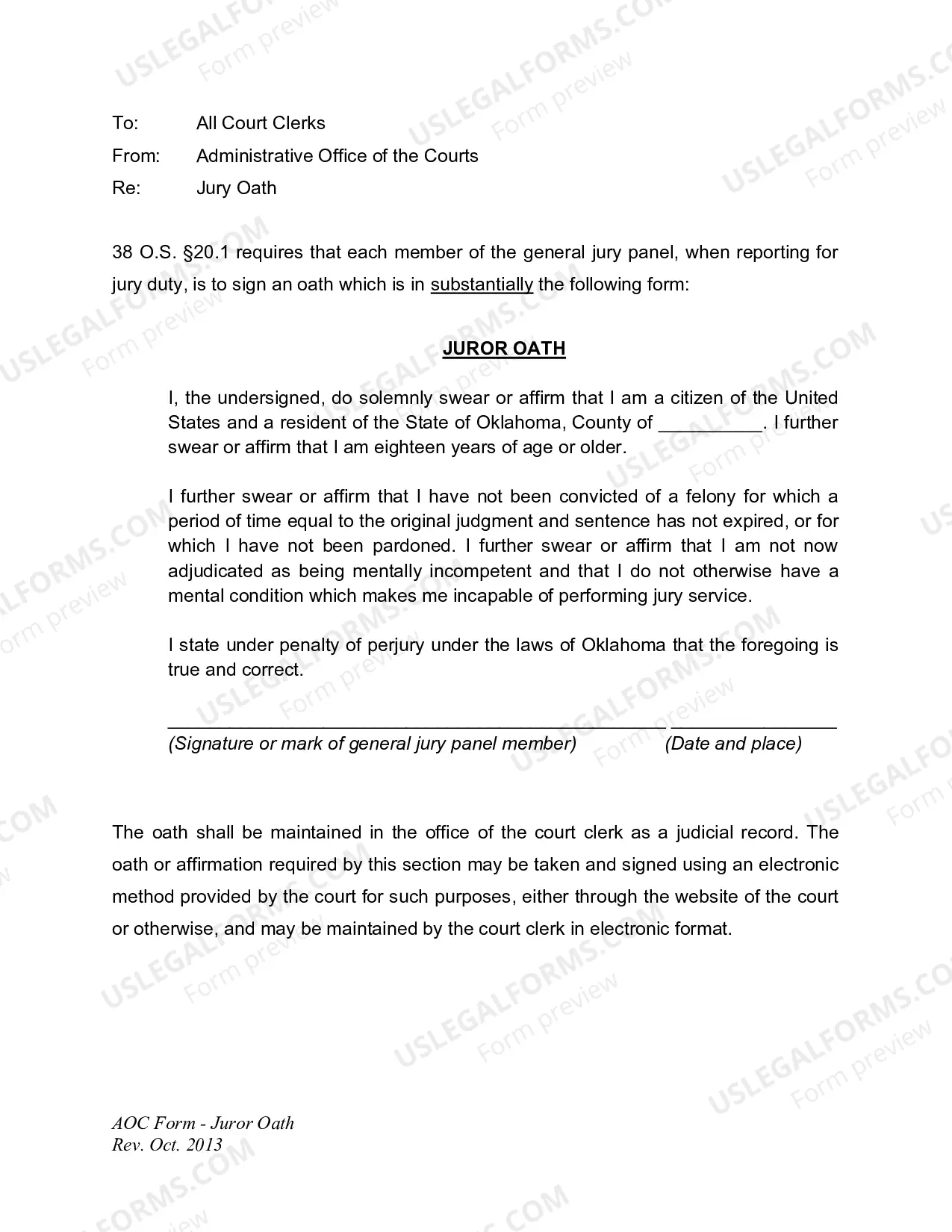
The Memorandum regarding Jury Oath from Court Administrator is an official document that serves to affirm a juror's eligibility to serve during jury duty. This memo outlines the requirements jurors must meet, differentiating it from other legal forms related to jury service. The form confirms that the juror is a citizen and resident and provides assurances regarding their criminal and mental competency status.
Key parts of this document
- Full name and address of the juror
- Affirmation of citizenship in the United States
- Declaration of residency in the State of Oklahoma
- Confirmation of age (at least eighteen years)
- Statement regarding felony convictions and mental competency
Common use cases
This form is required when reporting for jury duty to the chief judge in Oklahoma. It is used to verify that jurors meet the legal criteria necessary to serve, ensuring that all selected individuals are legally qualified and competent.
Who should use this form
- Individuals summoned for jury duty in Oklahoma
- Jurors needing to affirm their eligibility
- Those who have received instructions from the court regarding their jury service
Instructions for completing this form
- Enter your full name and address at the top of the form.
- Affirm your status as a citizen of the United States.
- Indicate your residency in Oklahoma, including your county.
- Confirm that you are at least eighteen years old and disclose any felony convictions.
- Sign and date the memorandum where indicated.
Does this document require notarization?
Notarization is not commonly needed for this form. However, certain documents or local rules may make it necessary. Our notarization service, powered by Notarize, allows you to finalize it securely online anytime, day or night.
Get your form ready online
Our built-in tools help you complete, sign, share, and store your documents in one place.
Make edits, fill in missing information, and update formatting in US Legal Forms—just like you would in MS Word.
Download a copy, print it, send it by email, or mail it via USPS—whatever works best for your next step.
Sign and collect signatures with our SignNow integration. Send to multiple recipients, set reminders, and more. Go Premium to unlock E-Sign.
If this form requires notarization, complete it online through a secure video call—no need to meet a notary in person or wait for an appointment.
We protect your documents and personal data by following strict security and privacy standards.

Make edits, fill in missing information, and update formatting in US Legal Forms—just like you would in MS Word.

Download a copy, print it, send it by email, or mail it via USPS—whatever works best for your next step.

Sign and collect signatures with our SignNow integration. Send to multiple recipients, set reminders, and more. Go Premium to unlock E-Sign.

If this form requires notarization, complete it online through a secure video call—no need to meet a notary in person or wait for an appointment.

We protect your documents and personal data by following strict security and privacy standards.
Avoid these common issues
- Missing critical information such as name or address.
- Failing to sign and date the form.
- Not accurately reporting felony convictions or mental competency status.
Why use this form online
- Convenient access to the form at any time without needing to visit a physical location.
- Editable and fillable format allows users to complete the form easily.
- Reliable templates drafted by licensed attorneys ensure legal compliance.
Looking for another form?
Form popularity
FAQ
1a : a member of a jury. b : a person summoned to serve on a jury.
And while there are always exceptions for particular cases, generally speaking as a defendant a trial by jury is usually a better choice than a judge (also known as a bench trial), one that is particularly preferred in Texas despite some declining numbers.
As nouns the difference between juror and jury is that juror is a member of a jury while jury is (legal) a group of individuals chosen from the general population to hear and decide a case in a court of law.
An officer of the judicial system who performs administrative and clerical duties essential to the proper operation of the business of a court, such as tracking trial dates, keeping records, entering judgments, and issuing process.
2. What happens if I do not report for jury service? Not going to court on the date you have been summoned for jury service is a violation of state law and you may be ordered to pay a fine.If you receive a jury summons and believe that you cannot serve you may seek a disqualification by contacting Jury Administration.
The judge in a criminal case tells the jury what the law is. The jury must determine what the true facts are. On that basis the jury has only to determine whether the defendant is guilty or not guilty as to each offense charged.
(a) Number of Jurors. A jury must begin with at least 6 and no more than 12 members, and each juror must participate in the verdict unless excused under Rule 47(c). (b) Verdict. Unless the parties stipulate otherwise, the verdict must be unanimous and must be returned by a jury of at least 6 members.
If you do not qualify for any of the Connecticut statutory exemptions listed above but seriously think that attending jury selection would cause you undue hardship, you can always submit a jury duty excuse letter with your response to the summons, and ask to be excused.
Jurors who fail to appear shall be subject to a civil penalty established by the judges of the Superior Court on case by case basis. Jurors may also be excused from payment. Fines may be enforced by the Attorney General. Employers in Connecticut are also forbidden from penalizing employees who miss work for jury duty.