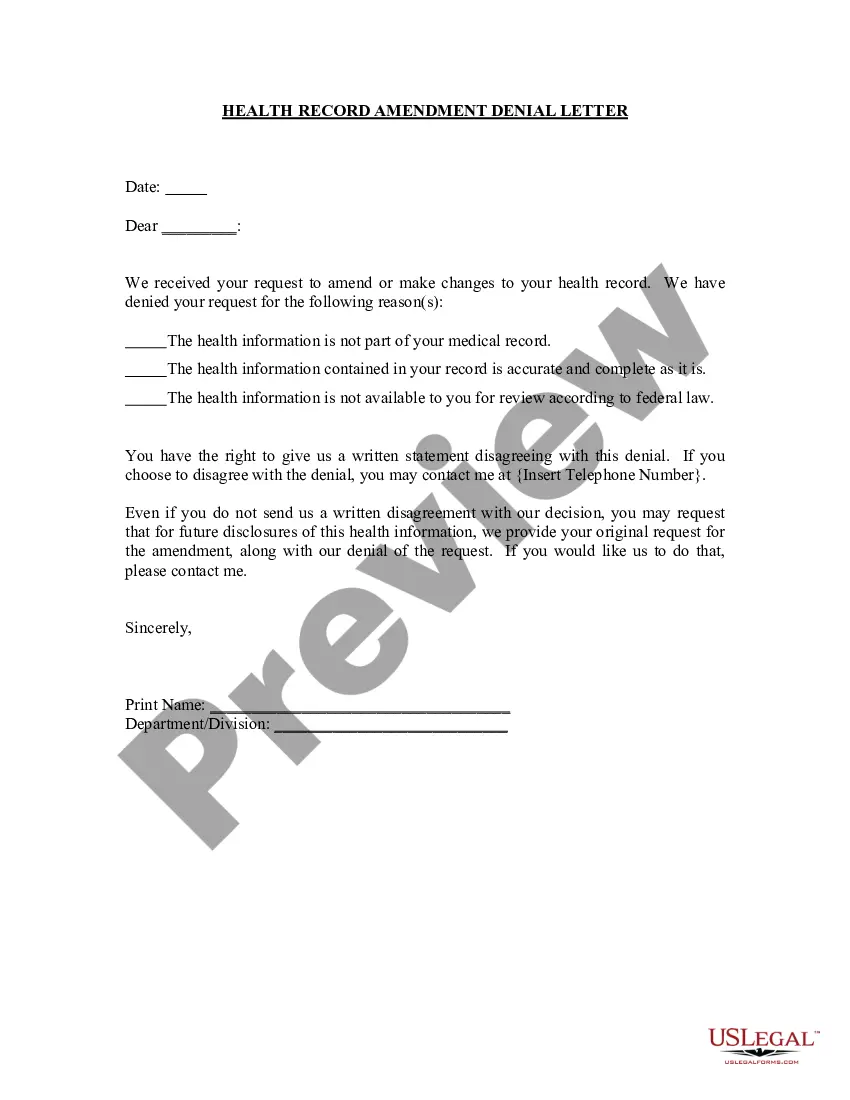
Ohio Health Record Amendment Denial Letter
Description
Get your form ready online
Our built-in tools help you complete, sign, share, and store your documents in one place.
Make edits, fill in missing information, and update formatting in US Legal Forms—just like you would in MS Word.
Download a copy, print it, send it by email, or mail it via USPS—whatever works best for your next step.
Sign and collect signatures with our SignNow integration. Send to multiple recipients, set reminders, and more. Go Premium to unlock E-Sign.
If this form requires notarization, complete it online through a secure video call—no need to meet a notary in person or wait for an appointment.
We protect your documents and personal data by following strict security and privacy standards.

Make edits, fill in missing information, and update formatting in US Legal Forms—just like you would in MS Word.

Download a copy, print it, send it by email, or mail it via USPS—whatever works best for your next step.

Sign and collect signatures with our SignNow integration. Send to multiple recipients, set reminders, and more. Go Premium to unlock E-Sign.

If this form requires notarization, complete it online through a secure video call—no need to meet a notary in person or wait for an appointment.

We protect your documents and personal data by following strict security and privacy standards.
Looking for another form?

How to fill out Health Record Amendment Denial Letter?
If you wish to accumulate, download, or print legal document templates, utilize US Legal Forms, the largest variety of legal forms available online.
Employ the site's straightforward and user-friendly search to locate the documents you require.
A range of templates for business and personal purposes are organized by categories and states, or keywords.
Step 3. If you are unsatisfied with the form, use the Search field at the top of the screen to find other forms in the legal form library.
Step 4. Once you have located the form you need, click the Get now button. Choose your preferred pricing plan and enter your information to register for an account.
- Utilize US Legal Forms to find the Ohio Health Record Amendment Denial Letter in just a few clicks.
- If you are already a US Legal Forms customer, sign in to your account and click the Download button to obtain the Ohio Health Record Amendment Denial Letter.
- You can also access forms you previously saved in the My documents tab of your account.
- If you are using US Legal Forms for the first time, please follow the instructions below.
- Step 1. Ensure you have selected the form for the appropriate city/state.
- Step 2. Use the Preview option to review the form's content. Don't forget to view the summary.
Form popularity
FAQ
Consequently, patients frequently ask about whether they have the right to remove a diagnosis from their medical records. But, can they do this? The answer to this question is NO.
A patient has the right to request an amendment to his or her health record per 45 CFR §164.526 of the HIPAA Privacy Rule, and it is the policy of this organization to respond to any amendment requests in accordance with this rule.
General concerns about psychological or emotional harm are not sufficient to deny an individual access (e.g., concerns that the individual will not be able to understand the information or may be upset by it). In addition, the requested access must be reasonably likely to cause harm or endanger physical life or safety.
As per Health Insurance Portability and Accountability Act (HIPPA), patients have the right to correct errors in their medical records, but they cannot omit anything completely. If found any mistakes, HIPAA allows the patients to request the medical staff changes and amend the document by adding extra information.
Reasons for Denial.The provider who received the amendment request had not created the original record. The record was created at another office. There is an exception if the creator is no longer available and the mistake in the record is apparent.
No. A patient's record should be complete and accurate to ensure they receive appropriate care. Patients can question the content of their records, but not on the basis that it is upsetting or that they disagree with it.
In general, the appropriate way to correct an error is the same as with paper records -- that is, make a new entry with today's date and time, stating that you are correcting an error in a previous entry; give the date and time of the previous entry; and enter the corrected data or explanation.
Corrections. If you think the information in your medical or billing record is incorrect, you can request a change, or amendment, to your record. The health care provider or health plan must respond to your request. If it created the information, it must amend inaccurate or incomplete information.
Changing a medical record to correct an error is anything but an easy process. Under federal HIPAA rules, patients have the right to request that doctors fix errors, but the provider has up to 60 days to respond, and can ask for a 30-day extension. The provider also can refuse, but must specify the reason in writing.