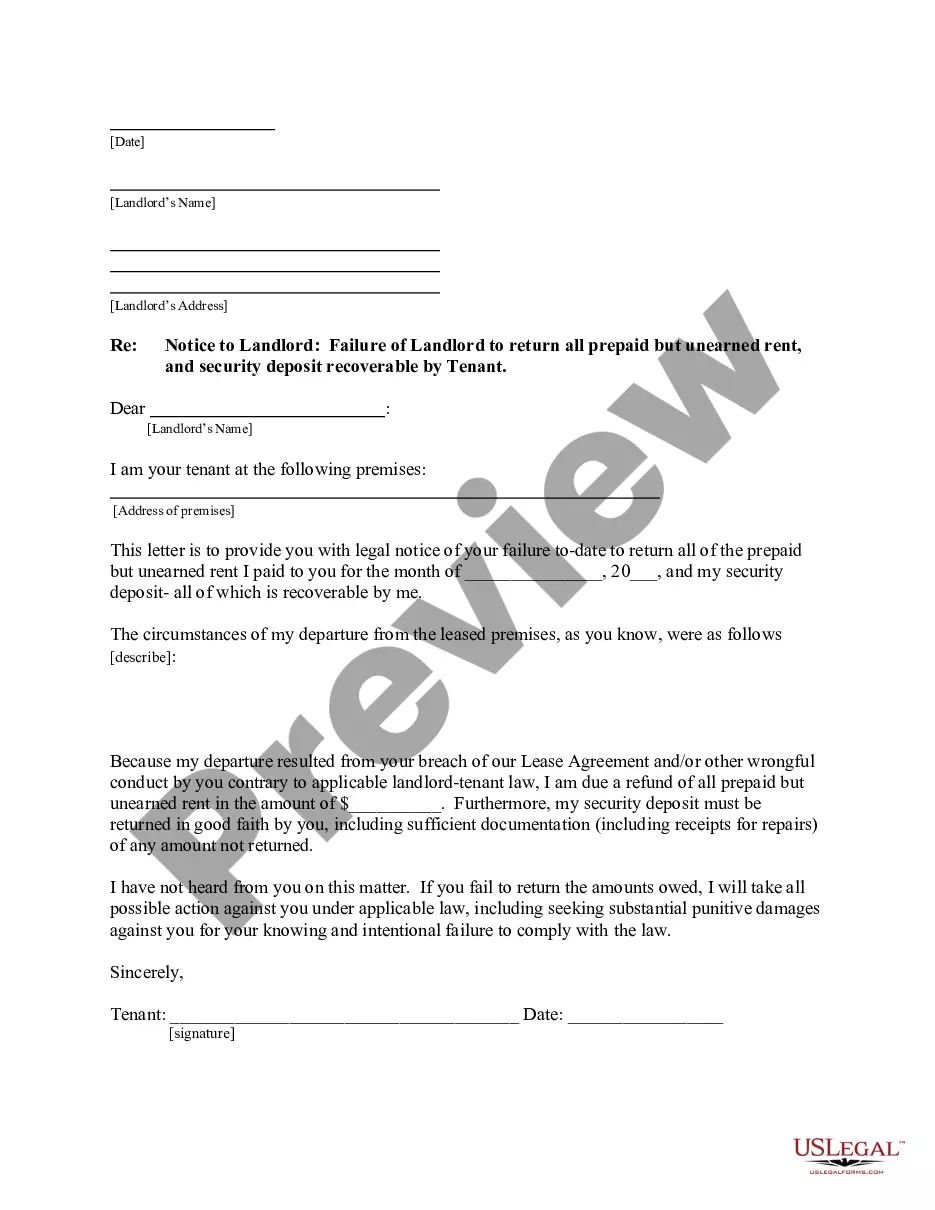
Driving Under the Influence - DUI - Questionnaire
About this form
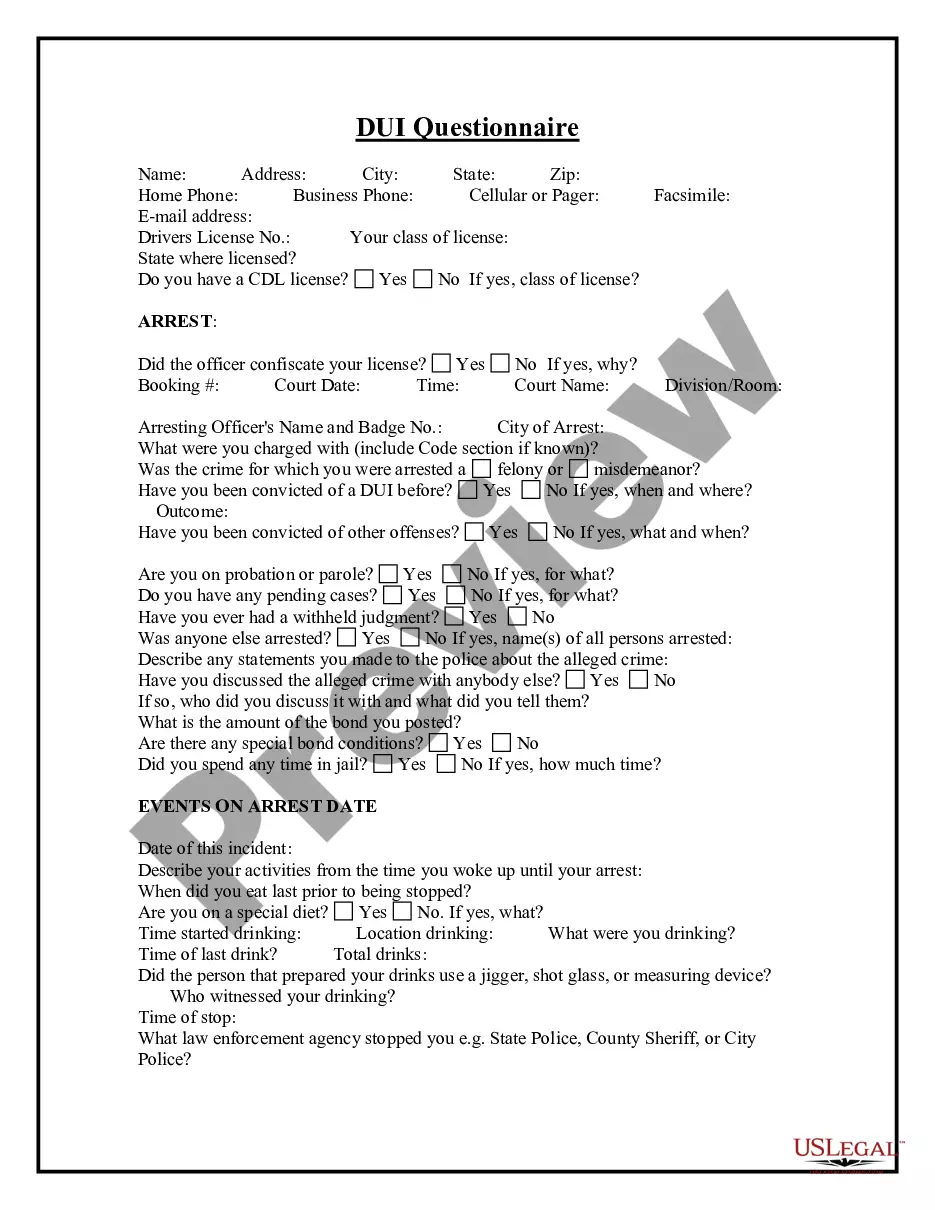
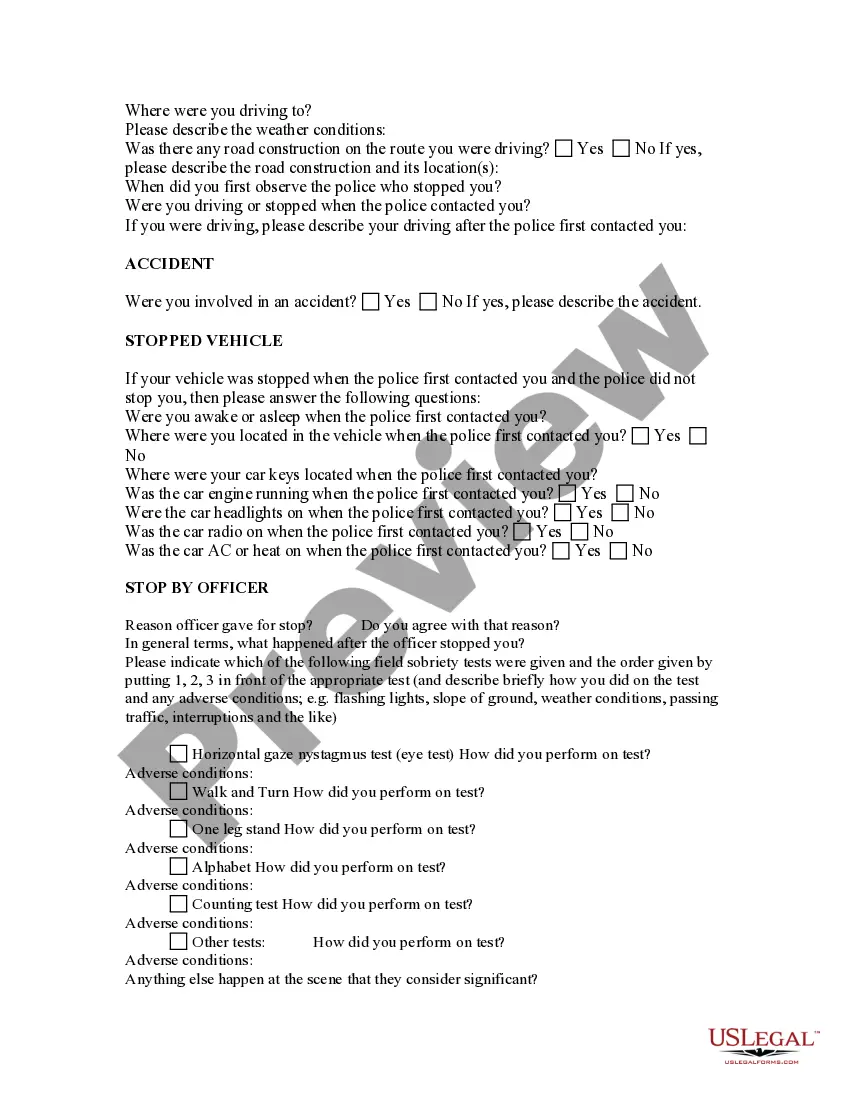
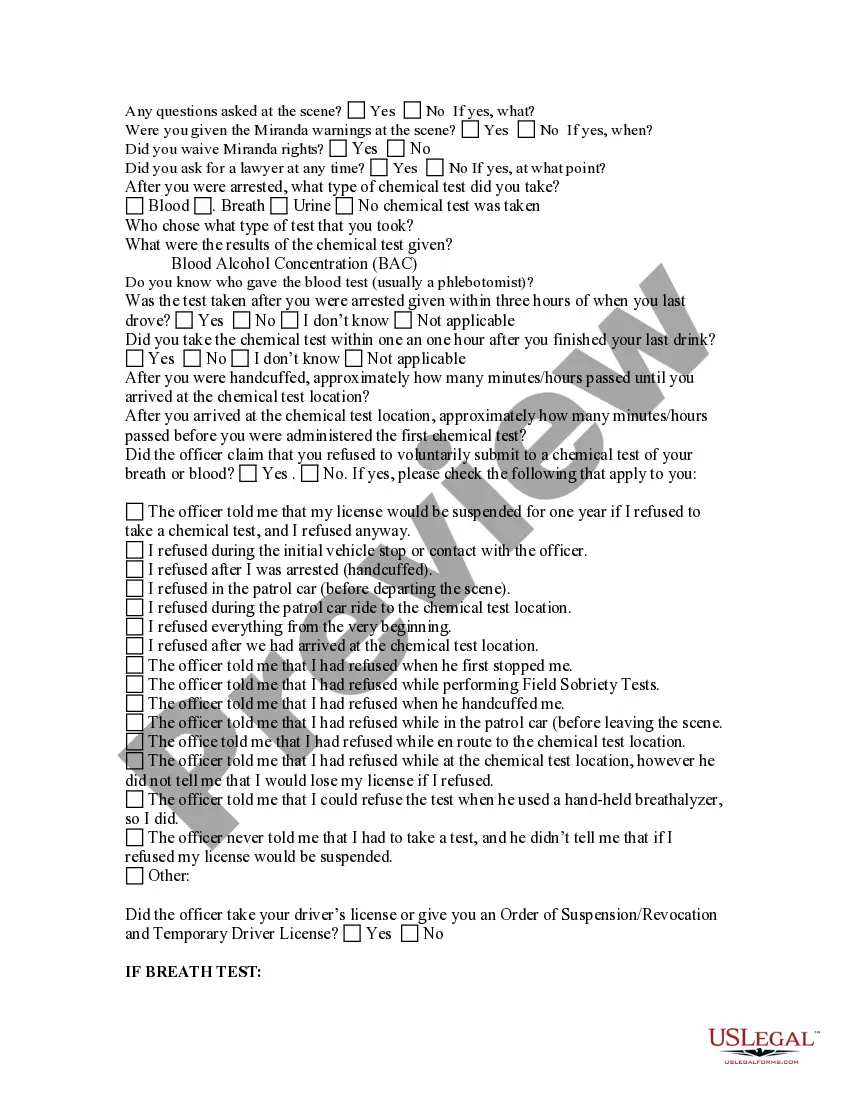
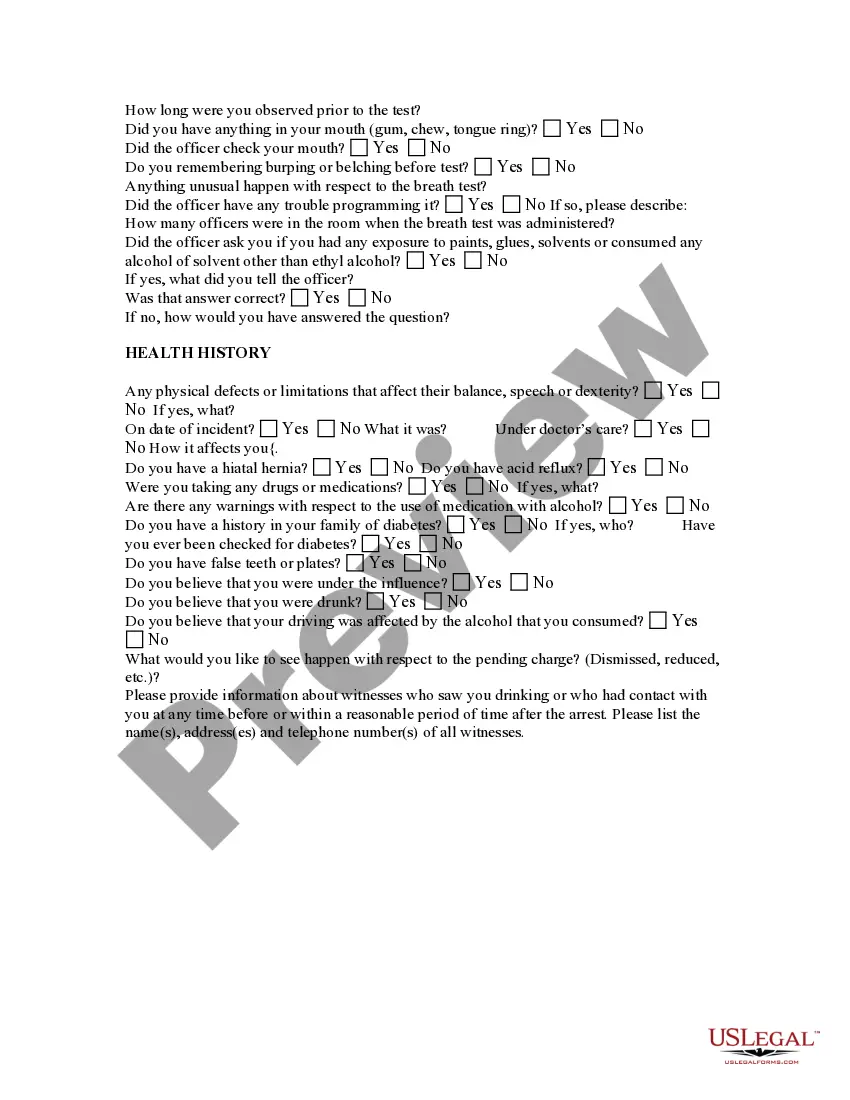
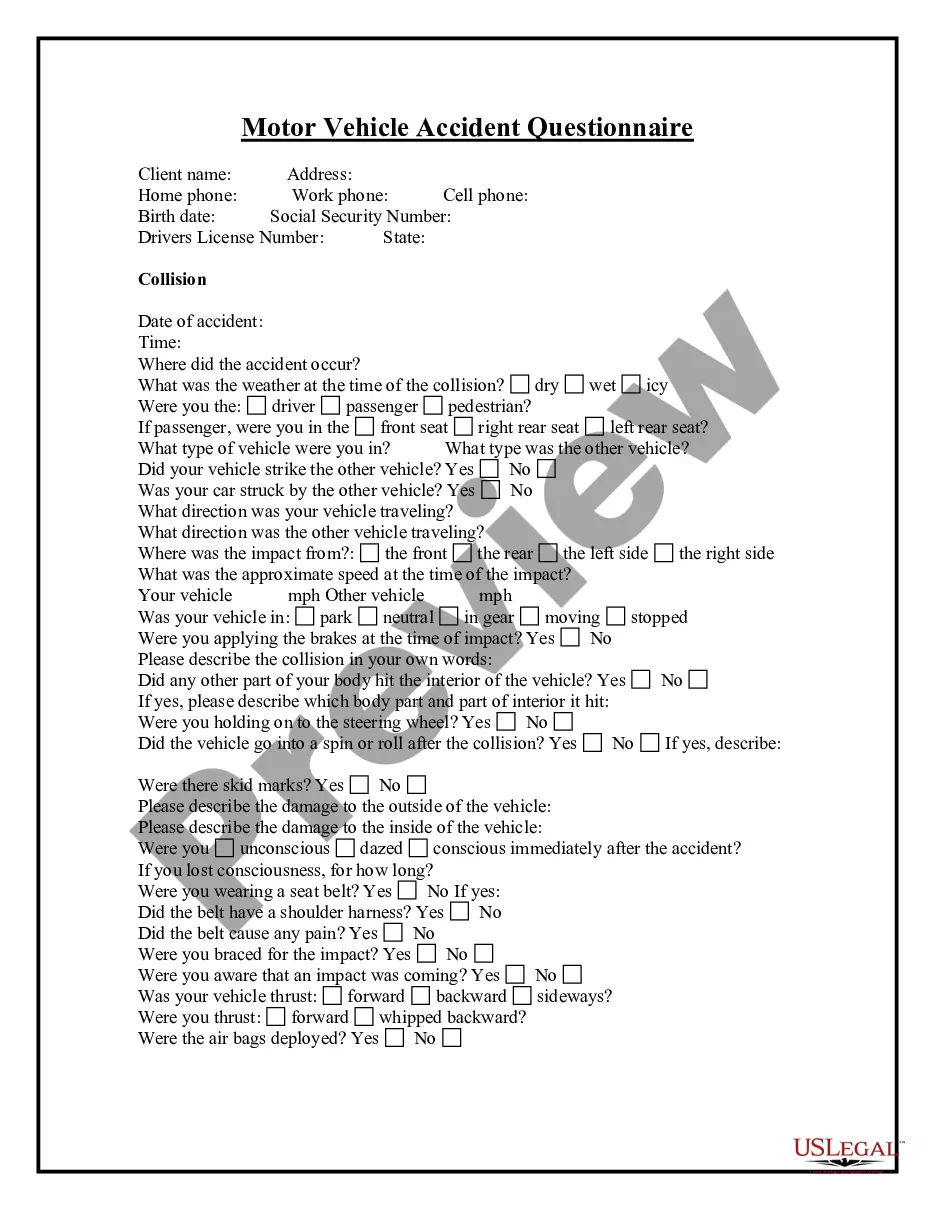
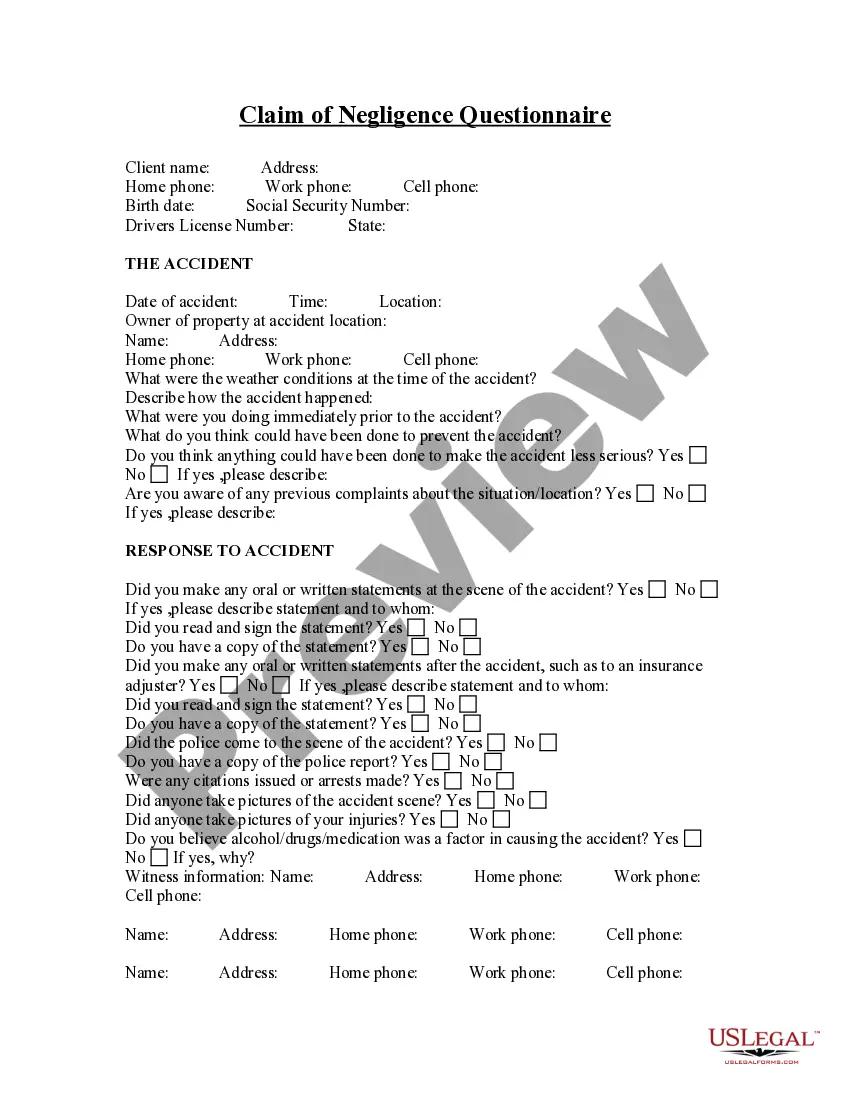
The Driving Under the Influence (DUI) Questionnaire is a legal document designed to gather important information regarding a DUI or DWI case. This form enables individuals to identify and prepare their legal issues effectively, aiding their attorney in evaluating the case. It serves as a crucial tool for new clients to communicate their concerns, ensuring thorough preparation and potentially reducing legal costs associated with case assessments.
What’s included in this form
- Questions regarding initial interactions with law enforcement, such as vehicle status during contact.
- Sections for personal details related to the DUI case.
- Space for summarizing the events leading to the DUI/DWI charge.
Common use cases
This form should be used when an individual is facing DUI or DWI charges and seeks legal help. It is particularly useful when preparing for an initial consultation with an attorney, allowing the individual to articulate their situation more clearly. It can also aid in determining legal strategies and identifying issues to discuss with legal counsel.
Intended users of this form
- Individuals who have been charged with DUI or DWI.
- Clients seeking legal representation for their DUI case.
- Attorneys who need to gather detailed information from a new client.
Completing this form step by step
- Begin by entering your personal information, such as name and contact details.
- Answer questions regarding your vehicle and condition during the police encounter.
- Provide a detailed account of the events that led to your DUI/DWI charge.
- Review all responses to ensure accuracy before submitting the questionnaire.
- Share the completed form with your attorney for a thorough evaluation.
Notarization guidance
This form does not typically require notarization unless specified by local law. However, consult with your attorney to determine if notarization is necessary for your specific situation.
Get your form ready online
Our built-in tools help you complete, sign, share, and store your documents in one place.
Make edits, fill in missing information, and update formatting in US Legal Forms—just like you would in MS Word.
Download a copy, print it, send it by email, or mail it via USPS—whatever works best for your next step.
Sign and collect signatures with our SignNow integration. Send to multiple recipients, set reminders, and more. Go Premium to unlock E-Sign.
If this form requires notarization, complete it online through a secure video call—no need to meet a notary in person or wait for an appointment.
We protect your documents and personal data by following strict security and privacy standards.

Make edits, fill in missing information, and update formatting in US Legal Forms—just like you would in MS Word.

Download a copy, print it, send it by email, or mail it via USPS—whatever works best for your next step.

Sign and collect signatures with our SignNow integration. Send to multiple recipients, set reminders, and more. Go Premium to unlock E-Sign.

If this form requires notarization, complete it online through a secure video call—no need to meet a notary in person or wait for an appointment.

We protect your documents and personal data by following strict security and privacy standards.
Common mistakes
- Leaving questions unanswered or incomplete.
- Inaccurately recalling the events leading to the DUI charge.
- Failing to review the form before submission.
Why complete this form online
- Convenience of immediate access from any device.
- Editability allows for corrections and updates as needed.
- Reliability of a template crafted by licensed attorneys.
Looking for another form?

Form popularity
FAQ
Generally, it's possible to be convicted of a DUI as a misdemeanor or a felony. A standard first offense is almost always going to be a misdemeanor.In some states, first and second DUI offenses are misdemeanors but a third or subsequent conviction is a felony.
A DUI does not have to ruin your life. If you get a lawyer, fight your case, and negotiate a good deal, you may be able to go on with your life with relatively little change. If your lawyer can win your case or get the charges dropped, you won't even have a DUI on your record.
Proving the driver had a blood or breath alcohol concentration (BAC) of . 08% or more (a per se DUI), or. showing that the motorist was actually impaired by drugs or alcohol.
Does DUI ruin your life? No, while any DUI, DWI charge will have an affect on a defendant's life until the case is resolved in court, what a person does before court to fight the charges will be a major determining factor in the extent a DUI will carry.
Select a Reliable Designated Driver. People who plan on drinking need to select a designated driver who will not drink. Use Public Transportation. Book a Hotel or Sleep Over. Hide or Take a Person's Keys. Alternative Drinks. Include Food. Cut Off the Alcohol Early On. Pay Attention to Guests.
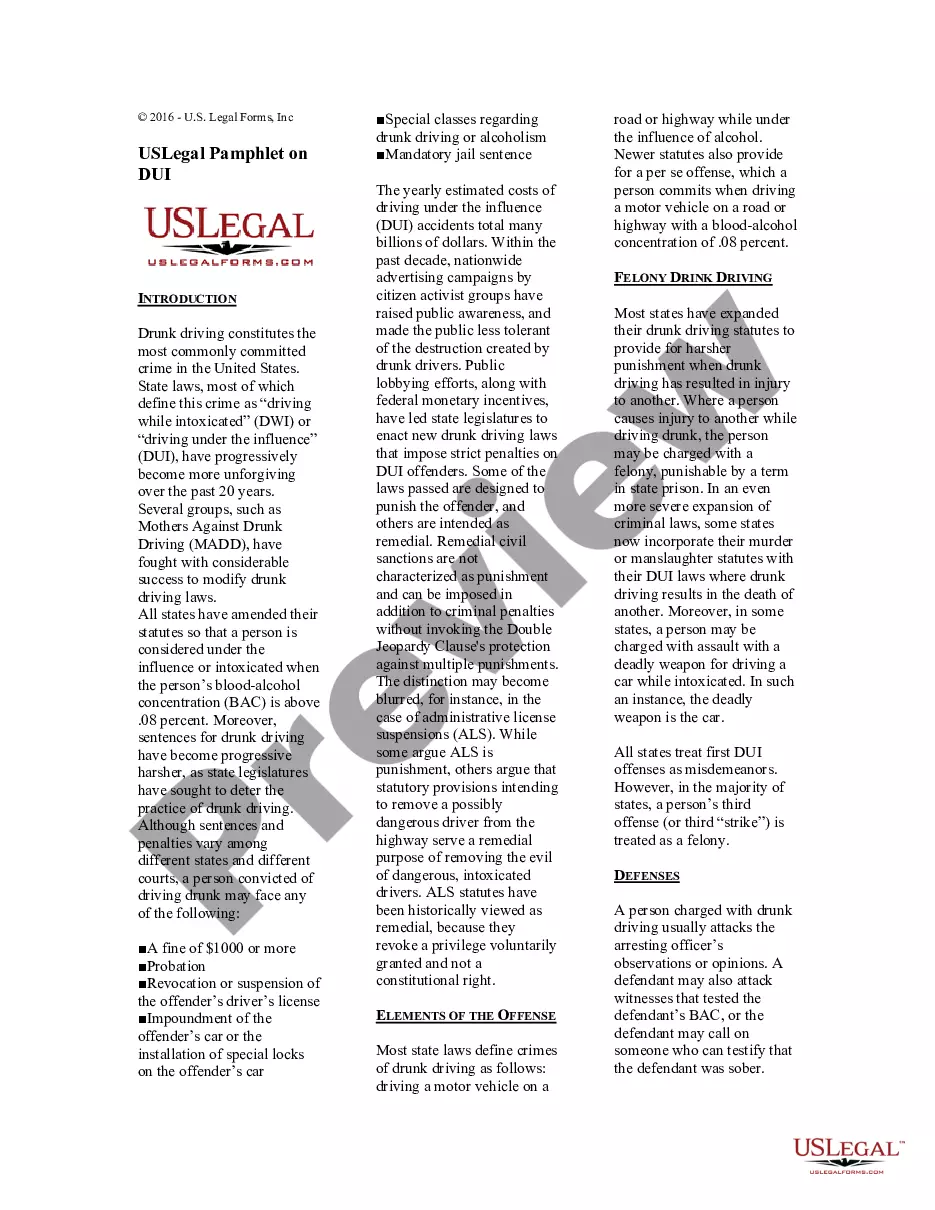
Whether the offense is labeled DUI, DWI (driving while intoxicated), or OUI (operating under the influence), the consequences are generally severe. Though the specifics differ by state, penalties often include license suspension, fines, fees, ignition interlock device (IID) installation, and jail time.
Bring a designated driver. Before you go out, plan ahead to drink responsibly. Check your status. Some bars will offer breathalyzer tests to their customers. Know your limit. Call a rideshare/taxi. Never get in the car with someone who is intoxicated.
That means one 12-ounce beer, one five-ounce glass of wine, and one 1.5-ounce shot of distilled spirits each count as one standard drink.Intoxication begins with the very first drink. You should never drink and drive, no matter how much you've consumed. You can be impaired and arrested even if your BAC is under 0.08%.
Straddling a lane, often driving over lane reflector markers or lane dividing lines for miles without correction. Exhibiting difficulty staying in one lane and narrowly missing objects including other cars, street signs, curbs and medians. Weaving across multiple lanes or swerving.