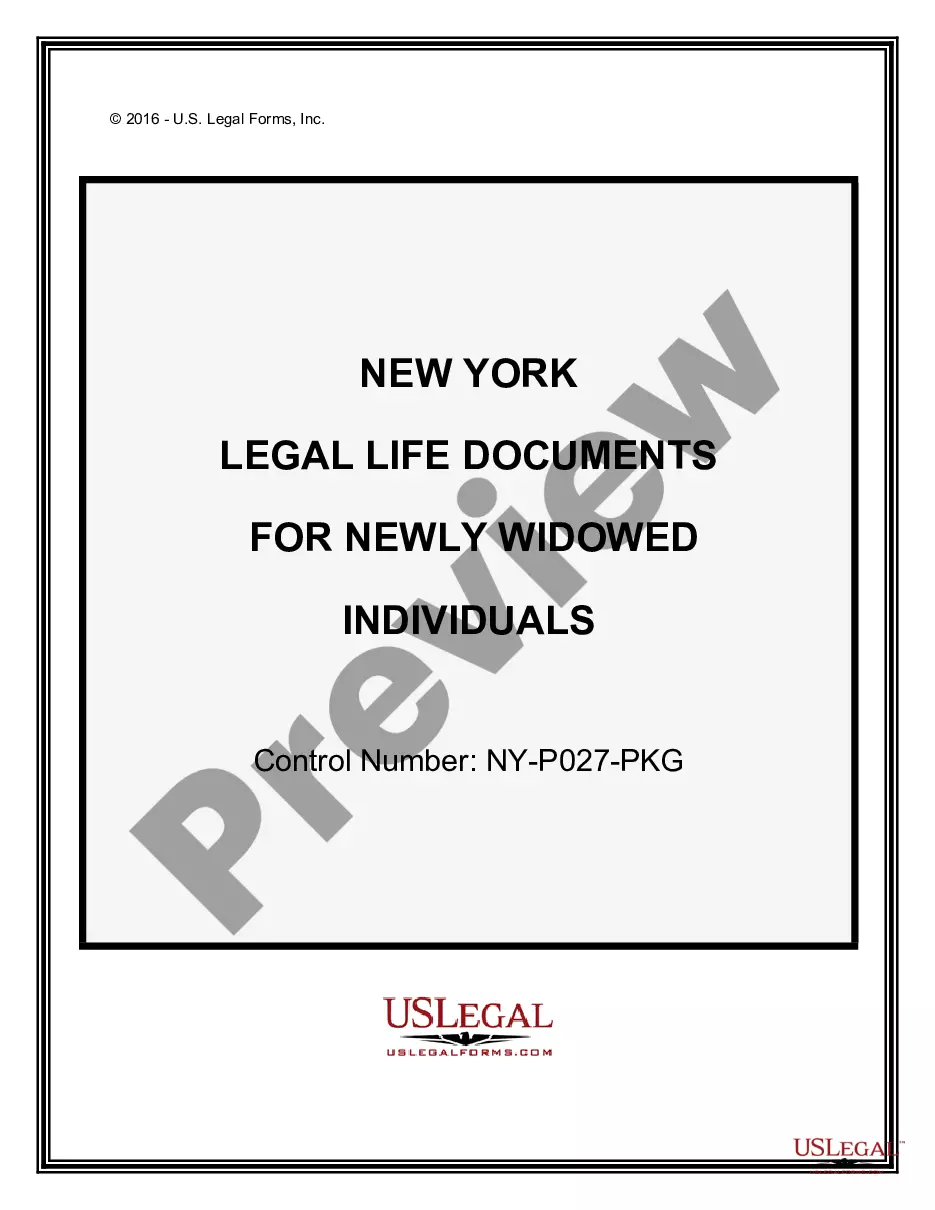
New York Newly Divorced Individuals Package
What this form package covers
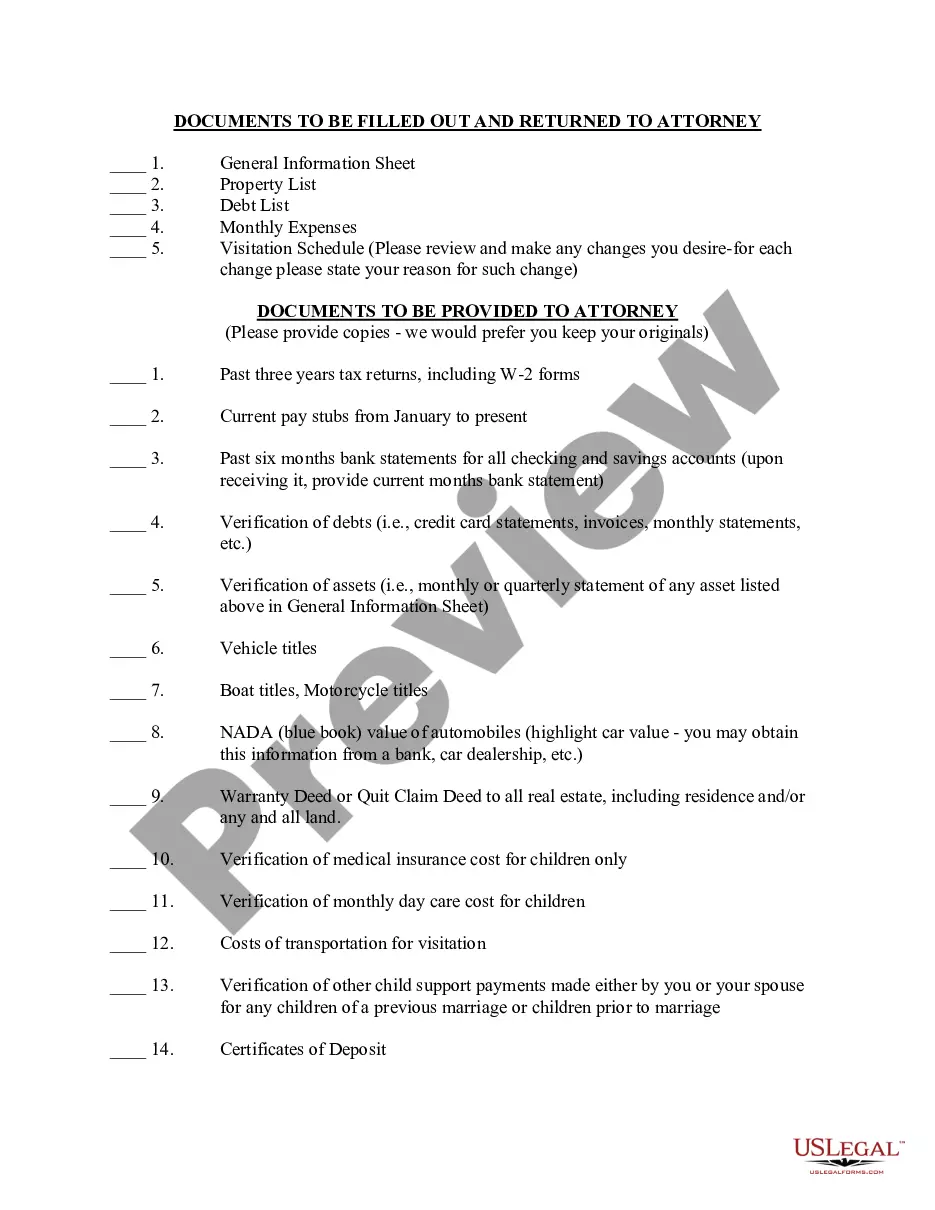
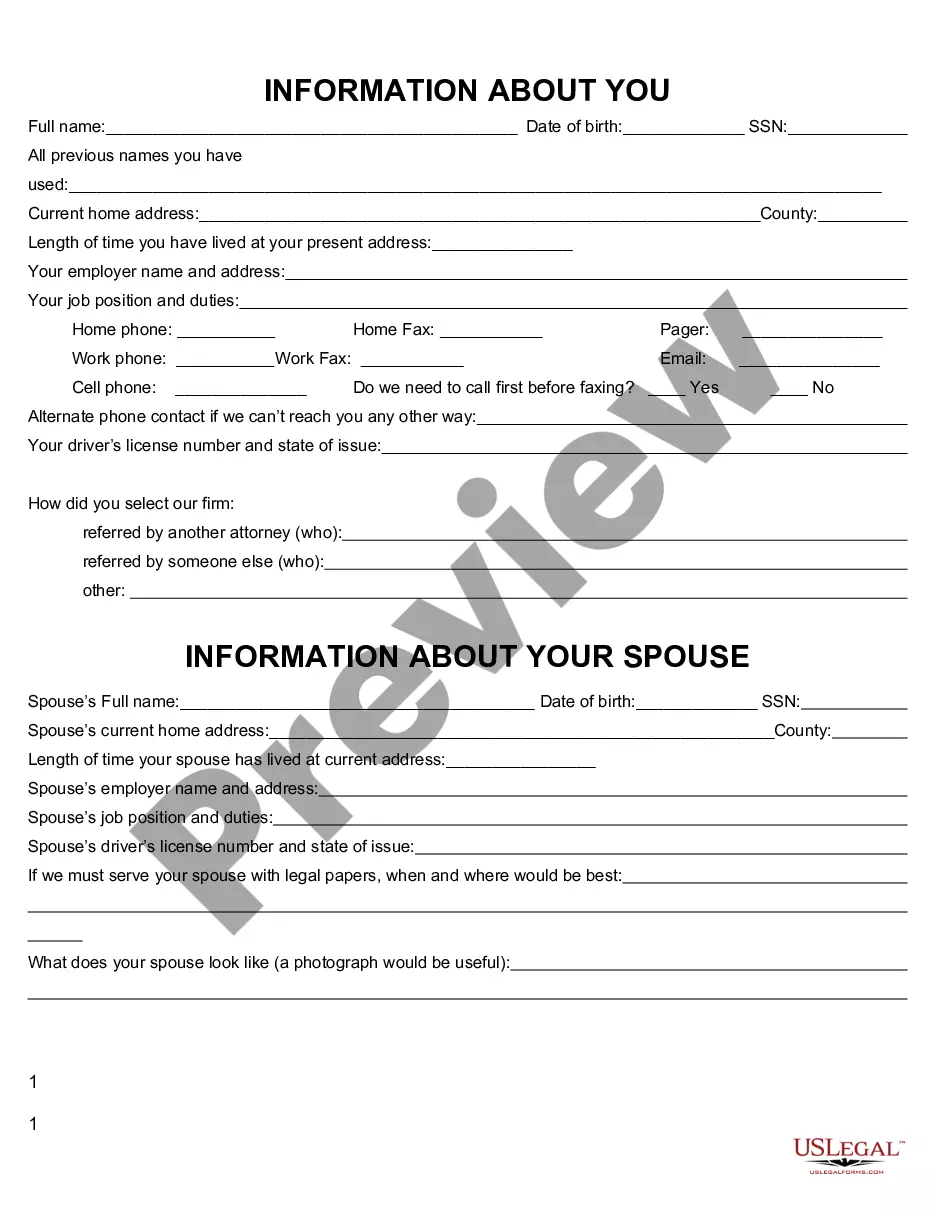
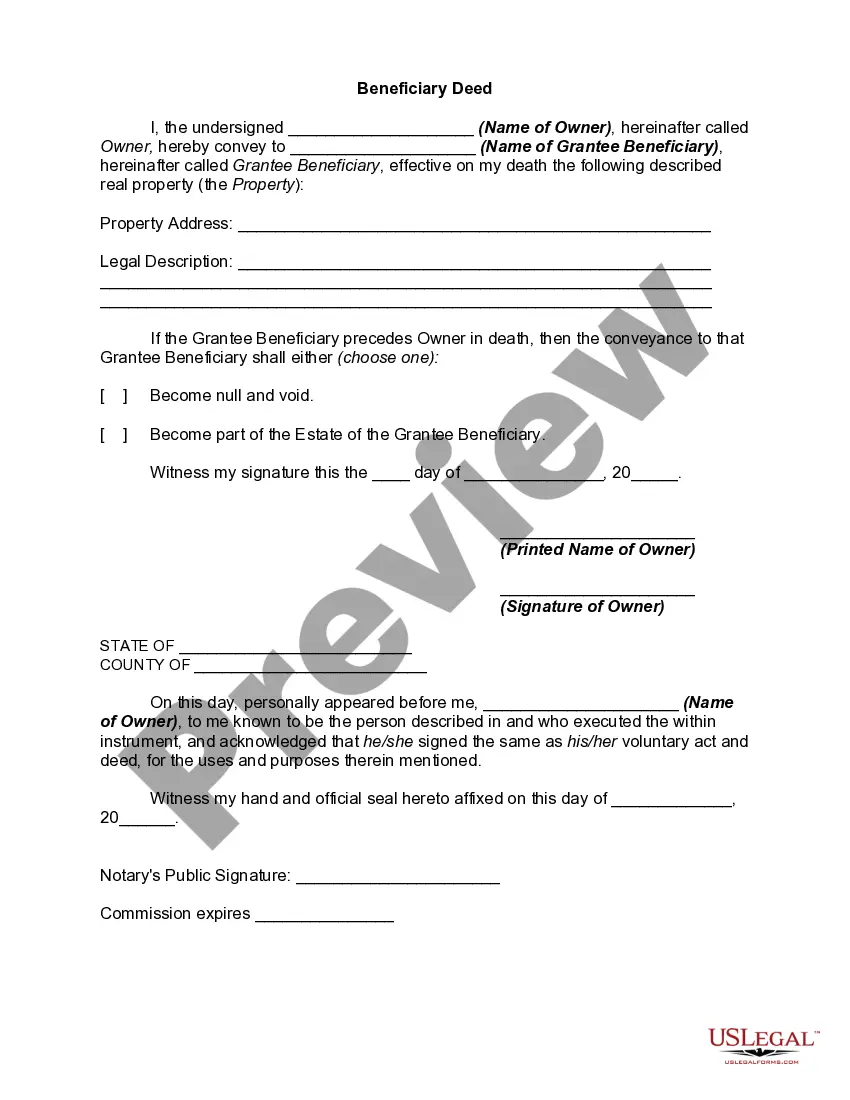
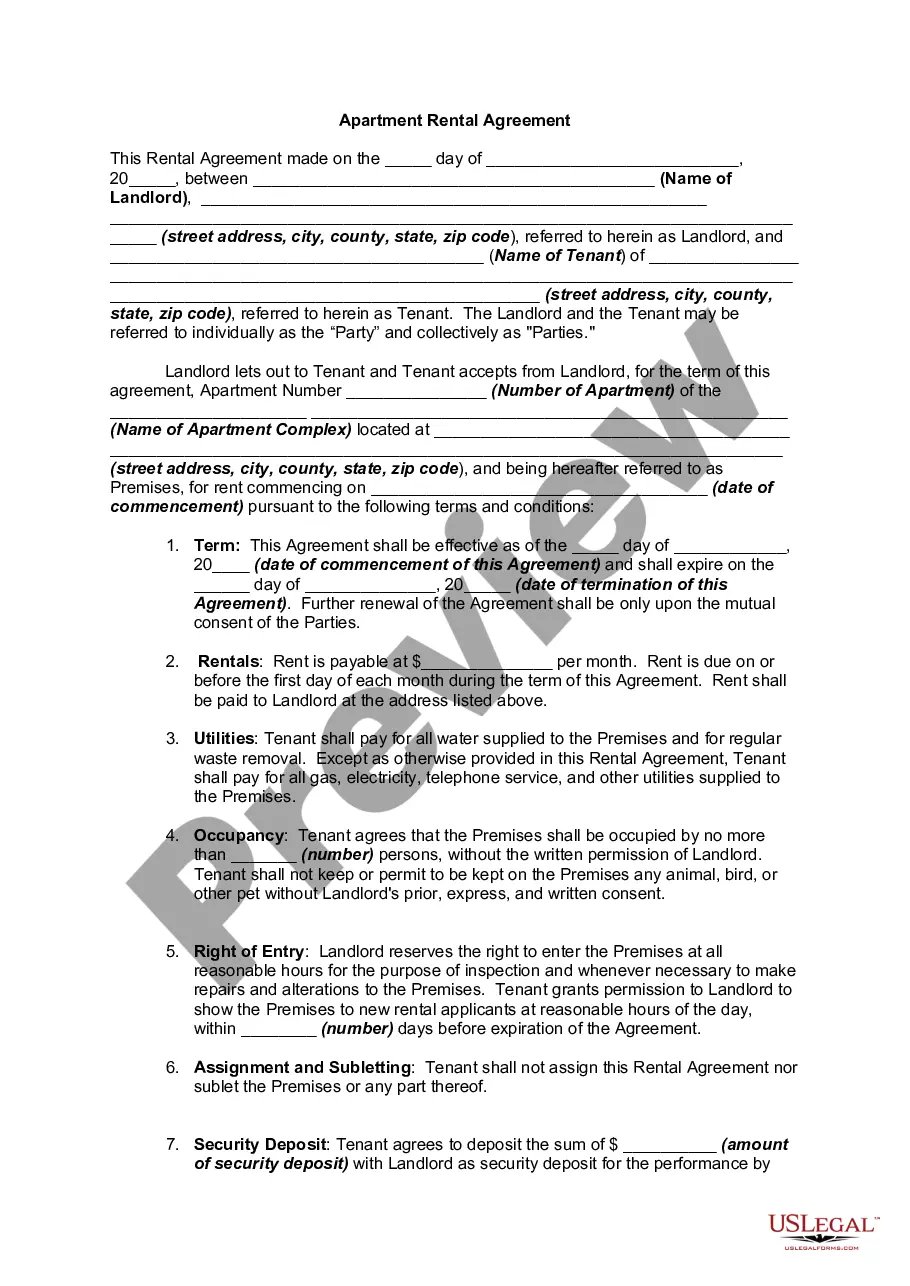
The New York Newly Divorced Individuals Package is a comprehensive collection of essential legal documents specifically designed for individuals who have recently gone through a divorce. This package helps you organize your legal life by providing state-specific forms that meet your unique needs. Unlike other general legal form packages, this one includes tailored documents such as a Will, a General Power of Attorney, and a Name Change Notification Form, ensuring that you are adequately equipped for post-divorce legal matters.
What’s included in this form package
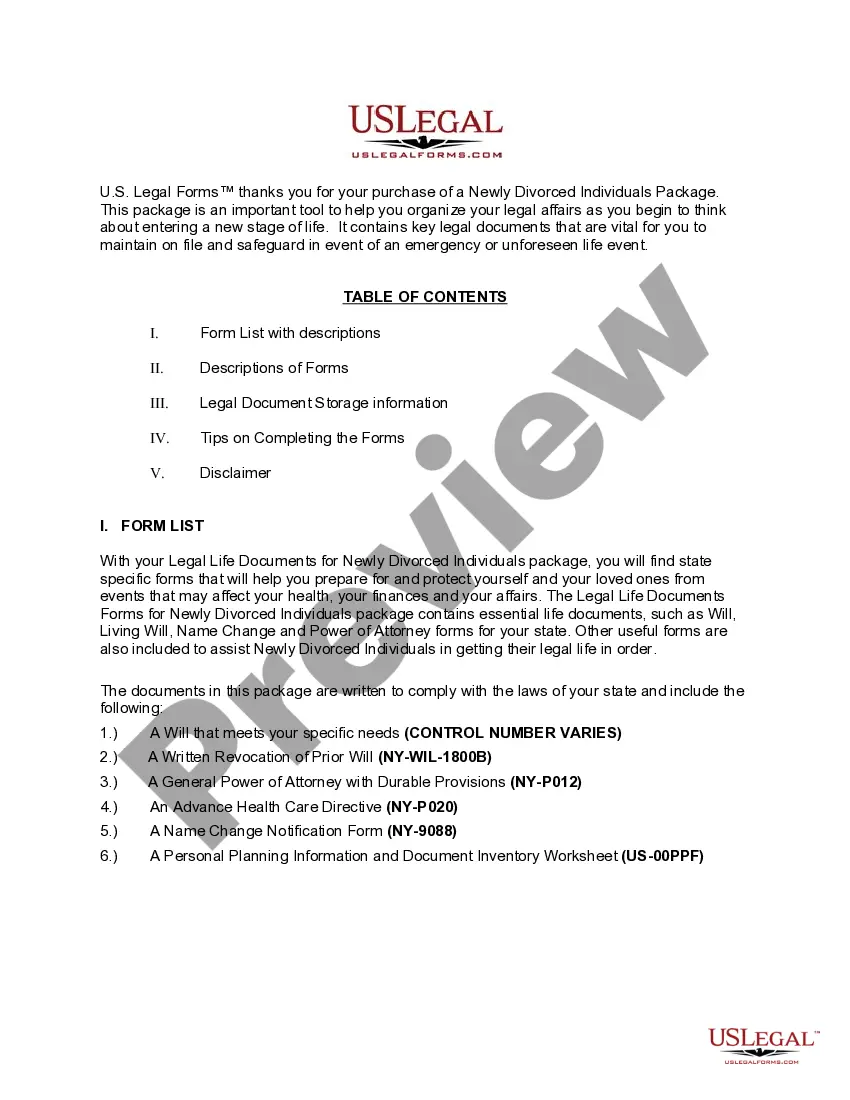
- Last Will and Testament
- Name Change Notification Form
- Statutory Durable Power of Attorney - Durable Provisions
- Health Care Proxy Health Care Decisions Statutory Form including Living Will Provisions
- Written Revocation of Will
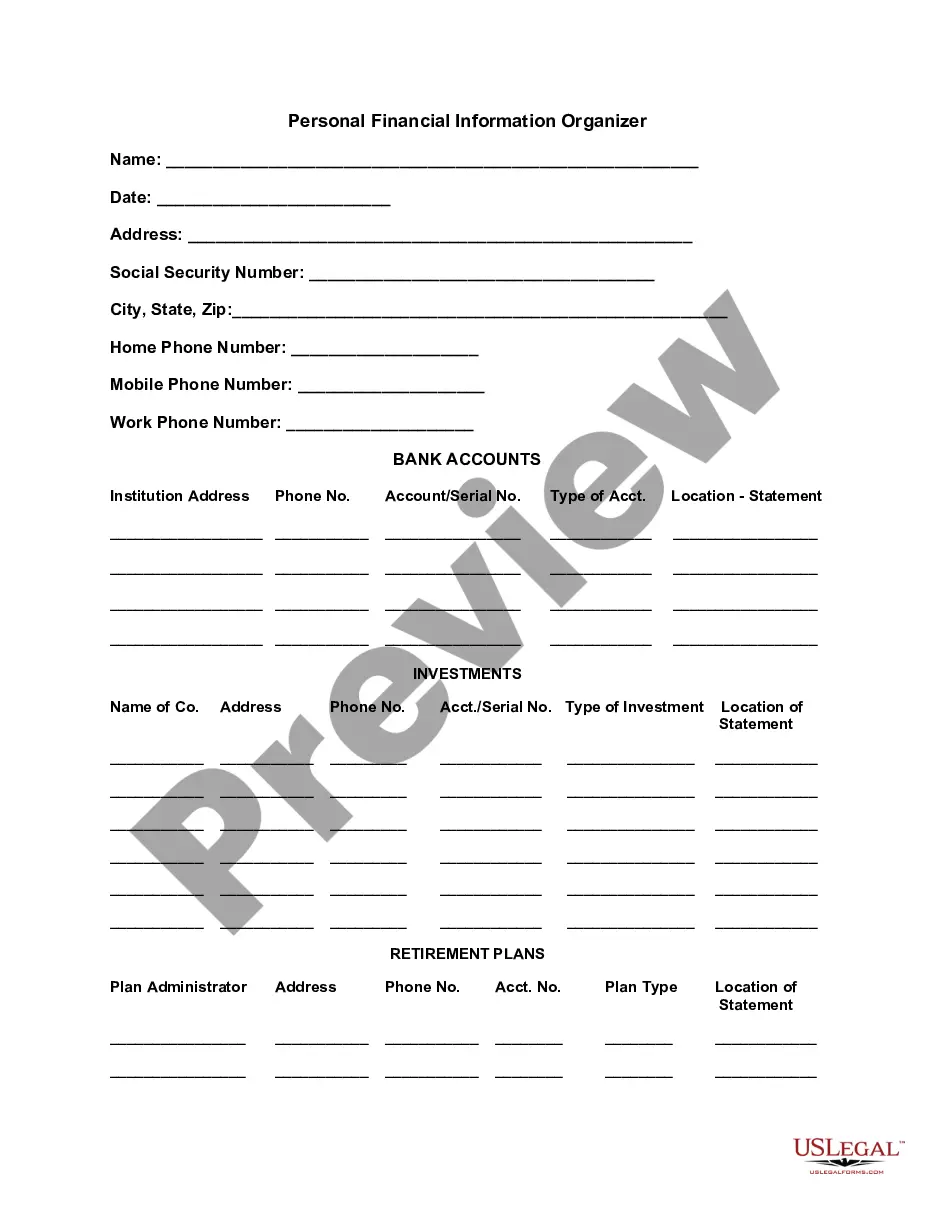
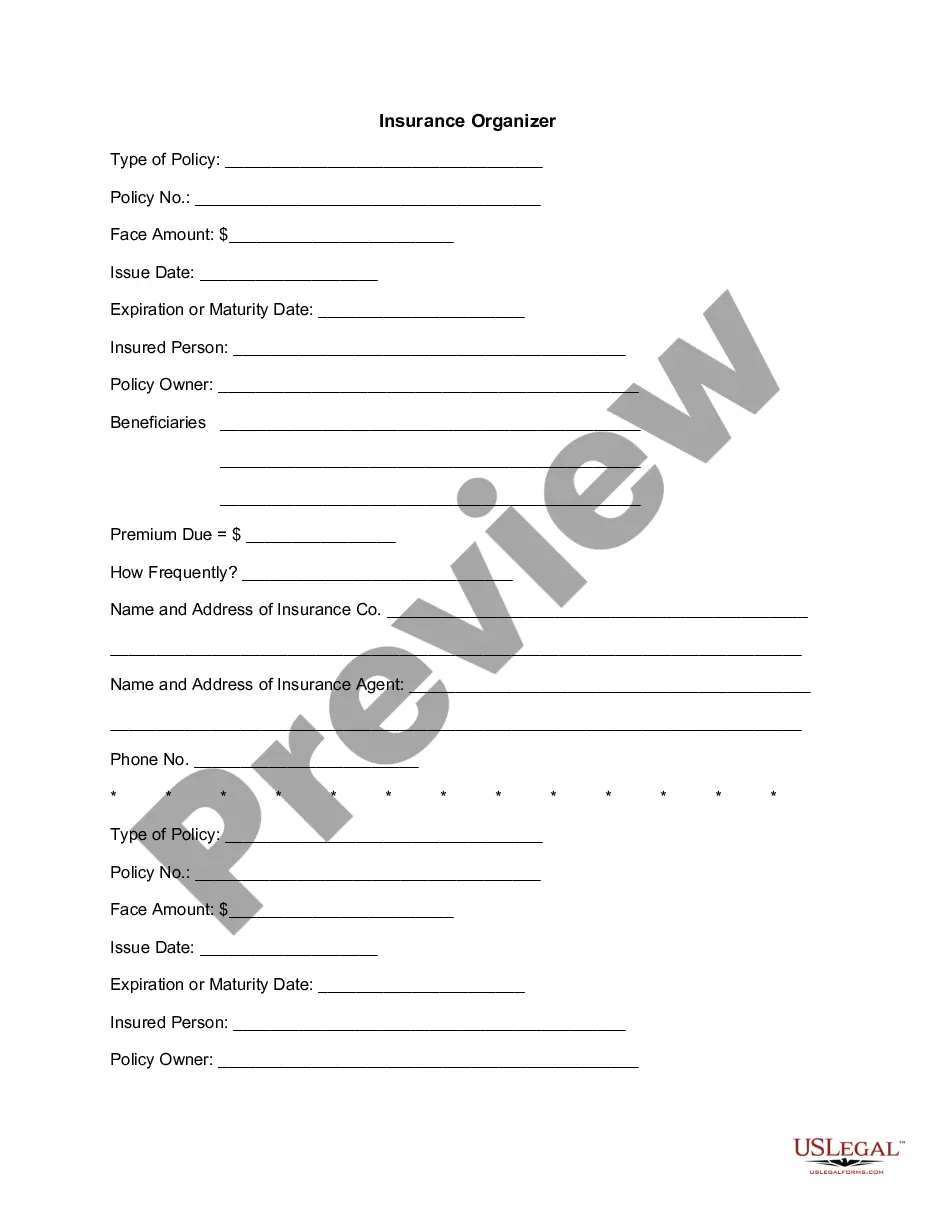
- Personal Planning Information and Document Inventory Worksheets - A Legal Life Document
When to use this document
This package is particularly useful in the following scenarios:
- After finalizing your divorce when legal matters need to be updated or addressed.
- If you need to revoke a prior will and create a new one that reflects your current wishes.
- When designating a power of attorney for financial and health decisions.
- When changing your name and needing to notify relevant parties.
- To ensure all essential legal documents are in order to protect your interests and those of your loved ones.
Who should use this form package
- Individuals who have recently finalized a divorce in New York.
- Those needing to update or establish legal documents following a marriage dissolution.
- Anyone looking to simplify the process of organizing their legal affairs.
- People who have changed their name and require formal documentation for notification.
How to prepare this document
- Review the included forms carefully to understand what each document entails.
- Fill in the required information, ensuring accuracy and completeness.
- Sign and date all forms where indicated, following any specific signing instructions.
- Keep the completed documents in a secure location, such as a safe deposit box or home safe.
- Notify relevant parties, especially for documents like the Name Change Notification Form.
Notarization requirements for forms in this package
Certain documents in this package must be notarized for legal effectiveness. Our online notarization service, powered by Notarize, lets you verify and sign documents remotely through an encrypted video session, available anytime.
Get your form ready online
Our built-in tools help you complete, sign, share, and store your documents in one place.
Make edits, fill in missing information, and update formatting in US Legal Forms—just like you would in MS Word.
Download a copy, print it, send it by email, or mail it via USPS—whatever works best for your next step.
Sign and collect signatures with our SignNow integration. Send to multiple recipients, set reminders, and more. Go Premium to unlock E-Sign.
If this form requires notarization, complete it online through a secure video call—no need to meet a notary in person or wait for an appointment.
We protect your documents and personal data by following strict security and privacy standards.

Make edits, fill in missing information, and update formatting in US Legal Forms—just like you would in MS Word.

Download a copy, print it, send it by email, or mail it via USPS—whatever works best for your next step.

Sign and collect signatures with our SignNow integration. Send to multiple recipients, set reminders, and more. Go Premium to unlock E-Sign.

If this form requires notarization, complete it online through a secure video call—no need to meet a notary in person or wait for an appointment.

We protect your documents and personal data by following strict security and privacy standards.
Typical mistakes to avoid
- Failing to revoke an old will, resulting in conflicts with your heirs.
- Not signing the forms where required, which may render them invalid.
- Incorrectly filling out the Name Change Notification Form, leading to complications.
- Neglecting to keep your legal documents in a secure but accessible location.
Benefits of completing this package online
- Convenience of downloading and completing forms from the comfort of your home.
- Editability allows you to make changes easily, ensuring your documents are accurate.
- Reliable state-specific documents that meet legal requirements for New York.
- A significant cost savings of up to 40% compared to purchasing each form separately.
Looking for another form?





Form popularity
FAQ
For marriages that lasted more than 15 years to 20 years, support should last 30%-40% of the length of the marriage, or. for marriages more than 20 years in duration, the court should order support to last between 35%-50% of the length of the marriage.
Equitable distribution is a method for dividing a married couple's property when they divorce.New York is now an equitable distribution state. When a spouse files for divorce, the court must divide marital property equitably or fairly. But equitable doesn't necessarily require an equal split of the couple's assets.
Generally it seems to take around 6 months once everything is fully submitted.
At divorce, community property is generally divided equally between the spouses, while each spouse keeps his or her separate property. Equitable distribution. In all other states, assets and earnings accumulated during marriage are divided equitably (fairly), but not necessarily equally.
Some uncontested divorces are resolved as quickly as six weeks, while others can take six months or more. Since New York doesn't have a waiting period, a divorce that both parties agree on takes roughly 3 months.
The Filing Fee The index number is the number for your case and should be put on all papers filed. An uncontested divorce costs at least $335 in total court and filing fees. This does not include the cost of a lawyer, photocopies, notary fees, transportation, mailing, process server fees, etc.
When a married couple gets a divorce, the court may award "alimony" or spousal support to one of the former spouses, based either on an agreement between the couple or a decision by the court itself. This is separate from the division of marital property and is decided on a case-by-case basis.
What Am I Entitled to in a Divorce in NY? Under New York's equitable distribution laws, only your marital property will be divided during a divorce. This means that you and your spouse will get to keep any separate property that was brought into the marriage.
It generally does not matter who files first in a New York divorce case. The filing spouse does not get an advantage to "set the rules" of the divorce. New York courts apply principles that do not favor one party over the other.