New York Mortgage Tax Credit Affidavit
Understanding this form
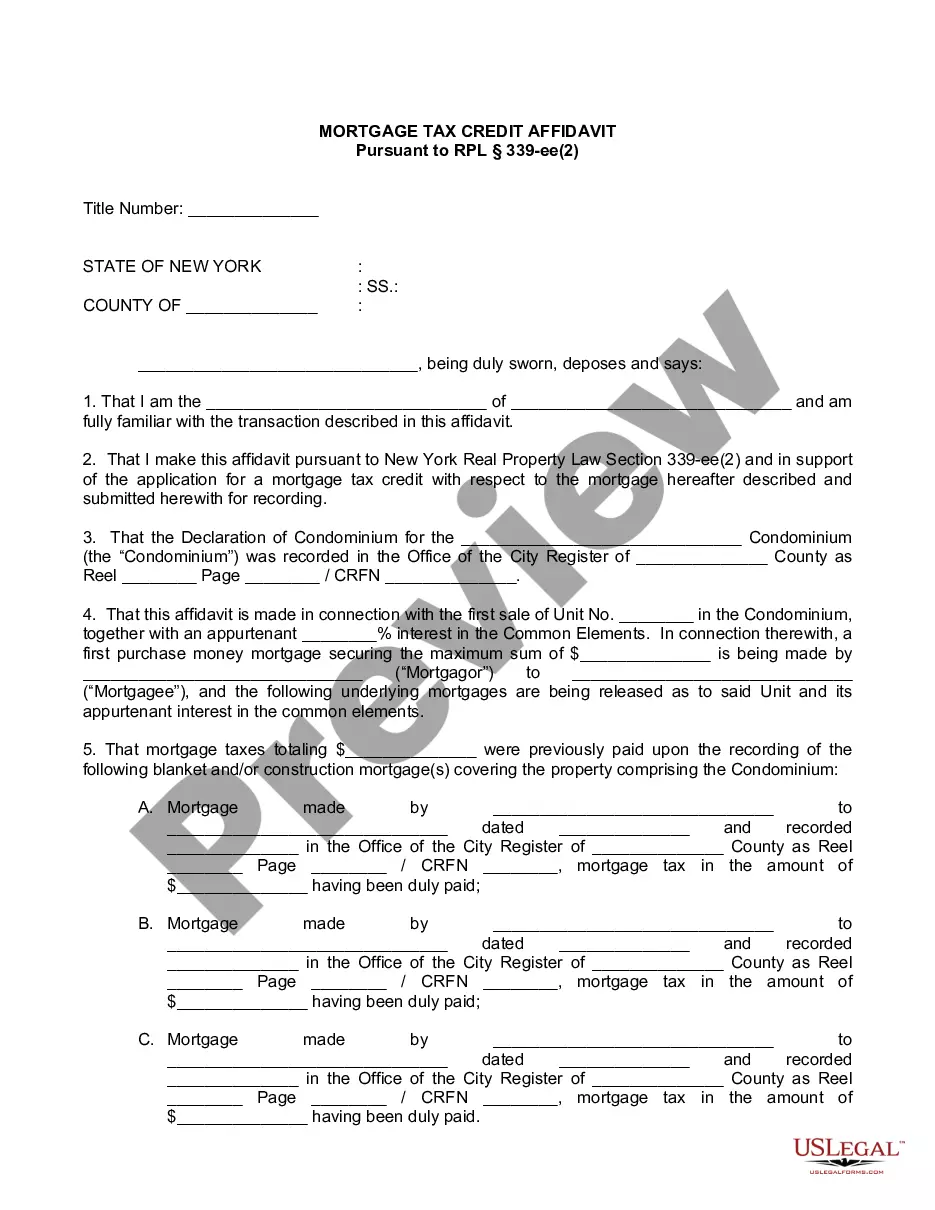
The Mortgage Tax Credit Affidavit is a legal document used when a developer of a condominium pays a mortgage tax on the underlying construction or blanket mortgage and later sells individual condominium units. This affidavit is essential for recording the mortgage and establishing eligibility for the mortgage tax credit, differentiating it from other standard mortgage documents by its specific focus on condominium transactions.
Main sections of this form
- Identification of the affiant, including their role and familiarity with the transaction.
- Details of the recorded Declaration of Condominium and related mortgage information.
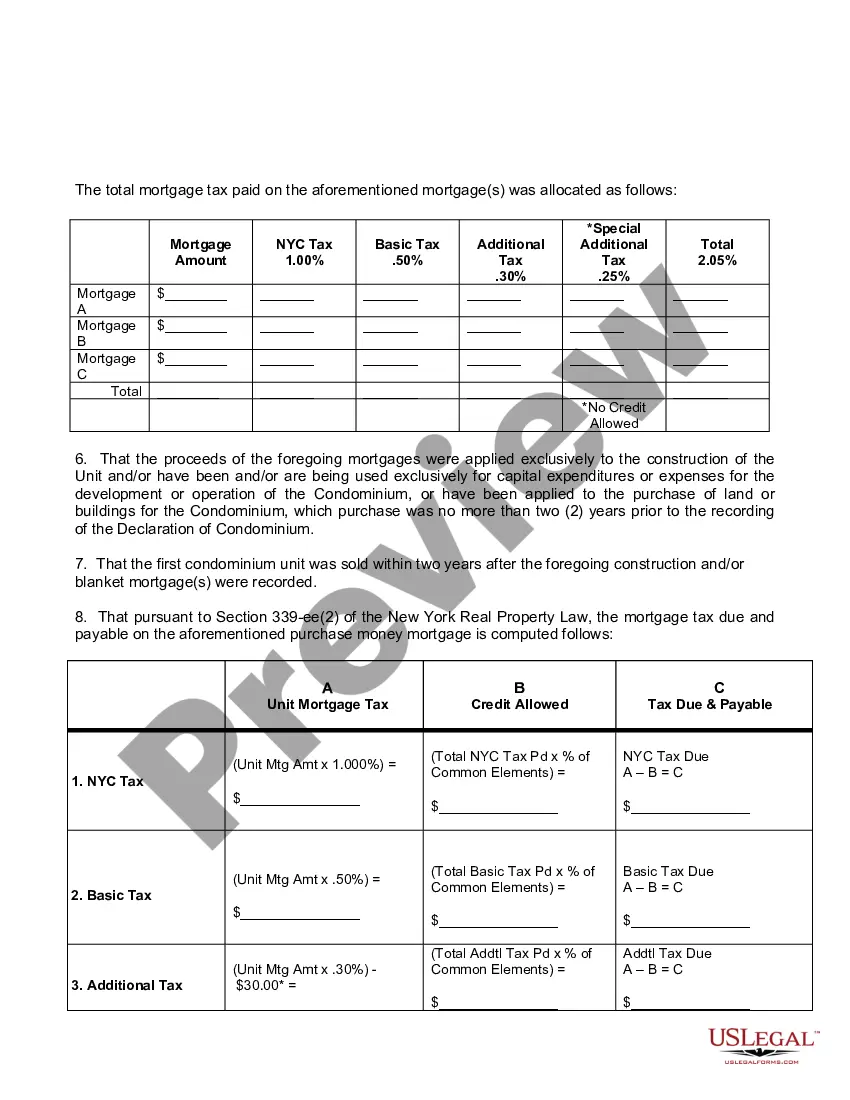
- Declaration of the total mortgage tax previously paid on the construction and blanket mortgages.
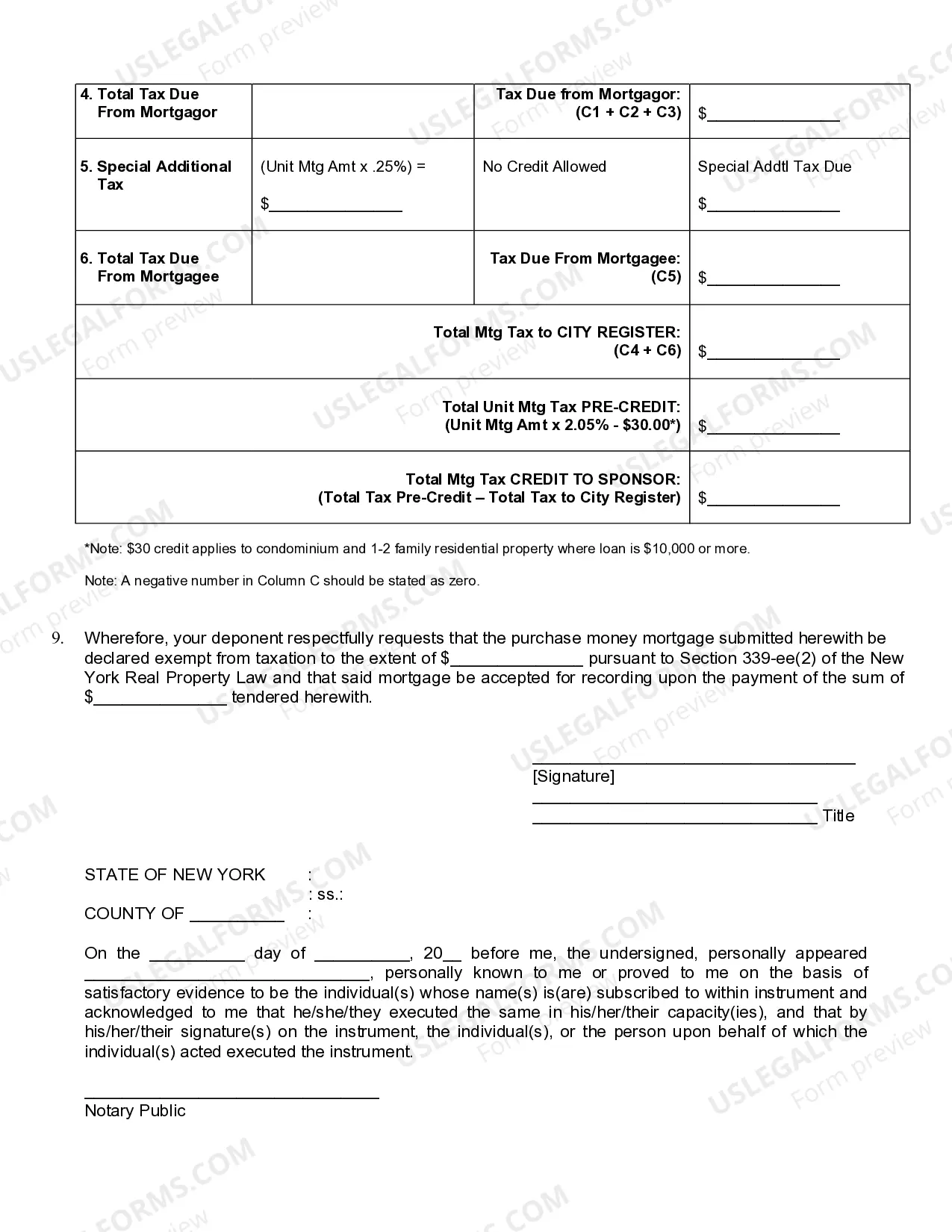
- Allocation of mortgage taxes among different mortgages and the computation of tax credits.
- Signature and notarization section to validate the affidavit.

When this form is needed
This form should be used when a developer sells individual condominium units after having previously paid mortgage taxes on the overall construction or blanket mortgage. It is necessary to demonstrate that the mortgage tax was paid and to apply for a tax credit when a mortgage is recorded for a first sale of a unit within the condominium.
Who this form is for
- Developers of condominiums who are selling individual units.
- Condominium associations facilitating the sale of units.
- Mortgagors seeking tax credits related to the purchase of a condominium unit.
Instructions for completing this form
- Identify the parties involved by entering their names and roles in the transaction.
- Specify the condominium's name and the recorded details of the Declaration.
- Input the sale details, including the unit number and the mortgage amount.
- Calculate and enter the total mortgage tax previously paid and the credit amount allocated to the sale.
- Ensure the affidavit is signed in front of a notary public to validate it.
Notarization guidance
Yes, this form must be notarized to be legally valid. US Legal Forms offers integrated online notarization services, allowing you to complete this process conveniently with secure video calls, ensuring compliance without the need to travel.
Get your form ready online
Our built-in tools help you complete, sign, share, and store your documents in one place.
Make edits, fill in missing information, and update formatting in US Legal Forms—just like you would in MS Word.
Download a copy, print it, send it by email, or mail it via USPS—whatever works best for your next step.
Sign and collect signatures with our SignNow integration. Send to multiple recipients, set reminders, and more. Go Premium to unlock E-Sign.
If this form requires notarization, complete it online through a secure video call—no need to meet a notary in person or wait for an appointment.
We protect your documents and personal data by following strict security and privacy standards.

Make edits, fill in missing information, and update formatting in US Legal Forms—just like you would in MS Word.

Download a copy, print it, send it by email, or mail it via USPS—whatever works best for your next step.

Sign and collect signatures with our SignNow integration. Send to multiple recipients, set reminders, and more. Go Premium to unlock E-Sign.

If this form requires notarization, complete it online through a secure video call—no need to meet a notary in person or wait for an appointment.

We protect your documents and personal data by following strict security and privacy standards.
Common mistakes
- Failing to accurately record previous mortgage tax payments.
- Not calculating the tax credits correctly based on the common elements percentage.
- Omitting signatures or notary information, rendering the affidavit invalid.
- Using outdated or incorrect forms that do not comply with current New York laws.
Benefits of using this form online
- Easy access to downloadable templates drafted by licensed attorneys.
- Ability to fill out forms at your convenience without visiting an office.
- Editable templates that can be tailored to meet specific transaction details.
- Secure storage of your legal documents for future reference.
Looking for another form?
Form popularity
FAQ
To deduct mortgage interest, real estate taxes, and home office expenses, you must complete Form IT-196, New York Resident, Nonresident, and Part-Year Resident Itemized Deductions, to compute your New York State itemized deduction.
Do you have to pay NYS mortgage tax on a refinance? New York charges a NYS mortgage tax or specifically a recording tax on any new mortgage debt. This rate varies by county, with the minimum being 1.05 percent of the loan amount. But fortunately, homeowners aren't required to pay the tax again once they refinance.
This template is a Section 255 Affidavit, which is used in New York to confirm that the portion of debt secured by a consolidation, extension, and modification agreement (CEMA), for which mortgage recording tax has already been paid, is exempt from mortgage recording tax pursuant to NY CLS Tax § 255.
Borrower shall pay all taxes, charges, filing, registration and recording fees, excises and levies payable with respect to the Note or the Liens created or secured by the Loan Documents, other than income, franchise and doing business taxes imposed on Lender.
New York State imposes a tax on the privilege of recording a mortgage on real property located within the state. In addition, New York City, Yonkers, and various counties impose local taxes on mortgages that are recorded in those jurisdictions.
How much is the mortgage recording tax buyers pay in NYC? The mortgage recording tax requires purchasers to pay 1.8% on mortgage amounts under $500,000 and 1.925% on mortgage amounts above $500,000 in NYC (this includes the recording tax for both New York City and New York State).
Section 253 1-a. (b) of the New York State tax law provides that if the lender (1) operates on a nonprofit basis; and (2) is exempt from federal income taxation under Section 501(a) of the Internal Revenue Code, then the lender is exempt from paying the special additional tax.
Mortgage Tax is equal to 1.05% of the total mortgage amount (minus a $30.00 deduction if applicable) which consists of the following: Basic Mortgage Tax is . 50% of mortgage amount. SONYMA (State of New York Mortgage Authority) aka Additional Tax is .
The VA loan program, like FHA loans, views non-payment of property taxes to be a violation of the loan agreement. But VA loan rules do not require a lender to establish an escrow account for the taxes and insurance on properties bought with VA mortgage loans.
The Veterans' Exemption provides exemption of property not to exceed $4,000 for qualified veterans who own limited property (see Revenue and Taxation Code section 205).