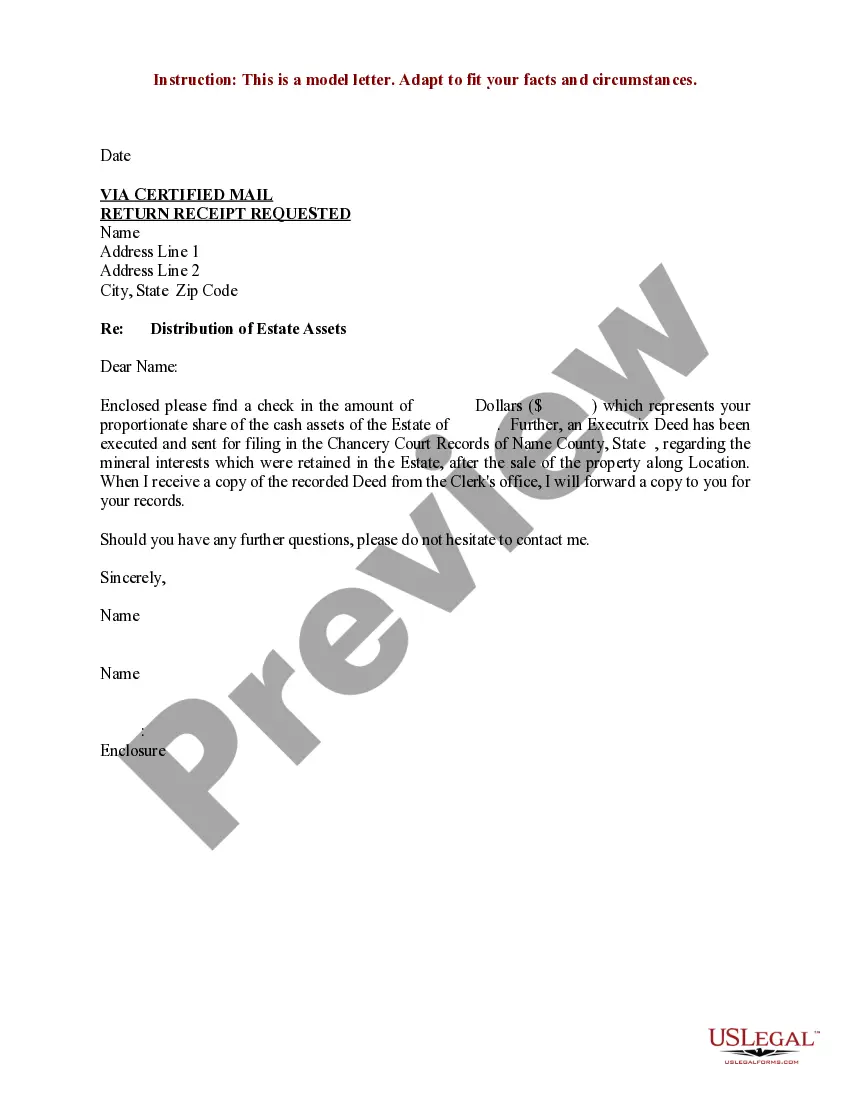
New York Grant Deed from Individual to Individual
About this form
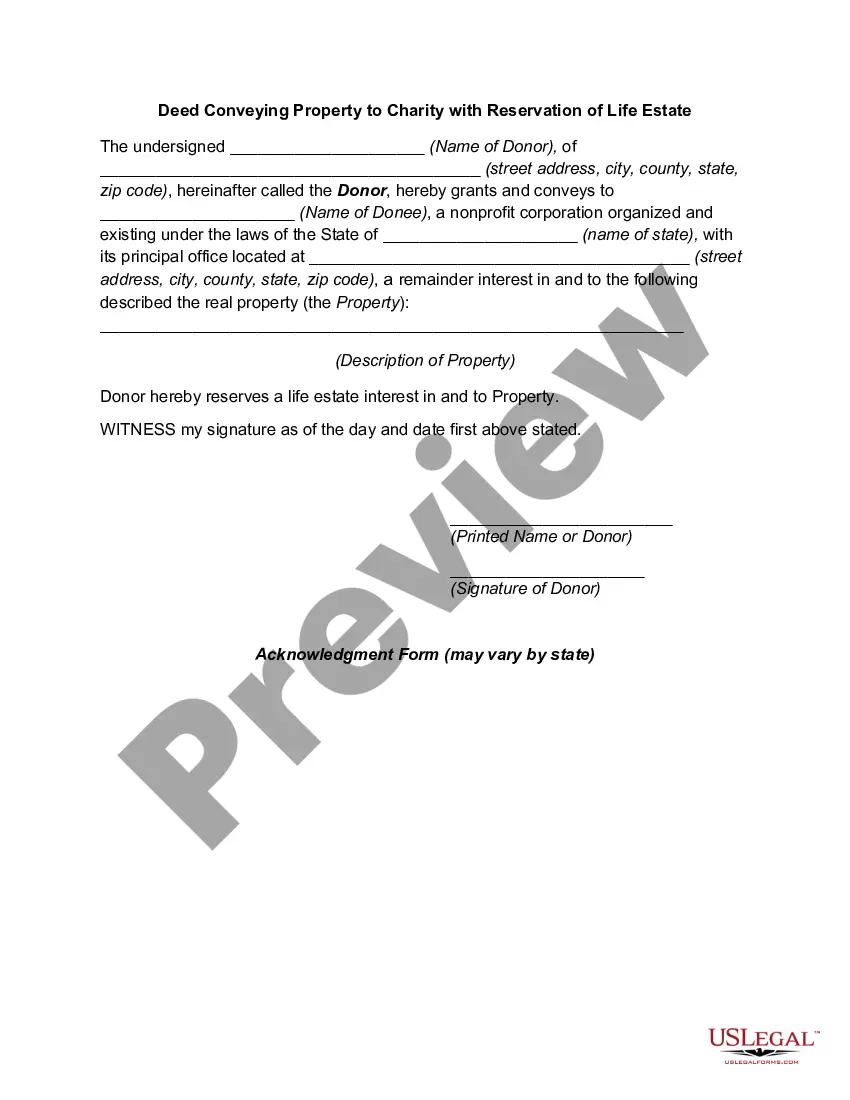
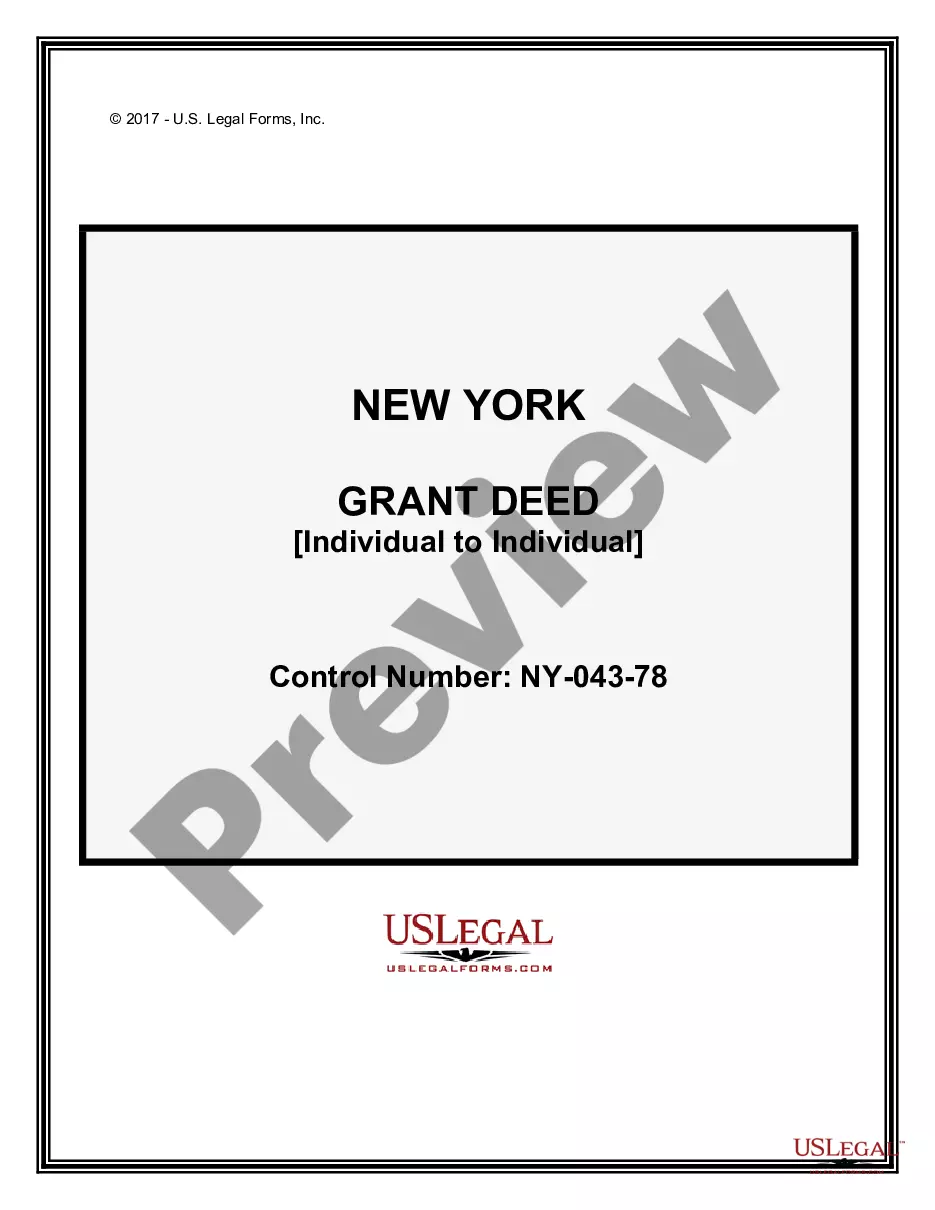
The Grant Deed from Individual to Individual is a legal document used to convey property ownership from one individual (the Grantor) to another (the Grantee). This form ensures that the transfer complies with all applicable state laws and outlines the specifics of the property being transferred. Unlike other types of deeds, such as warranty deeds or quitclaim deeds, a grant deed provides certain guarantees regarding the title to the property and is a commonly used form for transferring ownership between individuals.
Key parts of this document
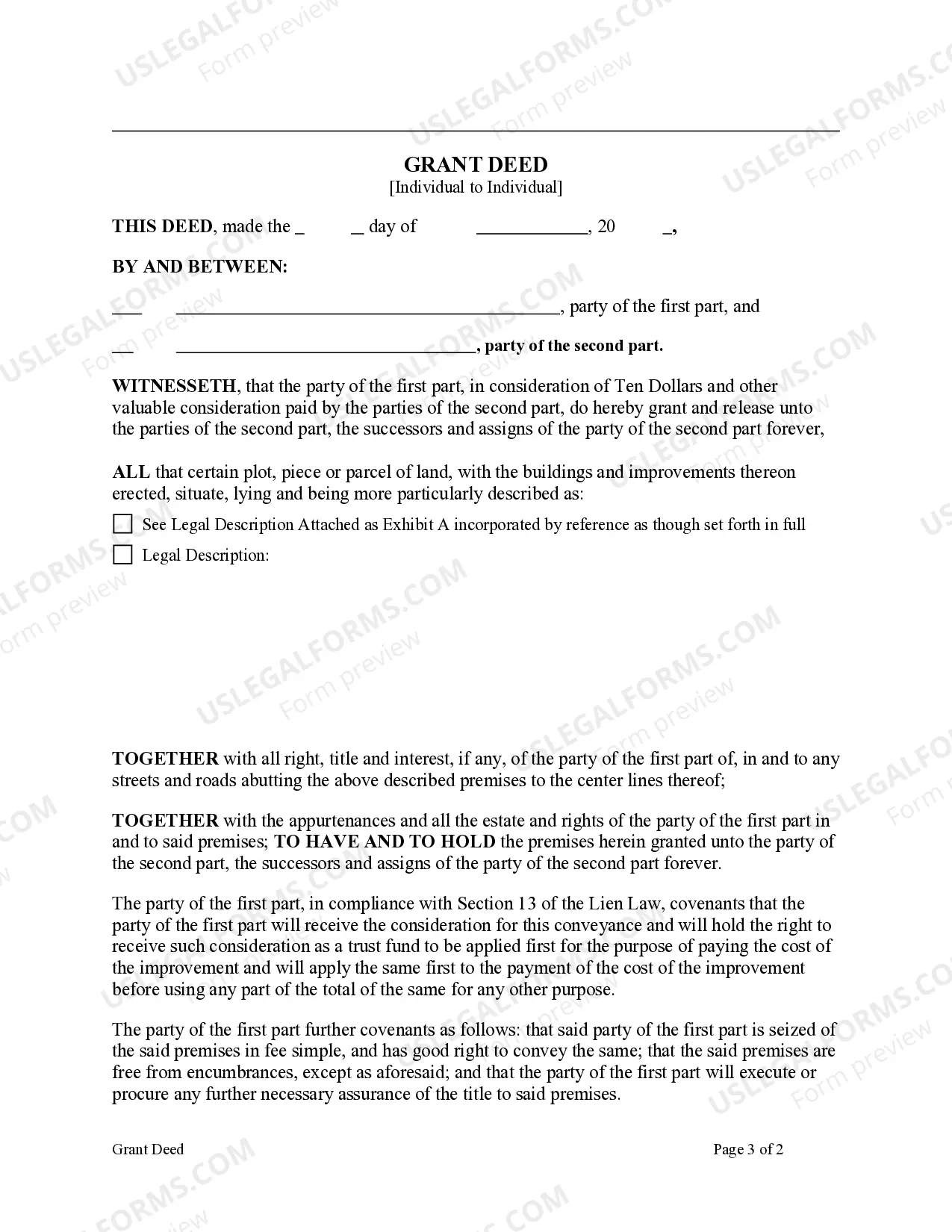
- Identification of the Grantor and Grantee
- Description of the property being conveyed
- Details regarding the consideration received for the property
- Covenants regarding title and encumbrances
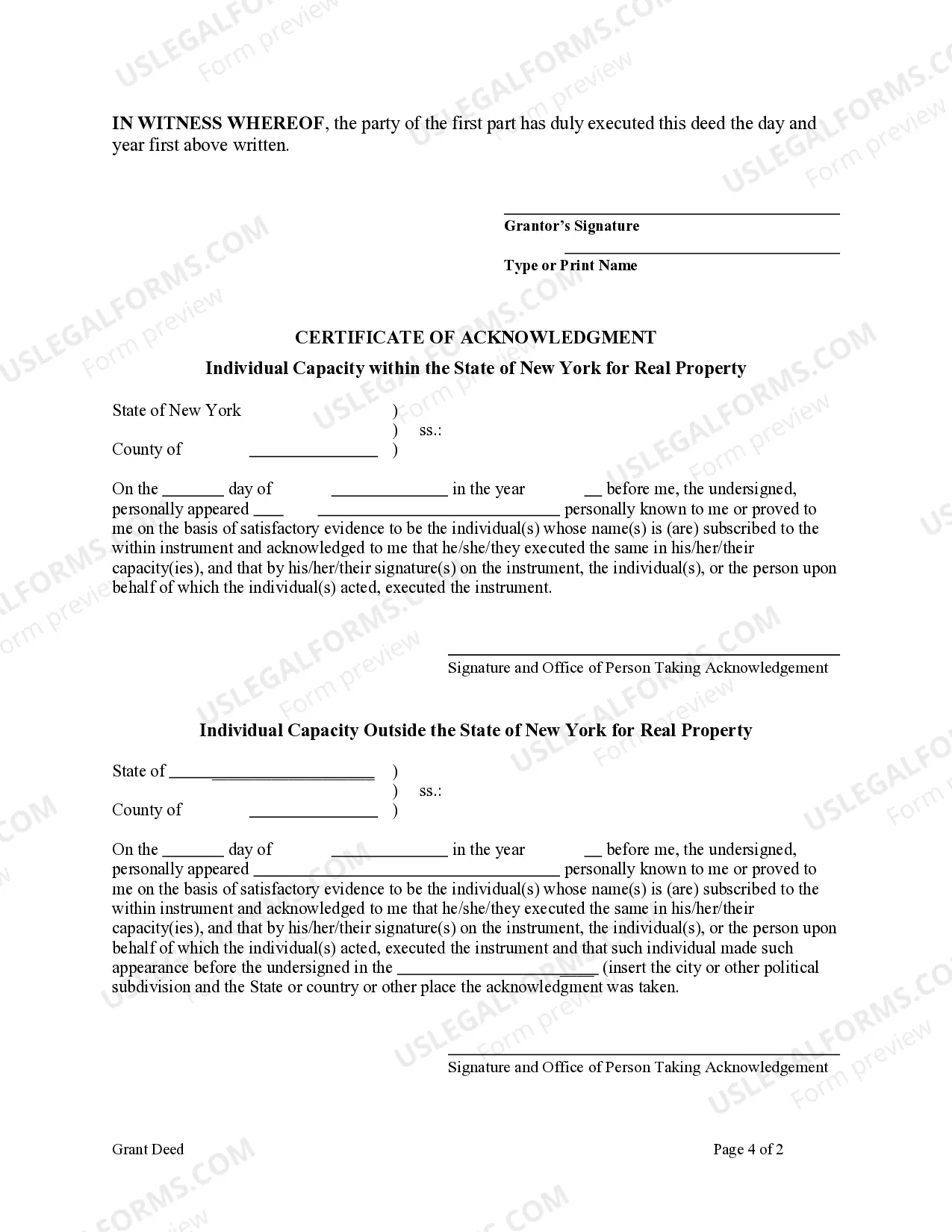
- Signatures of the parties involved
- Section for notarization of the deed




When this form is needed
This form is appropriate to use when an individual wishes to transfer ownership of real estate directly to another individual. Common scenarios for using a Grant Deed include selling property, gifting property to a family member, or transferring assets as part of estate planning. It helps establish clear ownership and ensures the transaction is legally recognized.
Intended users of this form
- Homeowners looking to sell or transfer their property
- Individuals gifting real estate to family or friends
- Co-owners dividing their interest in a property
- Anyone involved in property transactions where traditional warranty deeds are not required
Instructions for completing this form
- Identify the parties involved: the Grantor and the Grantee.
- Provide a detailed description of the property being transferred.
- Specify the consideration being exchanged for the property.
- Include any necessary covenants regarding the property title.
- Have both parties sign the form in the designated areas.
- Ensure the deed is notarized to validate the signatures, if required.
Does this document require notarization?
Yes, this form must be notarized to be legally valid. Notarization helps verify the identities of the parties involved and provides an additional layer of authenticity to the document. US Legal Forms offers integrated online notarization services, allowing you to complete the process securely and conveniently from anywhere.
Get your form ready online
Our built-in tools help you complete, sign, share, and store your documents in one place.
Make edits, fill in missing information, and update formatting in US Legal Forms—just like you would in MS Word.
Download a copy, print it, send it by email, or mail it via USPS—whatever works best for your next step.
Sign and collect signatures with our SignNow integration. Send to multiple recipients, set reminders, and more. Go Premium to unlock E-Sign.
If this form requires notarization, complete it online through a secure video call—no need to meet a notary in person or wait for an appointment.
We protect your documents and personal data by following strict security and privacy standards.

Make edits, fill in missing information, and update formatting in US Legal Forms—just like you would in MS Word.

Download a copy, print it, send it by email, or mail it via USPS—whatever works best for your next step.

Sign and collect signatures with our SignNow integration. Send to multiple recipients, set reminders, and more. Go Premium to unlock E-Sign.

If this form requires notarization, complete it online through a secure video call—no need to meet a notary in person or wait for an appointment.

We protect your documents and personal data by following strict security and privacy standards.
Common mistakes
- Failing to properly describe the property, leading to ambiguity.
- Not including adequate consideration for the transfer.
- Neglecting to obtain signatures from both the Grantor and Grantee.
- Omitting notarization if required by local law.
Benefits of using this form online
- Convenience of downloading and completing forms at your own pace.
- Easy integration of electronic fields for clarity and accuracy.
- Access to lawyer-reviewed templates ensuring compliance with state laws.
- Cost-effective solution compared to hiring an attorney for simple transfers.
Quick recap
- The Grant Deed officially transfers property from one individual to another.
- It includes guarantees about the propertyâs title and freedom from encumbrances.
- Ideal for selling, gifting, or transferring inherited property.
- Completing the form accurately is crucial for legal recognition.
Looking for another form?

Form popularity
FAQ
Print a grant deed from an online source. Sign the document in the presence of a notary public. Take the deed to the recorder's office in the county where the property is located.
A grant deed is the instrument used to transfer title to an interest in real property from one owner to someone else.A deed of trust is the security instrument given to a lender to secure a loan or other obligation. Bare naked title is deeded to the trustee, who holds the power of sale or the power to re-convey.
You would simply prepare a deed to you and your fiance. You would then have to prepare and execute the other necessary forms take them to the clerks office and file them. I suggest that you consult with a local attorney. They can do this at a modest cost.
To sign over property ownership to another person, you'll use one of two deeds: a quitclaim deed or a warranty deed.
The seller or the seller's broker will hire an attorney to prepare the real estate deed to ensure that all of the requirements in the creation of a valid deed are met before the seller conveys title to the property. All real estate deeds must be in writing.
Fill in the deed form. Print it out. Have the grantor(s) sign and get the signature(s) notarized. Complete a transfer tax form, Form TP-584. Complete and print out Form RP-5217 (or, if you are in New York City, Form RP-5217NYC).
Grantor's name. Grantee's name and address. Description of grantee (ex: unmarried man, husband and wife, joint tenants) Person who requested grant deed. Address of real estate that is being transferred. Legal description of property (lot number) Original title order number for property.
Contrary to normal expectations, the Deed DOES NOT have to be recorded to be effective or to show delivery, and because of that, the Deed DOES NOT have to be signed in front of a Notary Public. However, if you plan to record it, then it does have to be notarized as that is a County Recorder requirement.
The fees to file a New York quitclaim deed vary from county to county, but some of the fees are similar. As of 2018, the basic fee for filing a quitclaim deed of residential or farm property is $125, while the fee for all other property is $250. These fees are for the RP-5217 form.