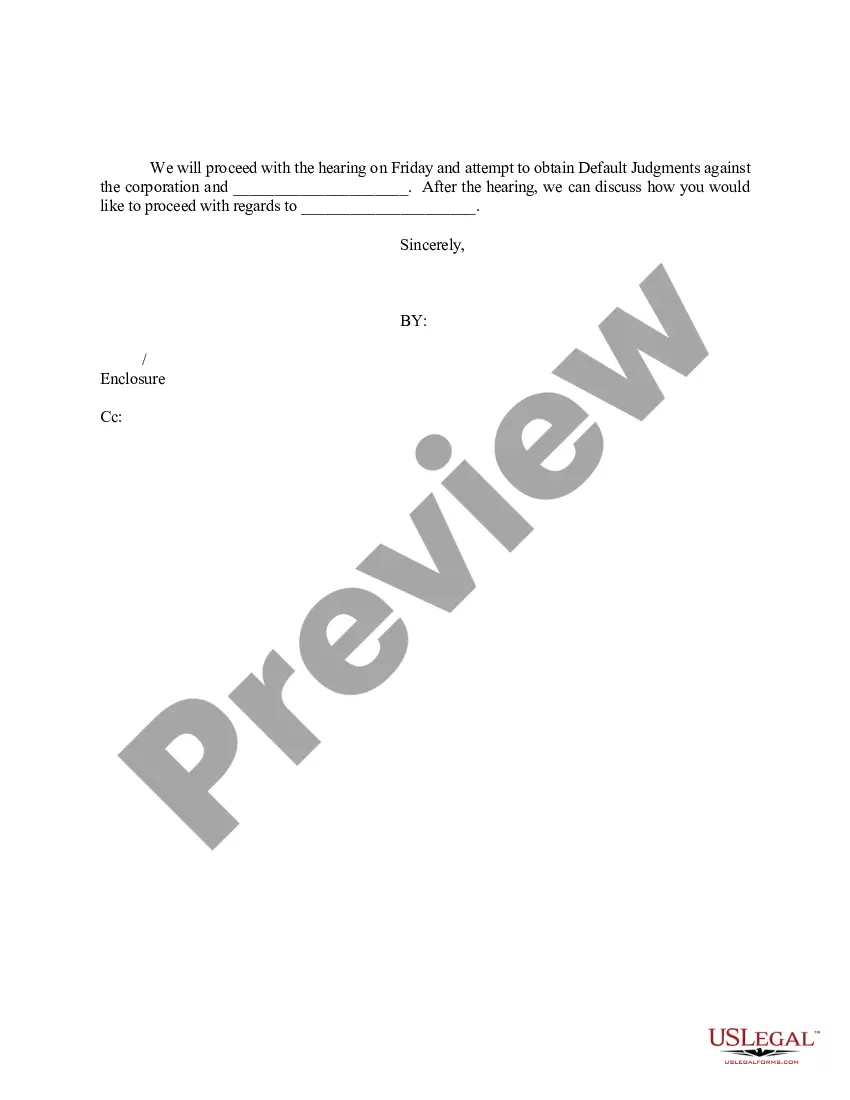
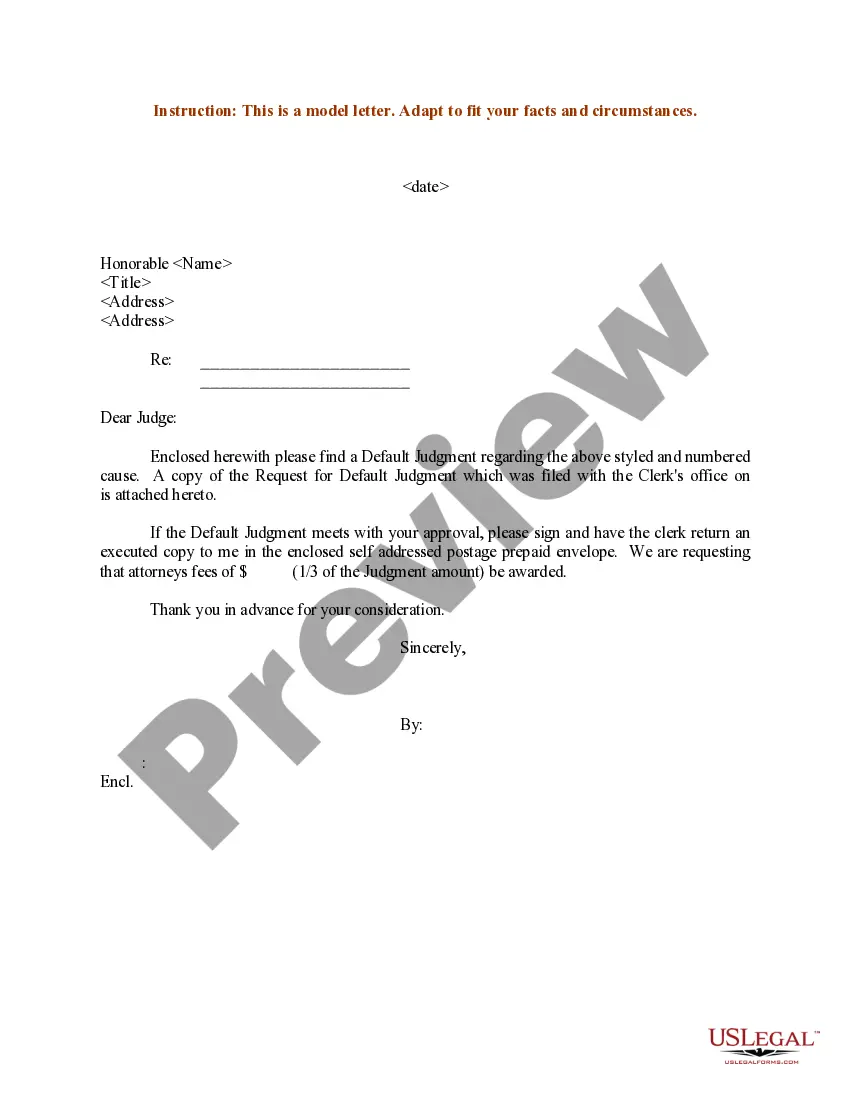
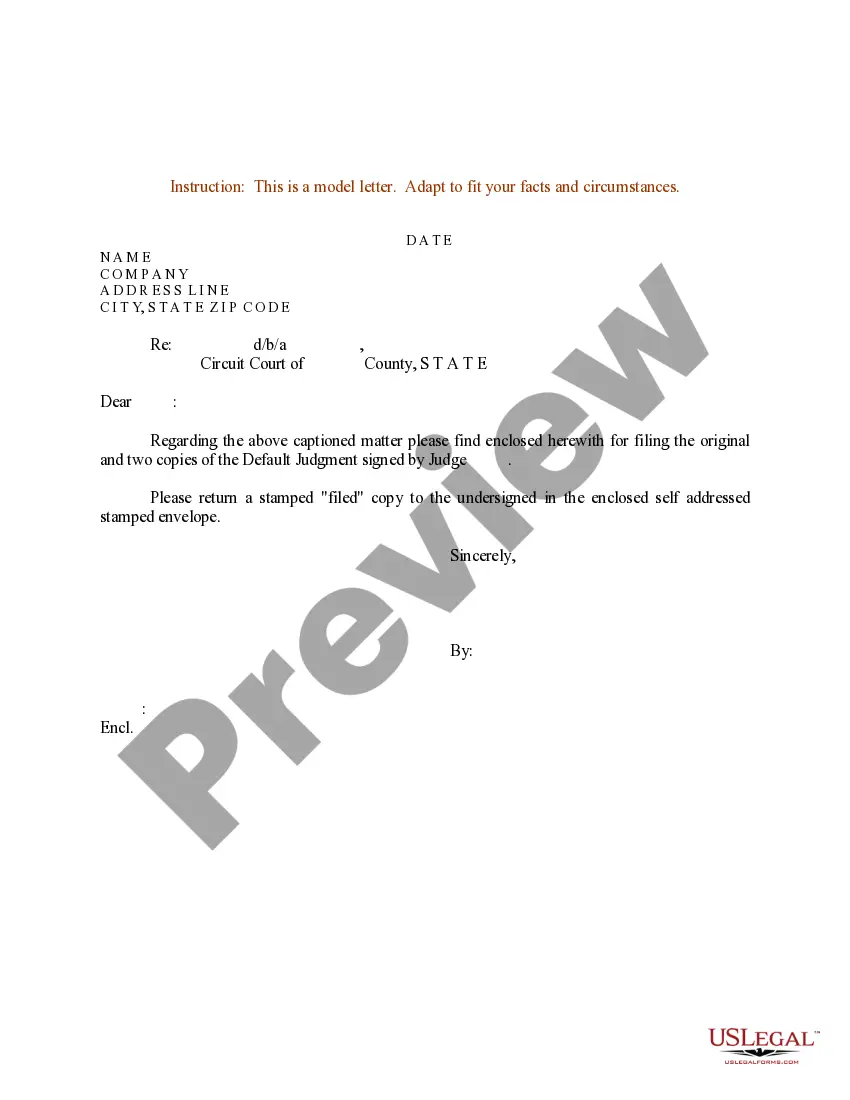
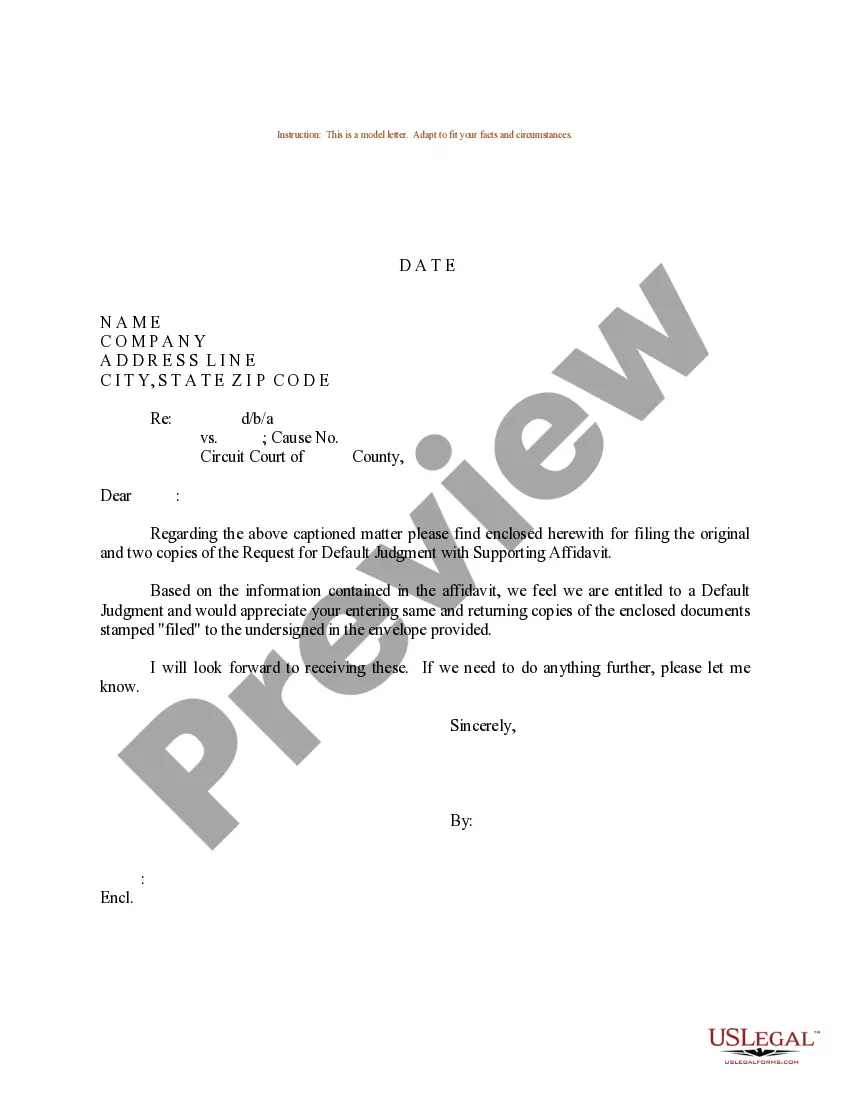
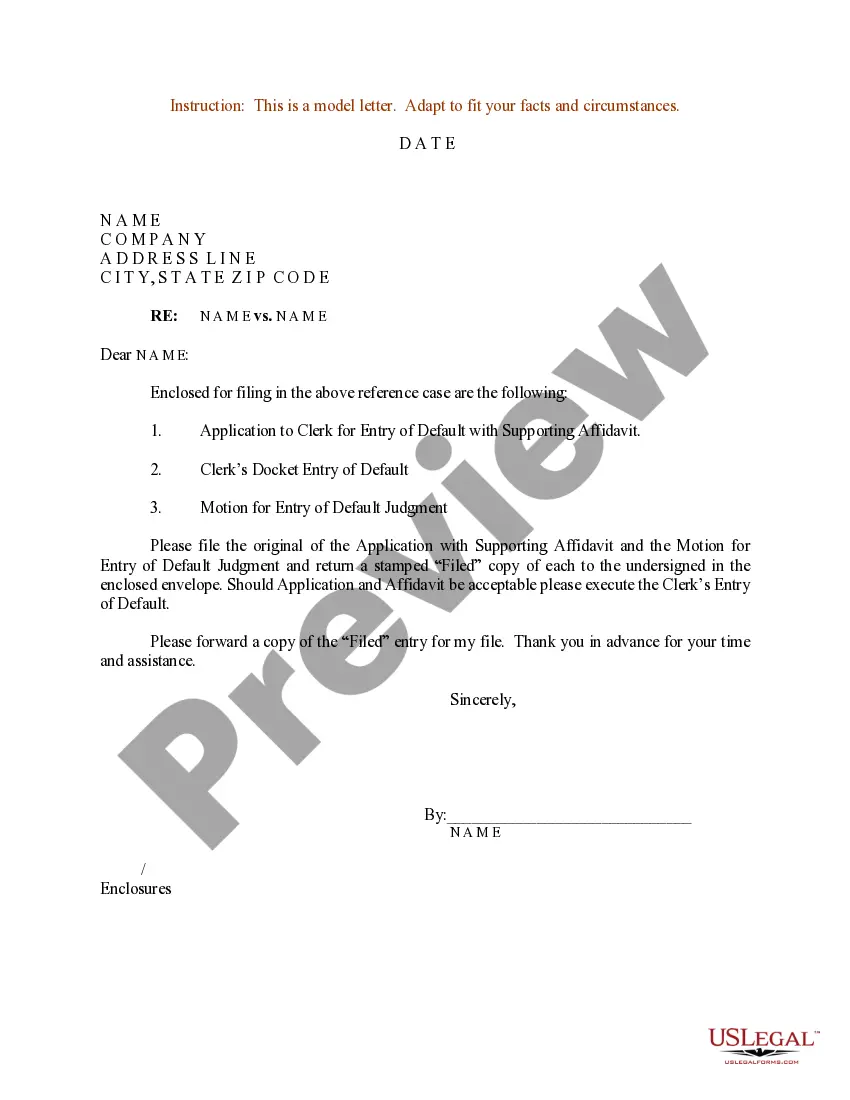
This form is a sample letter in Word format covering the subject matter of the title of the form.
New Jersey Sample Letter for Entrance of Default Judgments
State:
Multi-State
Category:
Control #:
US-0020LTR
Format:
Word;
Rich Text
121 downloads
Description
Free preview

Get your form ready online
Our built-in tools help you complete, sign, share, and store your documents in one place.
Built-in online Word editor
Make edits, fill in missing information, and update formatting in US Legal Forms—just like you would in MS Word.
Export easily
Download a copy, print it, send it by email, or mail it via USPS—whatever works best for your next step.
E-sign your document
Sign and collect signatures with our SignNow integration. Send to multiple recipients, set reminders, and more. Go Premium to unlock E-Sign.
Notarize online 24/7
If this form requires notarization, complete it online through a secure video call—no need to meet a notary in person or wait for an appointment.
Store your document securely
We protect your documents and personal data by following strict security and privacy standards.

Make edits, fill in missing information, and update formatting in US Legal Forms—just like you would in MS Word.

Download a copy, print it, send it by email, or mail it via USPS—whatever works best for your next step.

Sign and collect signatures with our SignNow integration. Send to multiple recipients, set reminders, and more. Go Premium to unlock E-Sign.

If this form requires notarization, complete it online through a secure video call—no need to meet a notary in person or wait for an appointment.

We protect your documents and personal data by following strict security and privacy standards.
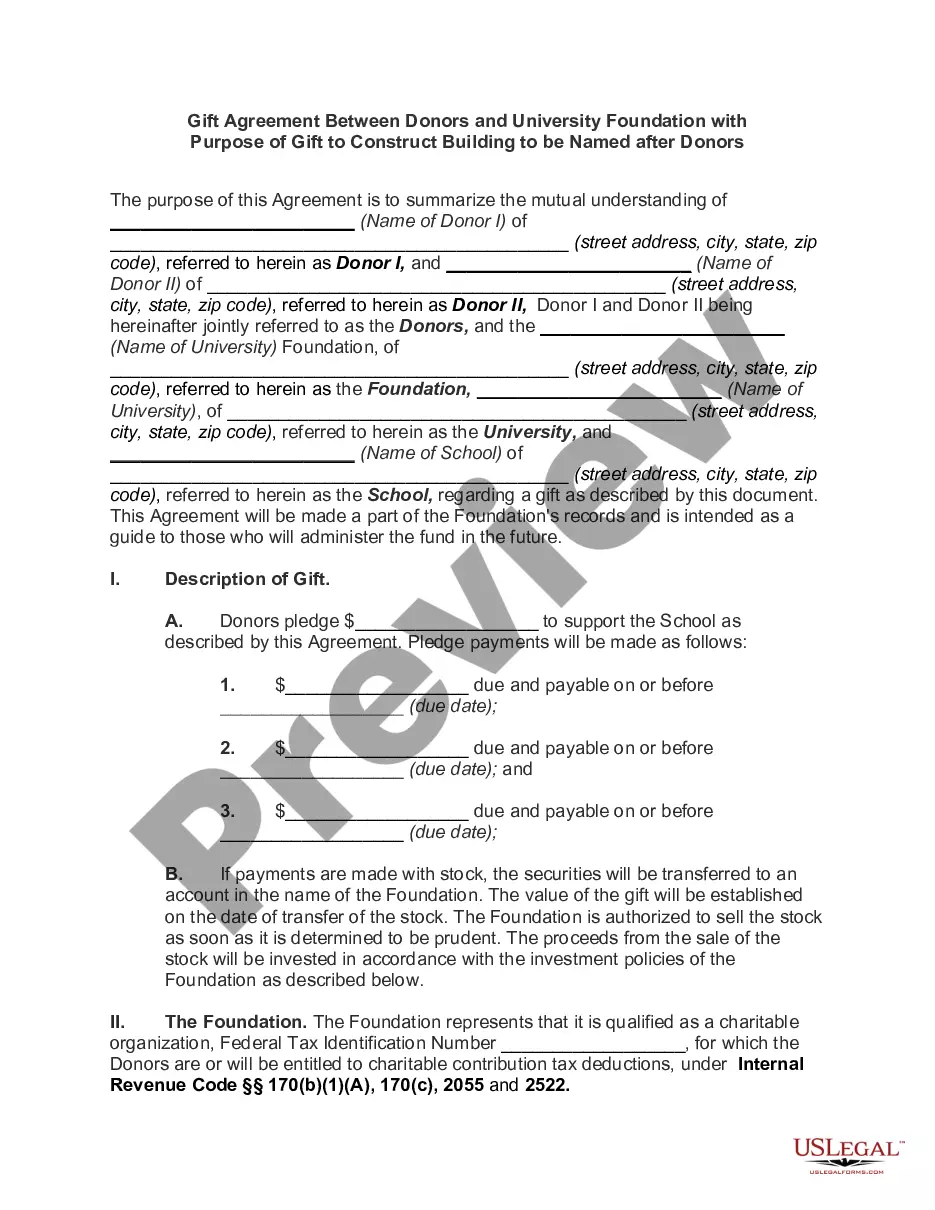
Looking for another form?
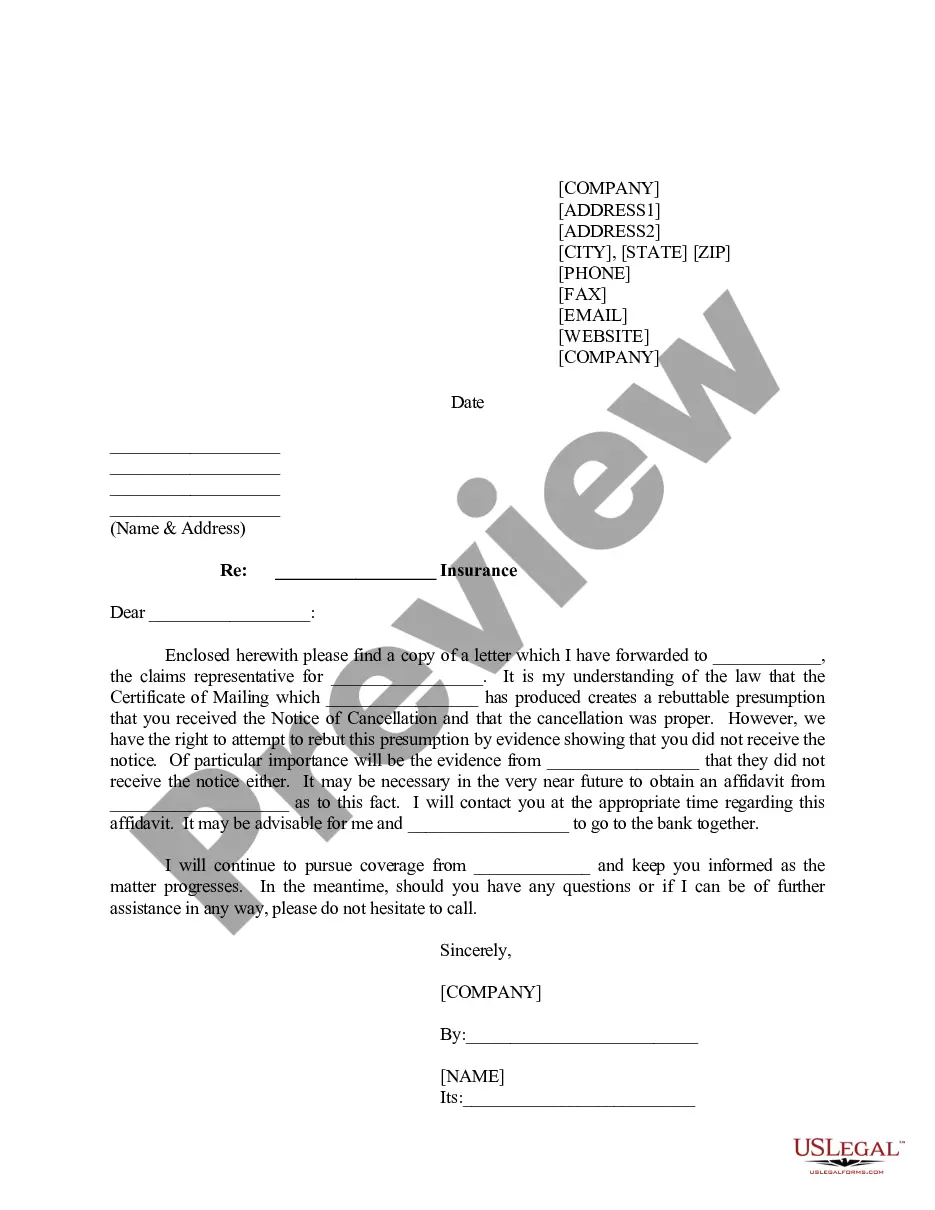
How to fill out Sample Letter For Entrance Of Default Judgments?
If you wish to completely acquire, download, or print authentic document templates, utilize US Legal Forms, the biggest collection of legal forms available online.
Take advantage of the site’s user-friendly and efficient search feature to find the documents you require.
Various templates for business and personal use are organized by categories and states, or keywords.
Step 3. If you are not satisfied with the form, utilize the Search field at the top of the screen to find alternative versions in the legal form format.
Step 4. Once you have identified the form you need, click the Buy now button. Choose the payment plan you prefer and enter your credentials to register for an account.
- Utilize US Legal Forms to obtain the New Jersey Sample Letter for Entrance of Default Judgments in just a few clicks.
- If you are already a US Legal Forms user, Log In to your account and click the Download button to locate the New Jersey Sample Letter for Entrance of Default Judgments.
- You can also access forms you have previously downloaded from the My documents tab in your account.
- If you are using US Legal Forms for the first time, follow the instructions below.
- Step 1. Confirm you have chosen the form for the correct city/state.
- Step 2. Use the Preview option to review the form’s content. Don’t forget to read the description.
Form popularity
FAQ
A default request is the formal document you submit to the court to declare that a defendant has not responded to a lawsuit. An affidavit entry is a sworn statement that supports your request for default, providing evidence of the defendant's inaction. A default judgment is the court's decision in favor of the plaintiff, based on the defendant's failure to respond. Utilizing a New Jersey Sample Letter for Entrance of Default Judgments can help you prepare these documents accurately.
When a case goes into default, it indicates that the defendant has not responded to the lawsuit, allowing the plaintiff to seek a judgment without the defendant's participation. This situation often arises when the defendant neglects their legal obligations. Understanding the implications of a default can help you navigate your case more effectively. A New Jersey Sample Letter for Entrance of Default Judgments can serve as a valuable resource during this process.
To make an application for default judgment, you need to file a motion with the court, along with an affidavit and any supporting documents. This process typically requires you to demonstrate that the defendant has not responded and that you are entitled to a judgment. Following the correct procedures is crucial for a successful application. Using a New Jersey Sample Letter for Entrance of Default Judgments can ensure your application is well-structured and meets legal standards.
An entry of default in New Jersey is an official acknowledgment by the court that a defendant has failed to respond to a lawsuit. This entry allows the plaintiff to proceed with requesting a default judgment, which can result in a favorable outcome without the need for a full trial. It's essential to understand this process to effectively manage your case. A New Jersey Sample Letter for Entrance of Default Judgments can simplify this step for you.
The term 'request to enter default' refers to the action you take to notify the court that a defendant has not answered or defended against your claims. It acts as a mechanism to hold the defendant accountable for their inaction. This request allows you to seek a default judgment, which can help expedite your case. A New Jersey Sample Letter for Entrance of Default Judgments can guide you in drafting this request properly.
A request for entry of default in New Jersey is a formal procedure you initiate when a defendant fails to respond to a lawsuit within the specified time frame. This request signals to the court that the defendant has not engaged with the legal process. By filing this request, you can move forward with your case, potentially leading to a default judgment. For a clear and effective submission, consider utilizing a New Jersey Sample Letter for Entrance of Default Judgments.
Collecting a Judgment You should contact the person who owes you the money, the judgment debtor, to talk about payment. Note: The court cannot guarantee payment. Although the court will try to help you collect the money owed to you, it cannot guarantee the debt will be paid.
To ask the judge to set aside your default judgment, you must file a ?motion? (a formal written request) with the court.
If a defendant does not respond within the 35 days, the court will enter a default. The plaintiff must then apply for the entry of a ?judgment by default? within 6 months from the date that default was entered, or they must file a motion in order to obtain the judgment by default.
Request for Entry of Default (Application to Enter Default) (CIV-100) Asks the court to enter a "default" against the defendant or cross-defendant because they failed to file an Answer or other responsive document in the case.