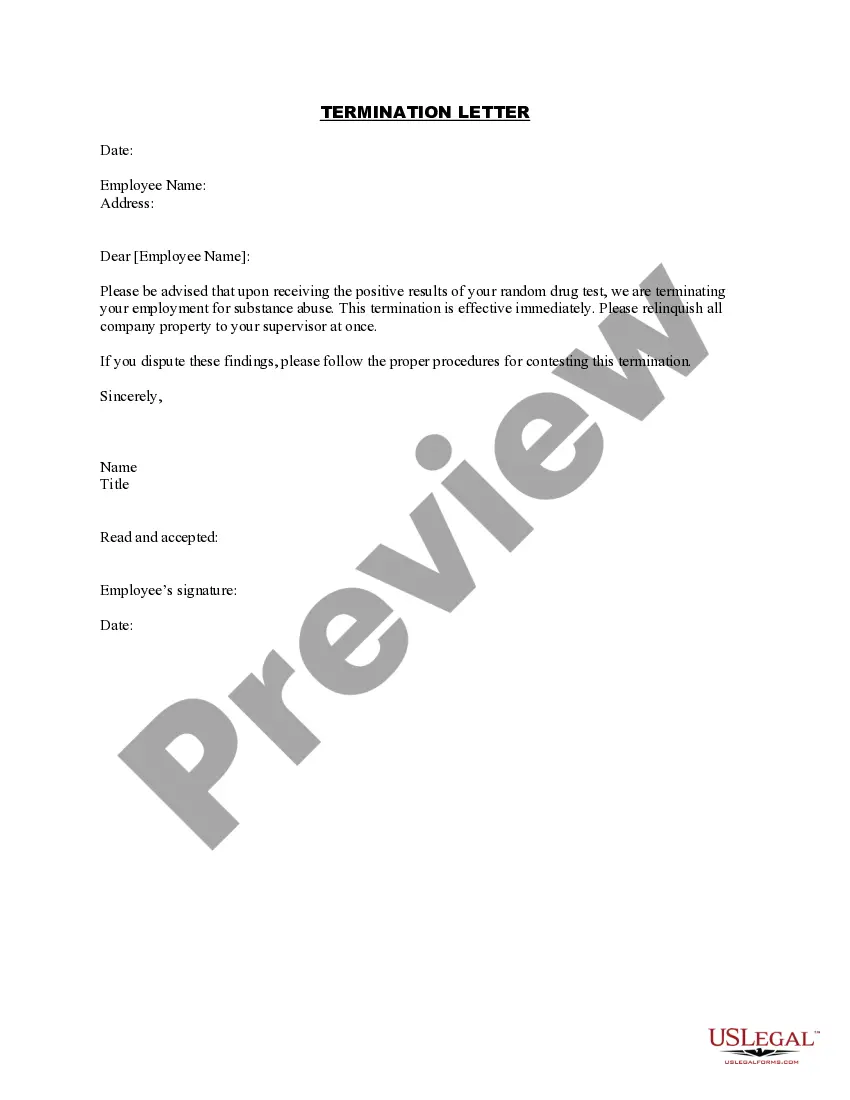
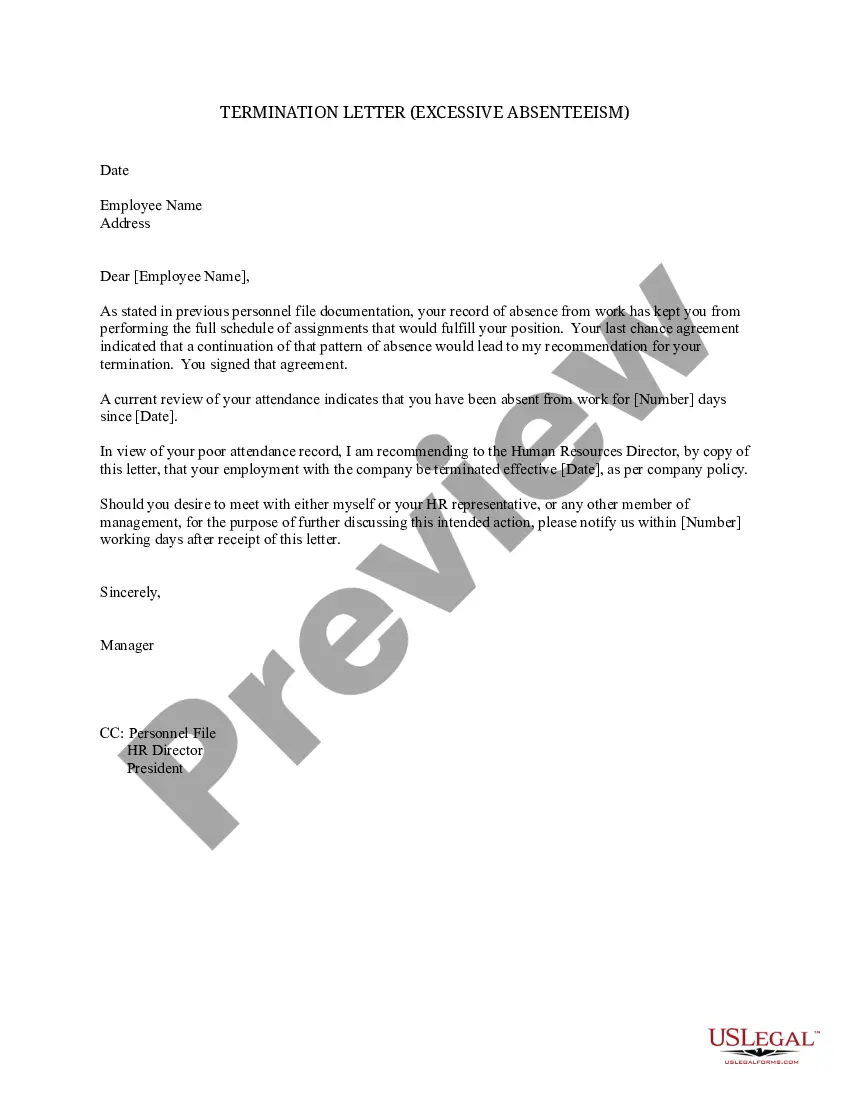
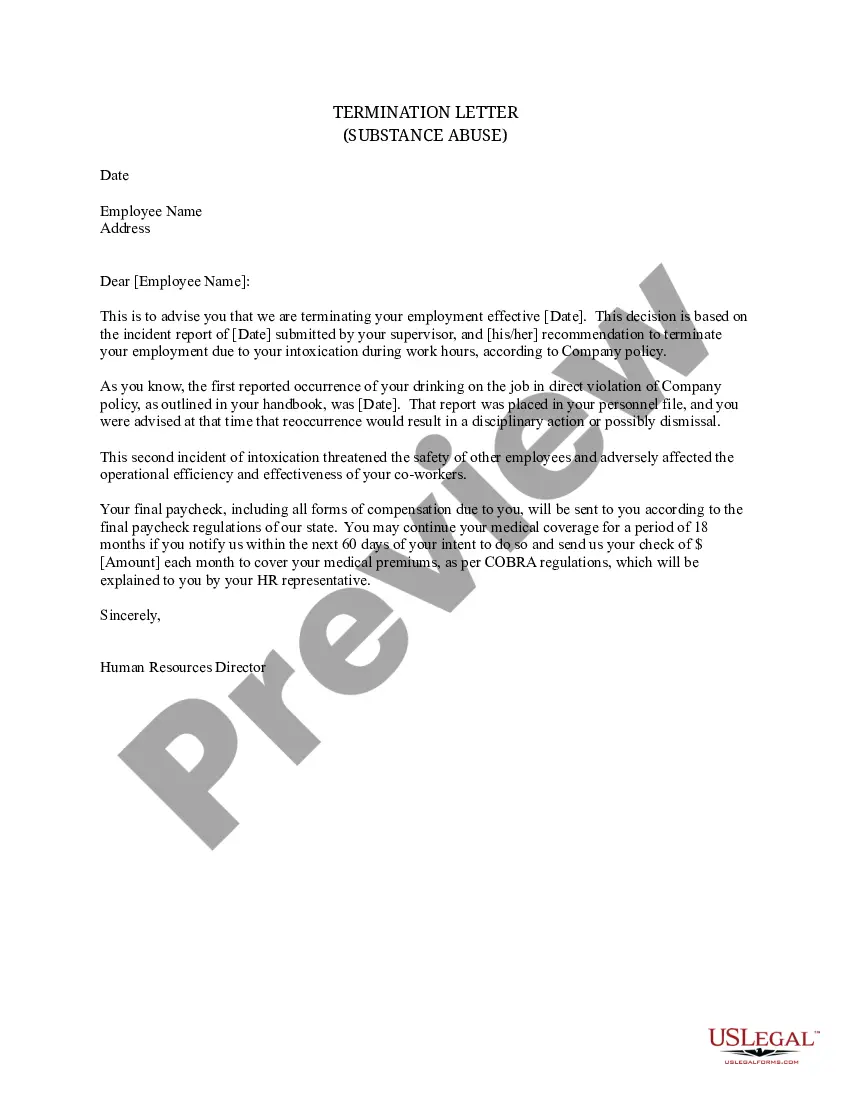
New Hampshire Termination Letter - Substance Abuse
Description
Get your form ready online
Our built-in tools help you complete, sign, share, and store your documents in one place.
Make edits, fill in missing information, and update formatting in US Legal Forms—just like you would in MS Word.
Download a copy, print it, send it by email, or mail it via USPS—whatever works best for your next step.
Sign and collect signatures with our SignNow integration. Send to multiple recipients, set reminders, and more. Go Premium to unlock E-Sign.
If this form requires notarization, complete it online through a secure video call—no need to meet a notary in person or wait for an appointment.
We protect your documents and personal data by following strict security and privacy standards.

Make edits, fill in missing information, and update formatting in US Legal Forms—just like you would in MS Word.

Download a copy, print it, send it by email, or mail it via USPS—whatever works best for your next step.

Sign and collect signatures with our SignNow integration. Send to multiple recipients, set reminders, and more. Go Premium to unlock E-Sign.

If this form requires notarization, complete it online through a secure video call—no need to meet a notary in person or wait for an appointment.

We protect your documents and personal data by following strict security and privacy standards.
Looking for another form?



How to fill out Termination Letter - Substance Abuse?
If you need to finalize, obtain, or print legal document templates, utilize US Legal Forms, the largest collection of legal forms available online.
Take advantage of the website's straightforward and convenient search feature to find the paperwork you require.
Various templates for business and personal purposes are organized by categories and states, or keywords.
Step 4. Once you have found the form you need, click the Buy now button. Choose the payment plan you prefer and enter your information to register for the account.
Step 5. Complete the payment process. You can use your credit card or PayPal account to finalize the transaction.
- Use US Legal Forms to obtain the New Hampshire Termination Letter - Substance Abuse with just a few clicks.
- If you are already a US Legal Forms user, Log In to your account and click the Download button to retrieve the New Hampshire Termination Letter - Substance Abuse.
- You can also access forms you previously downloaded from the My documents tab in your account.
- If you’re using US Legal Forms for the first time, follow the instructions below.
- Step 1. Ensure you have chosen the form for the correct city/state.
- Step 2. Use the Review feature to examine the form’s content. Be sure to read through the description.
- Step 3. If you are not satisfied with the form, utilize the Search area at the top of the screen to discover other versions of the legal form template.
Form popularity
FAQ
All employers must give their employees written Notice to Employee as to Change in Relationship form upon termination. If it is a promotion or demotion, change in location, change in work assignment, voluntary quit, or work stopped due to a trade dispute, the form is not required.
You're allowed to ask about current illegal drug use. But asking might not be useful: few, if any, people would say yes. You'll get a clearer answer from a legal drug test.
Employers should make sure they have documentation to support any decision to terminate. With that in mind, supervisors should be trained to document issues with employees as they arise. Not all documentation needs to be formal; if it's an isolated minor incident, an email may be enough.
Like many, New Hampshire is an at-will employment state, which means no reason or formal notice needs to be given to fire someone, and conversely no employee is required to provide reason or notice to the employer.
An employer can ask an applicant about drinking habits so long as the questions do not request information about alcoholism, a protected ADA disability. For example, an employer can ask if the applicant drinks alcohol, or whether the applicant has ever been arrested for driving under the influence.
Asking About Legal Drug Use The EEOC memo says that you can't ask employees about prior or present legal drug use, unless the question is innocuous and won't bring out information about a disability.
Response: During the interview, asking candidates whether they are taking prescription drugs or have a history of using unlawful drugs would be prohibited under state and federal disability discrimination statutes.
In other words, an employer cannot fire a worker based on the worker's race, religion, age, disability, national origin, color, sex, gender, or any other protected class.
Addiction is considered to be a disability and, as such, an employee cannot be fired for being addicted to substances such as drugs or alcohol. In fact, employers are required to accommodate employees who suffer from addiction to the point of undue hardship.
Prior to making an offer, an employer may ask an applicant whether he or she is currently using, or has in the past used, illegal drugs or alcohol as long as the questions are not likely to elicit information about past drug addiction, which is a disability under the Americans with Disabilities Act (ADA).