Nebraska Construction or Mechanics Lien Package - Corporation or LLC

Understanding this form package
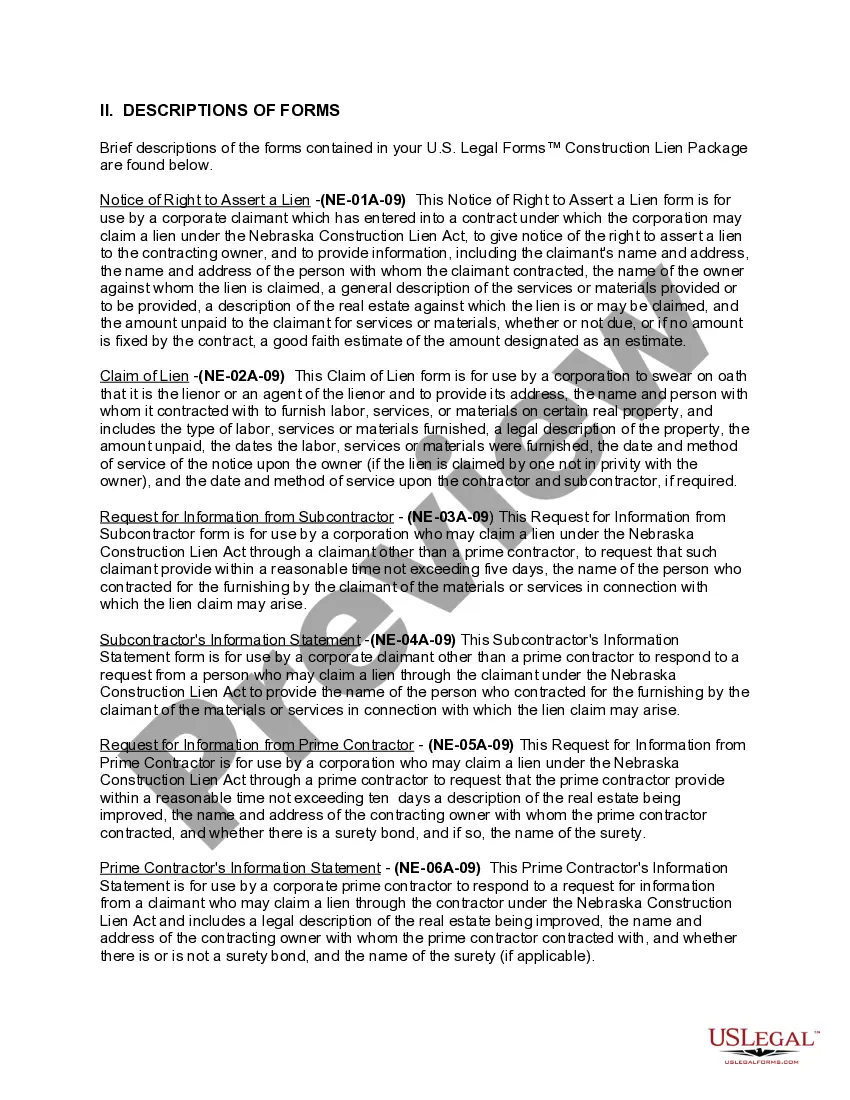
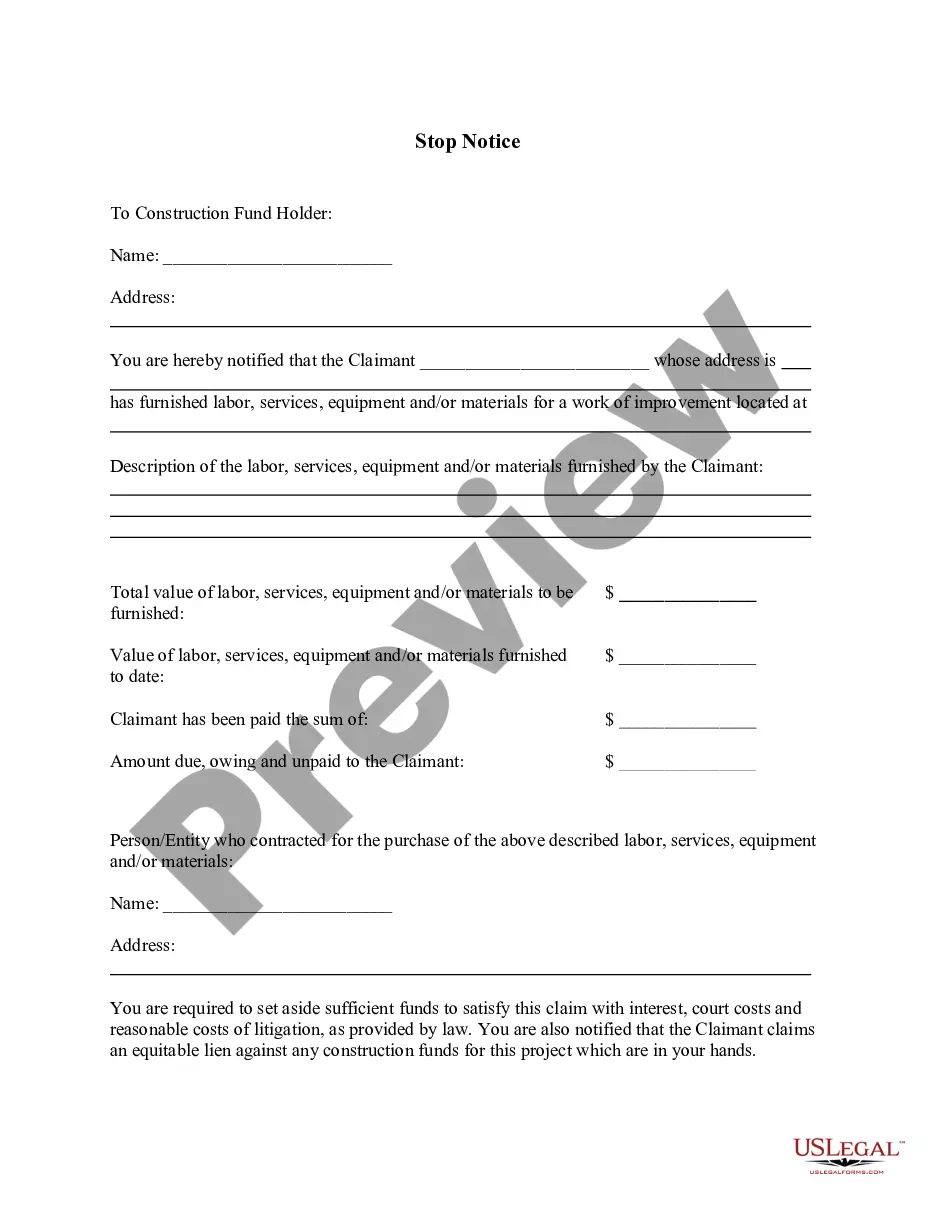
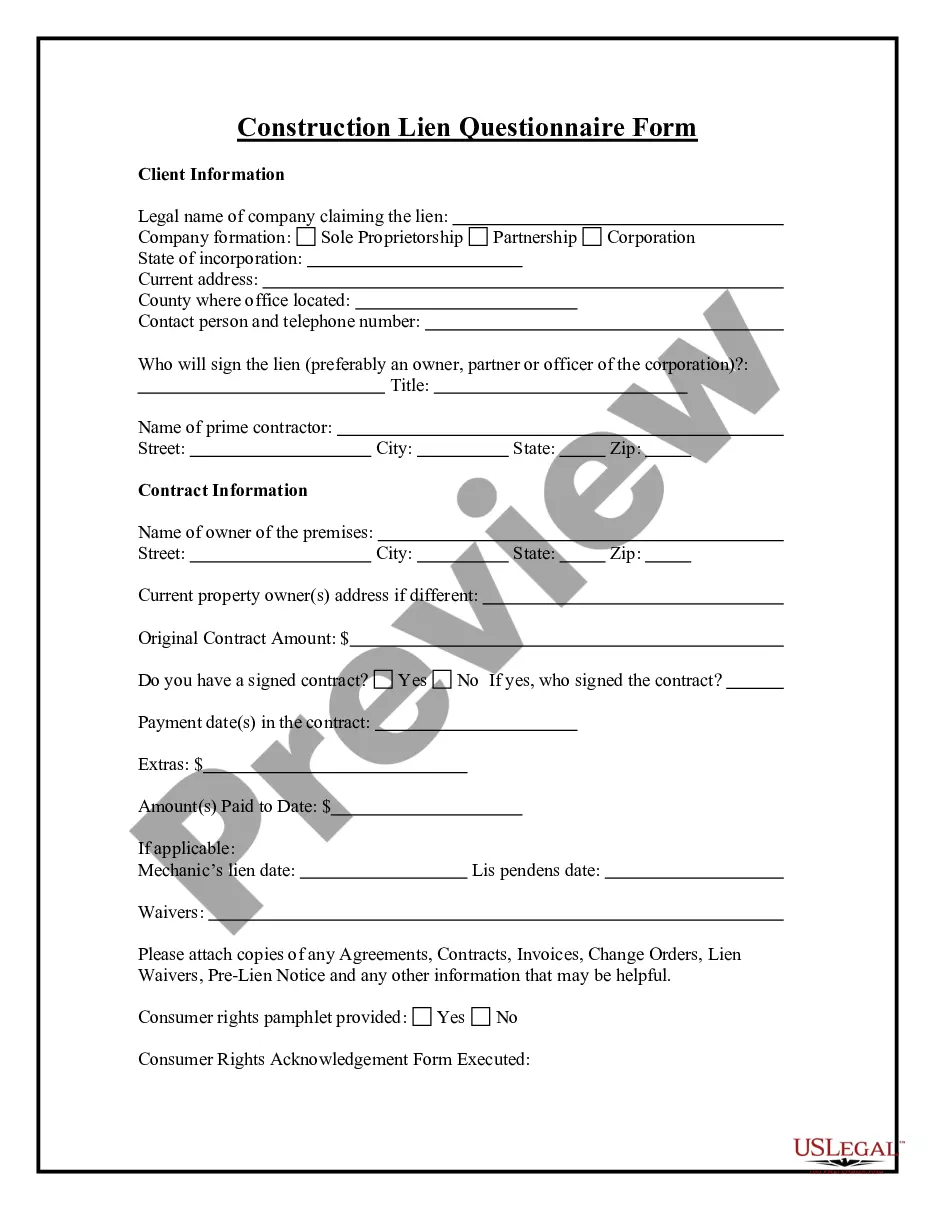
The Nebraska Construction or Mechanics Lien Package - Corporation or LLC is designed for corporations and limited liability companies that provide labor, materials, or services to improve real estate. This package helps these entities recover unpaid amounts through a lien on the improved property. Unlike other packages, it specifically addresses the needs of corporate entities in the construction sector and includes vital information, form lists, and procedural guidance tailored to Nebraska law.
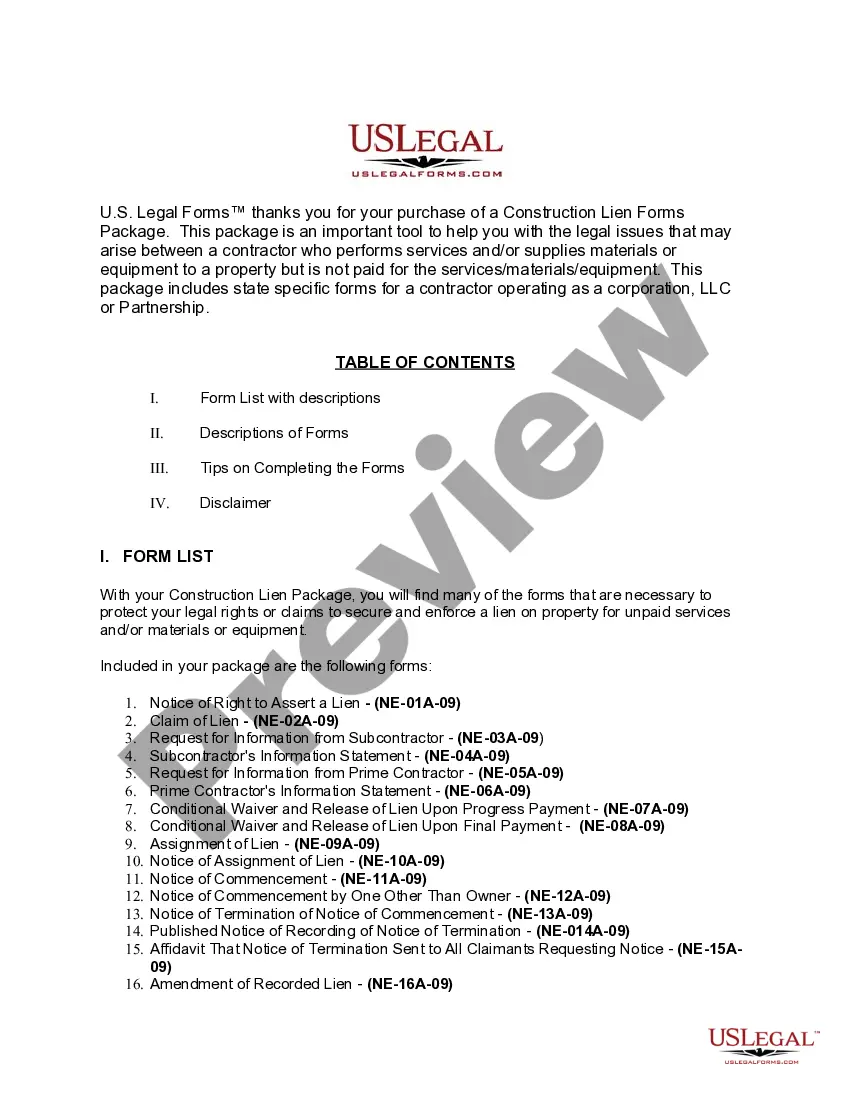
Forms included in this package
- Notice of Right to Assert a Lien - Corporation
- Claim of Lien - Corporation
- Request for Information from Subcontractor - Corporation
- Subcontractor's Information Statement - Corporation
- Request for Information from Prime Contractor - Corporation
- Prime Contractor's Information Statement - Corporation
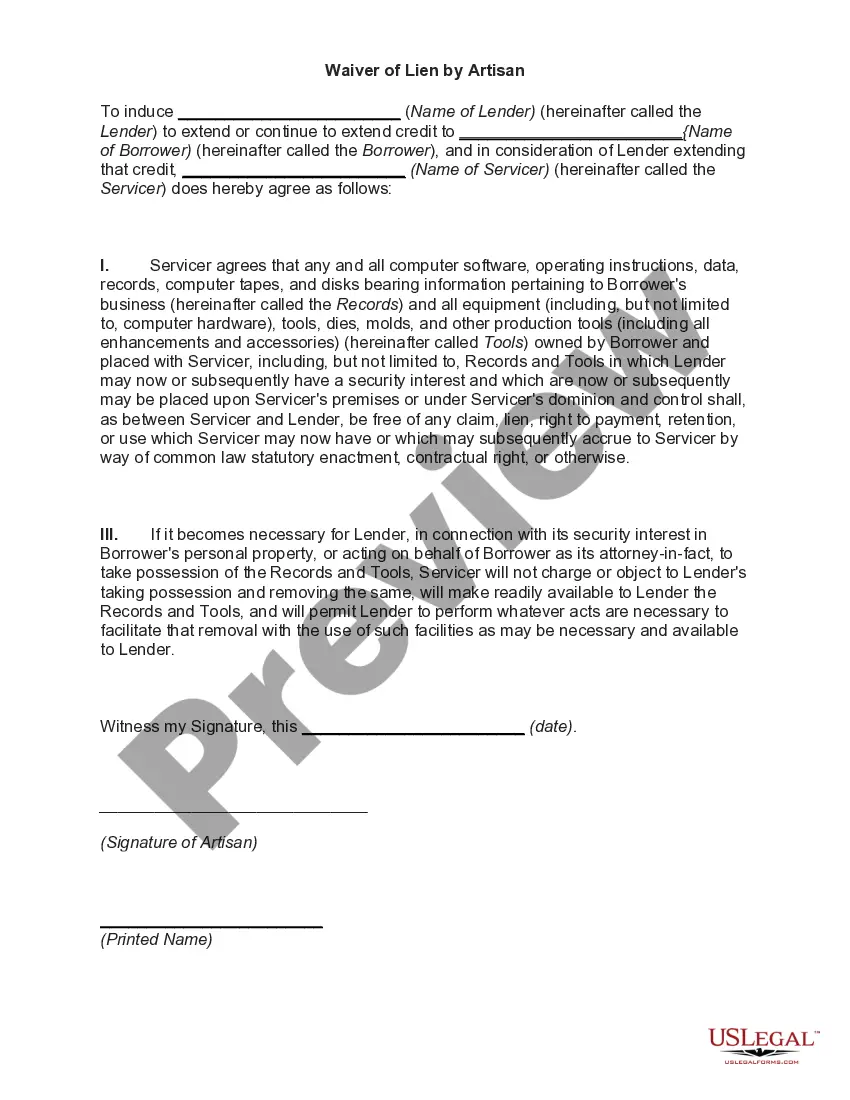
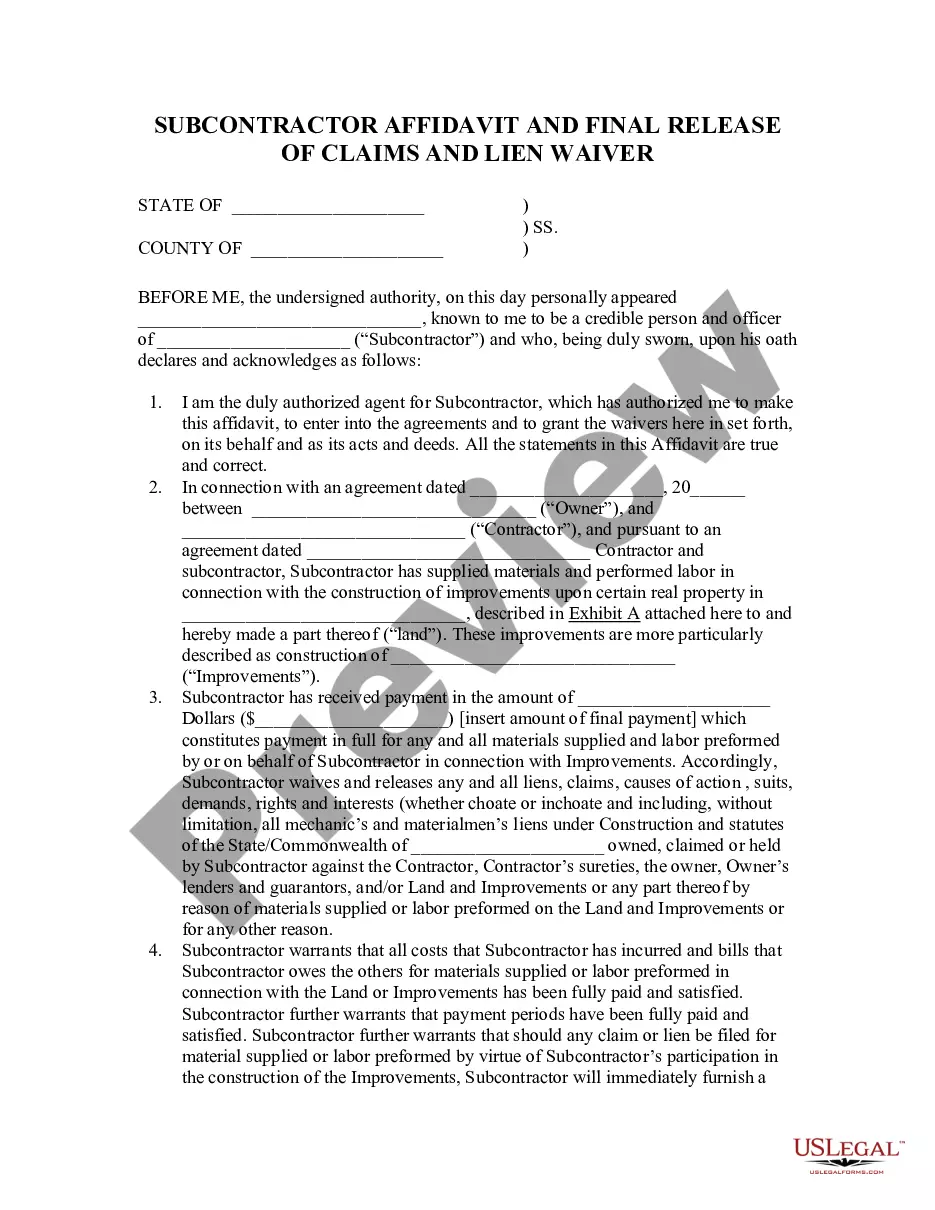
- Unconditional Waiver and Release of Lien Upon Progress Payment
- Unconditional Waiver and Release of Lien Upon Final Payment
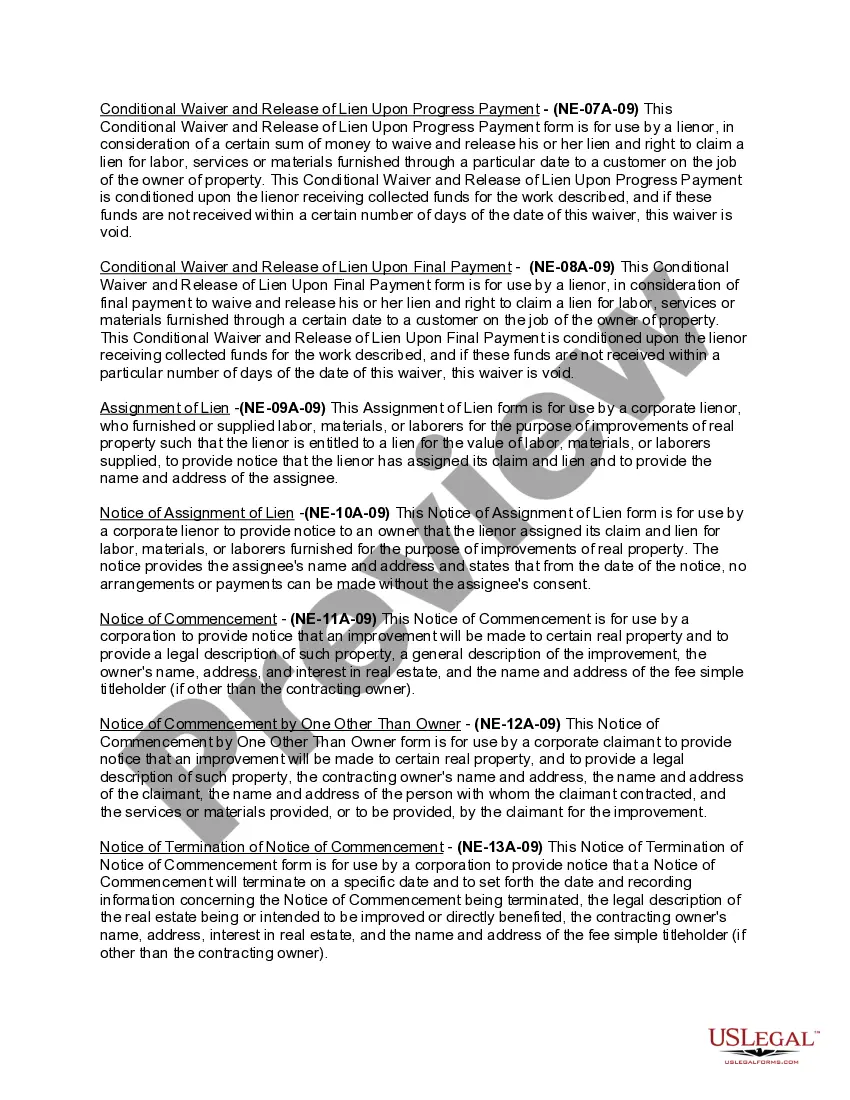
- Assignment of Lien - Corporation
- Notice of Assignment of Lien - Corporation
- Notice of Commencement - Corporation
- Notice of Commencement by One Other Than Owner - Corporation
- Notice of Termination of Notice of Commencement - Corporation
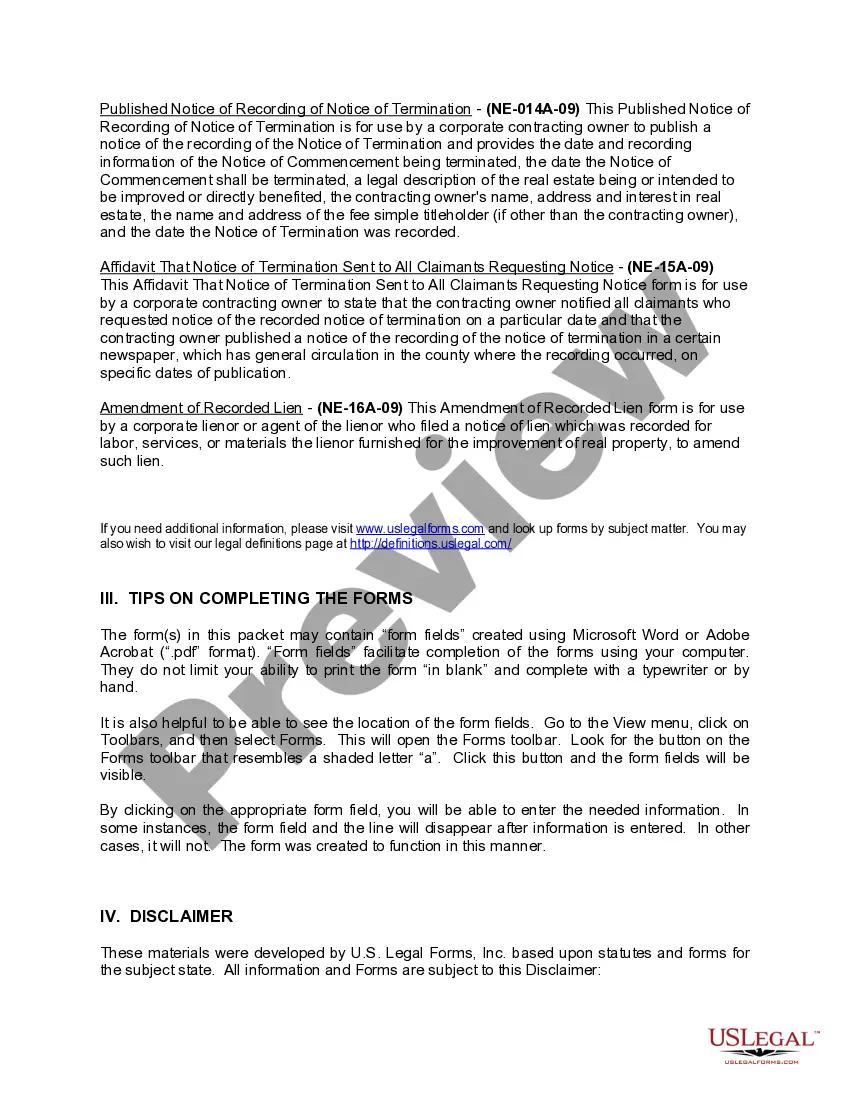
- Published Notice of Recording of Notice of Termination - Corporation or LLC
- Affidavit That Notice of Termination Sent to All Claimants Requesting Notice - Corporation
- Amendment of Recorded Lien - Corporation

When to use this document
This form package is essential in situations such as:
- When a corporation or LLC has provided construction services or materials and has not been compensated.
- When a corporate contractor needs to assert a lien on property to secure payment for labor or materials provided.
- When seeking legal recourse for outstanding invoices related to property improvement projects.
Who needs this form package
- Corporations and limited liability companies engaged in providing construction services or materials in Nebraska.
- Contractors or subcontractors looking to enforce a lien for unpaid services.
- Businesses seeking to understand and leverage their rights under the Nebraska Construction Lien Act.
Completing these forms step by step
- Review the included forms and the information about the lien procedure.
- Identify the parties involved, including contractors, subcontractors, and the property owner.
- Complete the necessary forms by filling in the required details, including dates and signatures.
- Ensure that all forms are correctly executed and comply with Nebraska's requirements.
- File the forms as required by Nebraska law and keep copies for your records.
Notarization requirements for forms in this package
Forms in this package usually don’t need notarization, but certain jurisdictions or signing circumstances may require it. US Legal Forms provides a secure online notarization option powered by Notarize, accessible 24/7 from anywhere.
Get your form ready online
Our built-in tools help you complete, sign, share, and store your documents in one place.
Make edits, fill in missing information, and update formatting in US Legal Forms—just like you would in MS Word.
Download a copy, print it, send it by email, or mail it via USPS—whatever works best for your next step.
Sign and collect signatures with our SignNow integration. Send to multiple recipients, set reminders, and more. Go Premium to unlock E-Sign.
If this form requires notarization, complete it online through a secure video call—no need to meet a notary in person or wait for an appointment.
We protect your documents and personal data by following strict security and privacy standards.

Make edits, fill in missing information, and update formatting in US Legal Forms—just like you would in MS Word.

Download a copy, print it, send it by email, or mail it via USPS—whatever works best for your next step.

Sign and collect signatures with our SignNow integration. Send to multiple recipients, set reminders, and more. Go Premium to unlock E-Sign.

If this form requires notarization, complete it online through a secure video call—no need to meet a notary in person or wait for an appointment.

We protect your documents and personal data by following strict security and privacy standards.
Mistakes to watch out for
- Failing to accurately describe the services or materials provided in the Claim of Lien.
- Not following proper service requirements for notifying parties involved.
- Neglecting to keep copies of all submitted forms and correspondence.
Benefits of using this package online
- Access forms anytime, anywhere, providing convenience for busy professionals.
- Edit forms easily using computer applications, making it user-friendly.
- Ensure compliance with legal standards, reducing the risk of errors and omissions.
Looking for another form?
Form popularity
FAQ
Step 1: Prepare the lien form. Fill out the information on the lien form. Step 2: Record your lien. Step 3: Serve a copy of the mechanics lien.
While they don't require lien filings to be notarized, they do require a lien filer to jump through various other hoops that, if not done properly, might cause your filing to be rejected or invalidated: Delaware.
How Liens Work. A lien provides a creditor with the legal right to seize and sell the collateral property or asset of a borrower who fails to meet the obligations of a loan or contract. The property that is the subject of a lien cannot be sold by the owner without the consent of the lien holder.
Even though these states may permit project participants to secure lien rights and claim a mechanics lien even without a written contract, it is generally best practice to have a signed written contract for work provided.
When your efforts to collect a bill from a business that owes you money have been unsuccessful, you can place a lien on the assets of the business. As a lienholder, you gain legal rights to the company's property and the authority to sell the property and use the proceeds to repay what is owed to you.
Avoid harassing the people that owe you money. Keep phone calls short. Write letters. Get a collection agency to write demand letters. Offer to settle for less than is due. Hire a collection agency. Small claims court. File a lawsuit.
If you borrow money to buy a house or a car, the lender gets a lien on the house or the car.The lien secures the loan, so that if you don't pay, the lender can take the property. The property you pledge to secure a loan is called collateral.
The people who can file mechanic's liens are identified by state law. A subcontractor or supplier to a subcontractor may not be able to file a lien. Also, unlicensed contractors are often barred from filing a mechanic's lien.
Filing a Court Claim Before you can place a lien on business property, you must first have a court order a judgment directing the debtor to pay what is owed. After filing a claim with the court and submitting proof of the amounts owed to you, the business must answer and explain why the debt is not owed.