North Carolina Estoppel Affidavit
Understanding this form
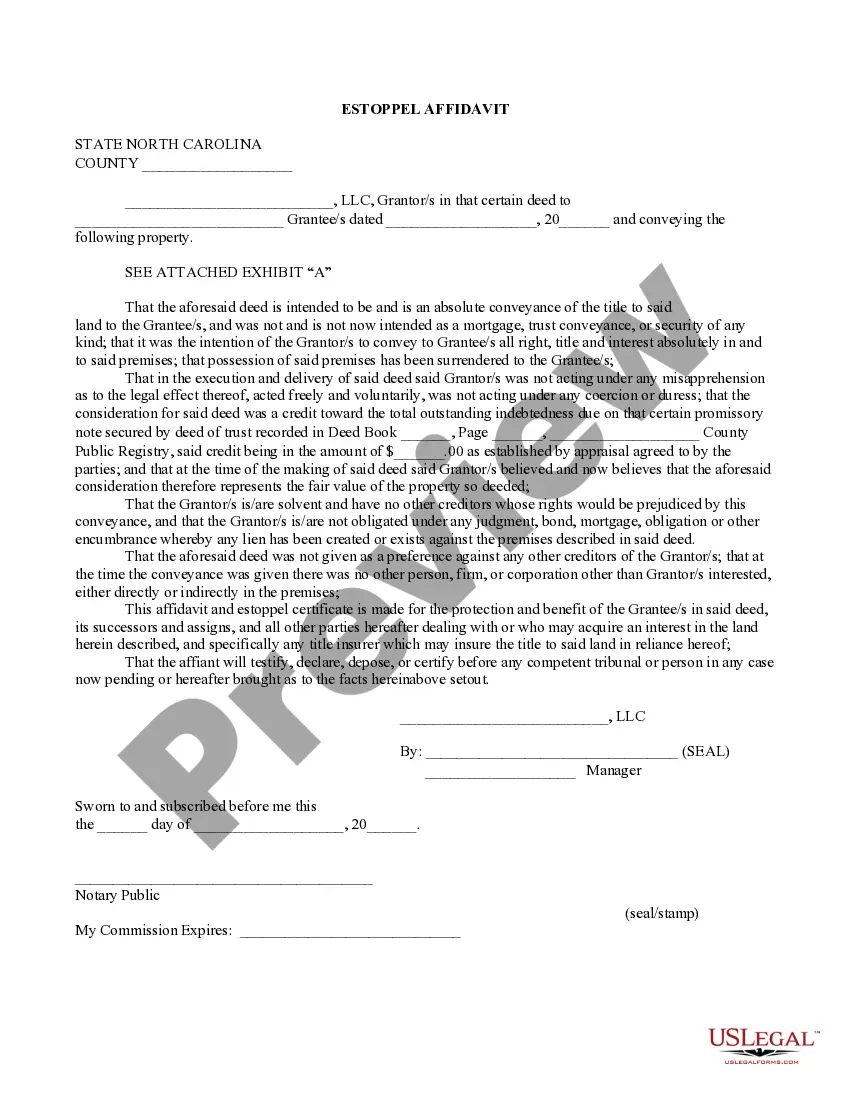
The Estoppel Affidavit is a legal document used primarily to affirm the terms of a property deed. It serves to protect the interests of the grantee (the buyer) and ensures that all parties involved understand the conveyance of title. Unlike other affidavits, this specific form addresses issues related to potential mortgages, liens, or other encumbrances that may affect the property. It is essential for clarifying that the property is being transferred outright without any obligations to existing creditors.
Key parts of this document
- The names and roles of the grantor(s) and grantee(s).
- A detailed description of the property being conveyed, typically found in an attached exhibit.
- Assertions by the grantor regarding the absolute nature of the conveyance.
- Confirmation that the grantor is not under any duress and is financially solvent.
- A statement ensuring the deed is not preferential to any existing creditors.
- Signatures and notarization details confirming the documentâs validity.

When this form is needed
This form is typically used when a property owner conveys the title of their property to a new owner or buyer. It is essential in situations where the property may have pending debts or liens. By providing this affidavit, the grantor asserts that the property is free of encumbrances, which helps the new owner obtain clear title and is often required by title insurance companies during property transactions.
Who needs this form
- Property owners transferring their property to a new owner.
- Purchasers of real estate seeking to ensure clear title and protect their investment.
- Real estate professionals assisting clients in property transactions.
- Title insurance companies needing confirmation of the title condition.
How to prepare this document
- Identify the parties involved: the grantor(s) and grantee(s).
- Specify the property being conveyed, referring to the attached Exhibit A.
- Enter the date of the deed and the amount of consideration provided.
- Fill in the details about the grantor's financial status and any other creditors.
- Ensure all parties sign the form in the presence of a notary.
Does this form need to be notarized?
Yes, this form must be notarized to be legally valid. Notarization verifies the identities of the signatories and ensures that the document is executed properly. US Legal Forms offers integrated online notarization services that are secure, available twenty-four hours a day, and legally equivalent to traditional methods.
Get your form ready online
Our built-in tools help you complete, sign, share, and store your documents in one place.
Make edits, fill in missing information, and update formatting in US Legal Forms—just like you would in MS Word.
Download a copy, print it, send it by email, or mail it via USPS—whatever works best for your next step.
Sign and collect signatures with our SignNow integration. Send to multiple recipients, set reminders, and more. Go Premium to unlock E-Sign.
If this form requires notarization, complete it online through a secure video call—no need to meet a notary in person or wait for an appointment.
We protect your documents and personal data by following strict security and privacy standards.

Make edits, fill in missing information, and update formatting in US Legal Forms—just like you would in MS Word.

Download a copy, print it, send it by email, or mail it via USPS—whatever works best for your next step.

Sign and collect signatures with our SignNow integration. Send to multiple recipients, set reminders, and more. Go Premium to unlock E-Sign.

If this form requires notarization, complete it online through a secure video call—no need to meet a notary in person or wait for an appointment.

We protect your documents and personal data by following strict security and privacy standards.
Common mistakes
- Failing to include all necessary identifying information for the property.
- Not accurately reflecting the financial status of the grantor.
- Omitting signatures or the notaryâs seal.
- Incorrectly asserting that there are no creditors when there are.
Advantages of online completion
- Convenience of completing the document at your own pace.
- Editable templates allow for customization based on individual circumstances.
- Access to forms drafted by licensed attorneys for legal reliability.
Looking for another form?


Form popularity
FAQ
What is an estoppel certificate? An estoppel certificate establishes the current status of the lease terms for a third party. Generally, the certificate requests that the Tenant verify that the rent is current or whether the Tenant has any potential claims against the Landlord.
Understanding Promissory Estoppel The doctrine prevents the promisor or enterprise from going back on their word or promise. For example, a vendor makes an oral promise to the customer to replace the goods if they do not fit the customer size requirements. The customer purchases the clothes and takes them home.
Types of estoppel include collateral estoppel, equitable estoppel, and promissory estoppel. Estoppel certificates are commonly used in real estate and must be signed by tenants when the landlord is trying to conduct a transaction with the property.
An estoppel certificate establishes the current status of the lease terms for a third party. Generally, the certificate requests that the Tenant verify that the rent is current or whether the Tenant has any potential claims against the Landlord.
Estoppel is an equitable doctrine, a bar that prevents one from asserting a claim or right that contradicts what one has said or done before, or what has been legally established as true. Estoppel may be used as a bar to the re-litigation of issues or as an affirmative defense.
For instance, if a landlord agrees not to terminate a tenant's lease as long as the tenant spends money on improving the property, an estoppel certificate could prevent the landlord from going back on their word and terminating the lease, even when the promise may not have been written into a contract.