Minnesota Sample Provisions for Inclusion in Custody Agreements
What is this form?
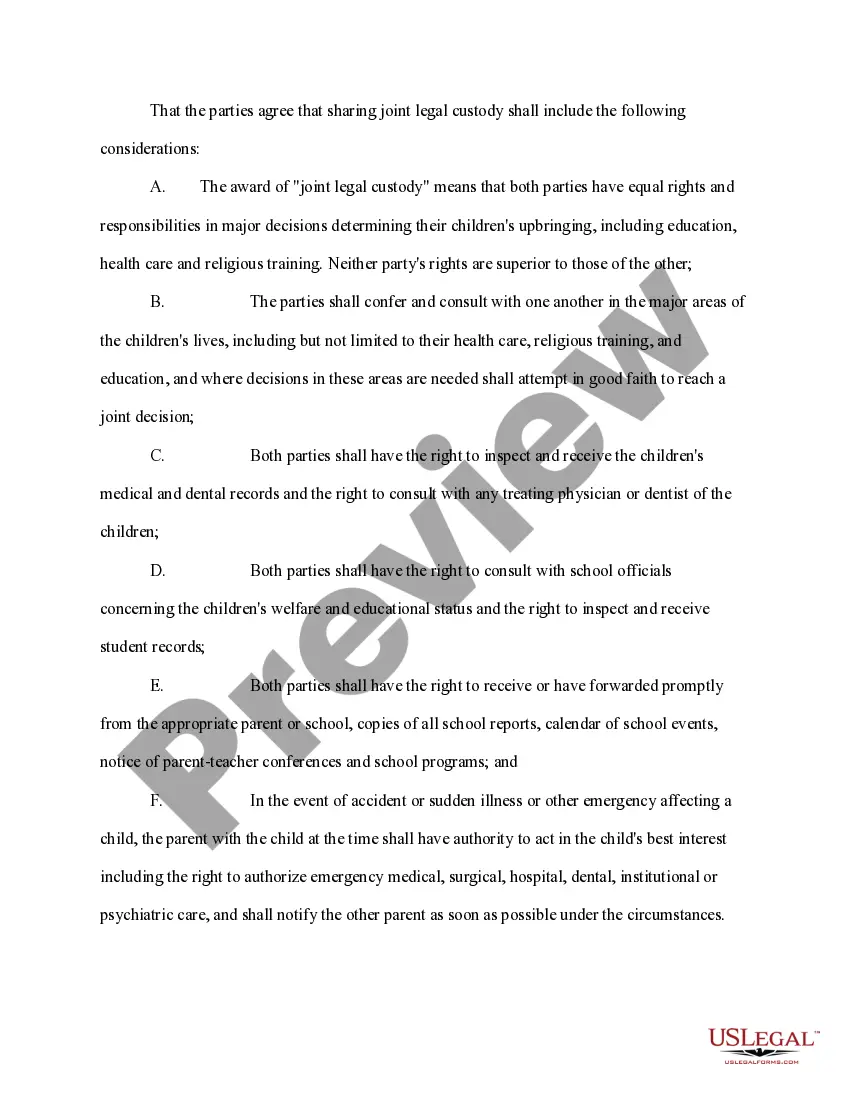
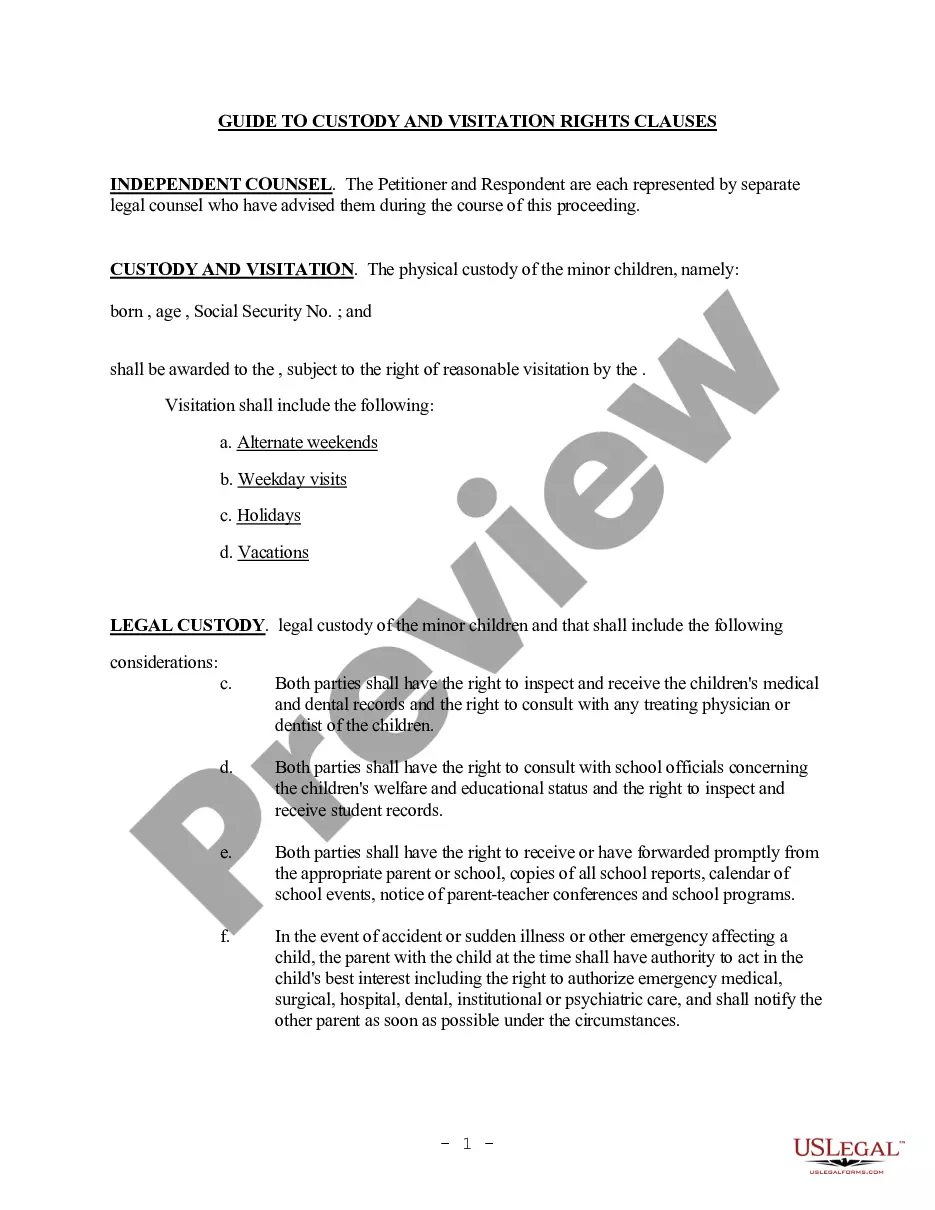
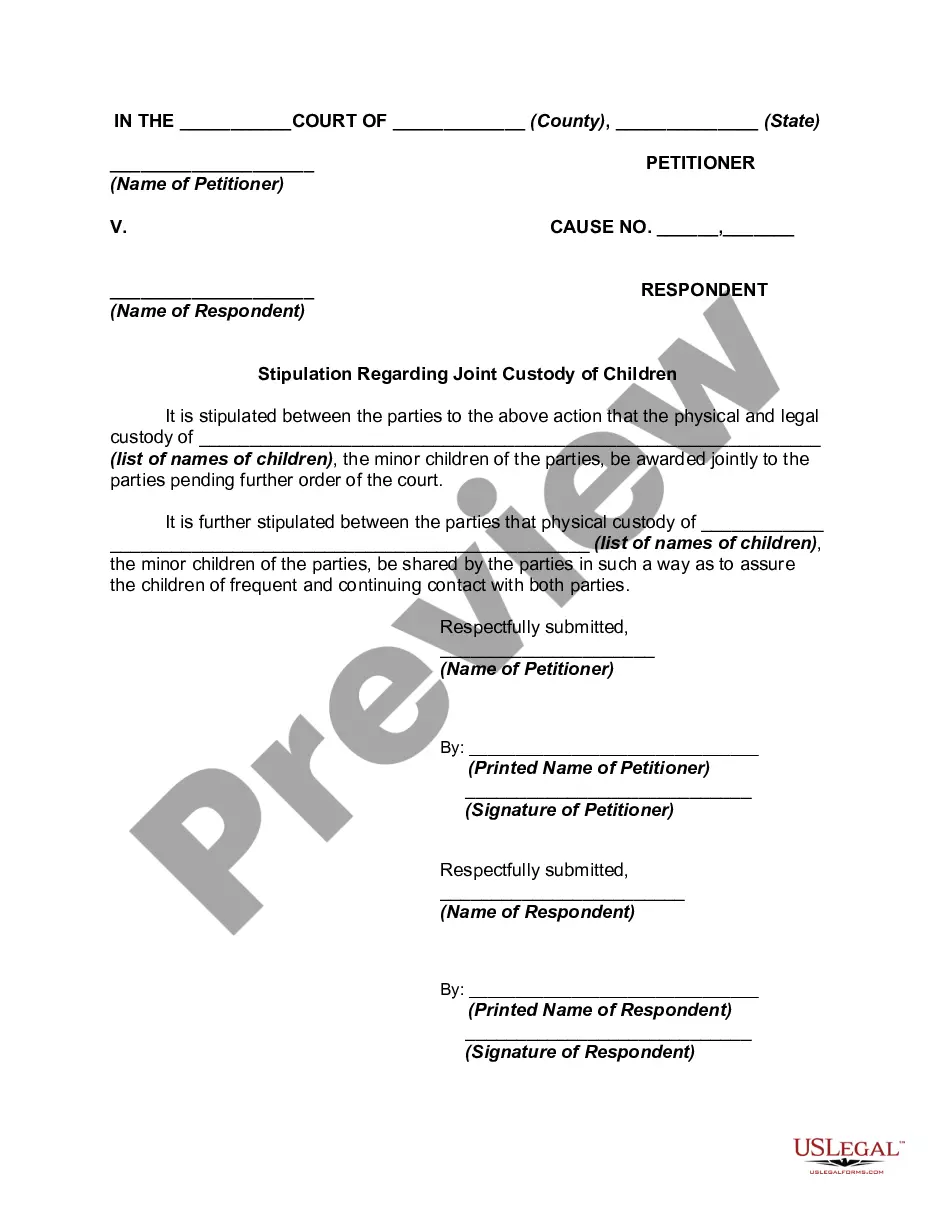
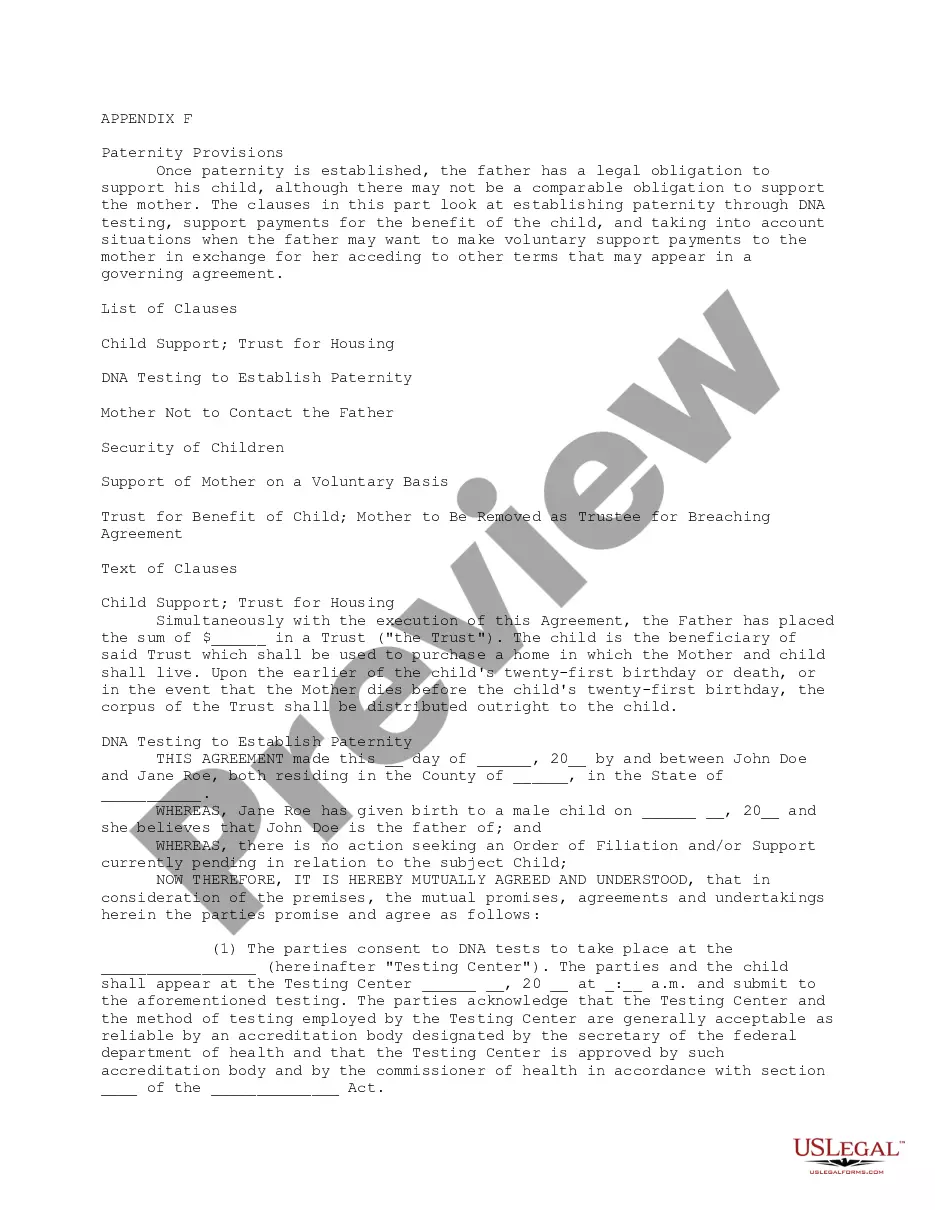
The Sample Provisions for Inclusion in Custody Agreements is a legal document that outlines an agreement for joint legal custody of minor children. This form serves to establish the equal rights and responsibilities of both parents in important decisions regarding their children's upbringing, including health care, education, and religious training. It sets forth the framework for parental collaboration and decision-making, distinguishing it from other custody forms that may not address these elements comprehensively.
Key components of this form
- Joint legal custody agreement defining equal rights and responsibilities.
- Provisions for mutual consultation on major decisions affecting children.
- Rights to access and receive children's medical and educational records.
- Emergency decision-making authority for the parent with the child at that moment.
- Notification procedures in case of emergencies affecting a child.
When this form is needed
This form is useful in situations where parents are separated or divorced and wish to share joint legal custody of their children. It ensures that both parents have a clear understanding of their rights and responsibilities regarding important decisions in their children's lives. This form should be used when parents want to facilitate cooperative co-parenting and reduce potential conflicts over educational, health, and religious decisions.
Who this form is for
- Parents or guardians seeking to establish joint legal custody of their minor children.
- Separated or divorced parents aiming for a structured parenting agreement.
- Parents wanting to outline specific responsibilities and rights concerning their children's upbringing.
Instructions for completing this form
- Identify and list both parents' full names and contact information.
- Clearly outline the terms of joint legal custody and decision-making responsibilities.
- Specify how parents will communicate regarding their children's health care and education.
- Include an emergency decision-making clause for immediate health concerns.
- Ensure both parties review and sign the agreement, indicating mutual consent.
Notarization guidance
This form does not typically require notarization to be legally valid. However, some jurisdictions or document types may still require it. US Legal Forms provides secure online notarization powered by Notarize, available 24/7 for added convenience.
Get your form ready online
Our built-in tools help you complete, sign, share, and store your documents in one place.
Make edits, fill in missing information, and update formatting in US Legal Forms—just like you would in MS Word.
Download a copy, print it, send it by email, or mail it via USPS—whatever works best for your next step.
Sign and collect signatures with our SignNow integration. Send to multiple recipients, set reminders, and more. Go Premium to unlock E-Sign.
If this form requires notarization, complete it online through a secure video call—no need to meet a notary in person or wait for an appointment.
We protect your documents and personal data by following strict security and privacy standards.

Make edits, fill in missing information, and update formatting in US Legal Forms—just like you would in MS Word.

Download a copy, print it, send it by email, or mail it via USPS—whatever works best for your next step.

Sign and collect signatures with our SignNow integration. Send to multiple recipients, set reminders, and more. Go Premium to unlock E-Sign.

If this form requires notarization, complete it online through a secure video call—no need to meet a notary in person or wait for an appointment.

We protect your documents and personal data by following strict security and privacy standards.
Mistakes to watch out for
- Not clearly defining both parents' rights and responsibilities.
- Omitting key areas of decision-making such as health care and education.
- Failing to include procedures for communicating about emergencies.
- Not having the form reviewed by an attorney for legal compliance.
Benefits of using this form online
- Convenience of downloading and filling out the form from home.
- Editability allows parents to customize the agreement to their needs.
- Access to attorney-drafted forms for reliability and legal validity.
Looking for another form?

Form popularity
FAQ
In Minnesota, there is no specific age at which a child can unilaterally refuse to see a parent. However, as children grow older, their preferences may be taken into account by the court, particularly around the age of 14. It's crucial to document any concerns regarding the child's well-being and to refer to Minnesota Sample Provisions for Inclusion in Custody Agreements for guidance on how to approach custody arrangements. Always prioritize open communication to understand the child's feelings and desires.
To prove parental manipulation in court, you need to gather evidence that shows the other parent is influencing your child's feelings or decisions about you. This can include documented communications, witness statements, or instances where your child expresses confusion about their relationship with you. Utilizing Minnesota Sample Provisions for Inclusion in Custody Agreements can help outline specific clauses that protect against such manipulation. It's important to present a clear and compelling case that focuses on the child's best interests.
To prove that the other parent is manipulative, you need to gather evidence of their behavior, such as text messages, emails, or witness testimonies. Documentation showing a pattern of manipulation can strengthen your case. When drafting custody agreements, incorporating Minnesota Sample Provisions for Inclusion in Custody Agreements can help establish clear boundaries and expectations. Our platform provides templates that assist you in outlining these provisions effectively.
In Minnesota, there is no specific age when a child can officially decide which parent to live with, but children aged 14 and older can express their preferences to the court. The court will consider the child's wishes, along with other factors, when determining custody arrangements. It's important to include Minnesota Sample Provisions for Inclusion in Custody Agreements to clearly outline how these preferences will be managed. By using our platform, you can create agreements that reflect these considerations.
During a custody battle, avoid making negative comments about the other parent or engaging in personal attacks. Stay focused on your child’s needs and avoid discussing past grievances that do not relate to your parenting capabilities. Keeping the conversation constructive will reflect positively on your character and align with the principles in Minnesota Sample Provisions for Inclusion in Custody Agreements.
The best witnesses for a child custody trial typically include family members, teachers, or childcare providers who can speak to your parenting abilities and your child's needs. Their testimonies should reflect your positive relationship with your child and your commitment to their well-being. Having reliable witnesses can strengthen your case and provide support for the provisions outlined in Minnesota Sample Provisions for Inclusion in Custody Agreements.
When speaking to a judge, emphasize your dedication to your child's well-being and stability. Clearly express your willingness to foster a positive relationship with the other parent while highlighting your ability to meet your child's emotional and physical needs. Referencing Minnesota Sample Provisions for Inclusion in Custody Agreements can demonstrate your preparedness and commitment to co-parenting.
A comprehensive custody agreement should detail parenting time, decision-making responsibilities, and provisions for communication between parents. It should also address child support and any necessary logistics, like transportation arrangements. Incorporating Minnesota Sample Provisions for Inclusion in Custody Agreements ensures that all essential elements are covered to protect the child's welfare.
Writing a solid declaration for child custody requires clear and honest communication about your relationship with your child. Focus on your parenting skills, your child's needs, and your ability to provide a stable environment. Including Minnesota Sample Provisions for Inclusion in Custody Agreements can help illustrate your commitment and outline your parenting plan effectively.
In a custody battle, negative behaviors such as lack of cooperation with the other parent, poor communication, and failure to prioritize the child's best interests can harm your case. Additionally, any evidence of neglect, substance abuse, or instability in living conditions may raise red flags for the judge. To strengthen your position, refer to Minnesota Sample Provisions for Inclusion in Custody Agreements that emphasize a healthy co-parenting relationship.