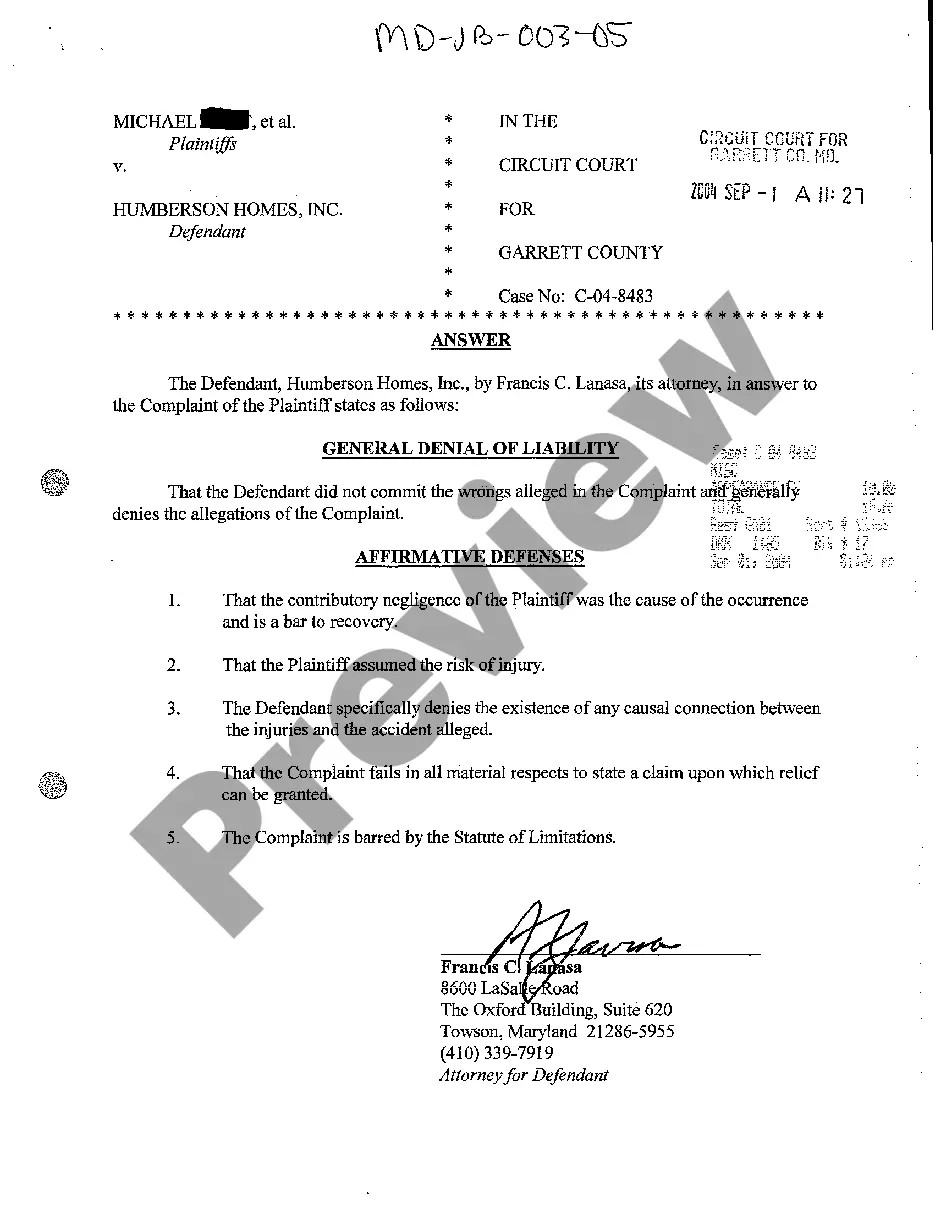
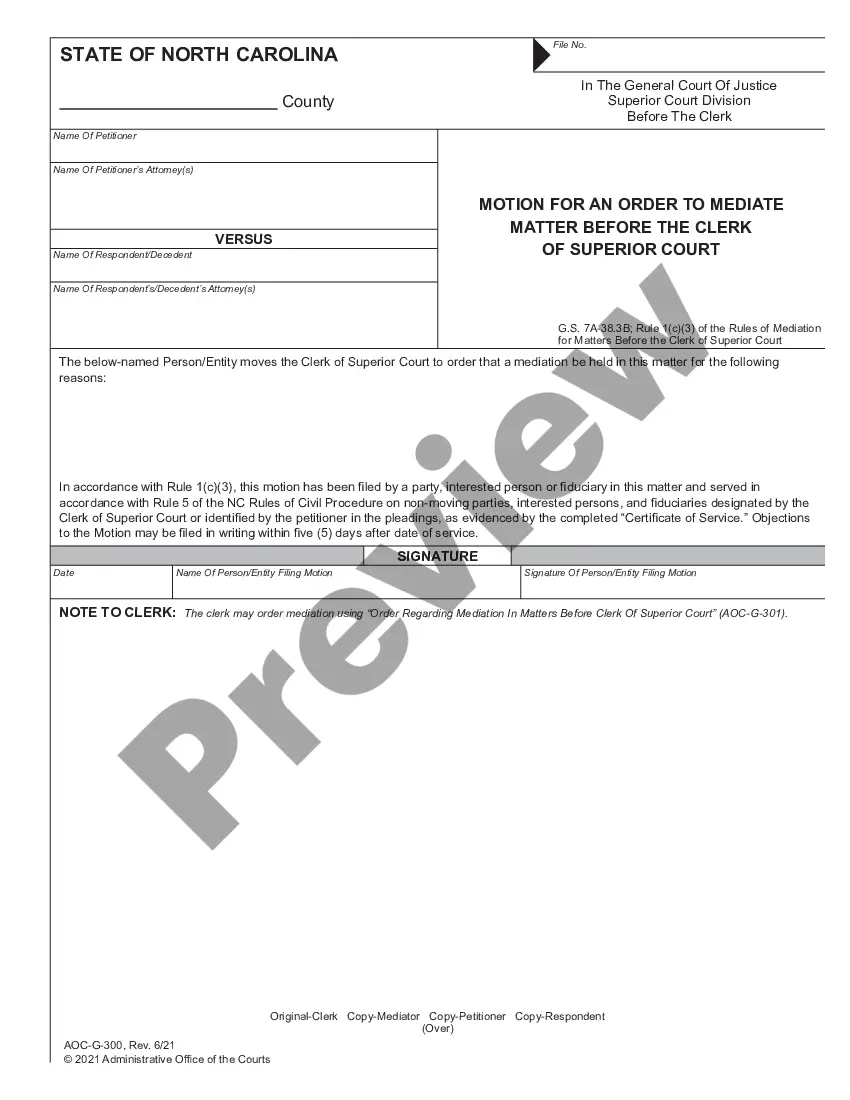
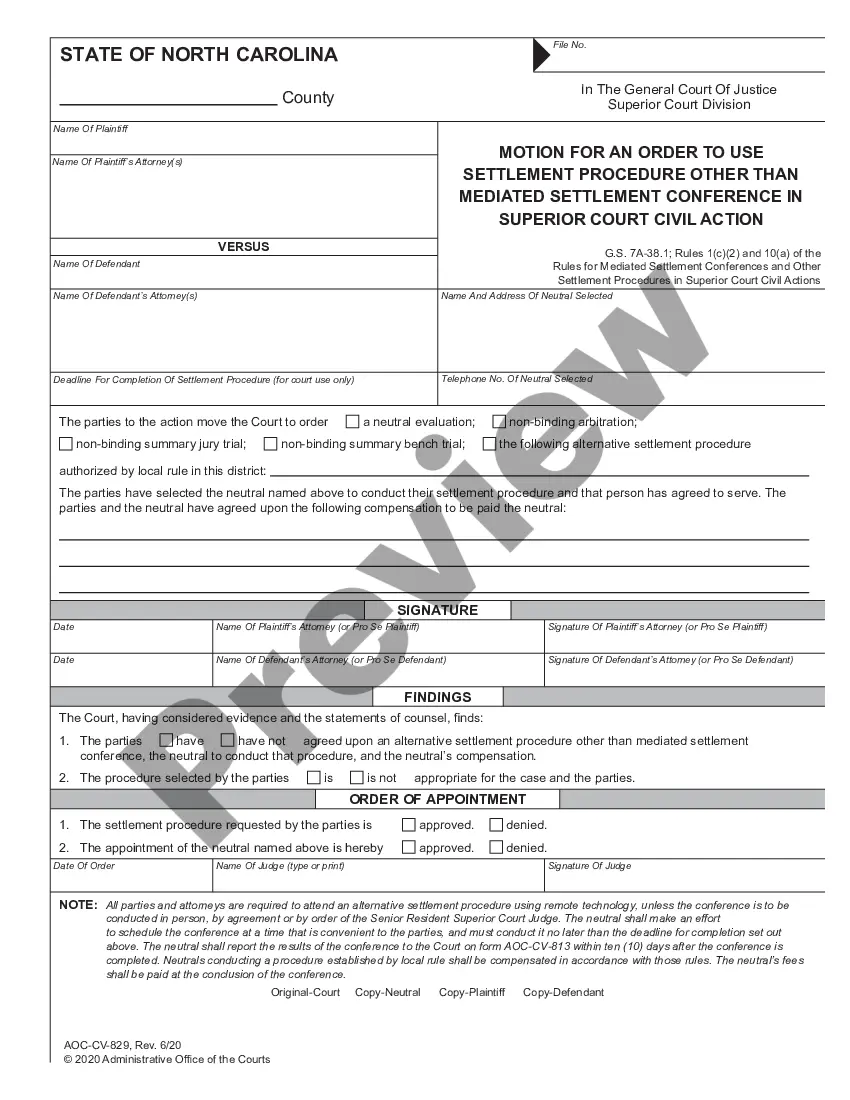
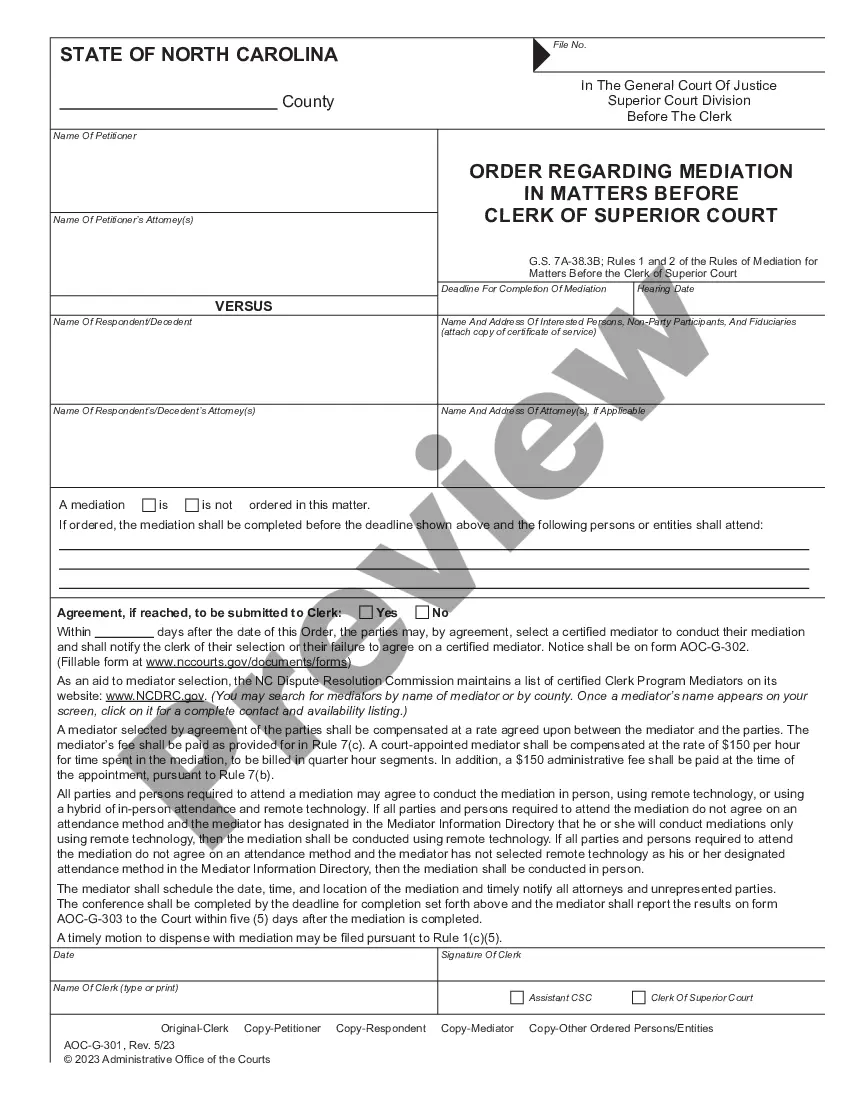
This is an official form from the North Carolina Court System, which complies with all applicable laws and statutes. USLF amends and updates the forms as is required by North Carolina statutes and law.
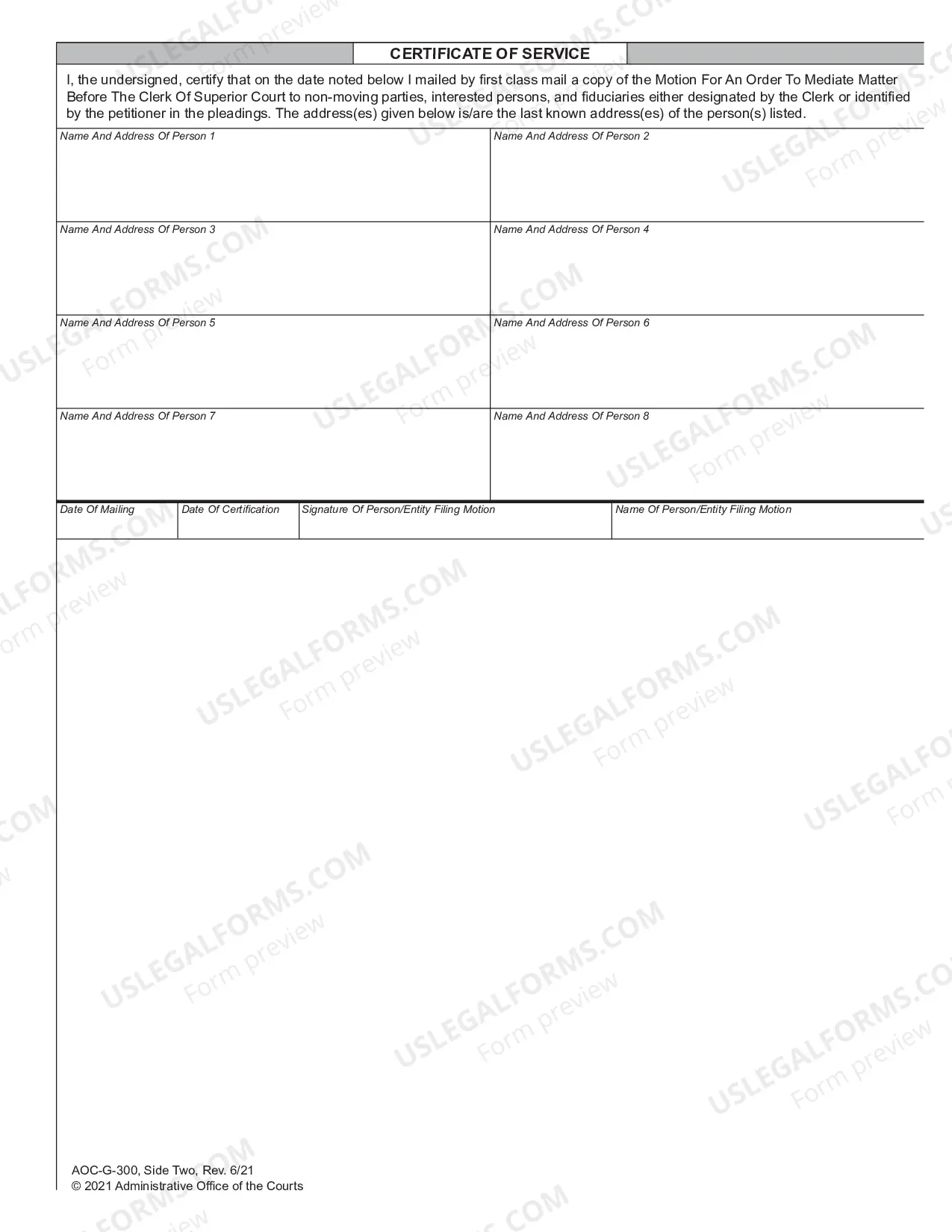
North Carolina Motion for an Order to Mediate Matter Before the Clerk
Instant download
This website is not affiliated with any governmental entity
Public form
Description
Free preview
Get your form ready online
Our built-in tools help you complete, sign, share, and store your documents in one place.
Built-in online Word editor
Make edits, fill in missing information, and update formatting in US Legal Forms—just like you would in MS Word.
Export easily
Download a copy, print it, send it by email, or mail it via USPS—whatever works best for your next step.
E-sign your document
Sign and collect signatures with our SignNow integration. Send to multiple recipients, set reminders, and more. Go Premium to unlock E-Sign.
Notarize online 24/7
If this form requires notarization, complete it online through a secure video call—no need to meet a notary in person or wait for an appointment.
Store your document securely
We protect your documents and personal data by following strict security and privacy standards.

Make edits, fill in missing information, and update formatting in US Legal Forms—just like you would in MS Word.

Download a copy, print it, send it by email, or mail it via USPS—whatever works best for your next step.

Sign and collect signatures with our SignNow integration. Send to multiple recipients, set reminders, and more. Go Premium to unlock E-Sign.

If this form requires notarization, complete it online through a secure video call—no need to meet a notary in person or wait for an appointment.

We protect your documents and personal data by following strict security and privacy standards.
Looking for another form?
How to fill out North Carolina Motion For An Order To Mediate Matter Before The Clerk?
Steer clear of costly attorneys and locate the North Carolina Motion for an Order to Mediate Matter Before the Clerk you need at a reasonable price on the US Legal Forms website. Utilize our straightforward categories feature to search for and download legal and tax documents. Review their descriptions and preview them thoroughly before downloading. Additionally, US Legal Forms offers users detailed instructions on how to obtain and complete each template.
US Legal Forms clients just need to Log In and access the specific form they require in their My documents section. Those who haven't purchased a subscription yet should follow the steps outlined below.
After downloading, you may complete the North Carolina Motion for an Order to Mediate Matter Before the Clerk by hand or using an editing software application. Print it out and reuse the form multiple times. Achieve more for less with US Legal Forms!
- Verify that the North Carolina Motion for an Order to Mediate Matter Before the Clerk is suitable for use in your state.
- If possible, review the description and utilize the Preview option prior to downloading the templates.
- If you’re certain the template fulfills your requirements, click on Buy Now.
- If the form is incorrect, use the search bar to find the appropriate one.
- Then, create your account and choose a subscription plan.
- Make payment via card or PayPal.
- Opt to receive the form in PDF or DOCX format.
- Click Download and locate your template in the My documents section. You can save the template to your device or print it out.
Form popularity
FAQ
Mediation is a process where a neutral and independent person (a mediator) helps the parties in a dispute to reach their own solution.If the parties resolve their dispute at the mediation, they may make a written agreement and have orders made by the Court to finalise the case.
If you don't respond or decline mediation without a good reason, you will usually have to explain why you declined mediation to the judge, if your case subsequently goes to court.
When the court compels parties to participate in a voluntary process, litigators can use a court-ordered mediation as an opportunity to advance their clients' interests by following 10 common sense steps. Background: Court-ordered mediations supplement the judicial arbitration program.
Since 1995, North Carolina has made mediation (i.e., mediated settlement conferences) mandatory in all Superior Court actions.Although mediation is less formal than a trial, it is still a legal proceeding guided by rules adopted by the North Carolina Supreme Court and the North Carolina Dispute Resolution Commission.
For most civil court-related matters including family cases, the mediator's fee ranges from $150-$250 per hour split between the parties. CDSS charges a one-time administrative fee of $150, which is also split between the parties.
To protect such public interest, mediation can be made compulsory to the parties, when there are elements of settlement, though the parties are not agreeing for such course in the beginning. Once they are into the process, they will understand the effectiveness of the process and participate in mediation.
Mediation is a process by which a neutral third party called a Mediator hears a dispute between two or more parties and attempts to help the parties settle their dispute without judging the merits of the case.
Costs risk if you unreasonably refuse to mediate You should expect the court to impose costs sanctions if you ignore or unreasonably turn down an invitation to mediate or indeed if you fail to consider mediation at all.
Court ordered mediation is an open forum for each party to express their concerns to a neutral third party certified mediator. While almost any issue can be mediated, child support is not one of them. Child support is not to be discussed or negotiated during mediation.