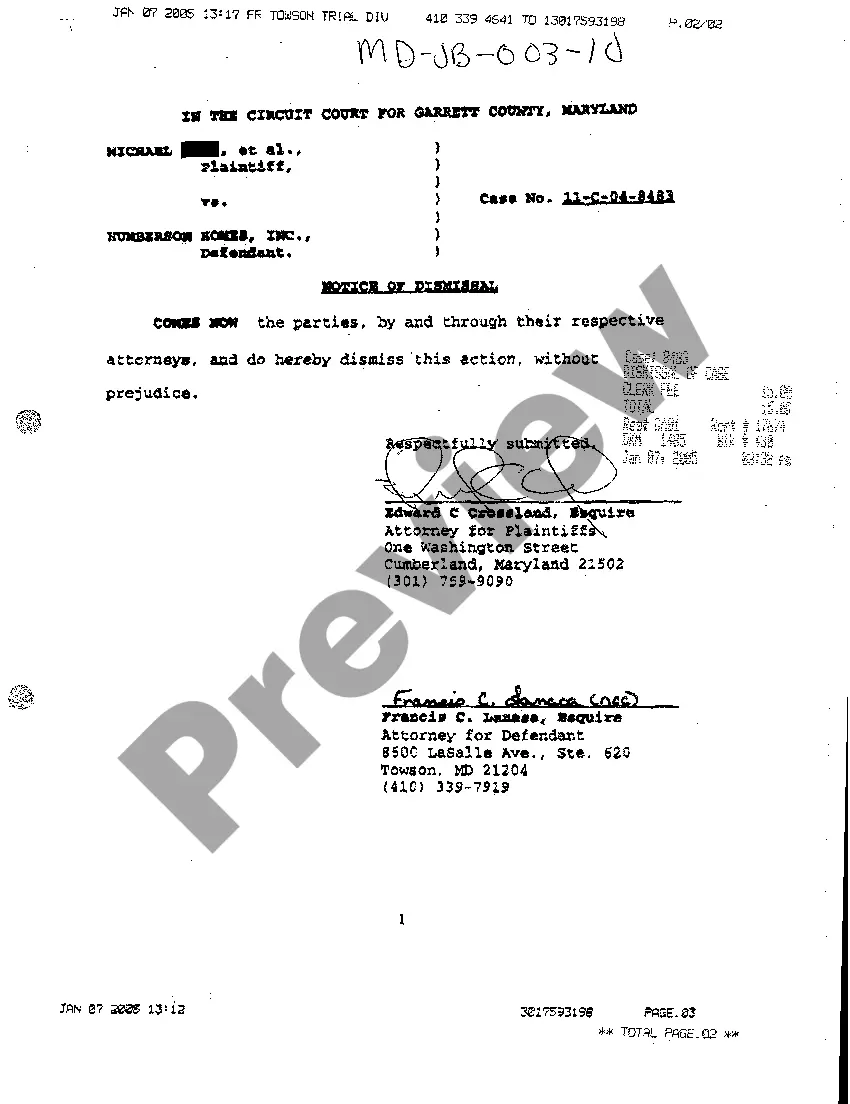
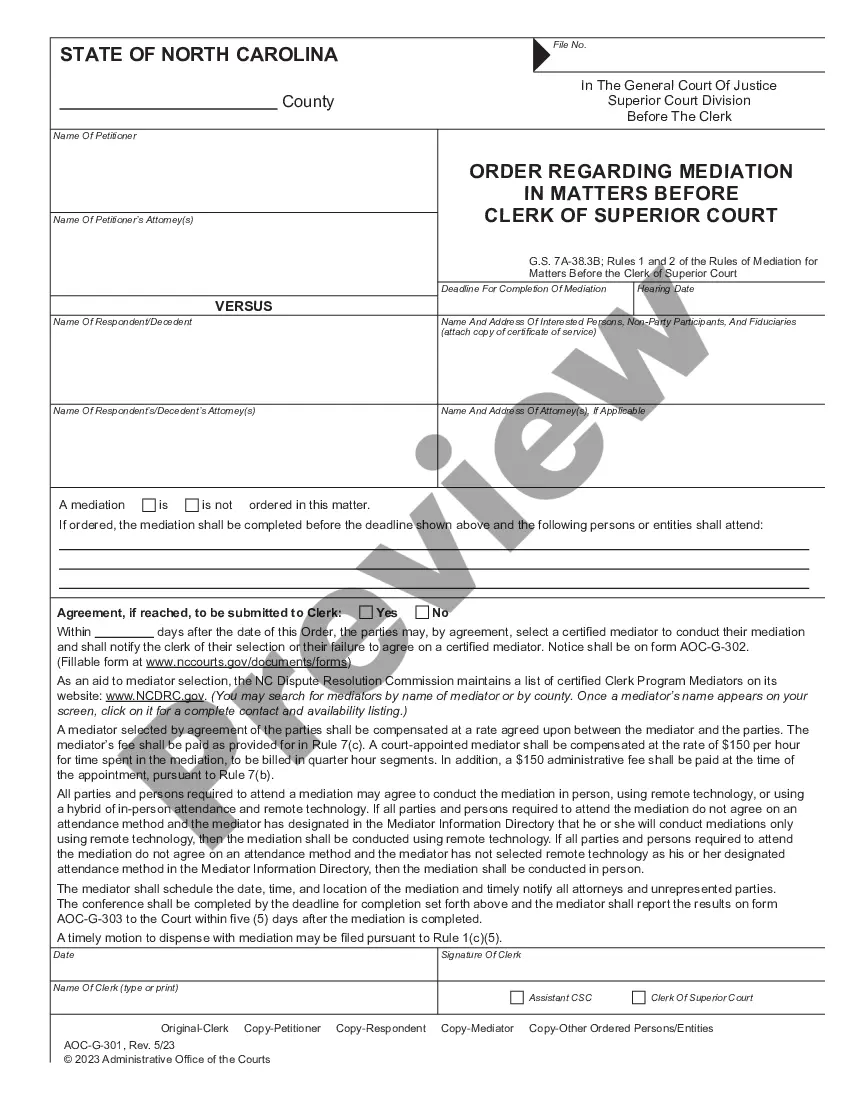
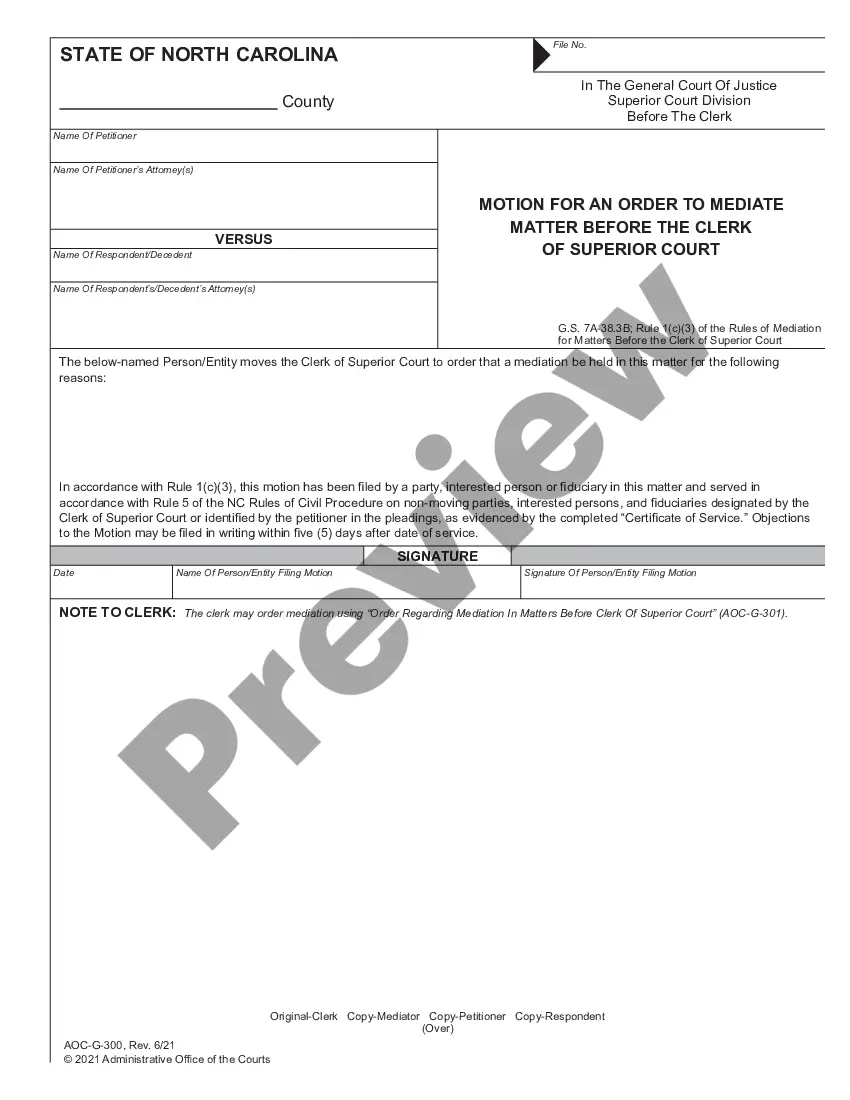
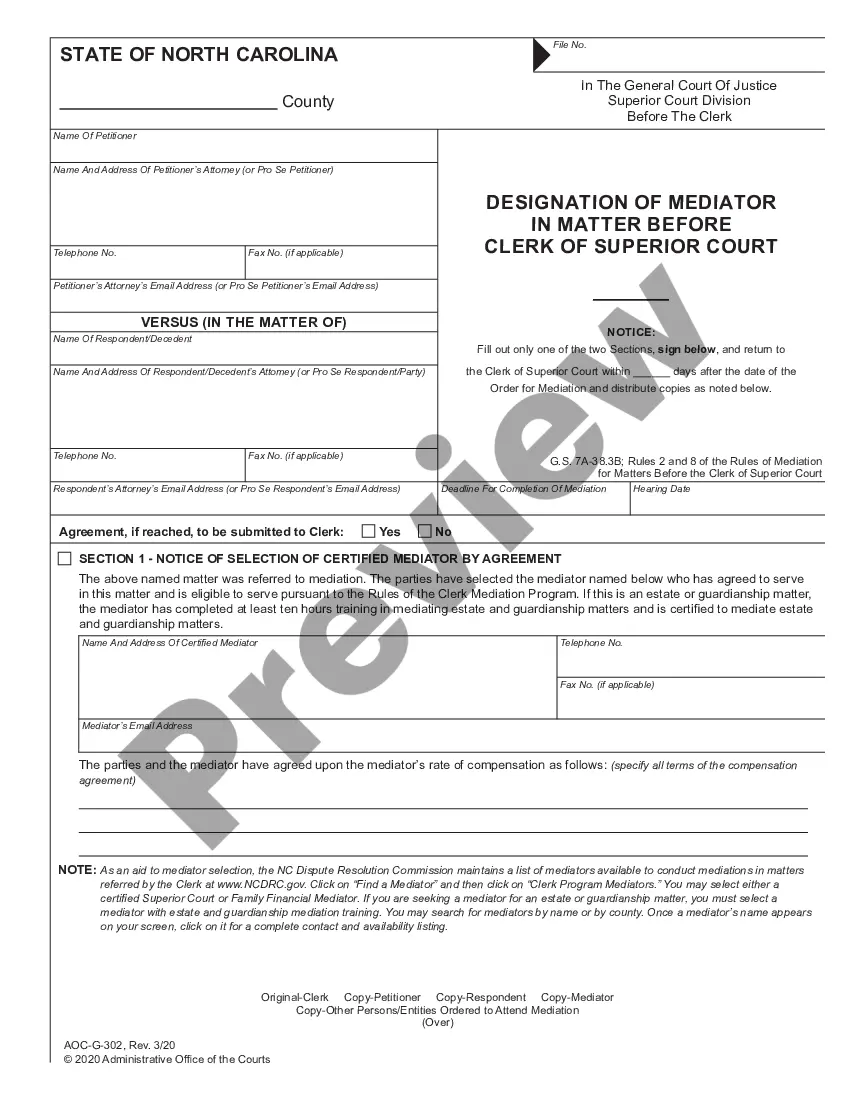
This is an official form from the North Carolina Court System, which complies with all applicable laws and statutes. USLF amends and updates the forms as is required by North Carolina statutes and law.
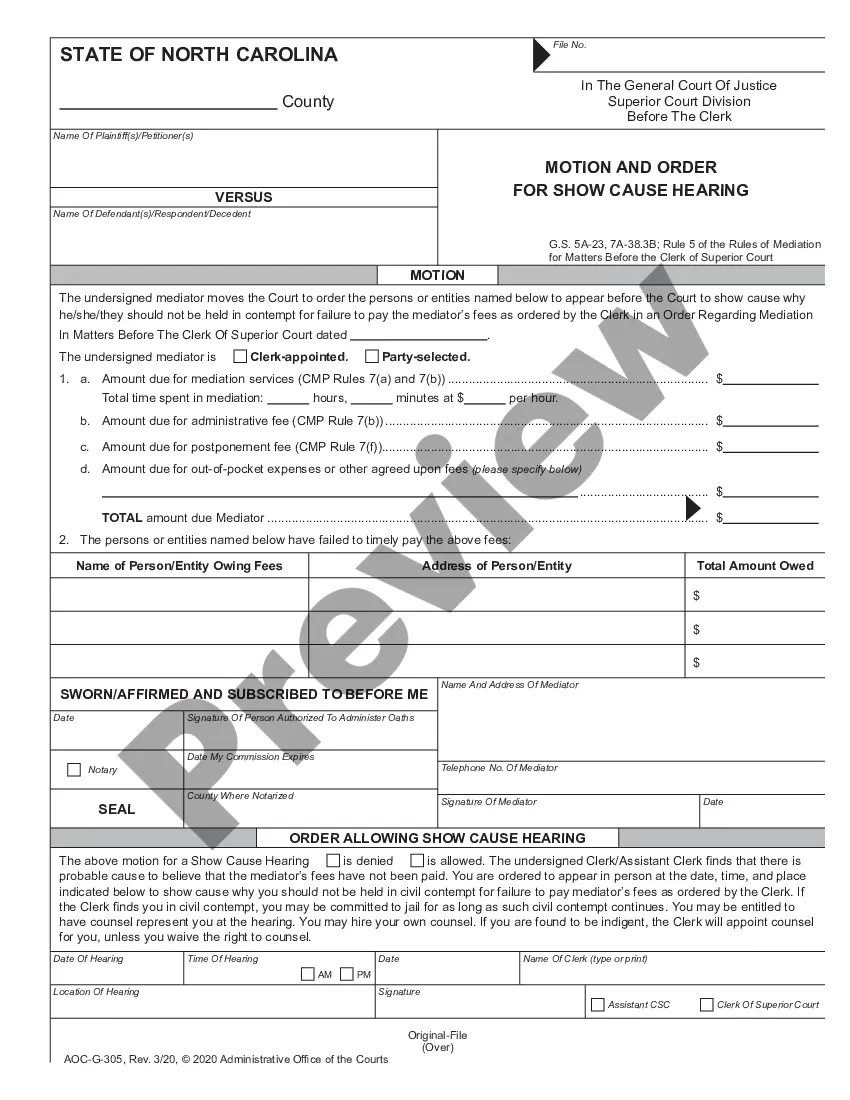
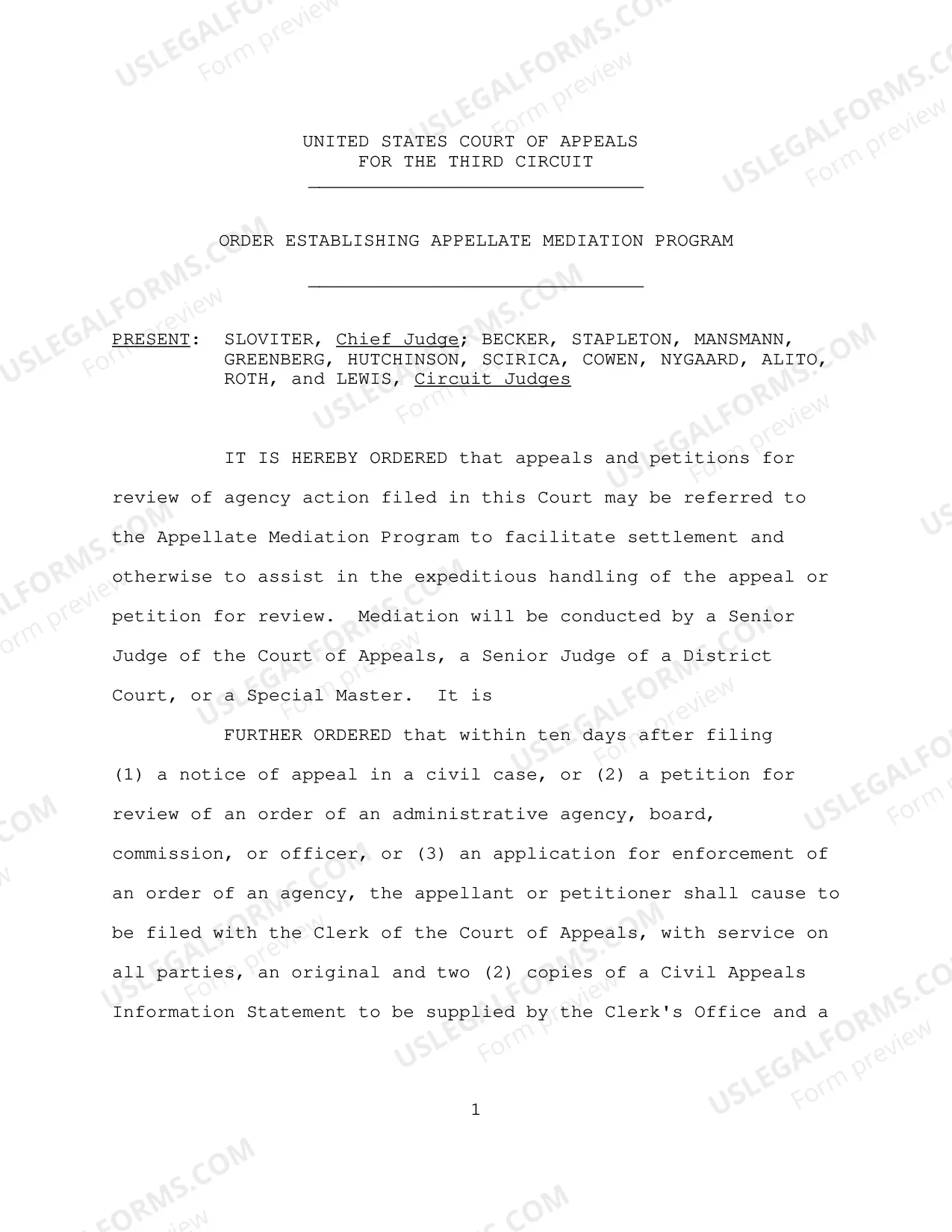
North Carolina Order Regarding Mediation in Matters Before Clerk of Superior Court
Instant download
This website is not affiliated with any governmental entity
Public form
Description
Get your form ready online
Our built-in tools help you complete, sign, share, and store your documents in one place.
Built-in online Word editor
Make edits, fill in missing information, and update formatting in US Legal Forms—just like you would in MS Word.
Export easily
Download a copy, print it, send it by email, or mail it via USPS—whatever works best for your next step.
E-sign your document
Sign and collect signatures with our SignNow integration. Send to multiple recipients, set reminders, and more. Go Premium to unlock E-Sign.
Notarize online 24/7
If this form requires notarization, complete it online through a secure video call—no need to meet a notary in person or wait for an appointment.
Store your document securely
We protect your documents and personal data by following strict security and privacy standards.

Make edits, fill in missing information, and update formatting in US Legal Forms—just like you would in MS Word.

Download a copy, print it, send it by email, or mail it via USPS—whatever works best for your next step.

Sign and collect signatures with our SignNow integration. Send to multiple recipients, set reminders, and more. Go Premium to unlock E-Sign.

If this form requires notarization, complete it online through a secure video call—no need to meet a notary in person or wait for an appointment.

We protect your documents and personal data by following strict security and privacy standards.
Looking for another form?
How to fill out North Carolina Order Regarding Mediation In Matters Before Clerk Of Superior Court?
Steer clear of expensive lawyers and locate the North Carolina Order Regarding Mediation in Matters Before Clerk of Superior Court you require at a fair price on the US Legal Forms website.
Utilize our straightforward grouping feature to search for and acquire legal and tax documents. Examine their descriptions and preview them thoroughly before downloading.
Choose to receive the document in PDF or DOCX format. Click Download and locate your document in the My documents section. You can either save the document to your device or print it out. After downloading, you may fill out the North Carolina Order Regarding Mediation in Matters Before Clerk of Superior Court manually or with editing software. Print it and reuse the document multiple times. Achieve more for less with US Legal Forms!
- Additionally, US Legal Forms offers users detailed guidance on how to acquire and complete each document.
- US Legal Forms clients simply need to Log In and retrieve the specific document they require from their My documents section.
- Those who haven't subscribed yet should follow the instructions below.
- Confirm that the North Carolina Order Regarding Mediation in Matters Before Clerk of Superior Court is permissible for use in your jurisdiction.
- If available, review the description and utilize the Preview function before downloading the template.
- If you are certain the document meets your requirements, click Buy Now.
- If the form is incorrect, use the search bar to find the correct one.
- Next, create your account and select a subscription option.
- Make payment via card or PayPal.
Form popularity
FAQ
Mediation is an alternative dispute resolution process wherein a neutral third party, the mediator, facilitates a discussion between the parties to a lawsuit to promote the voluntary resolution of disputes before trial.In a mediation, each party provides the mediator with materials regarding the case to review.
Mediation is a process where a neutral and independent person (a mediator) helps the parties in a dispute to reach their own solution.If the parties resolve their dispute at the mediation, they may make a written agreement and have orders made by the Court to finalise the case.
In California, approximately 95% of civil cases settle out of court. Many of these settle at a mediation. Others settle outside of mediation. (Parties are always free to discuss settlement...
Costs risk if you unreasonably refuse to mediate You should expect the court to impose costs sanctions if you ignore or unreasonably turn down an invitation to mediate or indeed if you fail to consider mediation at all.
During a court-ordered mediation the parties can design their own method to resolve their dispute. They might agree on a second mediation session, short cause trial, binding arbitration, (with or without a high-low agreement), or further good, old-fashioned, face-to-face negotiations between counsel and parties.
Mediation is an informal and flexible dispute resolution process. The mediator's role is to guide the parties toward their own resolution. Through joint sessions and separate caucuses with parties, the mediator helps both sides define the issues clearly, understand each other's position and move closer to resolution.
Mediation is a private process where a neutral third person called a mediator helps the parties discuss and try to resolve the dispute.While courts can mandate that certain cases go to mediation, the process remains "voluntary" in that the parties are not required to come to agreement.
Since 1995, North Carolina has made mediation (i.e., mediated settlement conferences) mandatory in all Superior Court actions.Although mediation is less formal than a trial, it is still a legal proceeding guided by rules adopted by the North Carolina Supreme Court and the North Carolina Dispute Resolution Commission.
Judges love to refer cases for mediation because every case that settles is one less case the judge has to deal with on the court docket.Mediation is a kind of brokered negotiation and settlement conference used to settle a lawsuit or other dispute, and sometimes seek reconciliation between the parties.