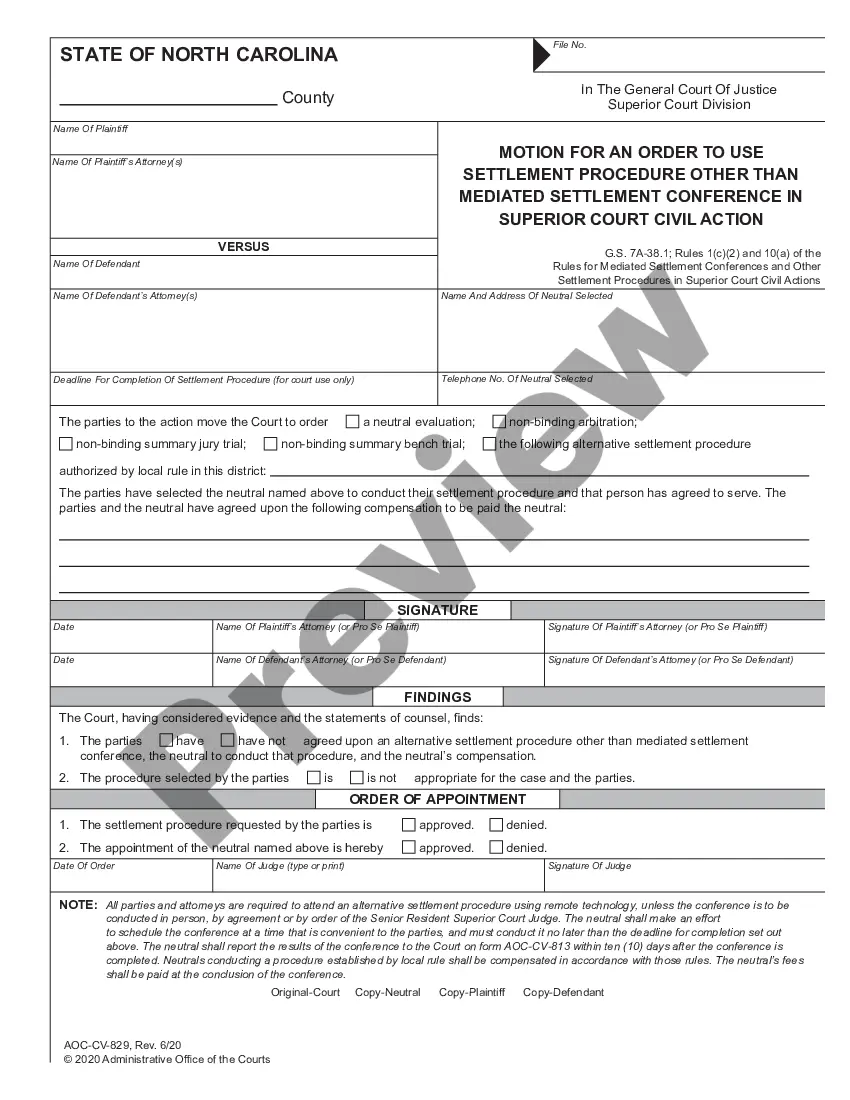
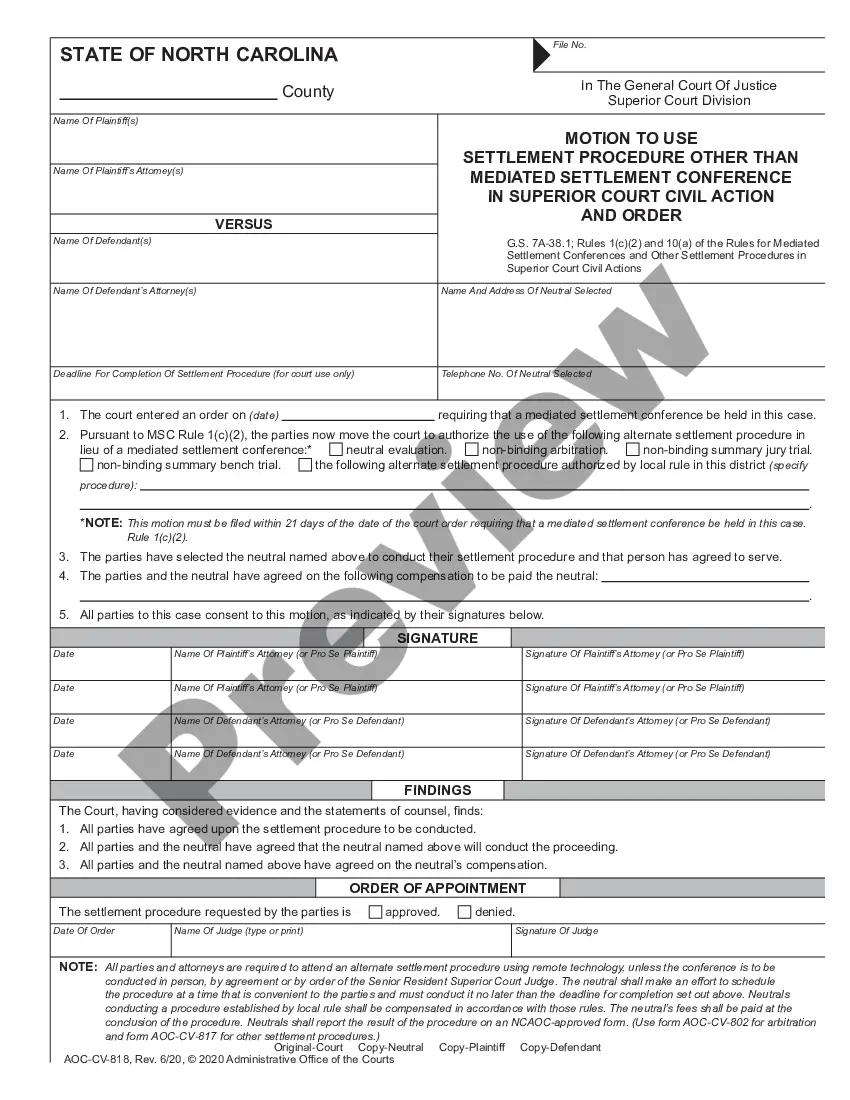
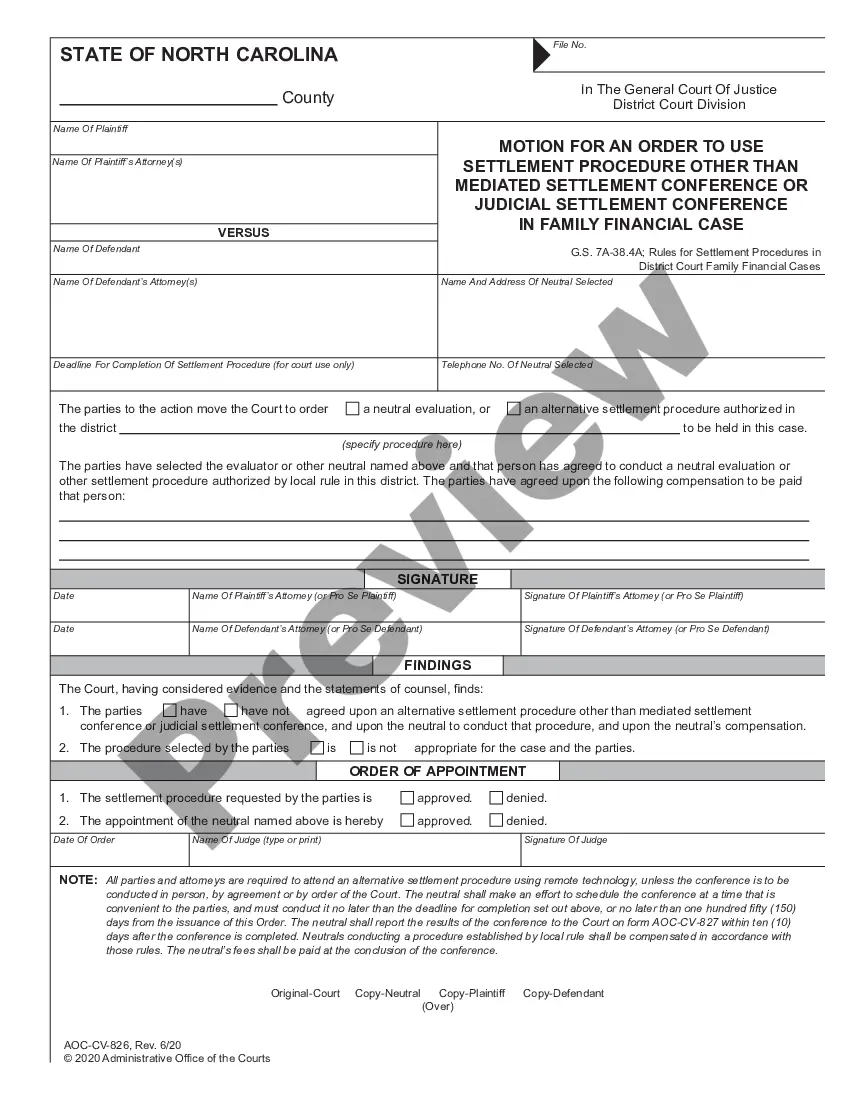
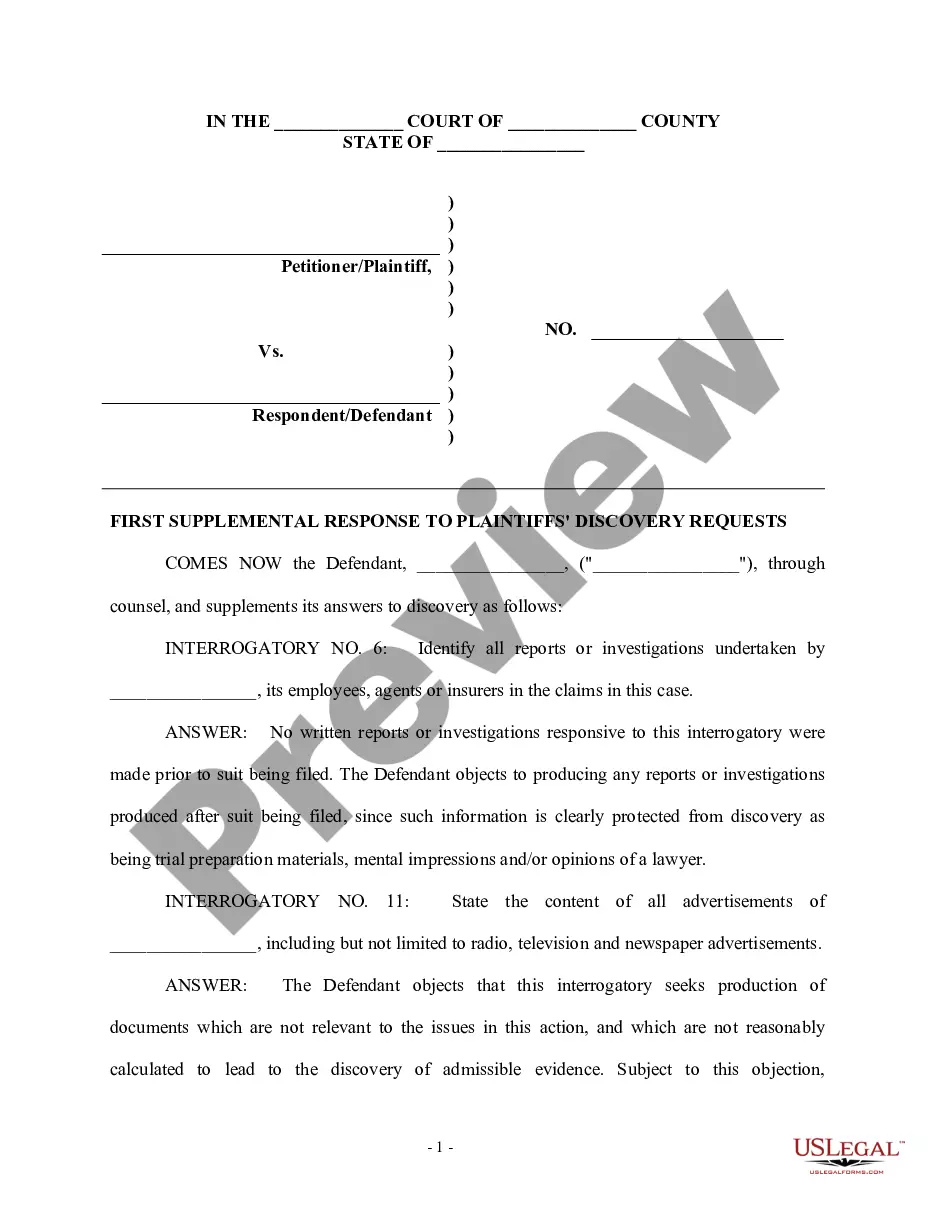
North Carolina Motion for an Order to Use Settlement Procedure Other Than Mediated Settlement Conference in Superior Court Civil Action
Description
Get your form ready online
Our built-in tools help you complete, sign, share, and store your documents in one place.
Make edits, fill in missing information, and update formatting in US Legal Forms—just like you would in MS Word.
Download a copy, print it, send it by email, or mail it via USPS—whatever works best for your next step.
Sign and collect signatures with our SignNow integration. Send to multiple recipients, set reminders, and more. Go Premium to unlock E-Sign.
If this form requires notarization, complete it online through a secure video call—no need to meet a notary in person or wait for an appointment.
We protect your documents and personal data by following strict security and privacy standards.

Make edits, fill in missing information, and update formatting in US Legal Forms—just like you would in MS Word.

Download a copy, print it, send it by email, or mail it via USPS—whatever works best for your next step.

Sign and collect signatures with our SignNow integration. Send to multiple recipients, set reminders, and more. Go Premium to unlock E-Sign.

If this form requires notarization, complete it online through a secure video call—no need to meet a notary in person or wait for an appointment.

We protect your documents and personal data by following strict security and privacy standards.
Looking for another form?



How to fill out North Carolina Motion For An Order To Use Settlement Procedure Other Than Mediated Settlement Conference In Superior Court Civil Action?
Steer clear of costly attorneys and locate the North Carolina Motion for an Order to Use Settlement Procedure Other Than Mediated Settlement Conference in Superior Court Civil Action you require at a reasonable price on the US Legal Forms website.
Utilize our straightforward grouping feature to search for and acquire legal and tax documents. Review their descriptions and preview them prior to downloading.
Pay using a credit card or PayPal. Choose to obtain the form in PDF or DOCX format. Click Download and locate your form in the My documents section. You can easily save the template to your device or print it. After downloading, you can fill out the North Carolina Motion for an Order to Use Settlement Procedure Other Than Mediated Settlement Conference in Superior Court Civil Action by hand or with editing software. Print it and reuse the form multiple times. Achieve more for less with US Legal Forms!
- Moreover, US Legal Forms provides users with detailed instructions on how to download and fill out each template.
- Clients of US Legal Forms only need to sign in and download the specific document they wish to their My documents section.
- Those without a subscription should adhere to the following steps.
- Verify that the North Carolina Motion for an Order to Use Settlement Procedure Other Than Mediated Settlement Conference in Superior Court Civil Action is permitted in your state.
- If possible, examine the description and utilize the Preview option before acquiring the sample.
- If you believe the document fits your needs, click Buy Now.
- If the template is incorrect, use the search function to find the appropriate one.
- Then, create your account and choose a subscription plan.
Form popularity
FAQ
Costs risk if you unreasonably refuse to mediate You should expect the court to impose costs sanctions if you ignore or unreasonably turn down an invitation to mediate or indeed if you fail to consider mediation at all.
The parties will give the judge some background information about the case so that they can prepare to help resolve the disputed issues. The judge will meet with the attorneys for each side, who will present their positions.However, the judge cannot force the parties to agree to a settlement against their will.
In general, voluntary settlement conferences are similar to mediations. During the conference, the officer will usually express an opinion about each position's merits, the likely outcome of trial, and the officer's projected settlement value for the case.
A mediation or settlement conference is an informal negotiation processyou will not testify under oath or present witnesses. Instead, you and the insurance company will discuss the claim and make settlement offers with the help of a trained, neutral third party (the mediator).
A settlement conference involves both parties sitting down with their attorneys all together at an office or neutral location to create a custody agreement and finalize it.
Since 1995, North Carolina has made mediation (i.e., mediated settlement conferences) mandatory in all Superior Court actions.Although mediation is less formal than a trial, it is still a legal proceeding guided by rules adopted by the North Carolina Supreme Court and the North Carolina Dispute Resolution Commission.
A settlement conference is a meeting in which a judge or magistrate assigned to the case presides over the process.Settlement conferencing is similar to mediation in that a third party neutral assists the parties in exploring settlement options.
The parties will give the judge some background information about the case so that they can prepare to help resolve the disputed issues. The judge will meet with the attorneys for each side, who will present their positions.However, the judge cannot force the parties to agree to a settlement against their will.
At times, a case will settle after the mediation because of the groundwork laid during mediation. Remember, keep your mind open, listen to the mediator and appreciate that both you and the insurance company must compromise if the case is going to settle.