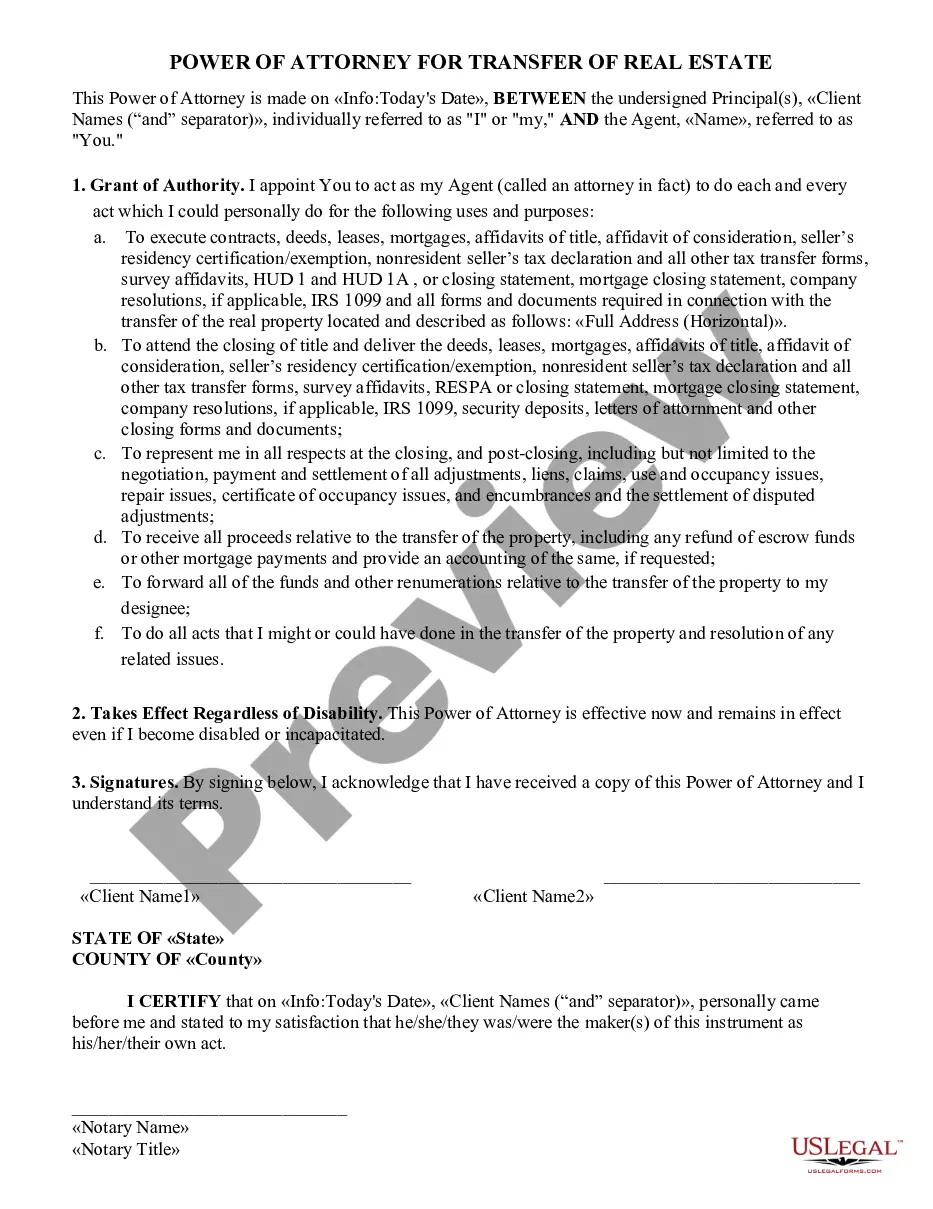
Resignation and Severance Agreement between Employer and Employee
Overview of this form
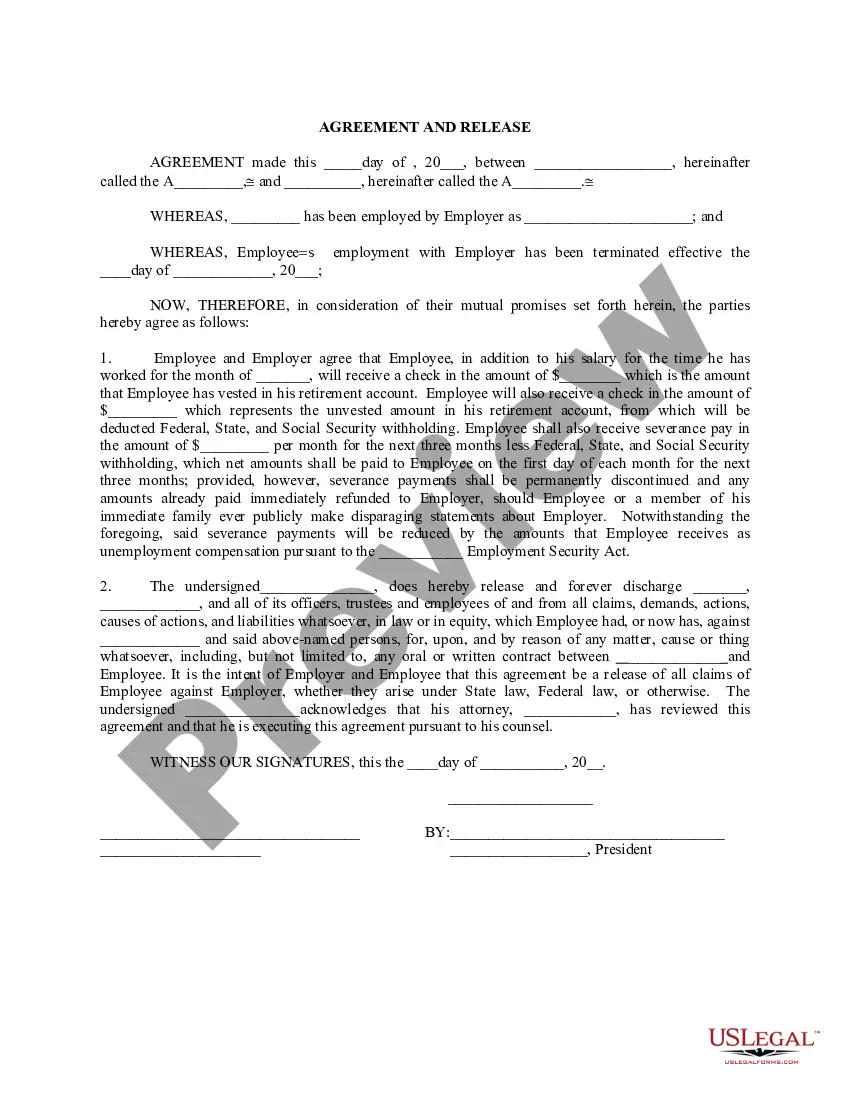
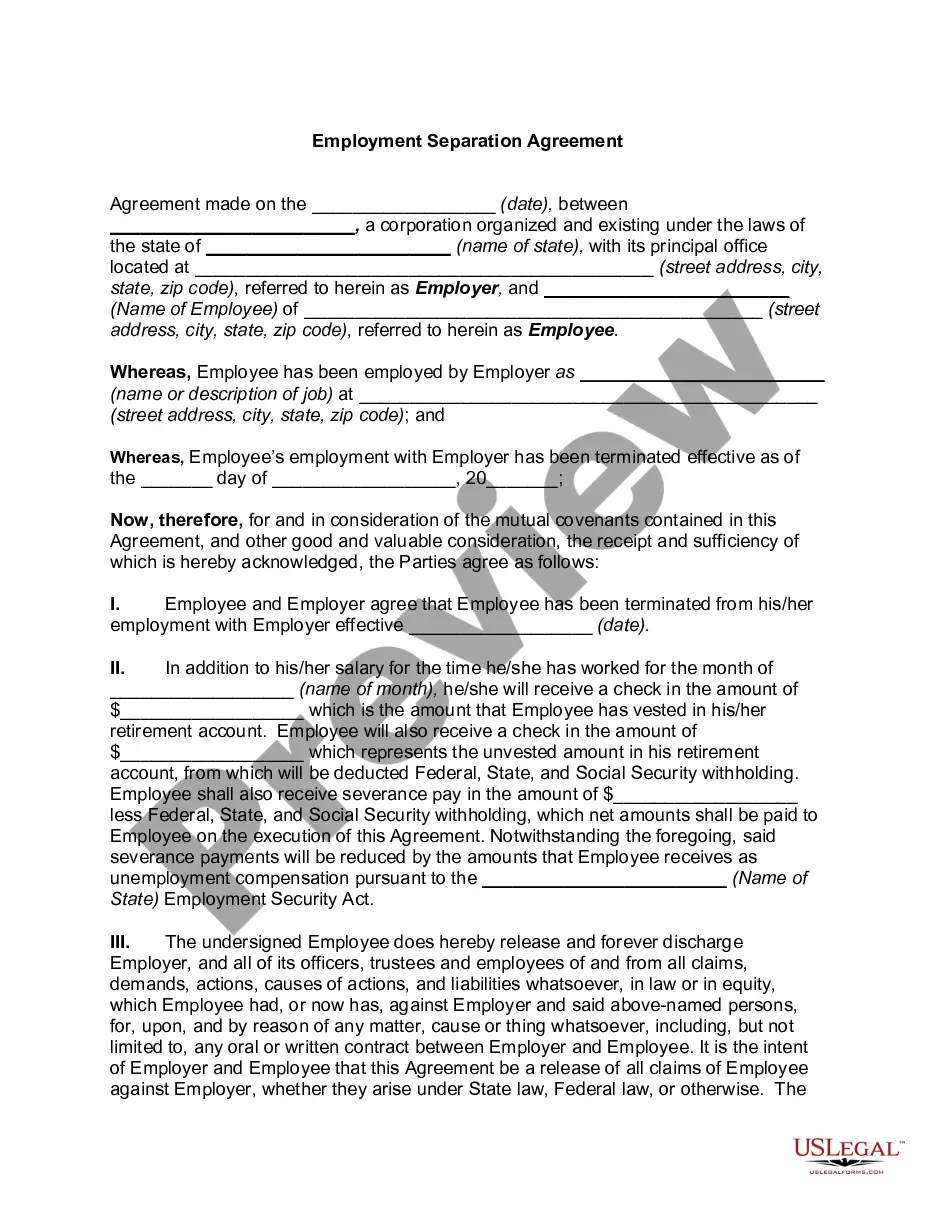
The Resignation and Severance Agreement between Employer and Employee is a legal document designed to formalize the resignation of an employee while providing severance pay and a release of claims against the employer. This form serves as an agreement that clearly outlines the terms of the resignation, including the conditions under which the severance will be paid. Unlike a resignation letter, this agreement provides more comprehensive coverage by addressing legal rights and obligations, ensuring a mutual understanding between the parties involved.
What’s included in this form
- Identification of parties: Details the employer and employee involved in the agreement.
- Effective date of resignation: Specifies when the employee's resignation becomes effective.
- Severance pay terms: Outlines the amount and schedule for severance payments to the employee.
- Voluntary resignation acknowledgment: The employee confirms that the resignation is voluntary.
- Release of claims: Ensures the employee waives the right to any further claims against the employer.
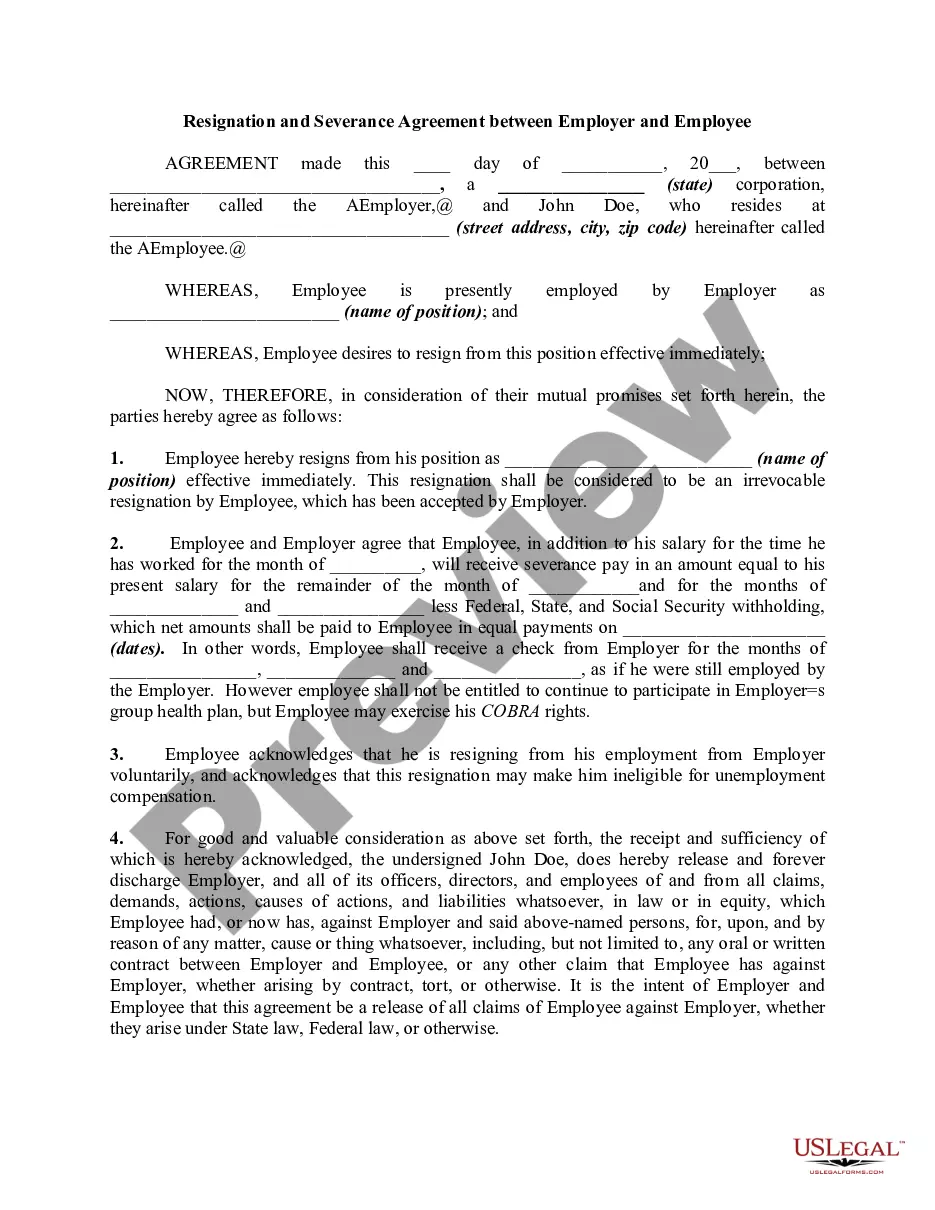


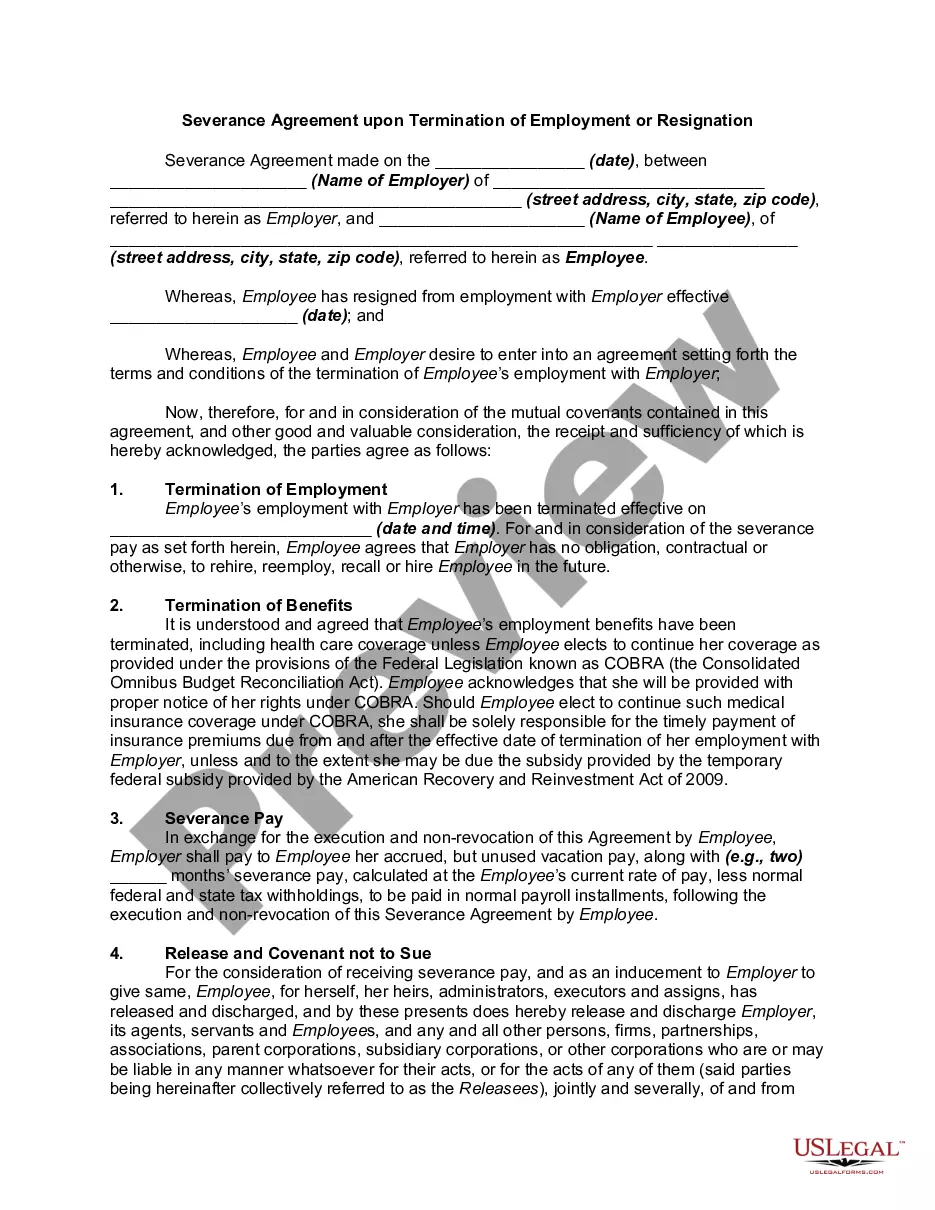
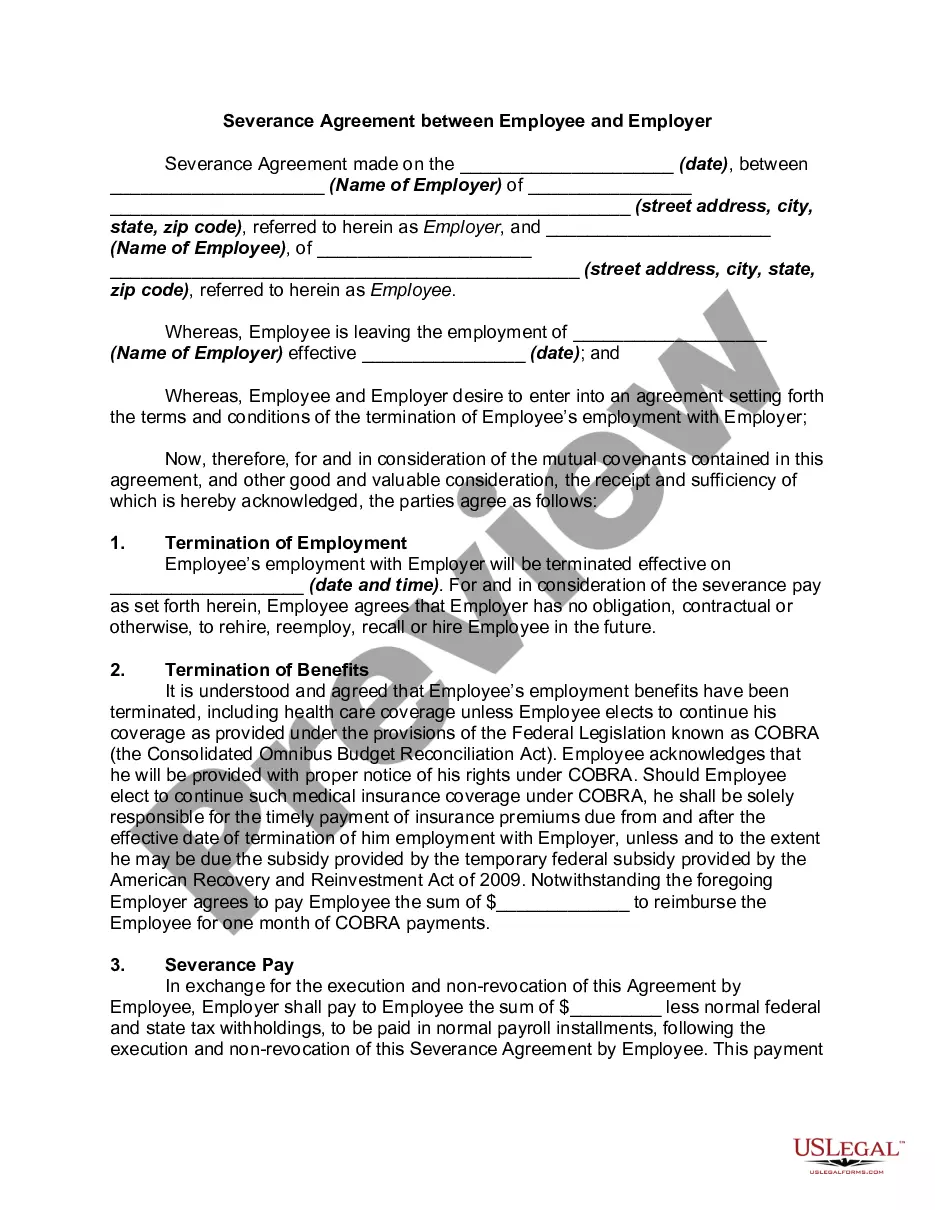
Situations where this form applies
You should use this Resignation and Severance Agreement when an employee wishes to resign from their position while also negotiating severance benefits. This form is particularly useful in cases where an employer offers severance pay in exchange for the employee's agreement to release any future claims. It is often utilized during layoffs, company downsizing, or when an employee resigns from a job after negotiations regarding their severance package.
Intended users of this form
This form is suitable for:
- Employers looking to formalize the separation with an employee while providing severance pay.
- Employees who have agreed to resign and wish to ensure they receive agreed severance benefits.
- Parties interested in establishing clear terms to avoid future disputes related to the resignation.
Completing this form step by step
- Identify the parties involved: Fill in the names and addresses of both the employer and employee.
- State the position and effective resignation date: Clearly specify the employee's job title and the date the resignation takes effect.
- Detail the severance pay: Indicate the severance amount and the payment schedule for the employee.
- Acknowledge the terms: Ensure both parties understand the voluntary nature of the resignation and the waiver of claims.
- Obtain signatures: Both the employer and employee should sign and date the agreement for it to be valid.
Does this form need to be notarized?
Notarization is not commonly needed for this form. However, certain documents or local rules may make it necessary. Our notarization service, powered by Notarize, allows you to finalize it securely online anytime, day or night.
Get your form ready online
Our built-in tools help you complete, sign, share, and store your documents in one place.
Make edits, fill in missing information, and update formatting in US Legal Forms—just like you would in MS Word.
Download a copy, print it, send it by email, or mail it via USPS—whatever works best for your next step.
Sign and collect signatures with our SignNow integration. Send to multiple recipients, set reminders, and more. Go Premium to unlock E-Sign.
If this form requires notarization, complete it online through a secure video call—no need to meet a notary in person or wait for an appointment.
We protect your documents and personal data by following strict security and privacy standards.

Make edits, fill in missing information, and update formatting in US Legal Forms—just like you would in MS Word.

Download a copy, print it, send it by email, or mail it via USPS—whatever works best for your next step.

Sign and collect signatures with our SignNow integration. Send to multiple recipients, set reminders, and more. Go Premium to unlock E-Sign.

If this form requires notarization, complete it online through a secure video call—no need to meet a notary in person or wait for an appointment.

We protect your documents and personal data by following strict security and privacy standards.
Mistakes to watch out for
- Failing to date the agreement properly, which can lead to confusion about the effective resignation date.
- Not detailing the severance amount clearly, which can result in disputes later.
- Omitting signatures from both parties, rendering the agreement invalid.
- Overlooking state-specific legal requirements that could impact enforceability.
Advantages of online completion
- Convenience: Download and complete the form at any time from anywhere.
- Editability: Easily customize the form to fit specific needs without starting from scratch.
- Reliability: Use a professionally drafted template to ensure legal compliance.
Summary of main points
- The Resignation and Severance Agreement formalizes an employee's resignation and outlines severance terms.
- This agreement helps prevent future legal claims by the employee against the employer.
- Ensure both parties understand and acknowledge the details before signing the agreement.
Looking for another form?
Form popularity
FAQ
A severance agreement is a legal document that goes over all of the responsibilities and rights of each party involved - the employee and the employer. The document lays out all of the benefits offered by the company - including pay, insurance, etc - while also ensuring that the employee was not wrongfully let go.
Severance agreements are offered and signed as part of a hiring process. It becomes part of an attractive benefits package. It may include monetary stipends that are earned over time, and are paid out at the time of termination.On the other hand, a separation agreement is offered and signed at the time of termination.
The name of the employer and employee. The effective date of the agreement. The employment period of the outgoing employee. The severance pay amount. Terms of continuation of benefits. Employee waiver of legal claims.
Although you don't have to sign a severance agreement, your employer may make it a condition of receiving severance pay.However, in most cases, an employer is free to condition severance on the employee signing the agreement. In other words, if the employee refuses to sign, the employee won't get any severance pay.
The main purpose of a severance agreement is to prevent your employees from filing for a wrongful termination lawsuit against your company, but there are several reasons a company could opt to provide a severance package.
An employee separation agreement is a legal document that lays out an understanding between a company and a terminated employee. After both parties sign, the terminated employee gives up their right to take legal action against the company in the future (i.e. suing for wrongful termination or severance pay).
If your employer fails to give you the required notice, then you are legally entitled to severance pay. An individual employee who's fired without notice may receive it too, but it's highly discretionary.
Compensation details. Confidentiality rules following termination. Date of employee's termination. Agreement from both parties in the form of a signature. Details about how long the employee will continue to have access to benefits.
If your severance agreement included a release, you may have given up the right to sue your former employer. Some employers offer severance to employees who lose their jobs. Often, however, employees who want a severance package have to sign a release or waiver, by which they give up their right to sue the company.