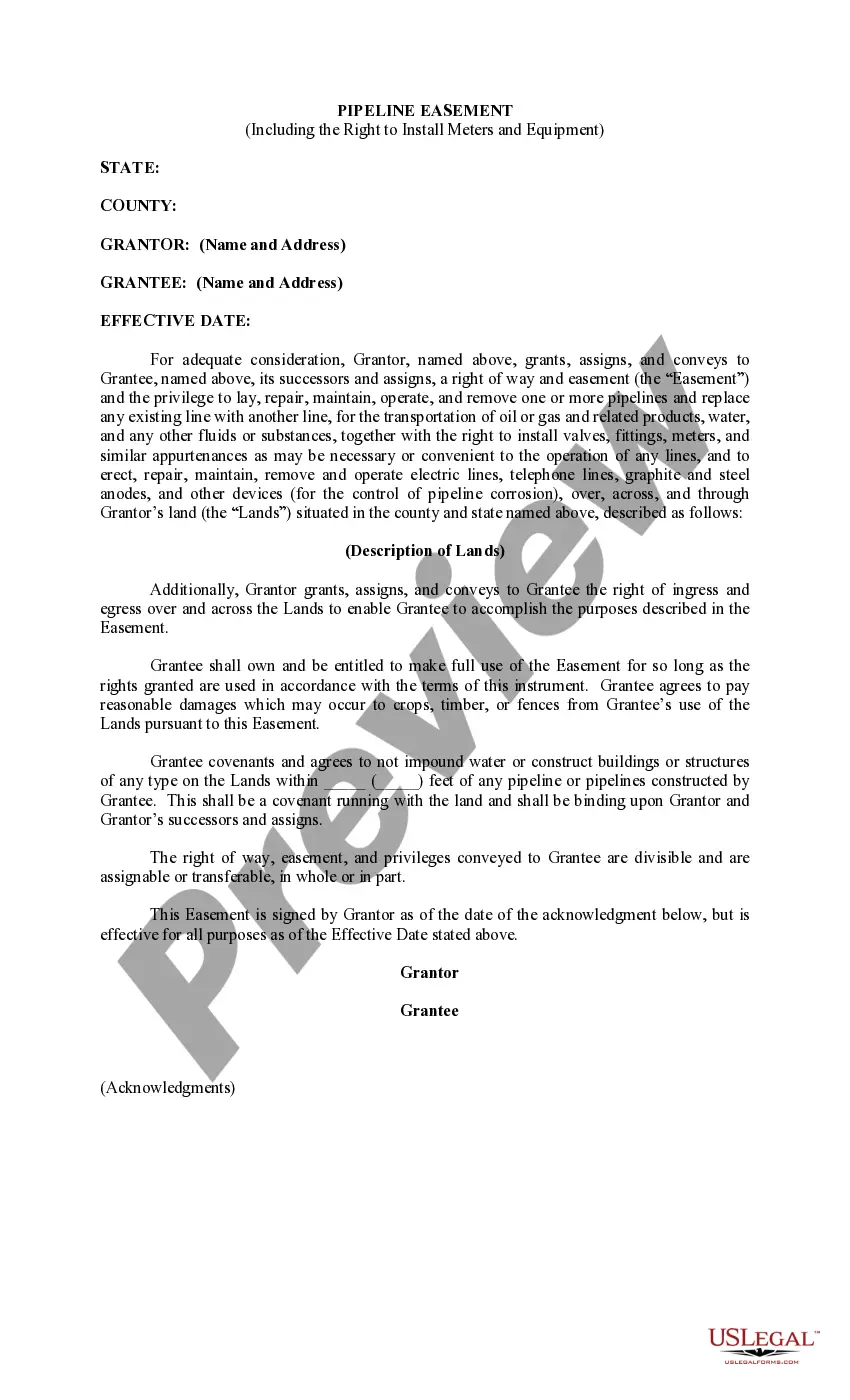
Pipeline Easement (Including the Right to Install Meters and Equipment)
What this document covers
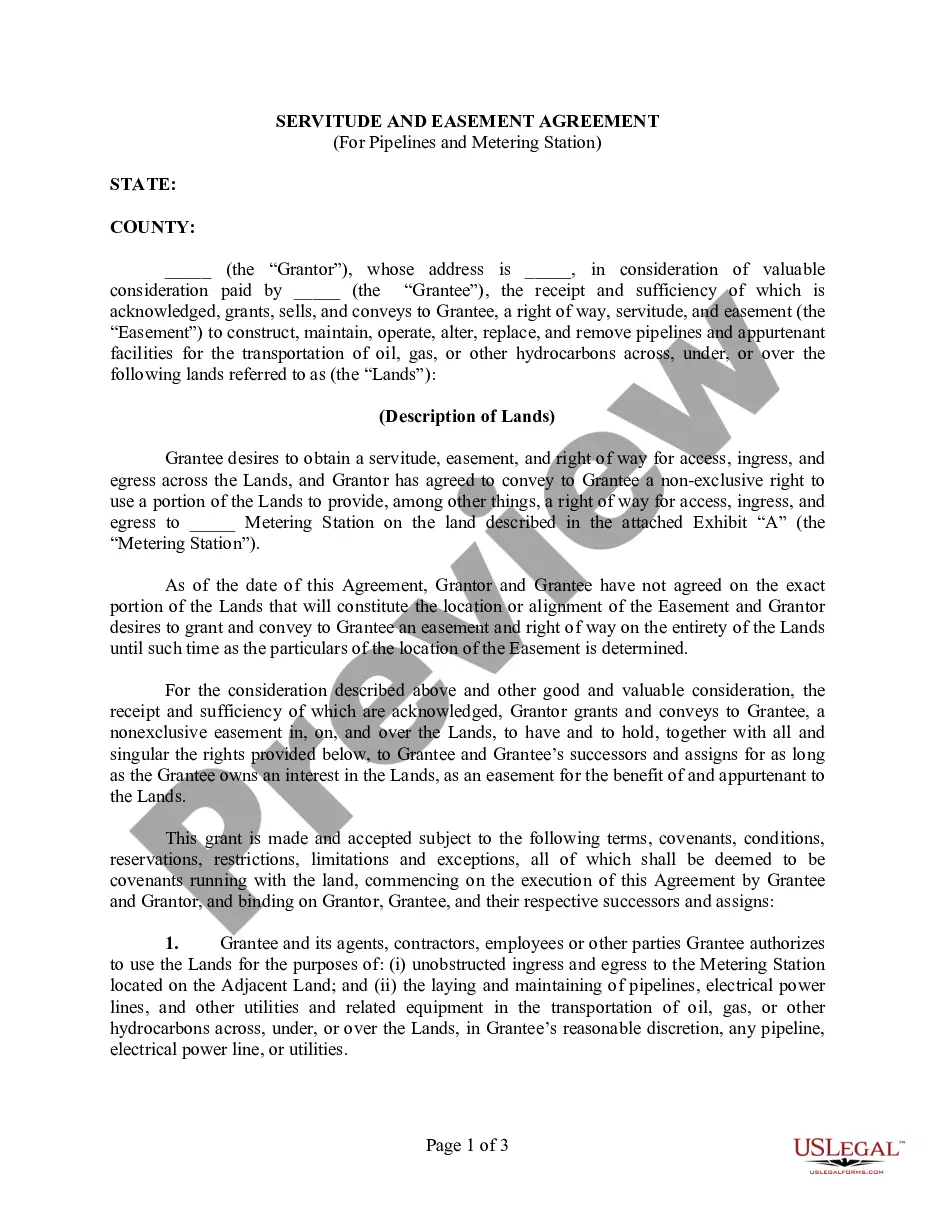
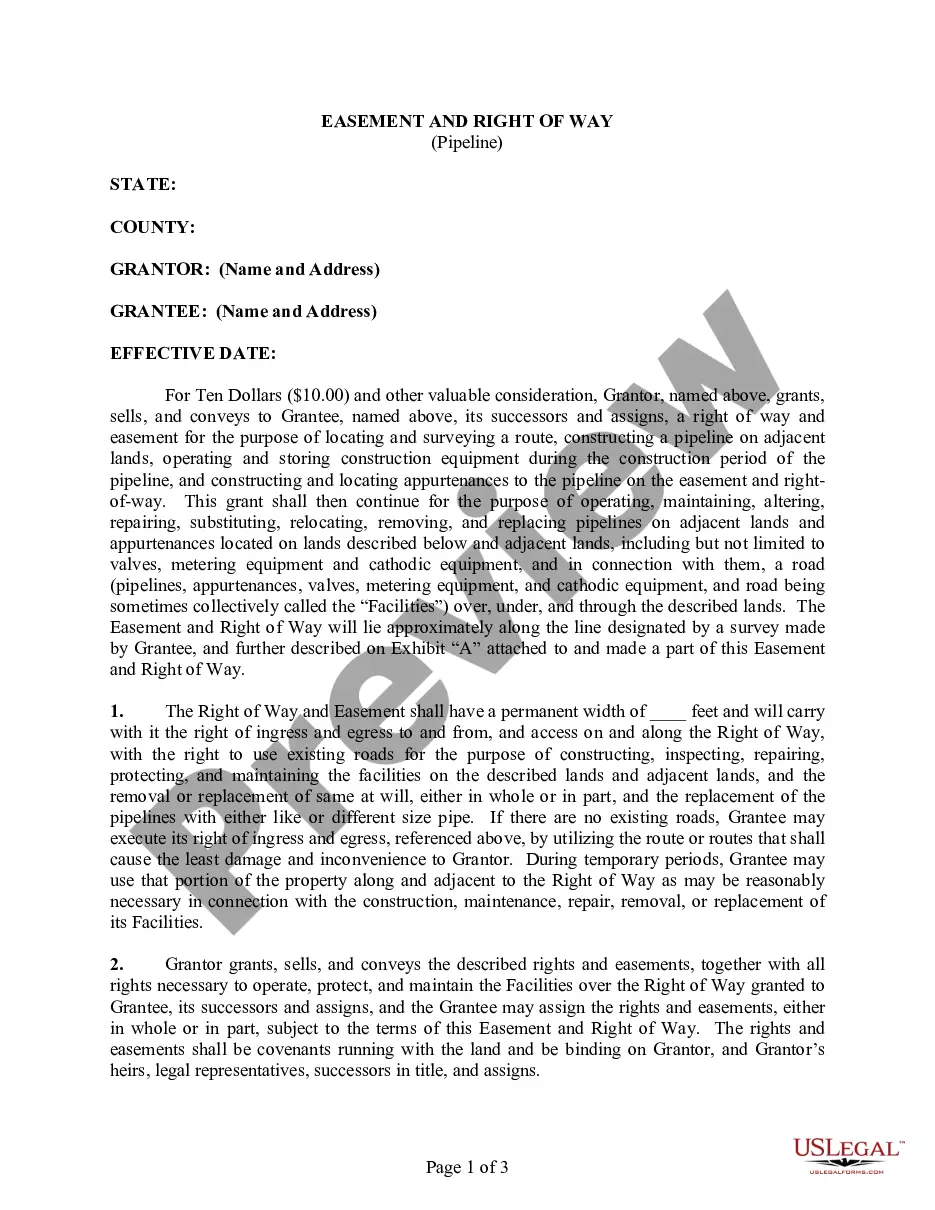
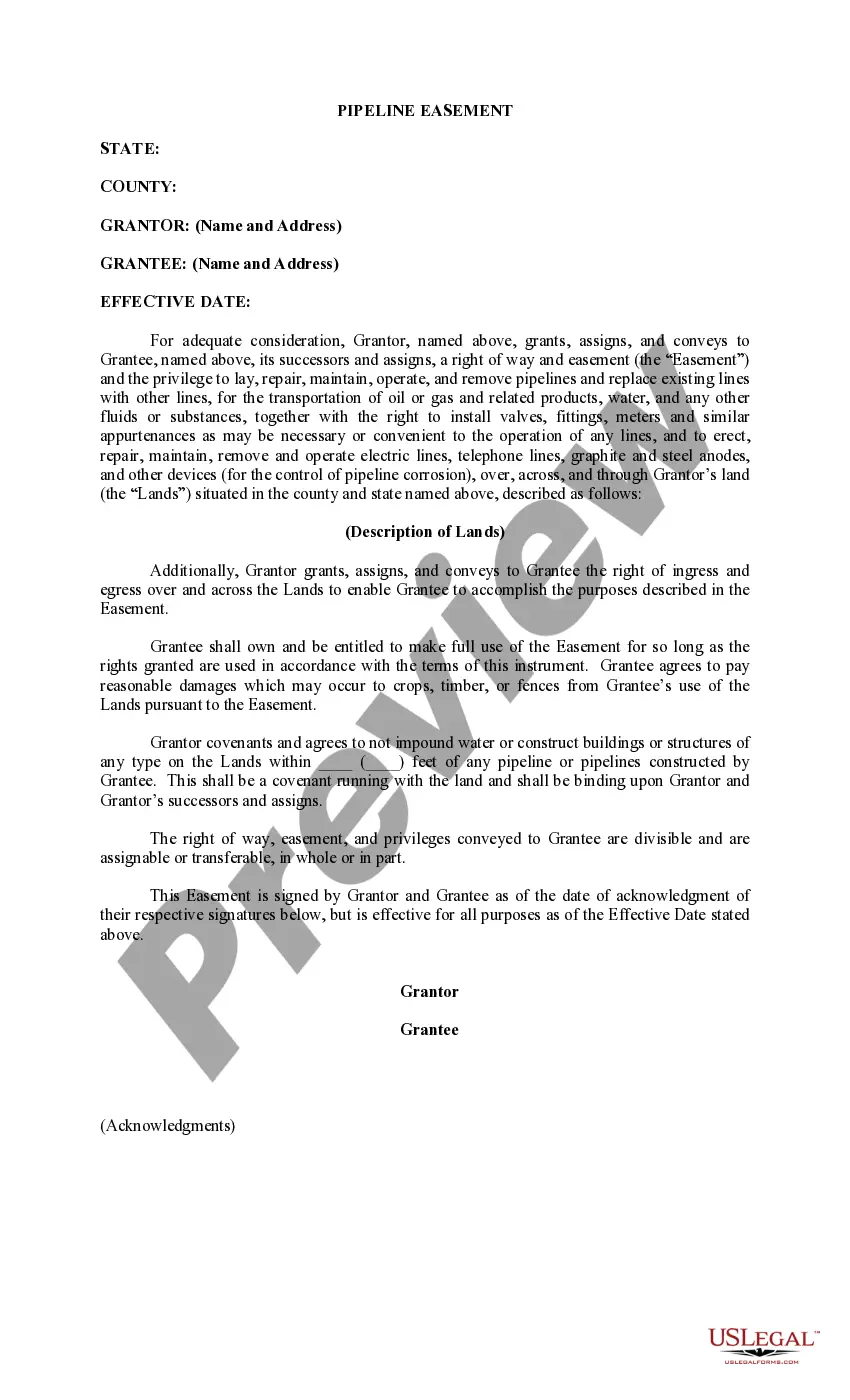
The Pipeline Easement (Including the Right to Install Meters and Equipment) is a legal document that allows a property owner (Grantor) to grant another party (Grantee) the right to install, maintain, and operate pipelines on their land. This easement also includes essential rights related to installing meters and equipment necessary for the operation of these pipelines. Unlike standard property rental agreements, this form specifically addresses the installation and management of pipeline infrastructure, making it unique and tailored for this purpose.
What’s included in this form
- Name and addresses of the Grantor and Grantee.
- The effective date of the easement.
- Description of the property (Lands) covered by the easement.
- Rights granted for ingress and egress, and installation of pipelines and related facilities.
- Obligations of the Grantee regarding land use and compensation for damages.
- Termination and transferability of easement rights.
When to use this document
This form should be used when a landowner wants to allow another entity to lay, operate, and maintain pipelines on their property. Scenarios include agreements with utility companies for the transportation of oil, gas, or water, as well as when installing meters and equipment for managing those utilities. It is ideal for property developers, utility companies, and landowners engaged in energy or water resource management.
Who this form is for
This form is appropriate for:
- Property owners granting easements for pipeline installation.
- Utility companies needing access for pipeline management.
- Developers involved in resource extraction, including oil and gas.
- Landowners negotiating with utility providers.
How to complete this form
- Identify and enter the names and addresses of both the Grantor and Grantee.
- Clearly state the effective date of the easement.
- Provide a detailed description of the property where the easement applies.
- Outline the rights being granted, including access for installation and maintenance.
- Review and specify any obligations related to damages or land use restrictions.
- Ensure both parties sign the form along with any required acknowledgments.
Does this document require notarization?
To make this form legally binding, it must be notarized. Our online notarization service, powered by Notarize, lets you verify and sign documents remotely through an encrypted video session.
Get your form ready online
Our built-in tools help you complete, sign, share, and store your documents in one place.
Make edits, fill in missing information, and update formatting in US Legal Forms—just like you would in MS Word.
Download a copy, print it, send it by email, or mail it via USPS—whatever works best for your next step.
Sign and collect signatures with our SignNow integration. Send to multiple recipients, set reminders, and more. Go Premium to unlock E-Sign.
If this form requires notarization, complete it online through a secure video call—no need to meet a notary in person or wait for an appointment.
We protect your documents and personal data by following strict security and privacy standards.

Make edits, fill in missing information, and update formatting in US Legal Forms—just like you would in MS Word.

Download a copy, print it, send it by email, or mail it via USPS—whatever works best for your next step.

Sign and collect signatures with our SignNow integration. Send to multiple recipients, set reminders, and more. Go Premium to unlock E-Sign.

If this form requires notarization, complete it online through a secure video call—no need to meet a notary in person or wait for an appointment.

We protect your documents and personal data by following strict security and privacy standards.
Common mistakes to avoid
- Not including a complete and accurate description of the property.
- Failing to specify all rights and obligations of both parties.
- Neglecting to sign and date the form correctly.
- Overlooking local regulations that may affect the use of easements.
Why complete this form online
- Convenient access to professionally drafted legal forms from home.
- Editable templates that allow customization to meet specific needs.
- Instant downloads that save time compared to traditional legal services.
- Reliable resources drafted by licensed attorneys, ensuring compliance with legal standards.
Quick recap
- The Pipeline Easement allows utility companies or others to install and maintain pipelines on private land.
- It is crucial to outline all rights and obligations clearly to avoid disputes.
- Consult local regulations to ensure compliance with any specific requirements.
- This form is readily available for quick and easy online completion.
Looking for another form?



Form popularity
FAQ
You are willing to either share in or bear the cost of land maintenance and are now ready to negotiate. Reducing the impact the easement has on the neighbor will help convince him to say yes. Include in the negotiations elements that include his continued use and rights to share that parcel of land with you.
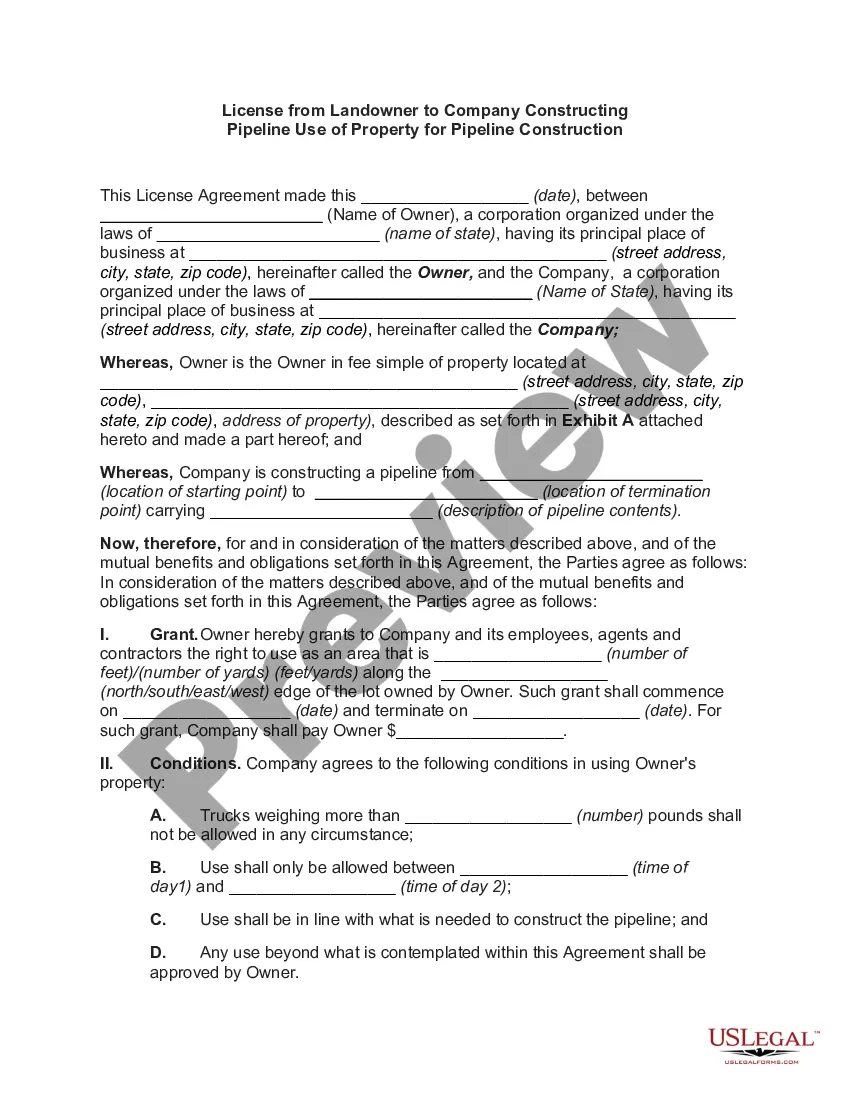
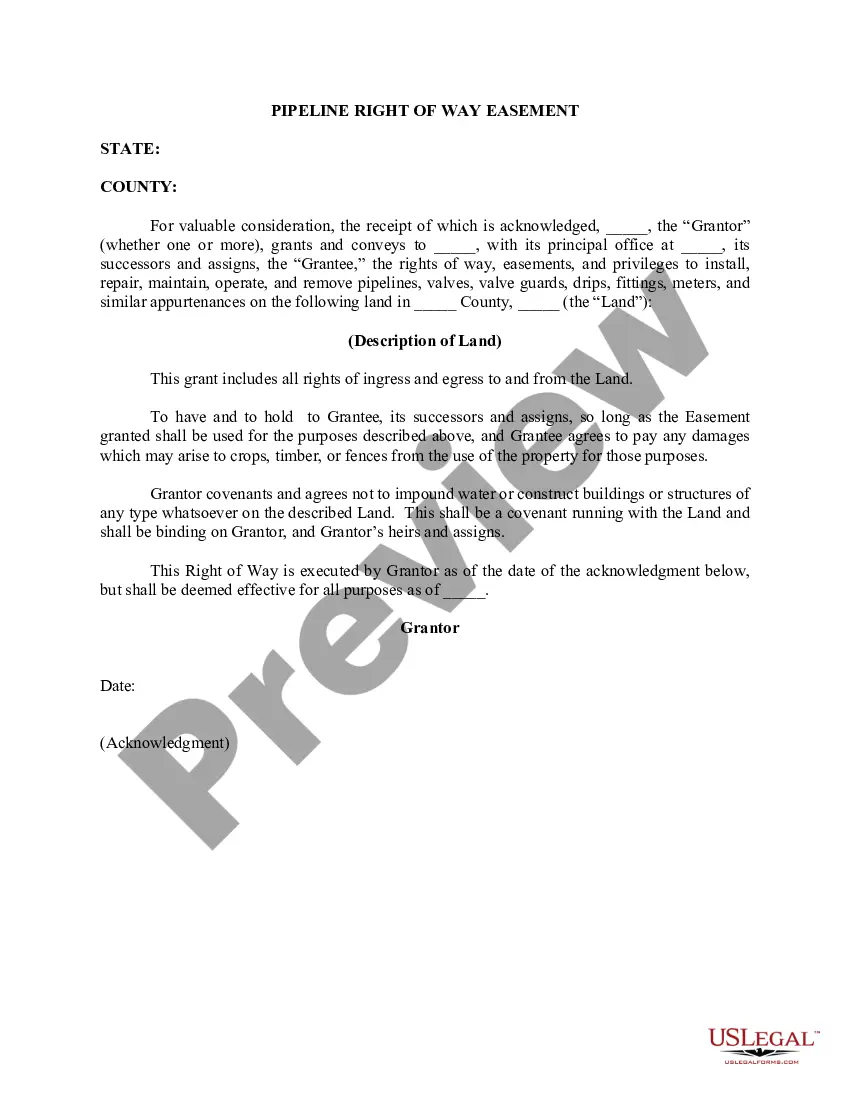
A pipeline right-of-way is a strip of land over and around natural gas pipelines, with some of the property owner's legal rights have been granted to a pipeline operator.These easements can be both permanent and temporary, with temporary easements granting the pipeline company additional space during construction.
A pipeline easement specifically gives the easement holder the right to build and maintain a pipeline on a landowner's property. It doesn't grant the easement holder actual ownership of the land, just a right to use the land for pipeline purposes.
Thanks in advance. You can build but it has to be open on two sides. The concern is that if a leak developed in the gas line it could fill your shed up with gas and create a heck of a dangerous situation. At some point a lean-to was added to my garage over top of a gas line (before I owned the place).
API recommends setbacks of 50 feet from petroleum and hazardous liquids lines for new homes, businesses, and places of public assembly (API 2003). It also recommends 25 feet for garden sheds, septic tanks, and water wells and 10 feet for mailboxes and yard lights.
If an easement is 50 rods long, that is almost an acre. In a recent case, a pipeline company paid some owners $180 per rod and others $767 per rod for the same project.
How much money should landowners get when an oil or gas pipeline crosses their land? As it stands, landowners receive a one-time payment roughly based on the length of the pipeline, with rates varying from $5 to $50 per foot or more for a Marcellus or Utica shale pipeline right-of-way agreement.