North Carolina Acknowledgment for Corporation
Understanding this form
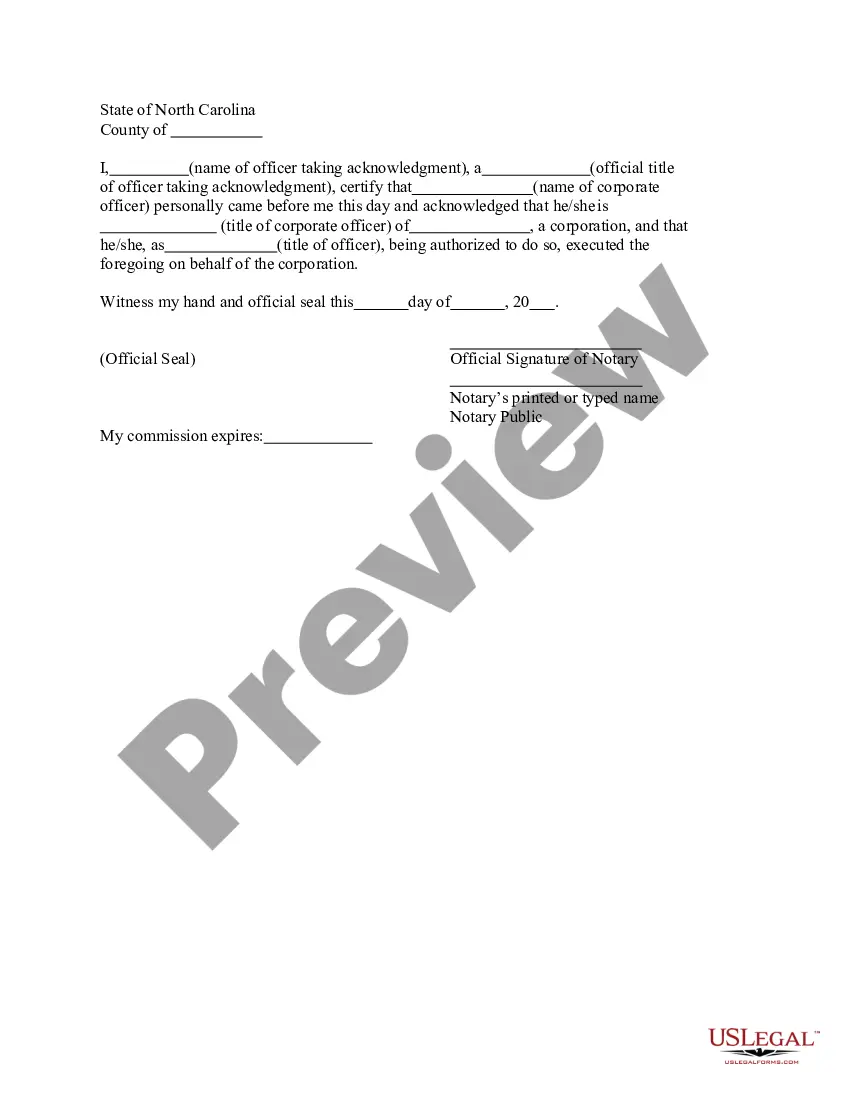
The Acknowledgment for Corporation is a legal document used to certify that a corporate officer has acknowledged their official capacity and the execution of documents on behalf of the corporation. This form serves as a critical record, distinguishing it from other corporate forms by providing verification directly from a notary or designated officer, ensuring authenticity and compliance with corporate governance requirements.
Key parts of this document
- Name of the officer taking acknowledgment.
- Official title of the officer.
- Name of the corporation represented.
- Signature of the officer.
- Date and notary details to verify the acknowledgment.
Common use cases
This form is essential in situations where a corporate officer needs to formally acknowledge their role or actions taken on behalf of the corporation, such as signing contracts, agreements, or official documents. It may also be required during corporate transactions, audits, or in response to regulatory inquiries where proof of authorization is necessary.
Intended users of this form
This form is intended for:
- Corporate officers who need to attest to their official capacity.
- Notaries public responsible for witnessing and verifying corporate acknowledgments.
- Legal practitioners handling corporate governance issues.
Completing this form step by step
- Identify the officer who will take the acknowledgment.
- Specify the official title of the officer.
- Fill in the name of the corporation.
- Ensure that the officer signs the form in the presence of a notary.
- Enter the date of acknowledgment and the notary's details.
Notarization requirements for this form
This form needs to be notarized to ensure legal validity. US Legal Forms provides secure online notarization powered by Notarize, allowing you to complete the process through a verified video call, available anytime.
Get your form ready online
Our built-in tools help you complete, sign, share, and store your documents in one place.
Make edits, fill in missing information, and update formatting in US Legal Forms—just like you would in MS Word.
Download a copy, print it, send it by email, or mail it via USPS—whatever works best for your next step.
Sign and collect signatures with our SignNow integration. Send to multiple recipients, set reminders, and more. Go Premium to unlock E-Sign.
If this form requires notarization, complete it online through a secure video call—no need to meet a notary in person or wait for an appointment.
We protect your documents and personal data by following strict security and privacy standards.

Make edits, fill in missing information, and update formatting in US Legal Forms—just like you would in MS Word.

Download a copy, print it, send it by email, or mail it via USPS—whatever works best for your next step.

Sign and collect signatures with our SignNow integration. Send to multiple recipients, set reminders, and more. Go Premium to unlock E-Sign.

If this form requires notarization, complete it online through a secure video call—no need to meet a notary in person or wait for an appointment.

We protect your documents and personal data by following strict security and privacy standards.
Common mistakes to avoid
- Failing to include the correct name of the corporation.
- Omitting the officer's official title.
- Not having the form notarized when required.
- Leaving out the date of acknowledgment.
Why complete this form online
- Convenient access to official templates at any time.
- Editability allows customization to fit specific corporate needs.
- Reliable legal formatting ensures conformity with state requirements.
Legal use & context
- This form can reinforce the validity of corporate decisions by providing an official record.
- Use of this form can prevent disputes over authority and authorization in legal and corporate settings.
- Acknowledgments are commonly required by banks, regulatory agencies, and for compliance with corporate bylaws.
What to keep in mind
- The Acknowledgment for Corporation is crucial for validating corporate actions.
- It must be completed accurately and notarized to ensure legal compliance.
- Utilizing this form online offers convenience and ensures adherence to state requirements.
Looking for another form?
Form popularity
FAQ
In NC, notary publics cannot attest that something is a true copy, the most they can do is attest that you acknowledge or swear the document is a true copy.North Carolina notaries cannot certify that a copy is a true copy.
NOTE- The written, open book examination is included with the application to become a notary. New applying notaries are required to complete 3 hours of instruction. Renewing notary applicants who have let their commission lapse must take the required 3 hours of instruction.
There is no legal requirement for a North Carolina notary public to use a journal to record notarial acts. It is, however, recommended by most to keep one.
It depends. You may notarize a document that does not have pre-printed notarial wording as long as the signer tells you what type of notarization is needed.As nonattorneys, Notaries cannot decide the type of notarization to perform on a document because the choice can have important legal ramifications.
The purpose of an acknowledgment is for a signer, whose identity has been verified, to declare to a Notary or notarial officer that he or she has willingly signed a document.The signer may either sign the document before appearing before you, or in your presence.
Willful failure to deliver journals to the county clerk of the county in which the Notary's oath and bond are filed is a misdemeanor and subjects the Notary to personal liability to any person injured as a result.Failing to retain journal records and turn them in can result in a Notary being fined $50-$500.
For your reference, according to the Notary Public Section of the National Association of Secretaries of State, the following states, and District of Columbia, require notaries to maintain records of notarial acts: Arizona, California, Colorado, Hawaii, Louisiana, Maryland, Massachusetts, Mississippi, Missouri, Montana
Only you, as the notary, may make corrections to the notary certificate. Illegible/ Expired Notary Seal: Stamp impressions that are too dark, too light, incomplete, smudged, or in any way unreadable may cause an otherwise acceptable document to be rejected for its intended use.
Should Every Notary Keep A Journal? Yes. Most states require or strongly recommend that Notaries own and maintain a journal or record book of the acts they perform.The Notary's journal record provided evidence that the loan documents had been notarized and helped keep the signers from losing their home.