Louisiana Warranty Deed to convert Community Property to Joint Tenancy
Understanding this form
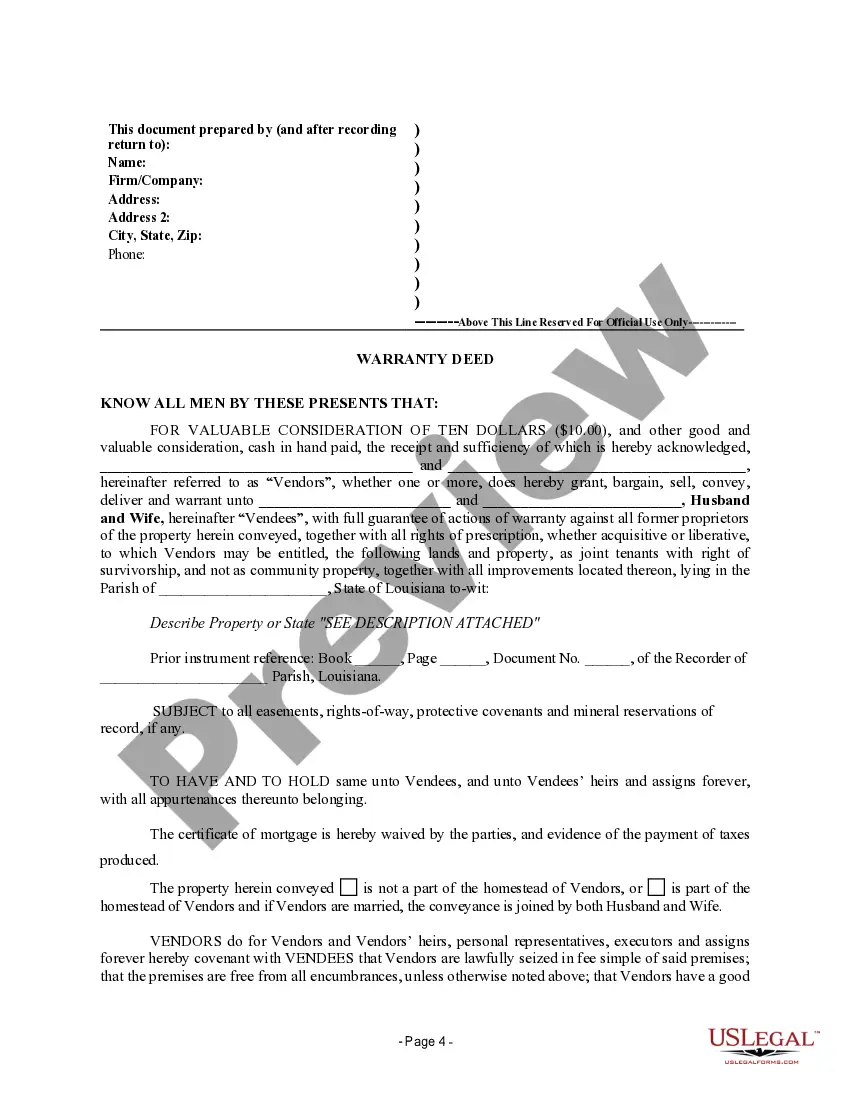
The Warranty Deed to Convert Community Property to Joint Tenancy is a legal document that enables a married couple to change their jointly owned property from community property to a joint tenancy holding. This form is essential for couples wanting to ensure that their property will transfer to the surviving spouse without going through probate upon death. Unlike a standard warranty deed, this form specifically addresses the needs of couples in community property states, providing clarity on ownership and inheritance rights.
Key components of this form
- Identification of the vendors (husband and wife) converting the property.
- Description of the property being transferred.
- Disclaimers regarding any current encumbrances or liens on the property.
- Warranties given by the vendors regarding their right to sell the property.
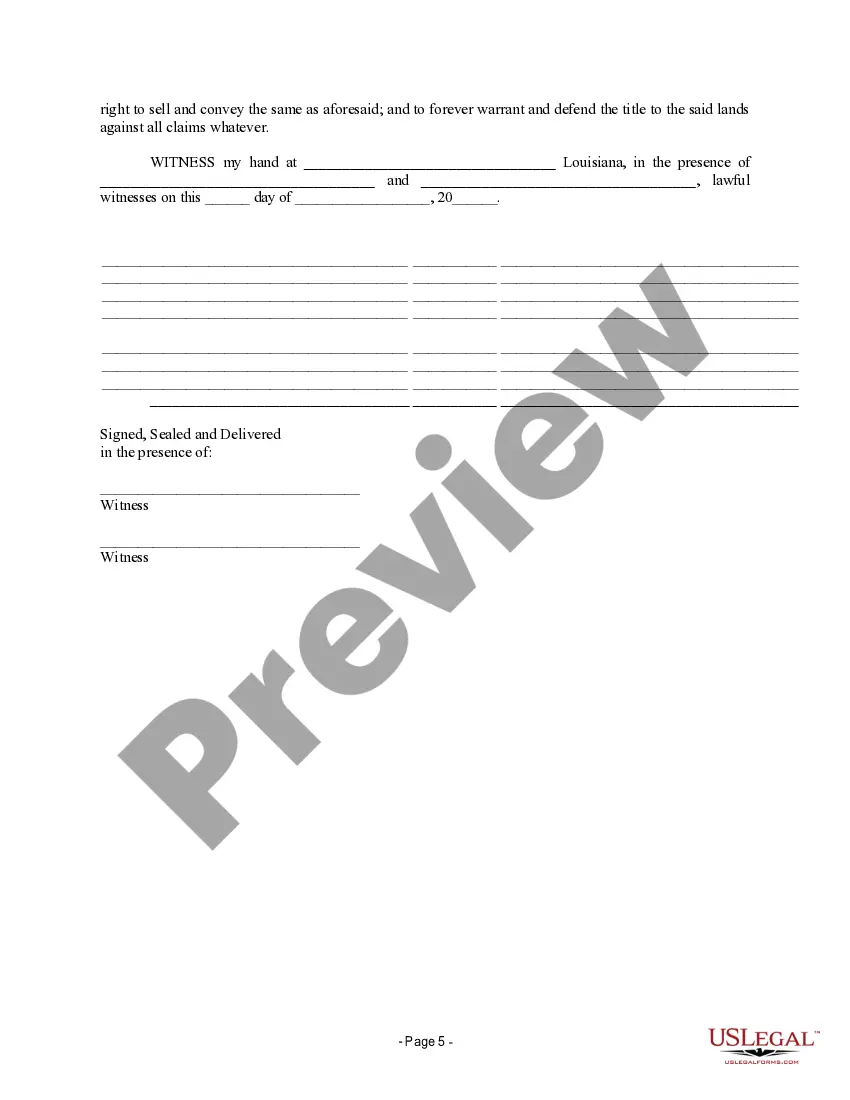
- Signatures of both vendors and witnesses.
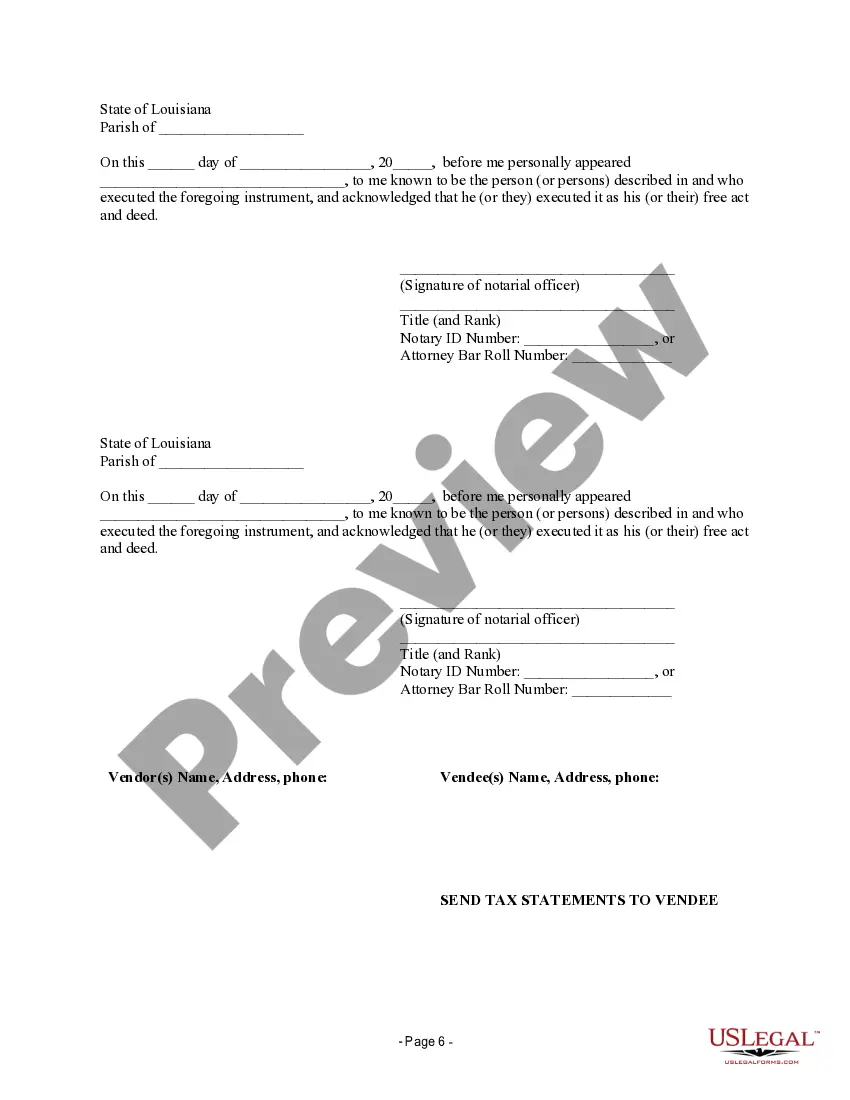
- Notarization clause to validate the deed upon execution.





Common use cases
This form is used when a married couple who owns property as community property wishes to convert their ownership to joint tenancy. This conversion can simplify the transfer of ownership upon the death of one spouse, making it particularly useful for estate planning. It is often used in situations where couples want to ensure their surviving spouse inherits the property directly.
Who needs this form
- Married couples owning property as community property.
- Couples wishing to simplify property transfer upon death.
- Individuals planning their estate and wanting to ensure their spouse inherits property without complications.
Completing this form step by step
- Identify the vendors by entering the names of both spouses at the top of the form.
- Provide a detailed description of the property being converted, including reference to the prior instrument.
- Specify whether the property is part of the homestead or not.
- Both vendors must sign the form in the presence of witnesses and a notary public.
- Complete the notary acknowledgment section to validate the deed.
Does this document require notarization?
Yes, this form must be notarized to be legally valid. Notarization ensures that the identities of the parties involved are verified and that the signatures are authentic. US Legal Forms offers an integrated online notarization service 24/7, allowing you to complete the process securely via video call without the need for travel.
Get your form ready online
Our built-in tools help you complete, sign, share, and store your documents in one place.
Make edits, fill in missing information, and update formatting in US Legal Forms—just like you would in MS Word.
Download a copy, print it, send it by email, or mail it via USPS—whatever works best for your next step.
Sign and collect signatures with our SignNow integration. Send to multiple recipients, set reminders, and more. Go Premium to unlock E-Sign.
If this form requires notarization, complete it online through a secure video call—no need to meet a notary in person or wait for an appointment.
We protect your documents and personal data by following strict security and privacy standards.

Make edits, fill in missing information, and update formatting in US Legal Forms—just like you would in MS Word.

Download a copy, print it, send it by email, or mail it via USPS—whatever works best for your next step.

Sign and collect signatures with our SignNow integration. Send to multiple recipients, set reminders, and more. Go Premium to unlock E-Sign.

If this form requires notarization, complete it online through a secure video call—no need to meet a notary in person or wait for an appointment.

We protect your documents and personal data by following strict security and privacy standards.
Avoid these common issues
- Failing to correctly identify both spouses as vendors.
- Leaving out essential property description details.
- Not having the document properly witnessed or notarized.
- Assuming the form is valid without checking local jurisdiction requirements.
Why use this form online
- Convenient access to legal forms to complete at your own pace.
- Editability allows for customization to fit your specific situation.
- Reliability of forms drafted by licensed attorneys to ensure legal compliance.
Looking for another form?

Form popularity
FAQ
The General Rule. In the great majority of states, if you and the other owners call yourselves "joint tenants with the right of survivorship," or put the abbreviation "JT WROS" after your names on the title document, you create a joint tenancy. A car salesman or bank staffer may assure you that other words are enough.
Adding someone to your tenancy There's no limit to the number of people who can be joint tenants of a property. Joint tenants are all equally responsible for paying the rent on a property and for sticking to the terms of the tenancy agreement.
A co-owner in a property who is willing to give up his or her rights over the property can resort to the relinquishment deed which allows for a smooth transfer. Often, legal heirs who are giving up their stake in a property are asked to sign this deed for clarity. For example, take Mahima Sinha's case.
There are three common ways to title property between spouses. The 'joint tenant' approach is the least common and usually must include the language 'with right of survivorship and not as tenants in common. ' Spouses typically acquire title as tenants by the entireties, which only applies to spouses.
Here are some of the options: Joint Ownership. If mom, daughter, and (perhaps) son-in-law own the house as joint tenants with right of survivorship, when mom passes away the house will go to the other owners without going through probate.
To hold a real estate property in joint tenancy, you and the co-owners have to write the abbreviation for joint tenants with the right of survivorship, or JTWROS, on the official real estate deed or title. This creates a legally binding joint tenancy.
You can assign your tenancy to your husband, wife or civil partner if they live with you. If you don't live with a married or civil partner, you can assign to any of the following family members, but only if the person has lived with you for at least 1 year: an unmarried partner. an adult child or grandchild.
Historically, the common law required that in order for a joint tenancy to be created, the co-owners must share the four unities of (1) time the property interest must be acquired by both tenants at the same time; (2) title - both tenants must have the same title to the property in the deed; (3) interest - both