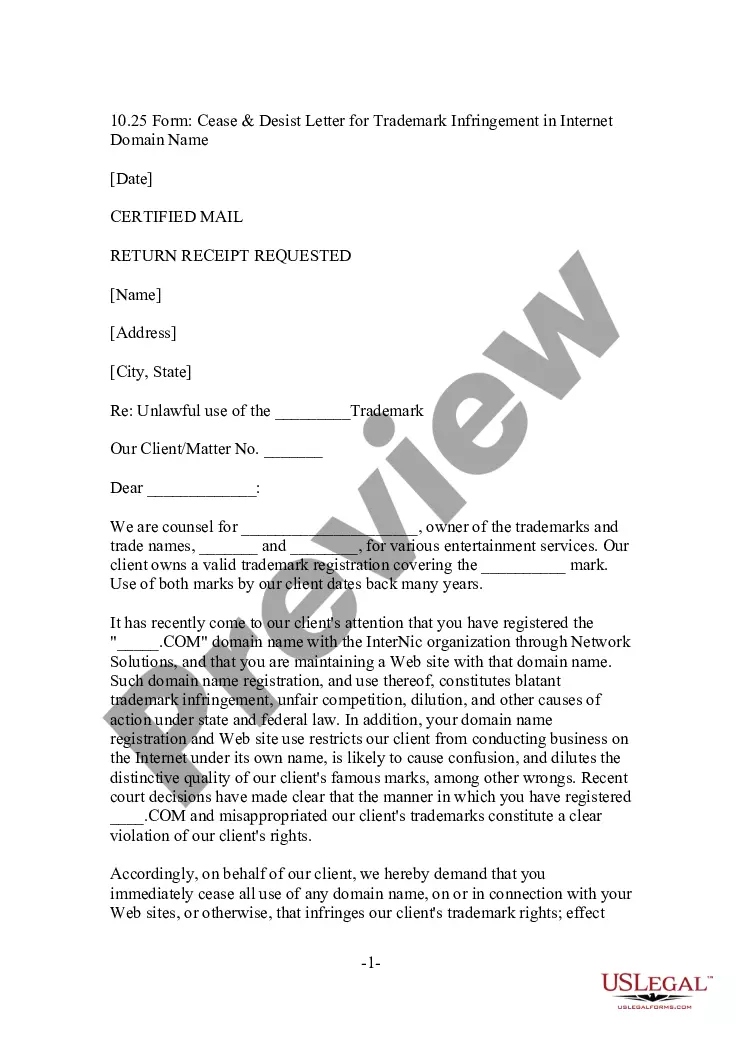
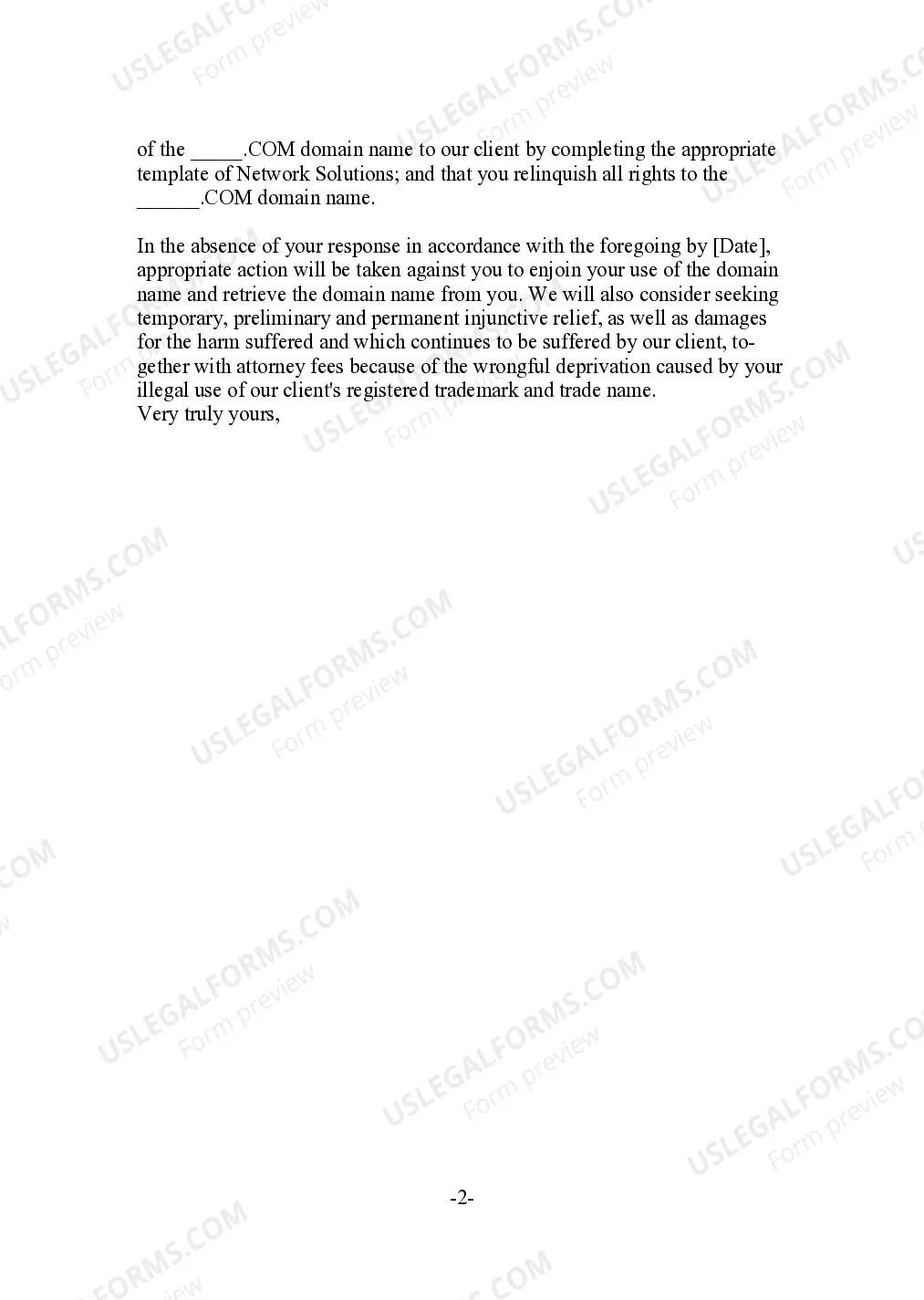
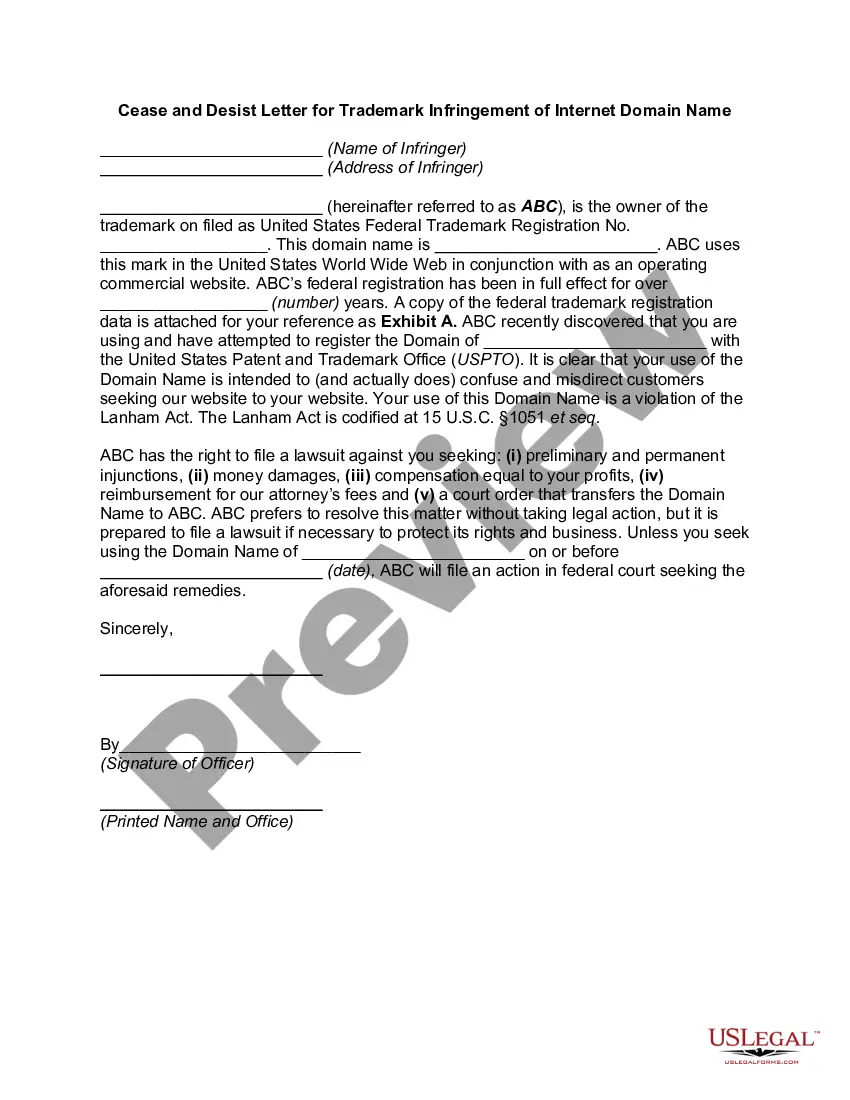
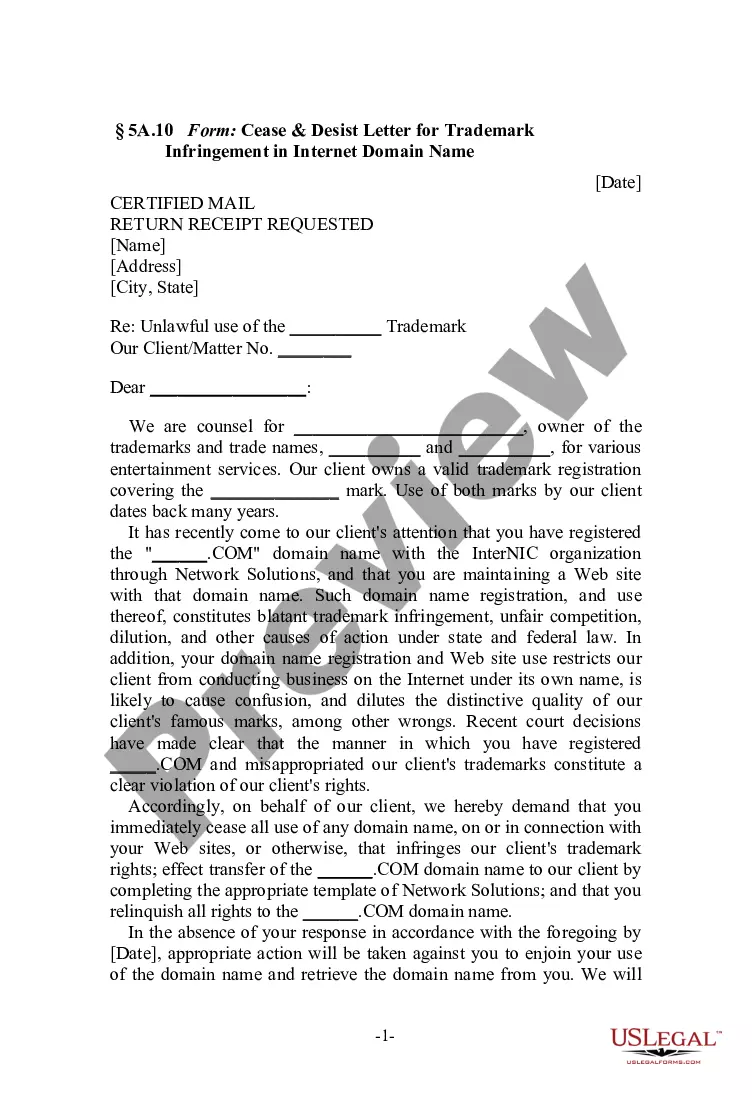
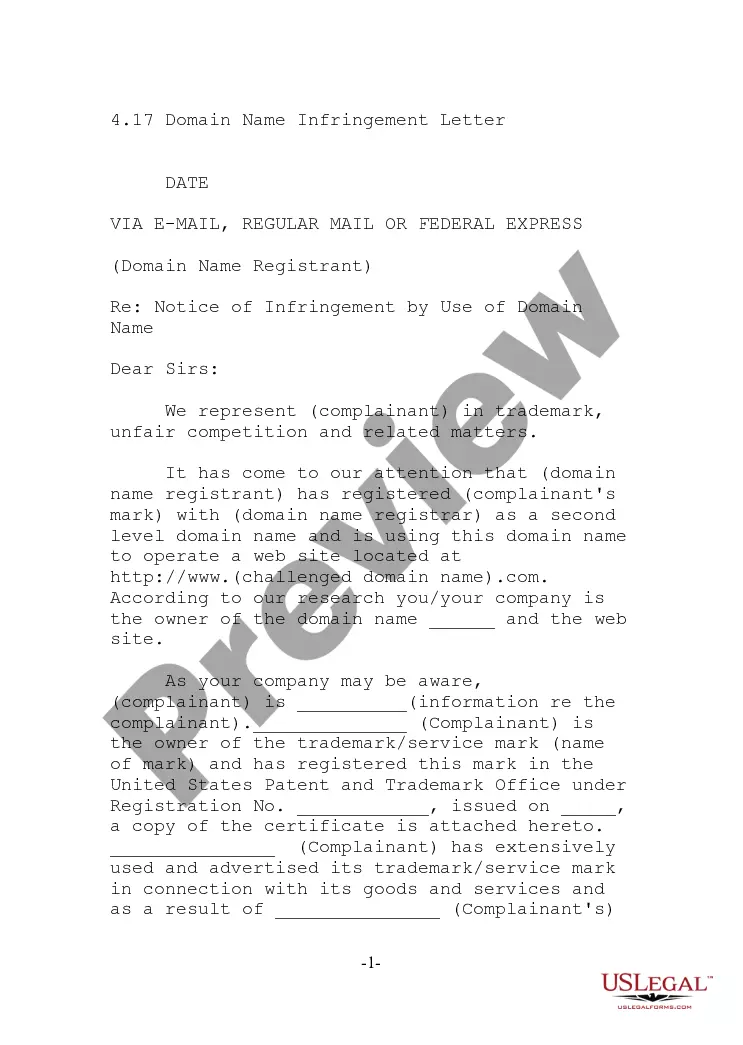
Montana Form - Cease and Desist Letter For Trademark Infringement Internet Domain Name
Description
Get your form ready online
Our built-in tools help you complete, sign, share, and store your documents in one place.
Make edits, fill in missing information, and update formatting in US Legal Forms—just like you would in MS Word.
Download a copy, print it, send it by email, or mail it via USPS—whatever works best for your next step.
Sign and collect signatures with our SignNow integration. Send to multiple recipients, set reminders, and more. Go Premium to unlock E-Sign.
If this form requires notarization, complete it online through a secure video call—no need to meet a notary in person or wait for an appointment.
We protect your documents and personal data by following strict security and privacy standards.

Make edits, fill in missing information, and update formatting in US Legal Forms—just like you would in MS Word.

Download a copy, print it, send it by email, or mail it via USPS—whatever works best for your next step.

Sign and collect signatures with our SignNow integration. Send to multiple recipients, set reminders, and more. Go Premium to unlock E-Sign.

If this form requires notarization, complete it online through a secure video call—no need to meet a notary in person or wait for an appointment.

We protect your documents and personal data by following strict security and privacy standards.
Looking for another form?


How to fill out Form - Cease And Desist Letter For Trademark Infringement Internet Domain Name?
You are able to devote time online looking for the legitimate document format that meets the state and federal demands you will need. US Legal Forms supplies a huge number of legitimate forms that are reviewed by specialists. It is possible to acquire or print the Montana Form - Cease and Desist Letter For Trademark Infringement Internet Domain Name from my service.
If you currently have a US Legal Forms account, you are able to log in and click the Acquire key. Afterward, you are able to full, modify, print, or indication the Montana Form - Cease and Desist Letter For Trademark Infringement Internet Domain Name. Every legitimate document format you buy is your own for a long time. To have yet another version for any obtained form, proceed to the My Forms tab and click the corresponding key.
If you use the US Legal Forms web site the very first time, follow the basic directions below:
- Very first, make certain you have selected the best document format for your state/area that you pick. Browse the form information to make sure you have picked out the proper form. If offered, utilize the Review key to look from the document format also.
- If you want to get yet another version from the form, utilize the Look for industry to find the format that fits your needs and demands.
- After you have identified the format you want, click on Get now to continue.
- Choose the prices program you want, key in your credentials, and sign up for a merchant account on US Legal Forms.
- Total the deal. You may use your bank card or PayPal account to purchase the legitimate form.
- Choose the structure from the document and acquire it to the gadget.
- Make modifications to the document if possible. You are able to full, modify and indication and print Montana Form - Cease and Desist Letter For Trademark Infringement Internet Domain Name.
Acquire and print a huge number of document themes using the US Legal Forms site, that offers the most important variety of legitimate forms. Use skilled and state-specific themes to tackle your business or individual needs.
Form popularity
FAQ
This type of domain infringement is similar to cybersquatting but occurs when the domain name holder registers a famous trademark. Competing use. Courts have prohibited such behavior from occurring. But competing claims is a complex field that still gets tangled up in many legal disputes.
A domain name cease and desist letter is usually written by an attorney, although sometimes it's written by the trademark owner. The letter is not a court order, so it isn't legally enforceable. The letter contains your opinion, while notifying the offender that they're intruding upon your trademark.
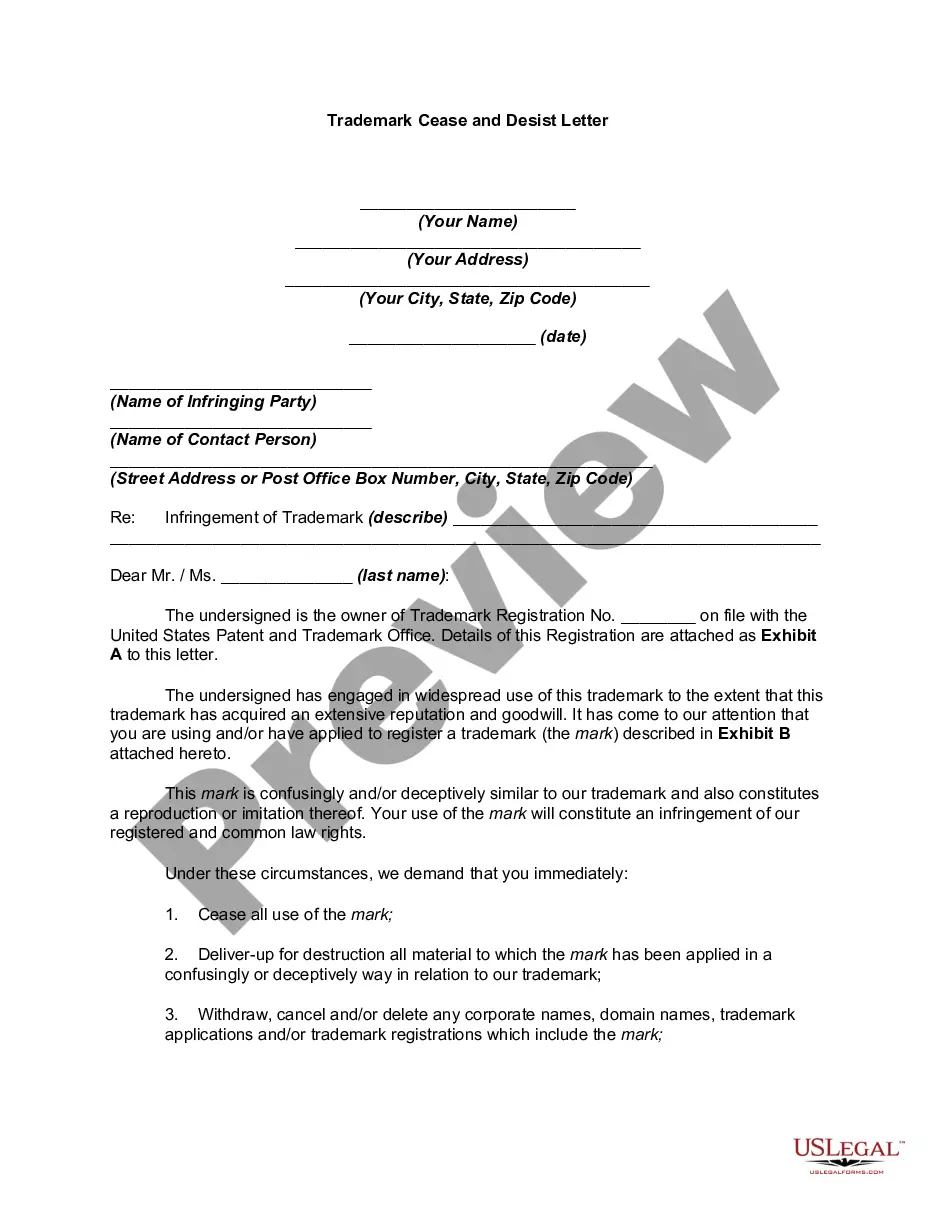
Cease and desist letters can take many forms (here is one example), but there are six essential components. Proper address of infringing party. ... Proof of your trademark rights. ... Details of the infringement. ... Reasonable time frame for infringing party to respond. ... Demand for written assurance of compliance.
If your trademark is being infringed, you need to tell the infringer to stop (typically by sending a ?cease and desist? letter). If that doesn't work and infringement persists, you should bring a lawsuit against the infringer.
Cases where there is clear ownership and infringement of a trademark are typically short and straightforward. Though a report to the court system is the only official report a person must make, a trademark owner can often report trademark infringement to a website or company where the infringement is occurring.
If you believe your trademark is being infringed upon on a specific tech platform, you may be able to report it directly to the company itself. They won't litigate the matter, but they may help delete any infringing material from their site.
In relation to this general concept, domain name trademark infringement thus occurs when a person or entity acquires and/or uses a domain name that is otherwise protected by a trademark.
A trademark owner who believes its mark is being infringed may file a civil action (i.e., lawsuit) in either state court or federal court for trademark infringement, depending on the circumstances.