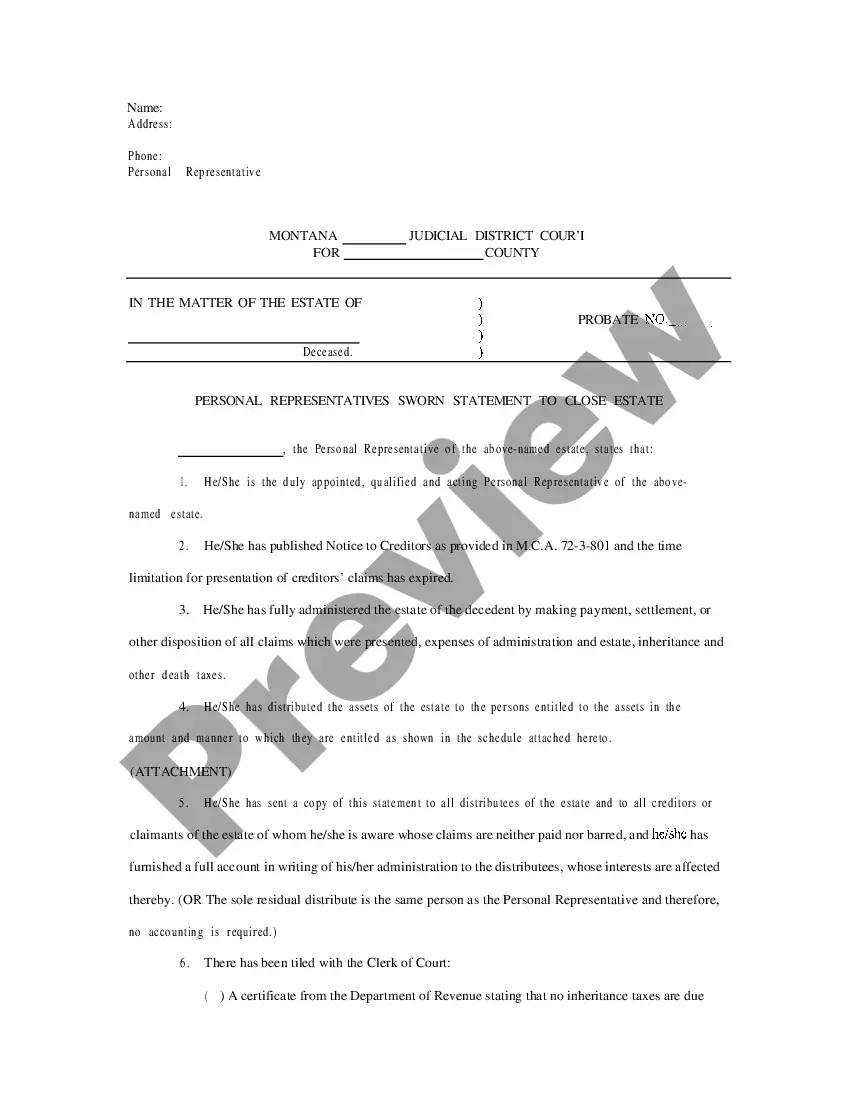
Montana Personal Representative Sworn Statement to Close Estate
Understanding this form
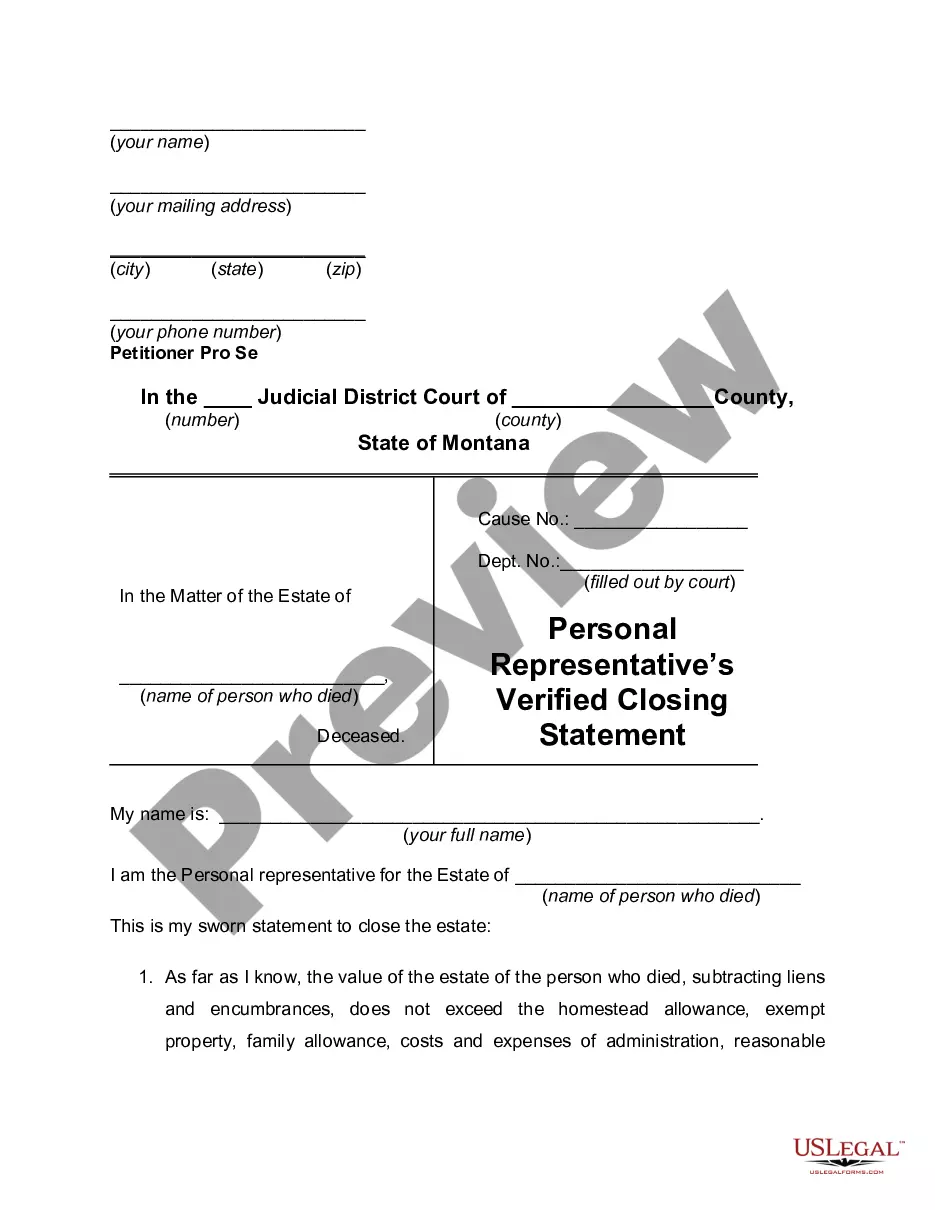
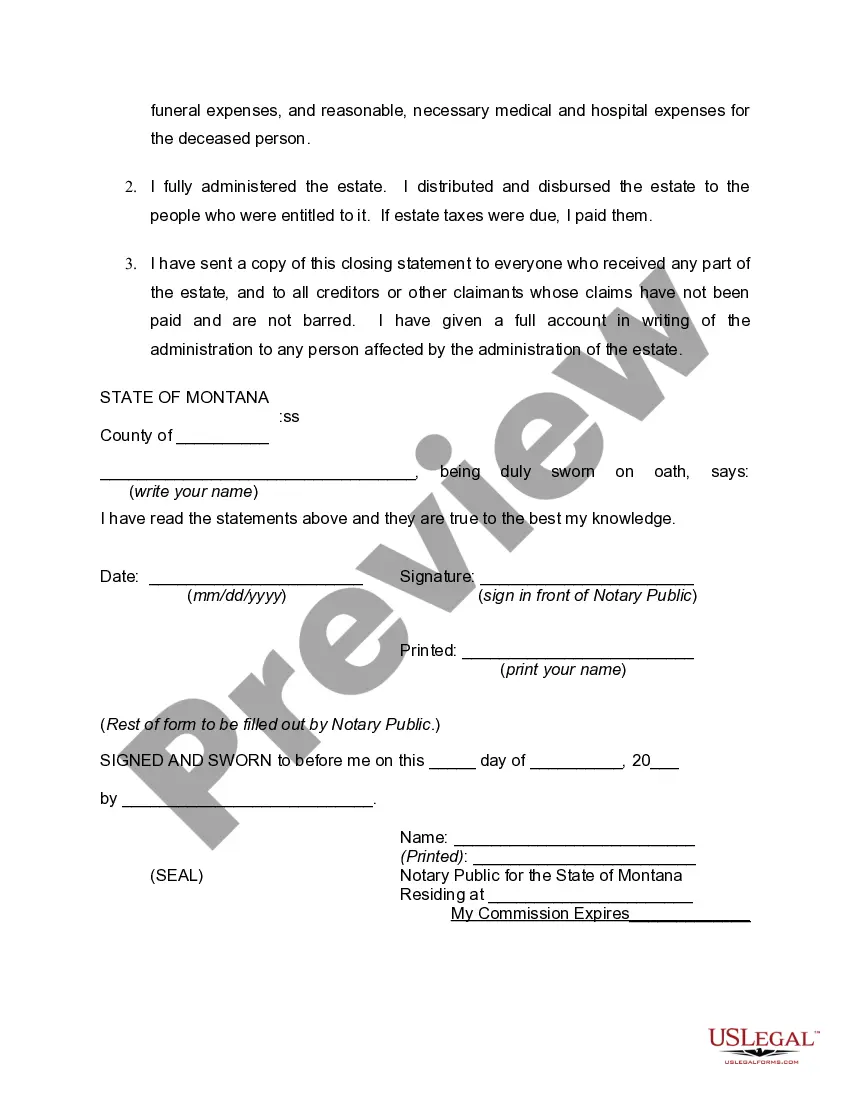
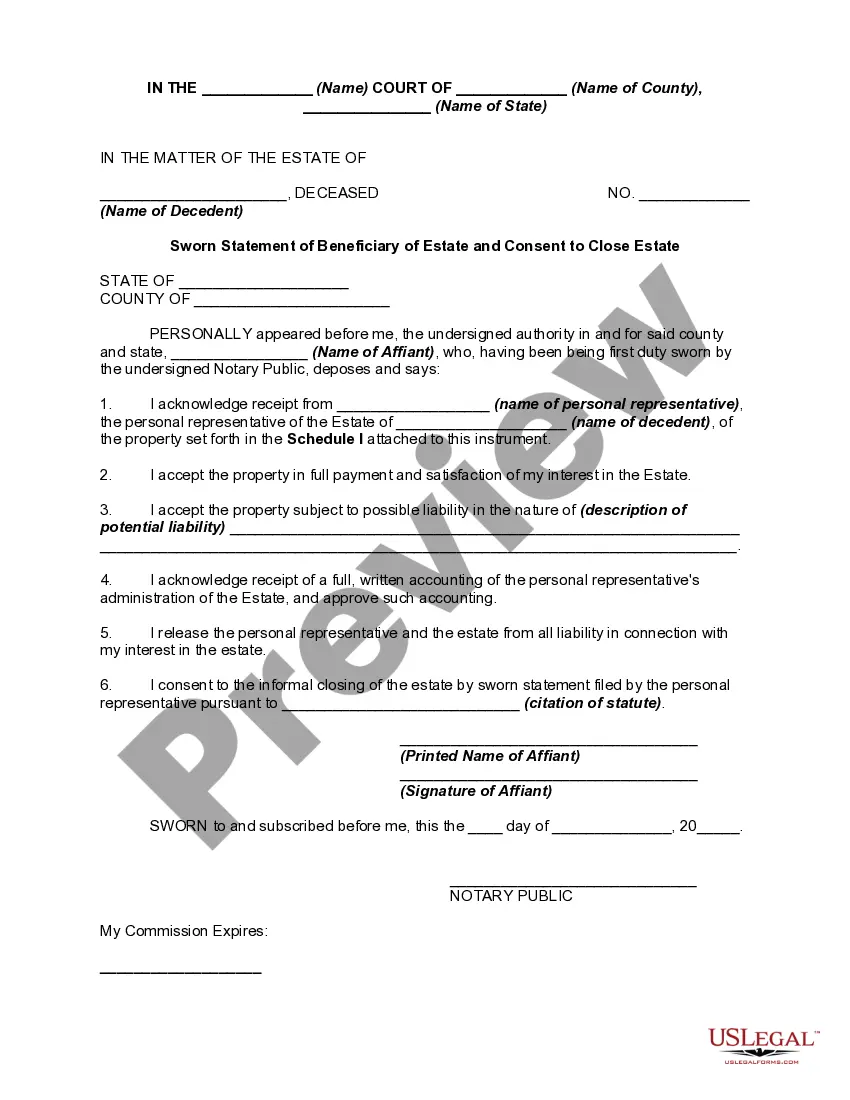
The Personal Representative Sworn Statement to Close Estate is a legal document used in Montana to formally close an estate after the personal representative has managed the estate's affairs. This form serves as a sworn statement asserting that all debts and taxes have been paid and the estate has been properly distributed to beneficiaries. It is essential for ensuring that the estate closure complies with state laws and regulations, distinguishing it from other estate-related documents.
Form components explained
- Petitioner's information including name and address.
- Details of the deceased person including name and estate value.
- Personal Representative's declaration of estate administration and distribution.
- Sworn statement with acknowledgment of laws related to estate settlement.
- Notary acknowledgment section to validate the statements made.
Situations where this form applies
This form should be used when a personal representative has completed the necessary steps to administer an estate and is ready to officially close it. Typical scenarios include when all debts and taxes have been settled, the estate assets have been distributed to beneficiaries, and the personal representative needs to affirm compliance with Montana laws regarding estate closure.
Who should use this form
- Personal representatives or executors of an estate in Montana.
- Individuals responsible for settling a deceased person's financial affairs.
- Estate administrators looking to finalize the estate's closure.
Completing this form step by step
- Identify yourself as the personal representative and provide your mailing address.
- Enter the name of the deceased and the estate value, ensuring it does not exceed allowed allowances.
- Detail the administration of the estate, including debts paid and assets distributed to beneficiaries.
- Sign the form in front of a Notary Public to validate your sworn statement.
- Ensure that a copy of the document is sent to all beneficiaries and creditors.
Does this document require notarization?
Yes, this form must be notarized to be legally valid. Notarization ensures that the sworn statements are authentic and confirms the identity of the person signing the form. US Legal Forms offers integrated online notarization services that are accessible 24/7, allowing for secure video calls and legal equivalence without the need for travel.
Get your form ready online
Our built-in tools help you complete, sign, share, and store your documents in one place.
Make edits, fill in missing information, and update formatting in US Legal Forms—just like you would in MS Word.
Download a copy, print it, send it by email, or mail it via USPS—whatever works best for your next step.
Sign and collect signatures with our SignNow integration. Send to multiple recipients, set reminders, and more. Go Premium to unlock E-Sign.
If this form requires notarization, complete it online through a secure video call—no need to meet a notary in person or wait for an appointment.
We protect your documents and personal data by following strict security and privacy standards.

Make edits, fill in missing information, and update formatting in US Legal Forms—just like you would in MS Word.

Download a copy, print it, send it by email, or mail it via USPS—whatever works best for your next step.

Sign and collect signatures with our SignNow integration. Send to multiple recipients, set reminders, and more. Go Premium to unlock E-Sign.

If this form requires notarization, complete it online through a secure video call—no need to meet a notary in person or wait for an appointment.

We protect your documents and personal data by following strict security and privacy standards.
Common mistakes
- Failing to provide complete and accurate information about the deceased's estate.
- Not notifying all interested parties about the estate's closure.
- Submitting the form without notarization.
Advantages of online completion
- Easy access to the latest version of the form, ensuring compliance with current laws.
- Downloadable format allows for quick printing and completion.
- Eliminates the need for in-person visits to legal offices, saving time and resources.
Looking for another form?
Form popularity
FAQ
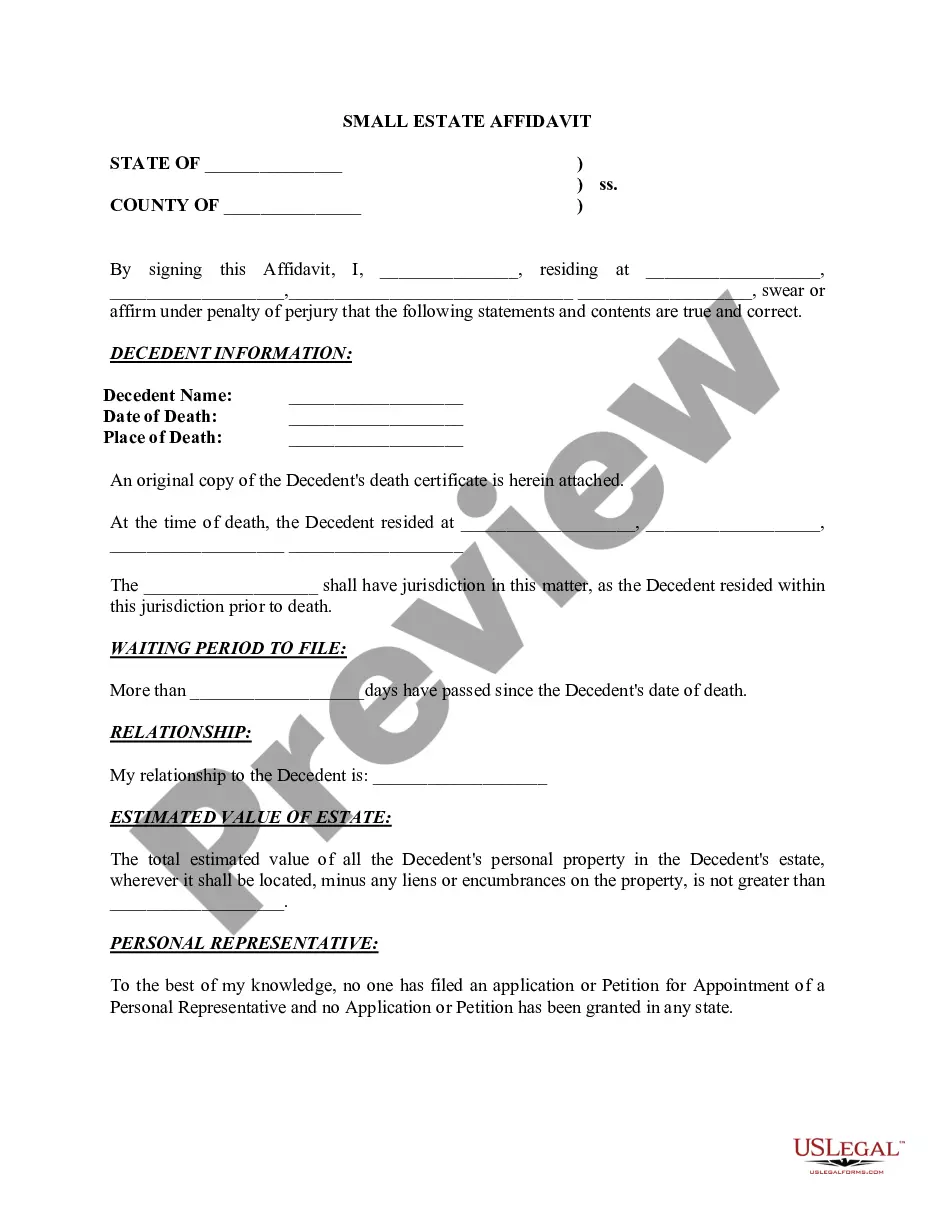
Under Montana statute, where as estate is valued at less than $50,000, an interested party may, thirty (30) days after the death of the decedent, issue a small estate affidavit to to demand payment on any debts owed to the decedent.
1) Petition the court to be the estate representative. 2) Notify heirs and creditors. 3) Change legal ownership of assets. 4) Pay Funeral Expenses, Taxes, Debts and Transfer assets to heirs.
Notify all creditors. File tax returns and pay final taxes. File the final accounting with the probate court. Distribute remaining assets to beneficiaries. File a closing statement with the court.
In Montana, you can make a living trust to avoid probate for virtually any asset you ownreal estate, bank accounts, vehicles, and so on. You need to create a trust document (it's similar to a will), naming someone to take over as trustee after your death (called a successor trustee).
In most states, however, there is the option to use a small estate affidavit when the assets of the estate are under a certain dollar amount, which varies by state. An attorney is not required to file a small estate affidavit, although it may be helpful to consult with one prior to filing the small estate affidavit.