Montana Warranty Deed to Joint Tenants With Right of Survivorship
Overview of this form
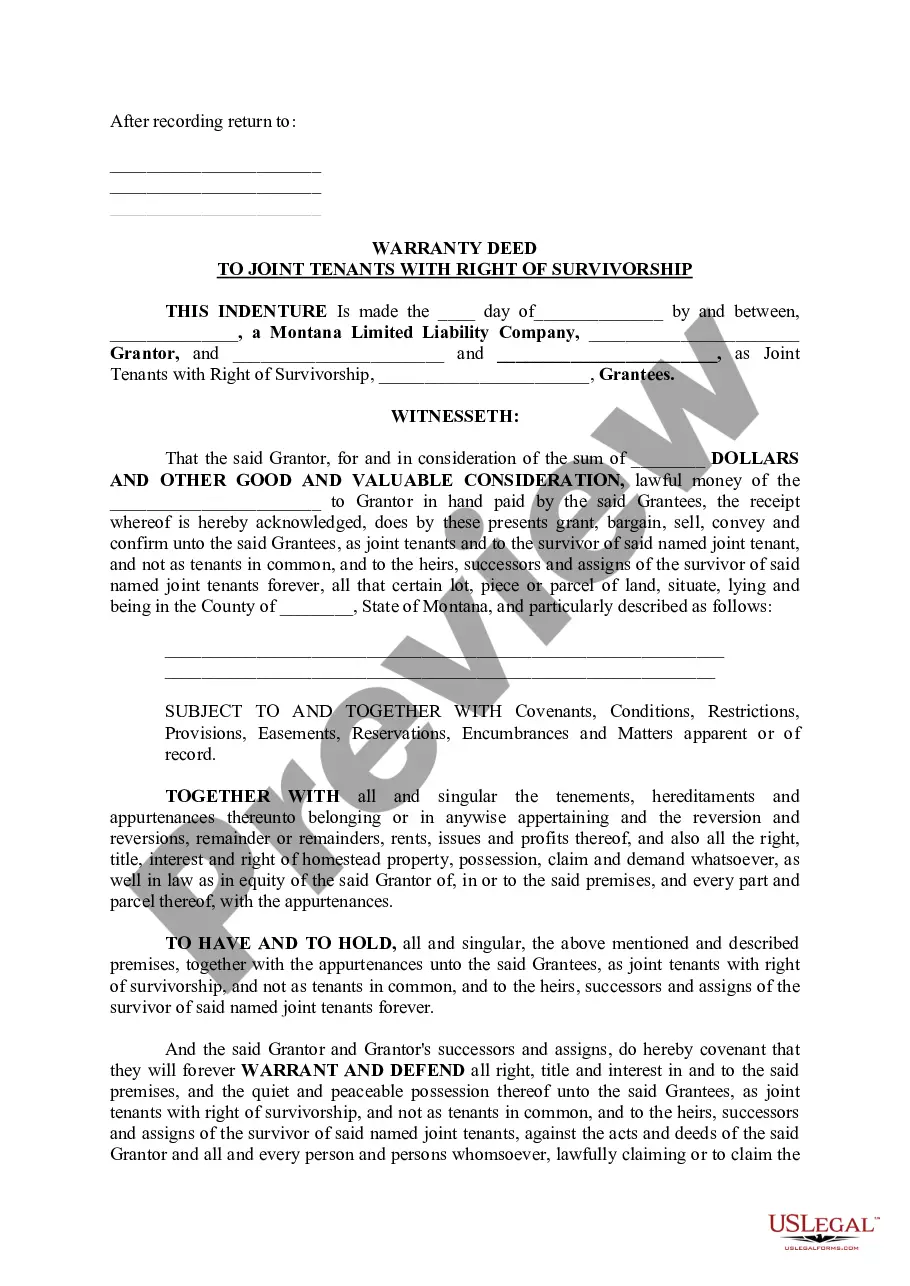
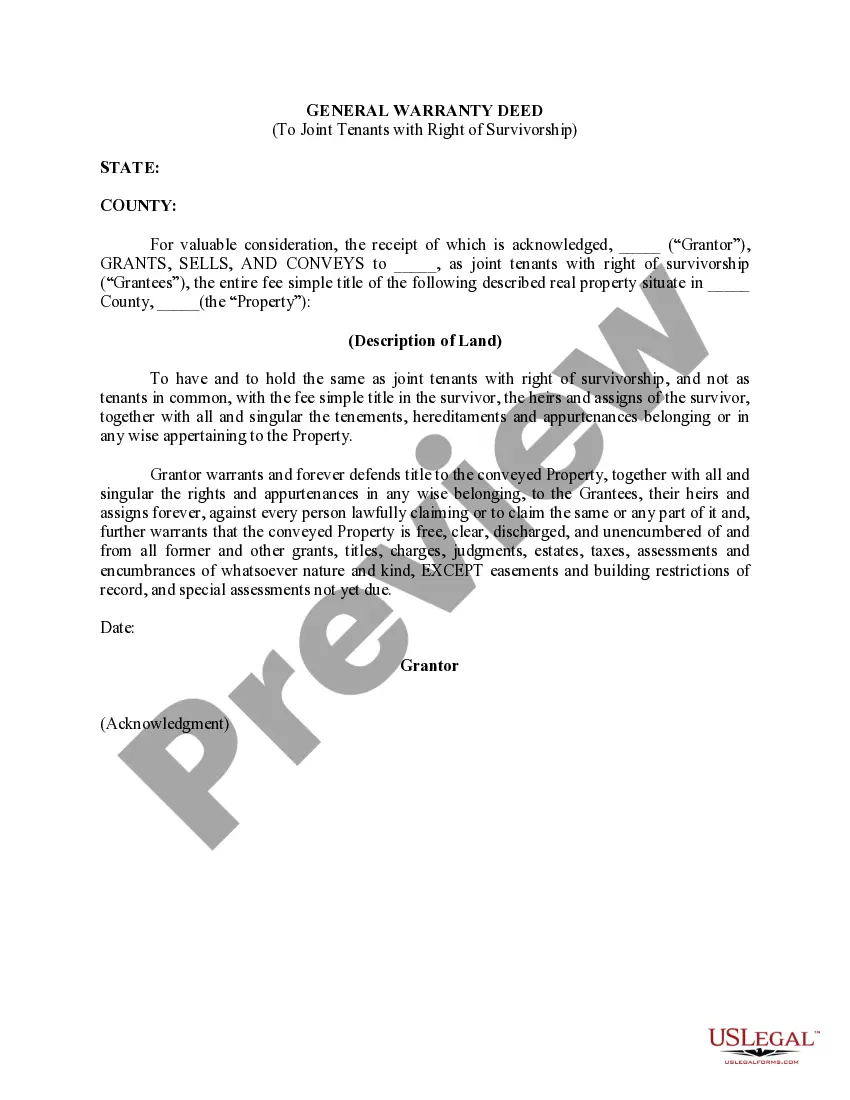
The Warranty Deed to Joint Tenants With Right of Survivorship is a legal document used to transfer property ownership to two or more individuals as joint tenants. This type of deed ensures that if one owner passes away, their share automatically transfers to the surviving owner(s), simplifying the transfer of property without the need for probate. Unlike a standard warranty deed that may simply convey property to multiple owners, this deed specifically includes the right of survivorship, which is a significant legal distinction for property inheritance.
Form components explained
- Parties involved, including grantor and grantees
- Legal description of the property being transferred
- Consideration amount (the price for the property)
- Covenant of warranty, guaranteeing lawful ownership
- Notary acknowledgment for legal validation

When this form is needed
This form is useful in scenarios where individuals wish to co-own property and ensure that the ownership rights automatically pass to the surviving tenant upon one ownerâs death. It is commonly used among family members or partners who want to avoid probate proceedings and ensure a seamless transfer of property ownership.
Who needs this form
- Individuals or couples wanting to co-own real estate
- Families wishing to facilitate property transfer upon the death of a co-owner
- Business partners who require joint ownership of business real estate
Completing this form step by step
- Identify the grantor (property owner) and grantees (new owners).
- Fill in the propertyâs legal description accurately.
- Provide the consideration amount exchanged for the property.
- Sign the deed in the presence of a notary public for validation.
- Record the deed with the appropriate county office to make it official.
Does this form need to be notarized?
Yes, this form must be notarized to be legally valid. Having a notary public validate the signer's identity and attest to the authenticity of the signatures provides legal holding in property transfers. US Legal Forms offers integrated online notarization services for convenience.
Get your form ready online
Our built-in tools help you complete, sign, share, and store your documents in one place.
Make edits, fill in missing information, and update formatting in US Legal Forms—just like you would in MS Word.
Download a copy, print it, send it by email, or mail it via USPS—whatever works best for your next step.
Sign and collect signatures with our SignNow integration. Send to multiple recipients, set reminders, and more. Go Premium to unlock E-Sign.
If this form requires notarization, complete it online through a secure video call—no need to meet a notary in person or wait for an appointment.
We protect your documents and personal data by following strict security and privacy standards.

Make edits, fill in missing information, and update formatting in US Legal Forms—just like you would in MS Word.

Download a copy, print it, send it by email, or mail it via USPS—whatever works best for your next step.

Sign and collect signatures with our SignNow integration. Send to multiple recipients, set reminders, and more. Go Premium to unlock E-Sign.

If this form requires notarization, complete it online through a secure video call—no need to meet a notary in person or wait for an appointment.

We protect your documents and personal data by following strict security and privacy standards.
Common mistakes to avoid
- Failing to provide a clear legal description of the property.
- Not having the deed notarized, which can invalidate the transfer.
- Incorrectly identifying the parties involved in the transaction.
- Neglecting to record the deed with the county office.
Benefits of using this form online
- Convenience of downloading and printing the form at any time.
- Editability allows customization to fit specific requirements.
- Access to templates drafted by licensed attorneys ensures relevance and reliability.
Looking for another form?
Form popularity
FAQ
This is known as 'Severing the Joint Tenancy'. It requires service of a written notice of change the 'severance'. It can be done without the other owner's cooperation or agreement. It is recorded at the Land Registry, and the other owner will know it has been done but only 'after the event' so to speak.
In title law, when we talk about tenants, we're talking about people who own property.When joint tenants have right of survivorship, it means that the property shares of one co-tenant are transferred directly to the surviving co-tenant (or co-tenants) upon their death.
Survivorship rights take precedence over any contrary terms in a person's will because property subject to rights of survivorship is not legally part of their estate at death and so cannot be distributed through a will.
In order to sever the right of survivorship, a tenant must only record a new deed showing that his or her interest in the title is now held in a Tenancy-in-Common or as Community Property.
What Is the Difference Between a Warranty Deed & a Survivorship Deed?A warranty deed is the most comprehensive and provides the most guarantees. Survivorship isn't so much a deed as a title. It's a way to co-own property where, upon the death of one owner, ownership automatically passes to the survivor.
A joint tenant can indeed sever the right of survivorship WITHOUT the consent of the other joint tenants.In order to sever the right of survivorship, a tenant must only record a new deed showing that his or her interest in the title is now held in a Tenancy-in-Common or as Community Property.
With a Survivorship Deed in place, when one of the parties in a joint tenancy dies, the other party (or parties) takes over the deceased party's interest in the property instead of it passing to the deceased's heirs or beneficiaries.
What Is the Difference Between a Warranty Deed & a Survivorship Deed?A warranty deed is the most comprehensive and provides the most guarantees. Survivorship isn't so much a deed as a title. It's a way to co-own property where, upon the death of one owner, ownership automatically passes to the survivor.
It would be simple for us to say that you can simply record a new document putting both of you onto title to the home as joint tenants with rights of survivorship. Usually, when you make a simple change in the title from tenants in common to joint tenants, the taxing authorities will ignore that change.