Mississippi Protective Order
What this document covers
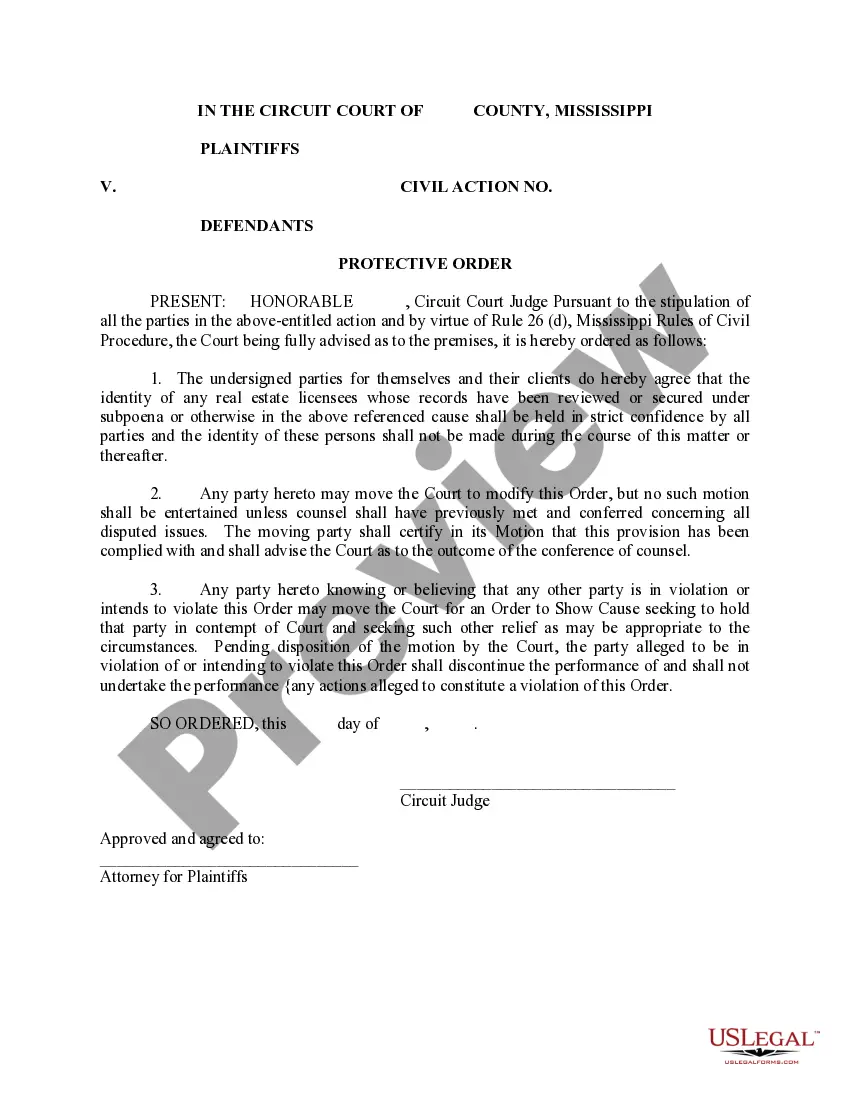
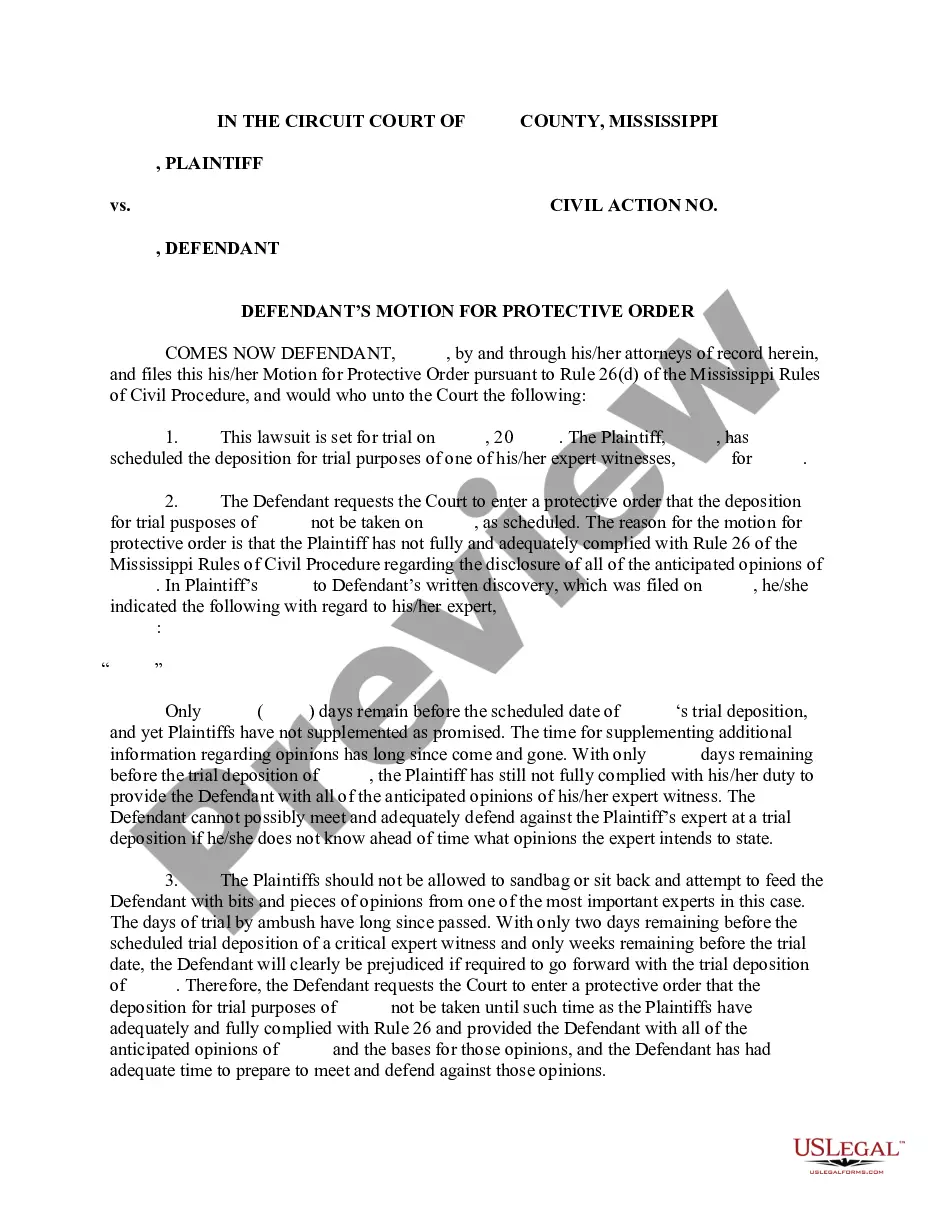
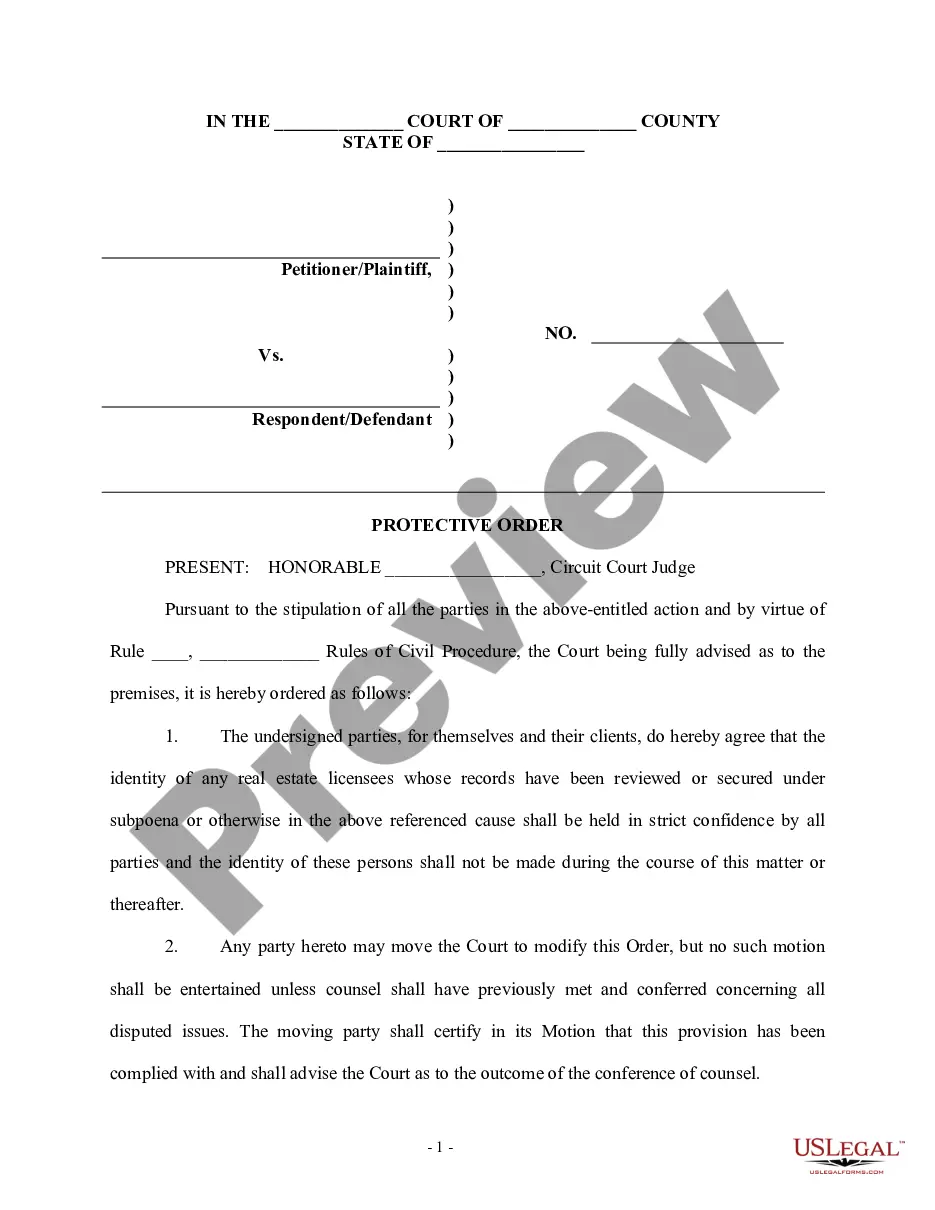
A Protective Order is a legal document used in the State of Mississippi, primarily in the context of motor vehicle accidents. This form aims to ensure that confidentiality is maintained regarding the identities of specific parties involved in legal proceedings. It differs from other legal forms by focusing specifically on protecting sensitive information related to real estate licensees whose records are reviewed in conjunction with the case.
Main sections of this form
- Confidentiality agreement regarding the identity of real estate licensees.
- Provision for modifying the order through prior consultation between parties' counsel.
- Mechanism for addressing violations of the order, allowing for motions to hold parties in contempt.
- Requirements for the moving party to certify compliance with the consultation provision.
Common use cases
This form is necessary when parties involved in a motor vehicle accident in Mississippi require a formal agreement to protect confidential information. It is particularly relevant when sensitive records of real estate licensees are involved, and there is a need to ensure that their identities remain undisclosed to prevent potential harm or bias during legal proceedings.
Who needs this form
This form is suitable for:
- Attorneys representing clients involved in motor vehicle accidents.
- Parties seeking to protect confidential information related to real estate transactions.
- Individuals or entities who need to ensure compliance with confidentiality agreements in legal cases.
Instructions for completing this form
- Identify all parties involved in the motor vehicle accident and their respective legal representatives.
- Include details regarding the confidential information that needs protection.
- Specify the terms under which the confidentiality will be maintained, including any limitations.
- Complete the certification section to affirm that necessary consultations have taken place prior to modification requests.
- Ensure that all parties sign the form where indicated before submission to the court.
Does this form need to be notarized?
Notarization is generally not required for this form. However, certain states or situations might demand it. You can complete notarization online through US Legal Forms, powered by Notarize, using a verified video call available anytime.
Get your form ready online
Our built-in tools help you complete, sign, share, and store your documents in one place.
Make edits, fill in missing information, and update formatting in US Legal Forms—just like you would in MS Word.
Download a copy, print it, send it by email, or mail it via USPS—whatever works best for your next step.
Sign and collect signatures with our SignNow integration. Send to multiple recipients, set reminders, and more. Go Premium to unlock E-Sign.
If this form requires notarization, complete it online through a secure video call—no need to meet a notary in person or wait for an appointment.
We protect your documents and personal data by following strict security and privacy standards.

Make edits, fill in missing information, and update formatting in US Legal Forms—just like you would in MS Word.

Download a copy, print it, send it by email, or mail it via USPS—whatever works best for your next step.

Sign and collect signatures with our SignNow integration. Send to multiple recipients, set reminders, and more. Go Premium to unlock E-Sign.

If this form requires notarization, complete it online through a secure video call—no need to meet a notary in person or wait for an appointment.

We protect your documents and personal data by following strict security and privacy standards.
Avoid these common issues
- Failing to consult with opposing counsel before filing a motion to modify the order.
- Not clearly defining the scope of confidential information that is being protected.
- Omitting required signatures from all parties involved.
Benefits of using this form online
- Convenience of downloading and completing the form at any time.
- Editable format allows for easy customization to fit specific needs.
- Reliability of legal documentation drafted by licensed attorneys.
Legal use & context
- The Protective Order is legally binding once approved by the court.
- Parties who violate the order may face legal consequences, including contempt charges.
Looking for another form?





Form popularity
FAQ
If you believe the protection order was granted improperly or that it is no longer needed, you can file a motion asking the court to dissolve (terminate or cancel) the protection order.If the court schedules a hearing and grants the motion, the protection order will become immediately void and unenforceable.
If you're the person who asked for the no contact order, you can ask the judge in your case to drop it. While there's no guarantee that the judge will do so, if you can show that you're not being forced or coerced into doing it, you'll have a better chance of getting it dropped.
Under section 93-21-7(2) of the Mississippi Code, there is no cost to file for a protection order. . temporary restraining order. the clerk will fill out the information for you.
If the judge is satisfied, he or she will issue a temporary protective order that will last ten days, but which can be extended upon request, up to the maximum length of one year, but can only last 30 days where the victim has minor children with the abuser.
These are orders to stop specific acts against everyone named in the restraining order as a protected person. Some of the things that the restrained person can be ordered to stop are: Contacting, calling, or sending any messages (including e-mail);
Ask the court to change the order. The court can drop the "no contact" part of the order but keep the "no abuse" part of the order. Get the 209A protective order "terminated." This will end the order completely.
It does not cost anything to file for an order of protection. Many orders of protection cases are handled without a lawyer however it can often be helpful to have one represent you in court.If you are going to be in court without a lawyer, our Preparing for Court By Yourself section may be useful to you.
A civil harassment restraining order is a court order that helps protect people from violence, stalking, serious harassment, or threats of violence. You can ask for a civil harassment restraining order if: A person has abused (or threatened to abuse), sexually assaulted, stalked, or seriously harassed you, and.
The court is looking for a description of your relationship to the respondent, when, where, what happened, and who did what to whom. Using the facts of the incident only, keep your statement brief and to the point. Briefly describe the most recent incident of abuse and/or threats of abuse or other behaviors.