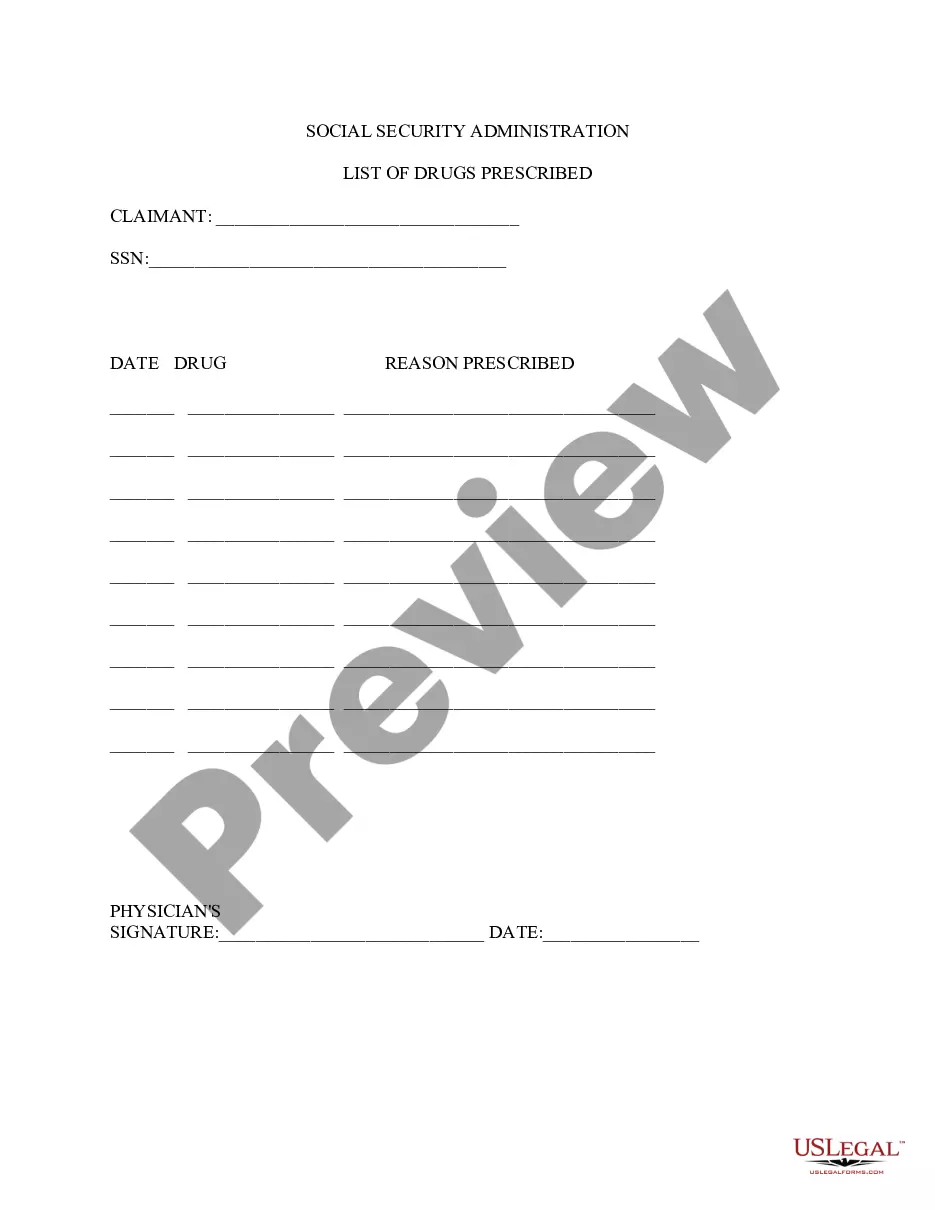
Mississippi List of Drugs Prescribed
What this document covers
The List of Drugs Prescribed form is a legal document used to outline all medications prescribed to an individual related to a specific cause of action. This form helps ensure clear communication regarding a party's medical treatment, which can be critical in legal proceedings. Unlike other medical forms, this one focuses specifically on the medications prescribed, providing essential details about each medication and its intended purpose.
Form components explained
- Claimant Information: Includes the name and Social Security Number of the individual receiving the prescriptions.
- Date: The date when the form is completed.
- Drug Details: A section to list the names of prescribed drugs.
- Reason Prescribed: Provides a space to note the medical reason for each prescription.
- Physician's Signature: Required signature of the prescribing physician to validate the document.
- Date of Signature: The date when the physician signs the form.


Common use cases
This form is typically used in cases where detailed information about a claimant's prescribed medications is necessary. It may be needed during personal injury claims, disability claims, or any situation where a party's medical history plays a role in the legal proceedings. Additionally, it could be useful for insurance claims or when disputing a medical malpractice case to provide evidence of prescribed treatments.
Who needs this form
- Individuals involved in a legal case who need to document prescribed medications.
- Claimants in personal injury or disability claims requiring evidence of medical treatment.
- Attorneys representing clients in cases that involve medical evidence.
- Physicians who need to provide a formal list of medications prescribed to a patient involved in a legal matter.
How to prepare this document
- Identify the claimant and enter their full name and Social Security Number at the top of the form.
- Enter the date when the form is being completed.
- List each prescribed drug in the designated fields, ensuring to include accurate names.
- For each drug listed, specify the reason it was prescribed in the corresponding section.
- Obtain the signature of the prescribing physician and enter the date of the signature.
Is notarization required?
In most cases, this form does not require notarization. However, some jurisdictions or signing circumstances might. US Legal Forms offers online notarization powered by Notarize, accessible 24/7 for a quick, remote process.
Get your form ready online
Our built-in tools help you complete, sign, share, and store your documents in one place.
Make edits, fill in missing information, and update formatting in US Legal Forms—just like you would in MS Word.
Download a copy, print it, send it by email, or mail it via USPS—whatever works best for your next step.
Sign and collect signatures with our SignNow integration. Send to multiple recipients, set reminders, and more. Go Premium to unlock E-Sign.
If this form requires notarization, complete it online through a secure video call—no need to meet a notary in person or wait for an appointment.
We protect your documents and personal data by following strict security and privacy standards.

Make edits, fill in missing information, and update formatting in US Legal Forms—just like you would in MS Word.

Download a copy, print it, send it by email, or mail it via USPS—whatever works best for your next step.

Sign and collect signatures with our SignNow integration. Send to multiple recipients, set reminders, and more. Go Premium to unlock E-Sign.

If this form requires notarization, complete it online through a secure video call—no need to meet a notary in person or wait for an appointment.

We protect your documents and personal data by following strict security and privacy standards.
Typical mistakes to avoid
- Leaving out the physician's signature or date, which can invalidate the form.
- Not providing clear reasons for each medication prescribed, which may lead to confusion.
- Failing to correctly enter the claimant's information, leading to potential disputes.
- Not updating the list of prescribed drugs if new medications have been added.
Advantages of online completion
- Convenience: Download the form instantly and fill it out at your own pace.
- Editability: Make changes as needed before finalizing the information.
- Reliability: Forms are drafted by licensed attorneys to ensure compliance with legal standards.
Looking for another form?
Form popularity
FAQ
There may be times, however, when you're away from home and realize you need to refill your prescription. If you're in a different state, can you still get your Rx filled? The good news is that you can fill a prescription in a different state.
In person. Go to the pharmacy where you originally filled your prescription, request a refill, and either wait for it or come back to pick it later. By phone. Use the pharmacy's phone number listed on your medicine label to call in your refill. Online. By mail.
Overall, for nurse practitioners in most states, prescribing across state lines is allowable. The prescribing of controlled substances, particularly Schedule II controlled substances, may be an exception to this generalization.
Date of the inventory. Whether the inventory was performed at the start or close of the business day. Name of each controlled substance that was inventoried. Finished dosage form of each controlled substance.
Texas, California, New York, and a few others will not fill an out of state prescription if it's for a controlled substance.It is legal to have a prescription written in one state and filled in another state. This includes controlled drugs like stimulants for ADHD.
Where will your next vacation take you? You can refill your prescriptions at any of our CVS locations nationwide.
Every prescription consists of seven parts: the prescriber's information, the patient's information, the recipe (the medication, or Rx), the signature (the patient instructions or Sig), the dispensing instructions (how much medication to be dispensed to the patient or Disp), the number of refills (or Rf), and the
No pharmacy that is physically located in another state may ship, mail, or otherwise deliver a prescription drug, medication or device to any patients located in a state unless the pharmacy is licensed in that state.Obviously, mail order pharmacies must also follow this rule.
Make sure all of the information is filled in clearly. Bring your insurance card the first time you fill the prescription. When calling the pharmacy for a refill, make sure to give your name, the prescription number, and the name of the medicine.