Mississippi Motion for Additional Time to Respond to Motion for Summary Judgment and to Reset Hearing
Understanding this form
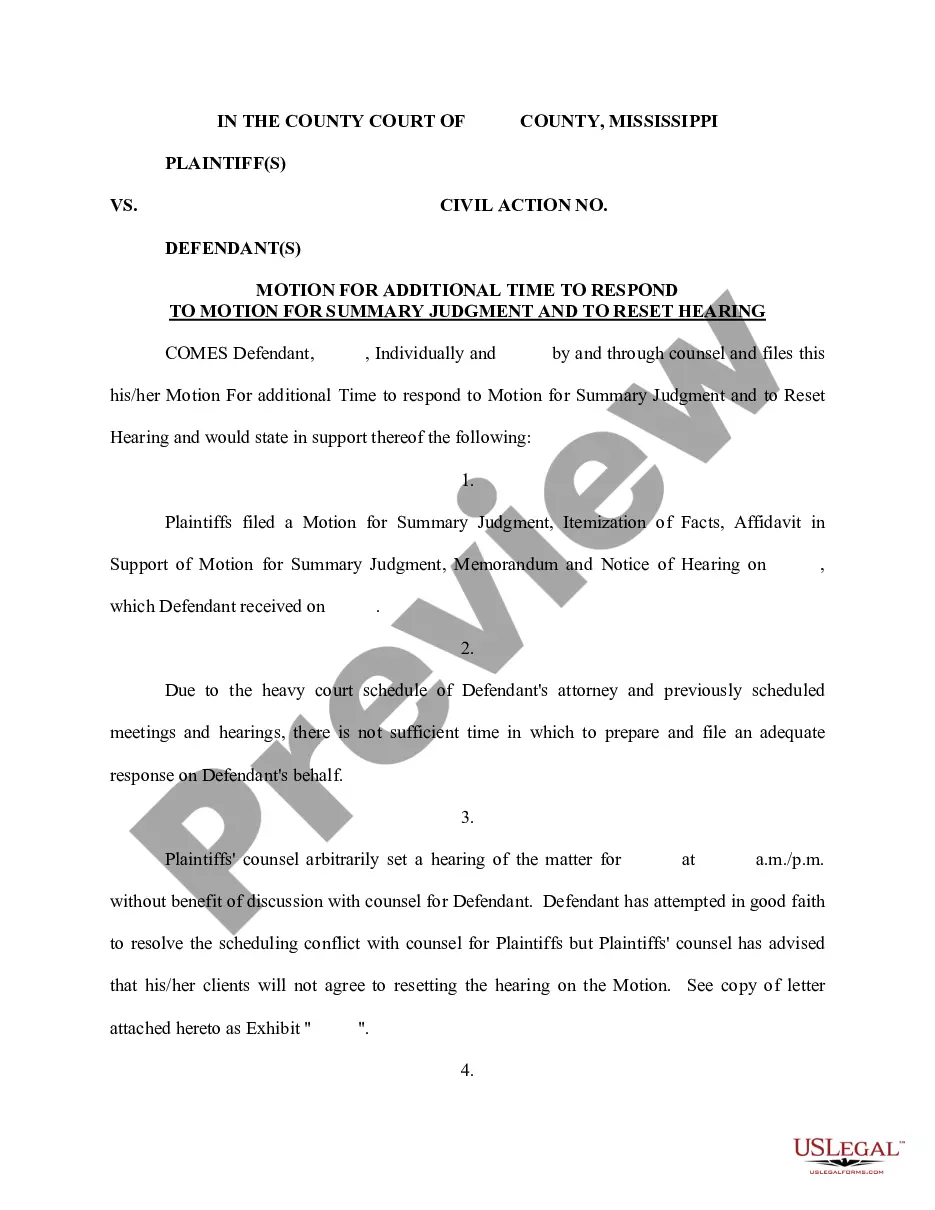
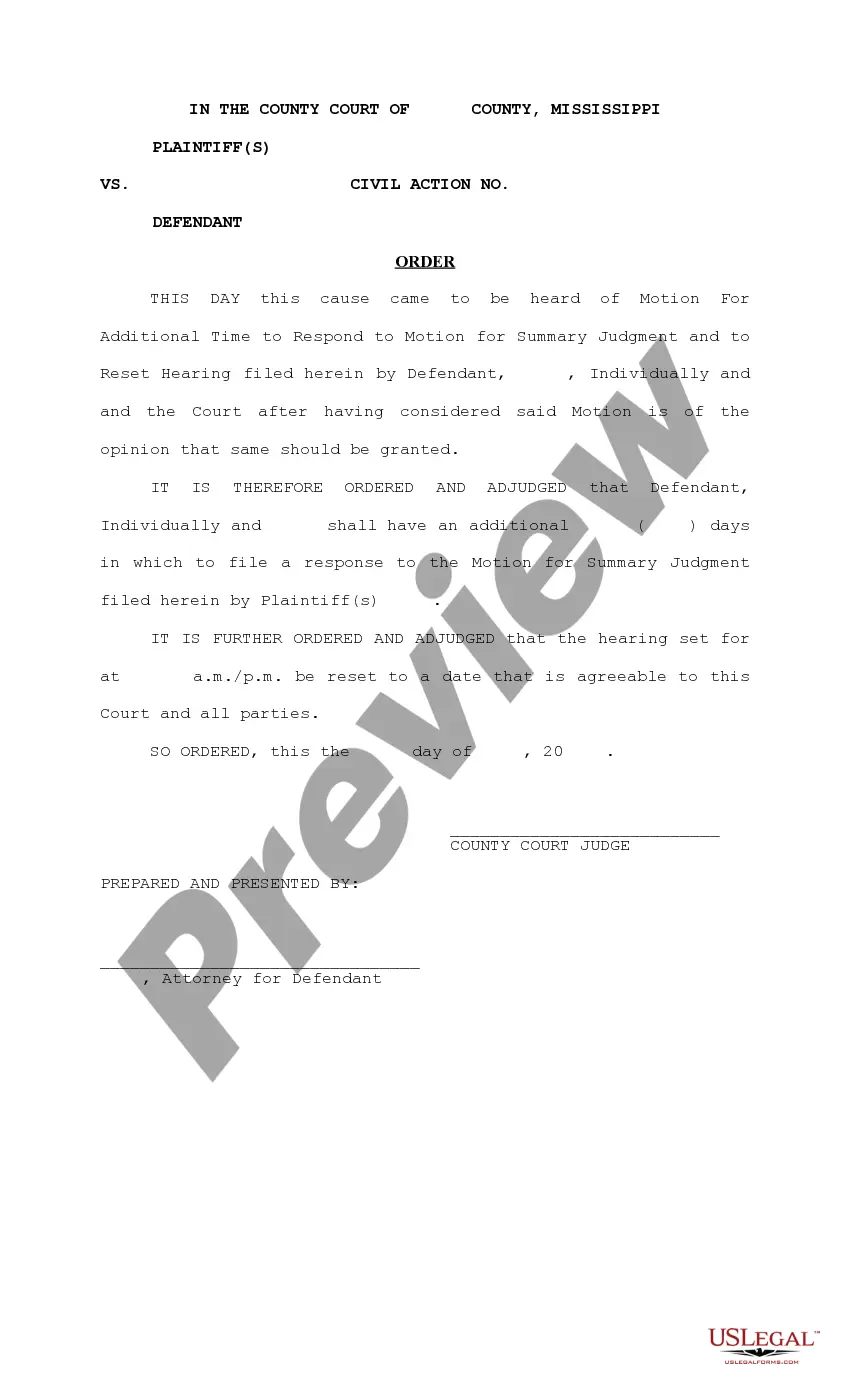
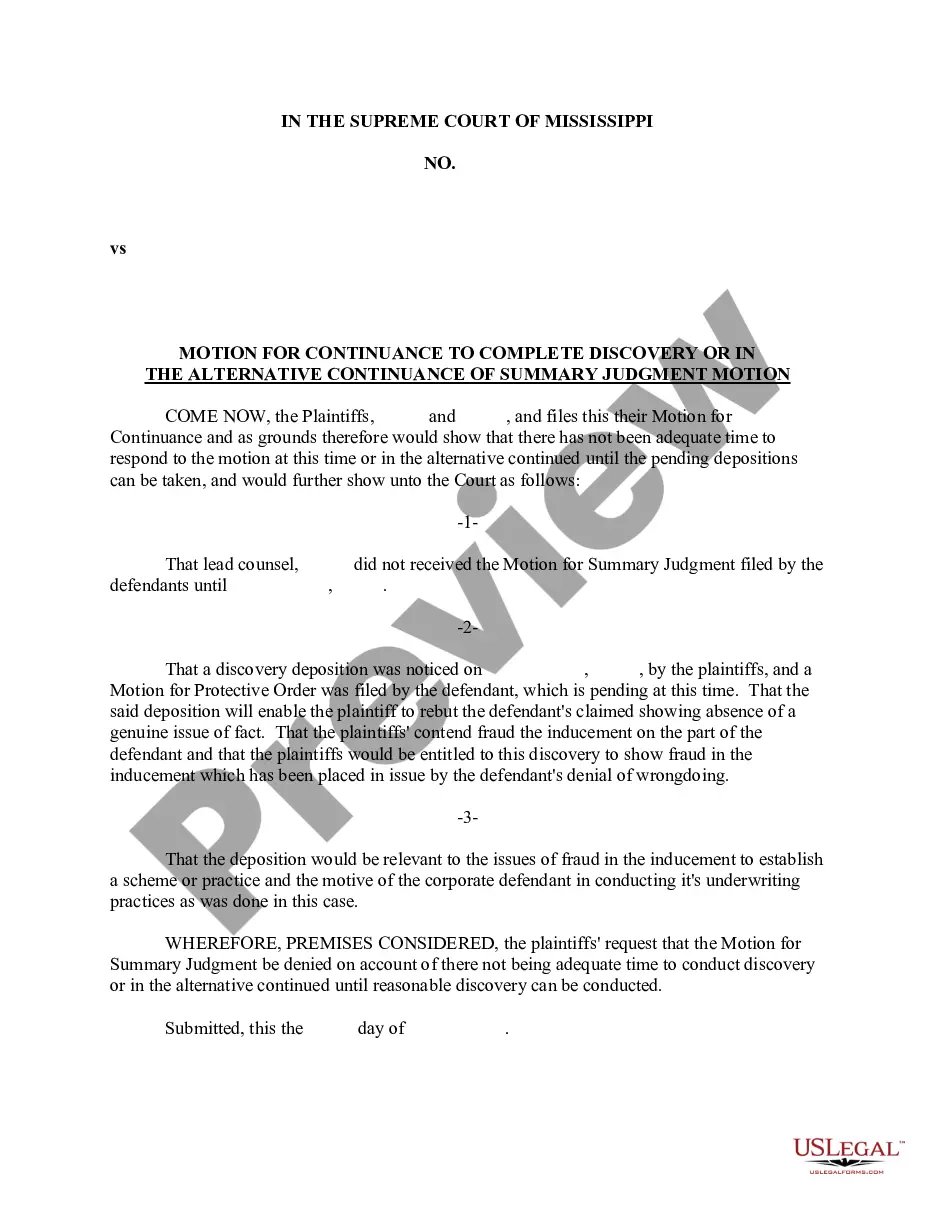
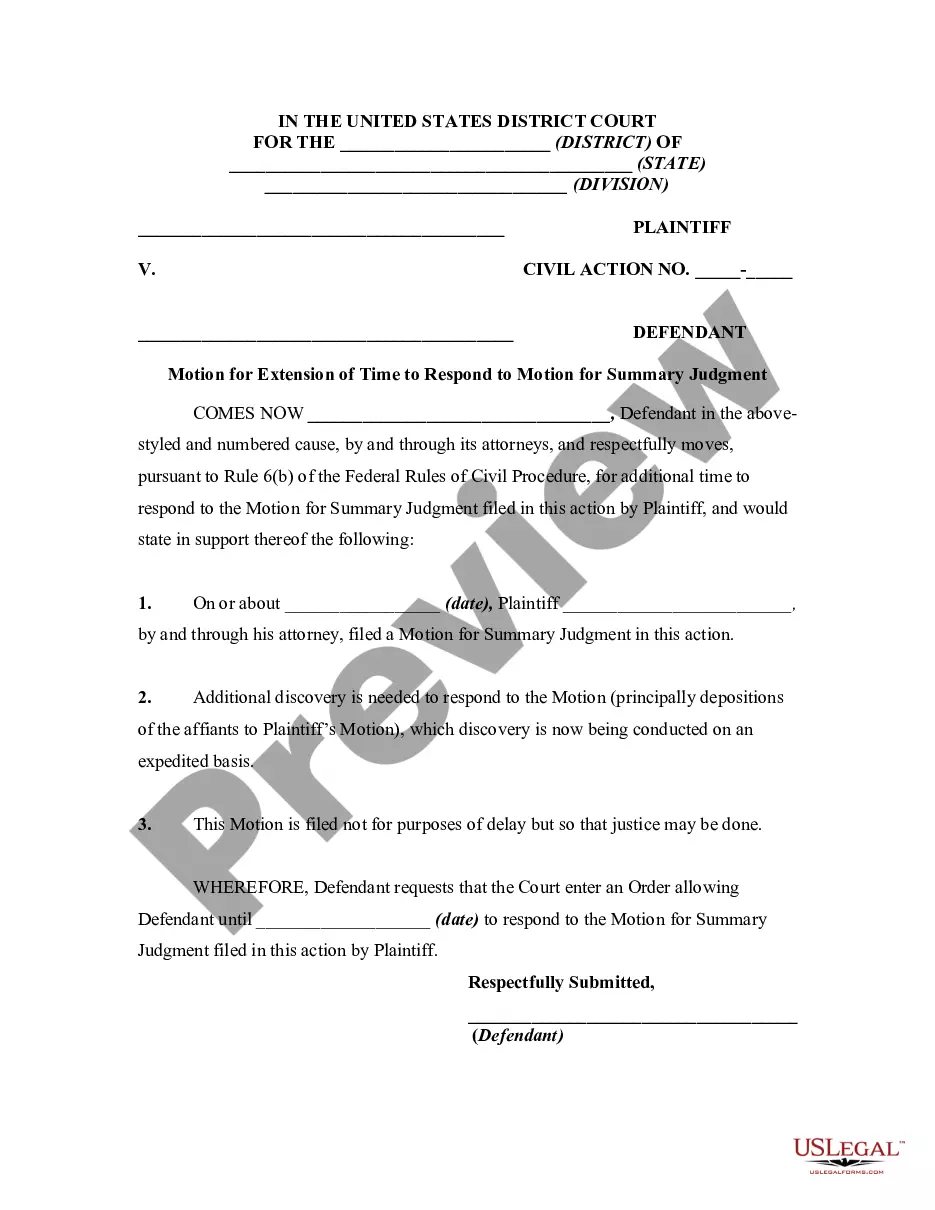
A Motion for Additional Time to Respond to Motion for Summary Judgment and to Reset Hearing is a formal request submitted to a court. It asks for an extension of time to prepare and submit a response to a motion for summary judgment. This form differs from standard motions, as it specifically addresses the need for additional time related to a summary judgment issue, which can significantly impact the outcome of a case.
Main sections of this form
- Heading identifying the court and case number
- Statement of the reason for requesting additional time
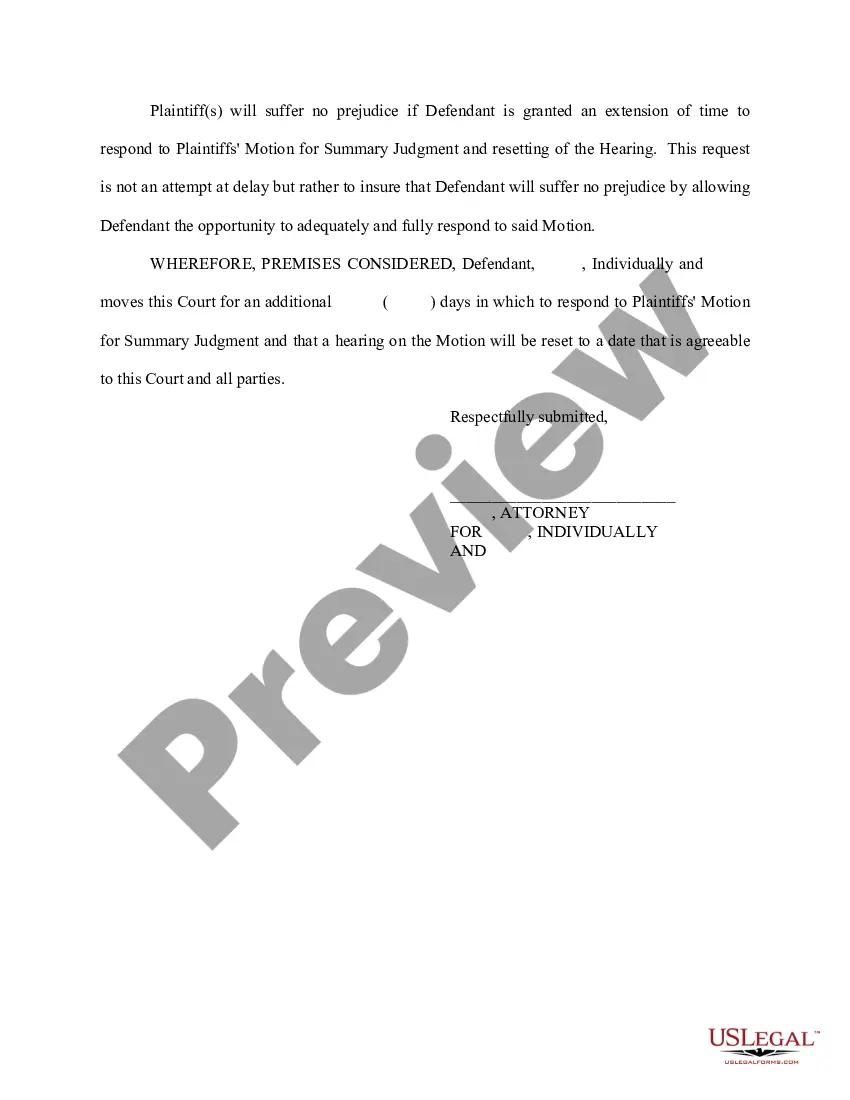
- Proposed new deadlines for responses and hearings
- Signature line for the party making the motion
- Affidavit or declaration to support the motion (if applicable)

When this form is needed
This form should be used when a party involved in a legal case needs more time to respond to a motion for summary judgment. Situations may include insufficient time to gather evidence, waiting for discovery materials, or other valid reasons that justify a delay. Additionally, it can be used to propose a new hearing date that accommodates all parties involved.
Who needs this form
- Defendants in civil litigation seeking more time to respond
- Parties who have received notice of a motion for summary judgment
- Individuals or entities involved in legal proceedings needing to adjust deadlines
How to complete this form
- Identify the court name and case number at the top of the form.
- Clearly state the reason for requesting additional time in the designated section.
- Suggest a new deadline for submitting your response.
- Propose a new date for the hearing if applicable.
- Sign and date the form at the bottom to authenticate your request.
Does this form need to be notarized?
This form does not typically require notarization unless specified by local law. Always check with your jurisdiction to confirm requirements before filing.
Get your form ready online
Our built-in tools help you complete, sign, share, and store your documents in one place.
Make edits, fill in missing information, and update formatting in US Legal Forms—just like you would in MS Word.
Download a copy, print it, send it by email, or mail it via USPS—whatever works best for your next step.
Sign and collect signatures with our SignNow integration. Send to multiple recipients, set reminders, and more. Go Premium to unlock E-Sign.
If this form requires notarization, complete it online through a secure video call—no need to meet a notary in person or wait for an appointment.
We protect your documents and personal data by following strict security and privacy standards.

Make edits, fill in missing information, and update formatting in US Legal Forms—just like you would in MS Word.

Download a copy, print it, send it by email, or mail it via USPS—whatever works best for your next step.

Sign and collect signatures with our SignNow integration. Send to multiple recipients, set reminders, and more. Go Premium to unlock E-Sign.

If this form requires notarization, complete it online through a secure video call—no need to meet a notary in person or wait for an appointment.

We protect your documents and personal data by following strict security and privacy standards.
Common mistakes
- Failing to provide a valid reason for requesting additional time.
- Not adhering to the specific formatting requirements of the court.
- Missing signature or date on the motion.
- Not filing the motion within the appropriate time frame.
Benefits of completing this form online
- Convenient downloading and immediate access to necessary forms.
- Editable templates allow for customization to specific case details.
- Reliability of professionally drafted forms that meet legal standards.
Legal use & context
- A motion for additional time is a recognized legal procedure to ensure fair opportunity for response.
- The court has discretion to grant or deny the motion based on provided facts.
- Failure to respond timely can result in default judgments or adverse rulings.
Key takeaways
- A Motion for Additional Time is crucial for managing court deadlines and ensuring adequate preparation.
- Timely submission can prevent negative impacts on your case.
- Always double-check specific requirements in your jurisdiction for filing motions.
Looking for another form?
Form popularity
FAQ
A summary judgement occurs when, in a civil case, one party wants to move to a court decision without a trial. That only happens however, when the two parties agree to the critical facts of the issue, and the law allows summary judgement based on the undisputed facts at hand.
Rule 56 of the Federal Rules of Civil Procedure governs summary judgment for federal courts. Under Rule 56, in order to succeed in a motion for summary judgment, a movant must show 1) that there is no genuine dispute as to any material fact, and 2) that the movant is entitled to judgment as a matter of law.
The motion must include a separate "Notice of Motion" which includes a brief summary of the nature of the motion, the deadline for filing a response, and if there is a hearing, the date, time, and location of the hearing.
If the motion is granted, the judgment on the issue or case is deemed to be a final judgment from which a party may seek an appeal. The court of appeal can reverse the grant of summary judgment and reinstate the claim in the lower court. However, this is rarely done and most summary judgments are upheld on appeal.
The Rule 81 Summons is used when directing a person to appear in court on a date and time certain, like. a scheduled court hearing. It is used to provide notice to the Defendants in a lawsuit.
You cannot file a second motion dismiss. You have to raise it as an affirmative defense in your answer and present it with evidence at summary judgement or trial...
A motion asking the court to issue summary judgment on at least one claim.Typically, the motion must show that no genuine issue of material fact exists, and that the opposing party loses on that claim even if all its allegations are accepted as true.
Unless the requirements of Code of Civil Procedure 437c, subdivision (f)(2), are met a party may not file a second summary judgment motion.
Completely resolve a case (e.g., entry of judgment for plaintiff or defendants) Completely resolve a claim. Completely determine the status of a particular party. Resolve a particular claim's application to a particular party. Establish a fact or ruling applicable to the case as it is further adjudicated.