Mississippi Amended Petition for Protection from Abuse and Motion for Modification
Overview of this form
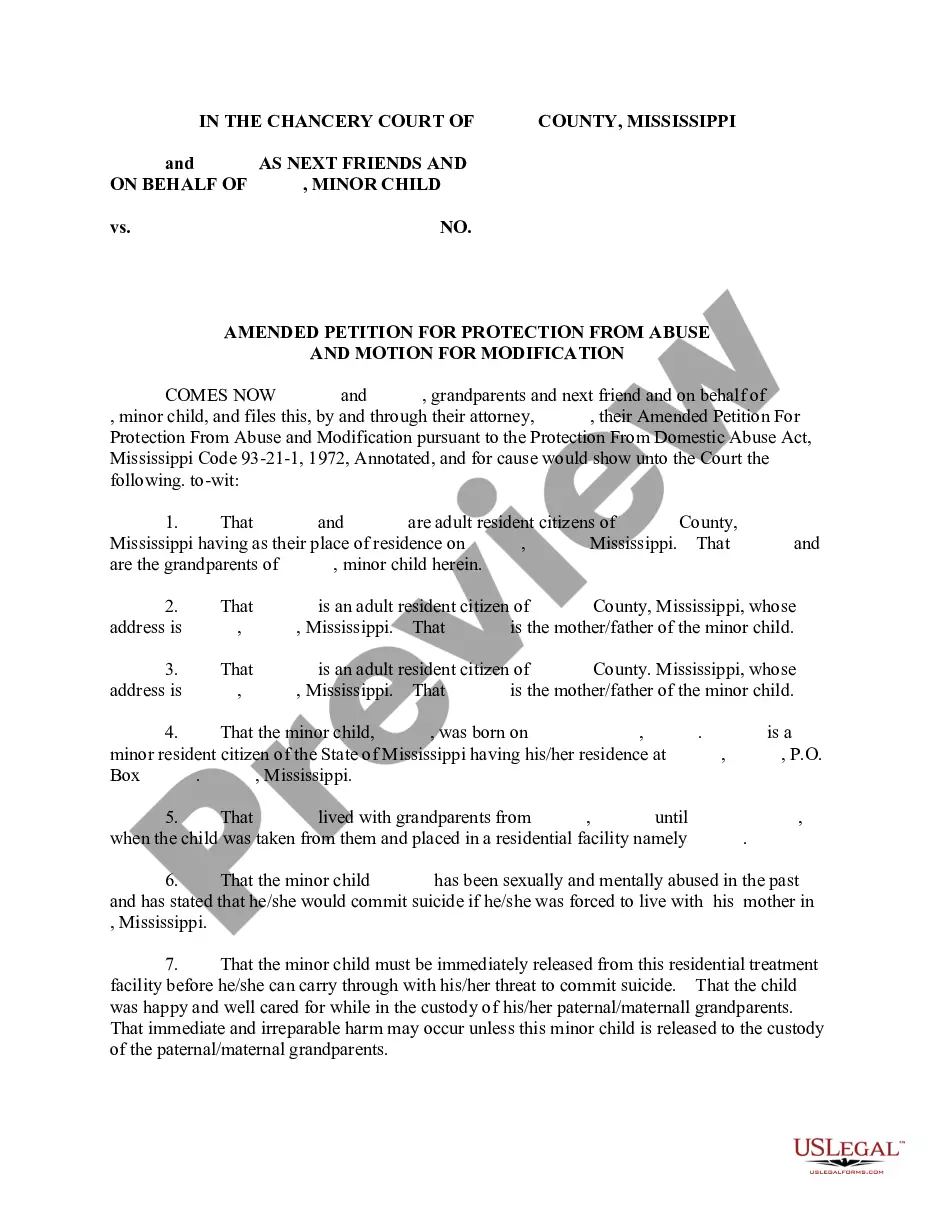
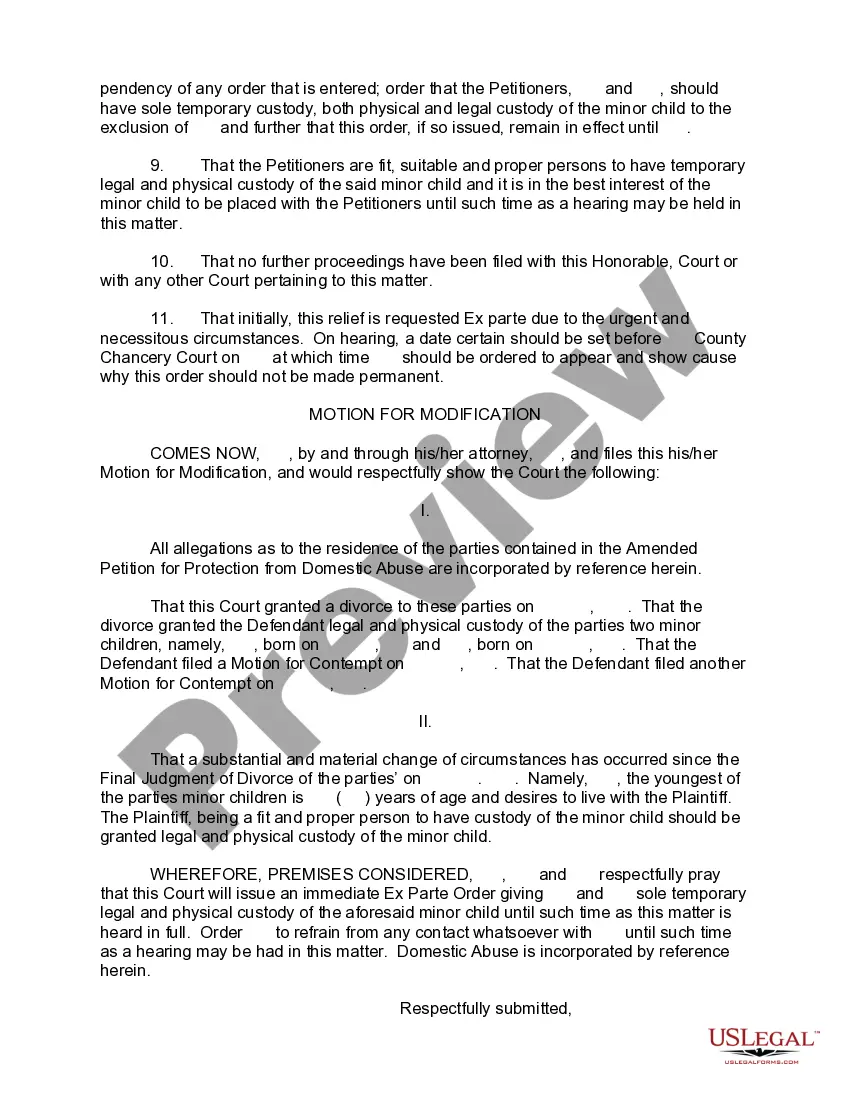
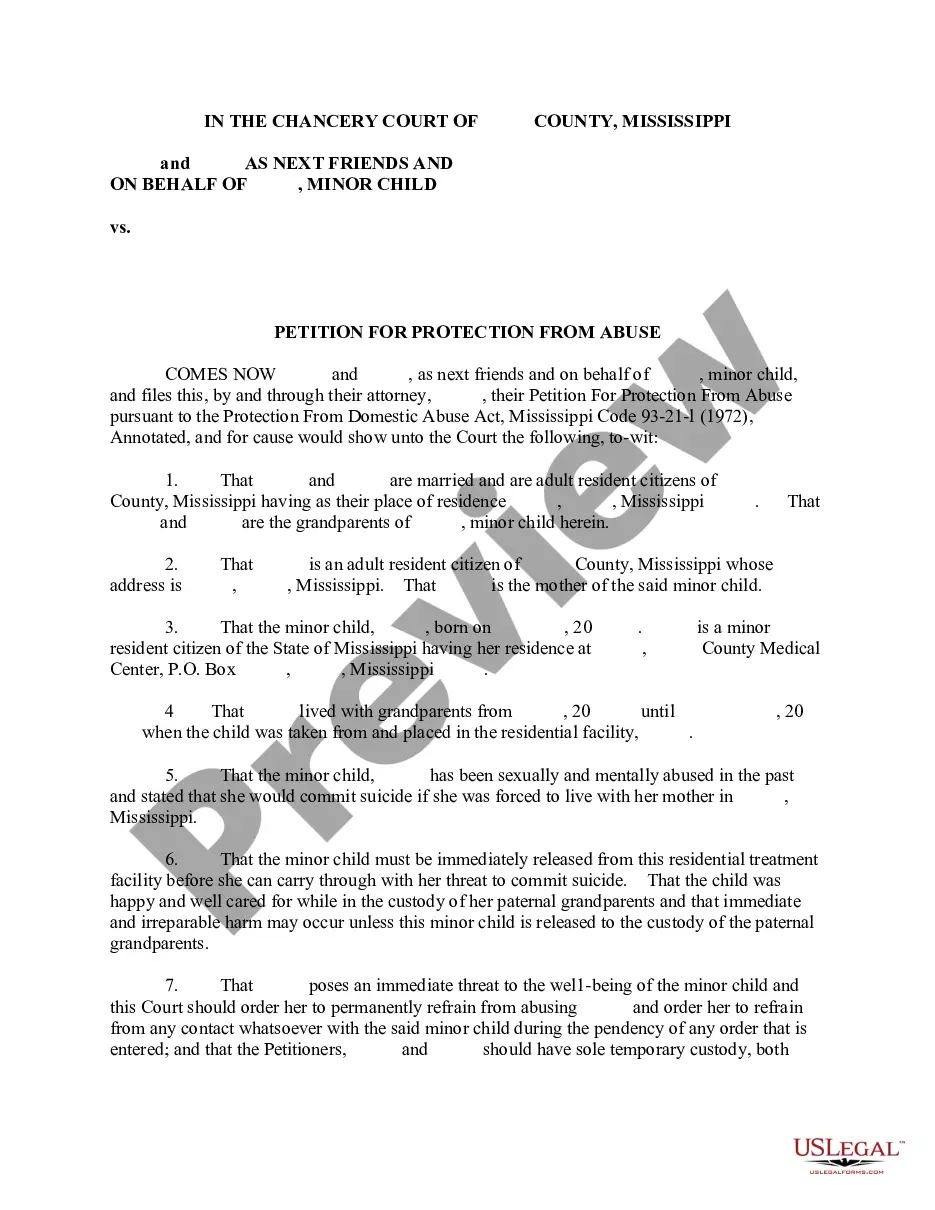
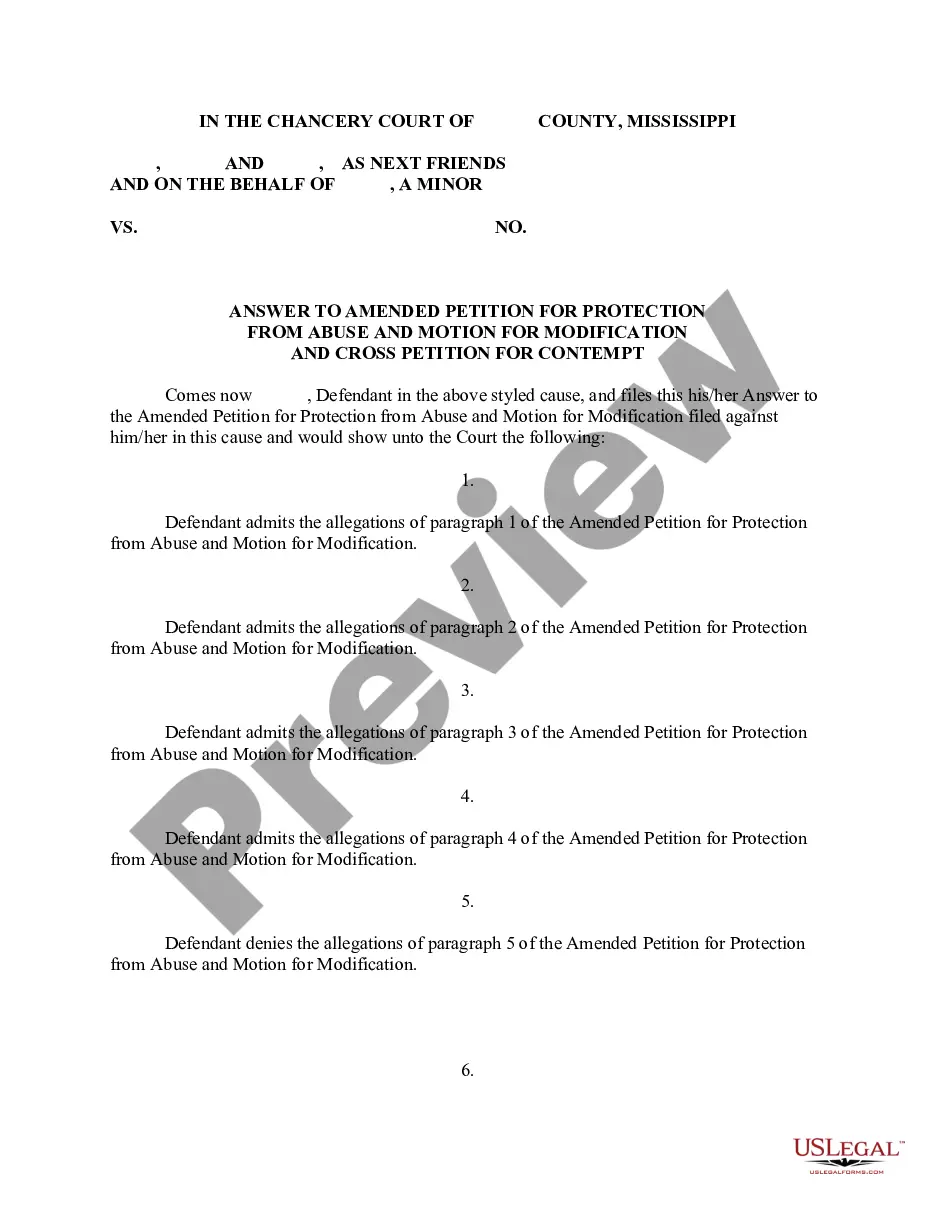
The Amended Petition for Protection from Abuse and Motion for Modification is a legal document used to request a court's intervention in situations involving domestic abuse and custody modification. This form is specifically designed for grandparents acting as next friends on behalf of a minor child. Unlike a general motion form, this document details the past abuse and emphasizes the immediate need for protective custody to ensure the child's safety and well-being.
Key parts of this document
- Petitioners' identification and residency information.
- Details regarding the minor child's living situation and history of abuse.
- Statements justifying the request for protection and modification of custody.
- Urgent circumstances prompting an Ex parte request for immediate action.
- Legal basis for the modification of custody in light of changing circumstances.

Common use cases
This form should be used when a child has experienced abuse and there is an urgent need to change custody arrangements. Specific instances might include scenarios where a minor child is at risk of harm from a parent or guardian, or if there have been significant changes in the child's living conditions that warrant a legal intervention to protect their well-being.
Who should use this form
- Grandparents seeking legal protective custody on behalf of a minor child.
- Any adult acting as a next friend for a child who has experienced abuse.
- Individuals with legal representation who need to modify existing custody agreements due to abusive circumstances.
Steps to complete this form
- Identify the petitioners and the minor child, including their names and addresses.
- Detail previous incidents of abuse and the child's current living conditions.
- Incorporate statements regarding the urgent need for immediate protective custody.
- Ensure all parties' names involved in the custody matter are clearly stated.
- Sign the form in the presence of a witness if required by local regulations.
Is notarization required?
This form does not typically require notarization to be legally valid. However, some jurisdictions or document types may still require it. US Legal Forms provides secure online notarization powered by Notarize, available 24/7 for added convenience.
Get your form ready online
Our built-in tools help you complete, sign, share, and store your documents in one place.
Make edits, fill in missing information, and update formatting in US Legal Forms—just like you would in MS Word.
Download a copy, print it, send it by email, or mail it via USPS—whatever works best for your next step.
Sign and collect signatures with our SignNow integration. Send to multiple recipients, set reminders, and more. Go Premium to unlock E-Sign.
If this form requires notarization, complete it online through a secure video call—no need to meet a notary in person or wait for an appointment.
We protect your documents and personal data by following strict security and privacy standards.

Make edits, fill in missing information, and update formatting in US Legal Forms—just like you would in MS Word.

Download a copy, print it, send it by email, or mail it via USPS—whatever works best for your next step.

Sign and collect signatures with our SignNow integration. Send to multiple recipients, set reminders, and more. Go Premium to unlock E-Sign.

If this form requires notarization, complete it online through a secure video call—no need to meet a notary in person or wait for an appointment.

We protect your documents and personal data by following strict security and privacy standards.
Avoid these common issues
- Failing to provide complete information regarding past abuse.
- Not including all relevant parties involved in the custody arrangement.
- Neglecting to sign the document, which can invalidate the request.
- Submitting the form without understanding local requirements and legal terms.
Benefits of completing this form online
- Convenience of downloading and accessing legal forms at any time.
- Editability allows tailoring the form to specific circumstances easily.
- Access to attorney-drafted templates ensures accurate legal language and structure.
- Reduction in the risk of errors through guided prompts during the completion process.
Key takeaways
- The Amended Petition for Protection from Abuse and Motion for Modification is crucial for ensuring child safety in abusive situations.
- Understanding key components of the form can help streamline the filing process.
- Completing the form accurately is vital to avoid common pitfalls and ensure its acceptance by the court.
Looking for another form?

Form popularity
FAQ
If you believe the protection order was granted improperly or that it is no longer needed, you can file a motion asking the court to dissolve (terminate or cancel) the protection order. After you file the motion, the court will decide whether or not to schedule a hearing.
The Stay-Away Order generally lasts for three years or until the criminal case against the defendant has been resolved. Sometimes the Stay-Away Order can be extended for 10 years.
There are typically two reasons for a denied restraining order petition: Petitioner did not establish a claim for relief. Petitioner did not appear at the time set for the ex parte hearing on the petition.
Under section 93-21-7(2) of the Mississippi Code, there is no cost to file for a protection order. . temporary restraining order. the clerk will fill out the information for you.
You cannot drop the charges, but as long as the judge believes that you are not being forced or coerced into dropping the No Contact order, he/she should drop it. Just go to the court that put the order in effect and ask the Clerk's office to pull the case and tell them what it is that you are seeking.
If the judge is satisfied, he or she will issue a temporary protective order that will last ten days, but which can be extended upon request, up to the maximum length of one year, but can only last 30 days where the victim has minor children with the abuser.
If the judge is satisfied, he or she will issue a temporary protective order that will last ten days, but which can be extended upon request, up to the maximum length of one year, but can only last 30 days where the victim has minor children with the abuser.
If a person violates a no contact orders, he or she can face serious consequences. Consequences often include potential jail time, the payment of fines or the loss of certain civil rights.Violating a no contact order is considered a crime as well as a violation of a probation, parole or bail conditions.
Both work the same way, but the pretrial order is issued before your case is heard and the post-conviction order is issued afterward. Keep in mind that NCOs only restrict your behavior as far as making contact and do not pertain to the behavior of the alleged victim.