Mississippi Answer to Counterclaim for Citation for Contempt
About this form
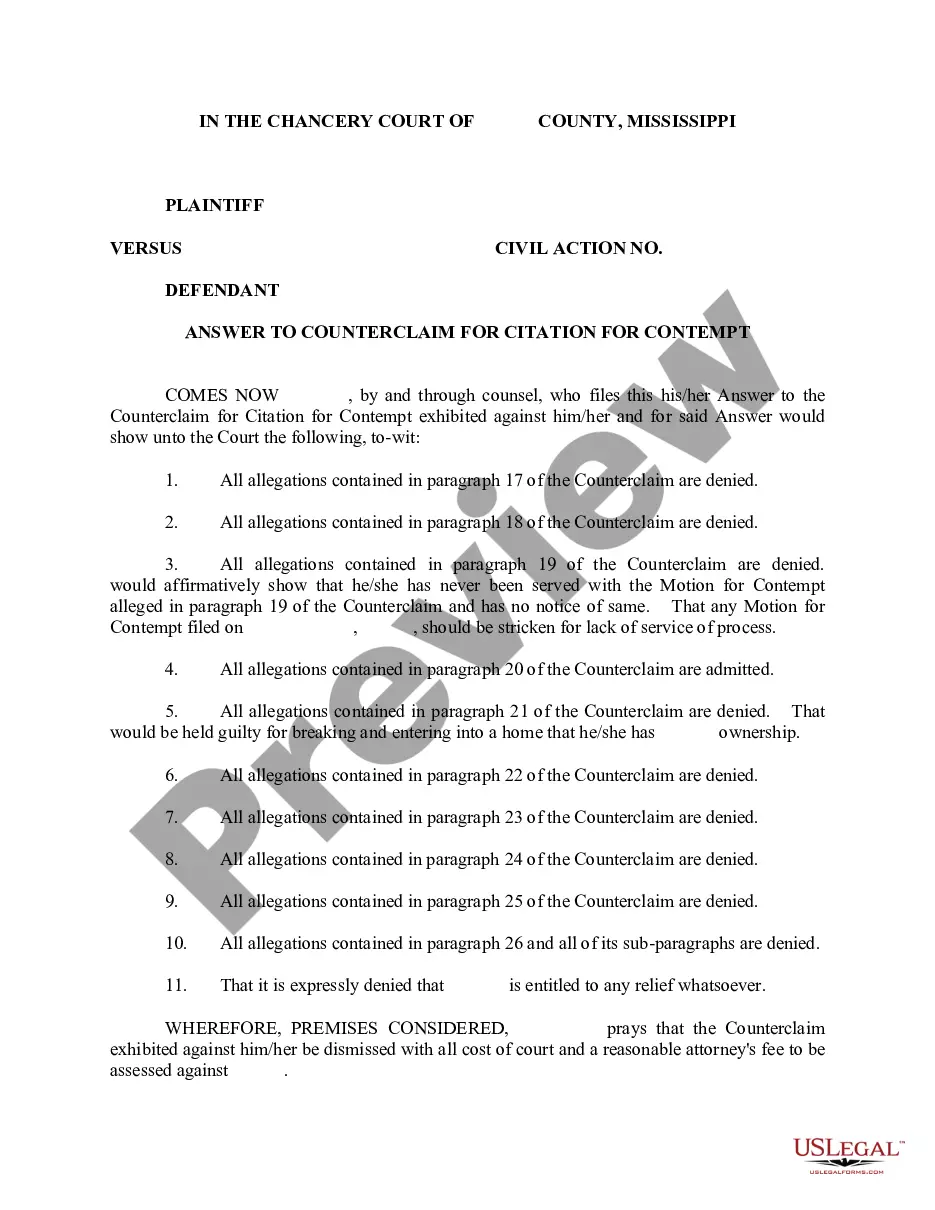
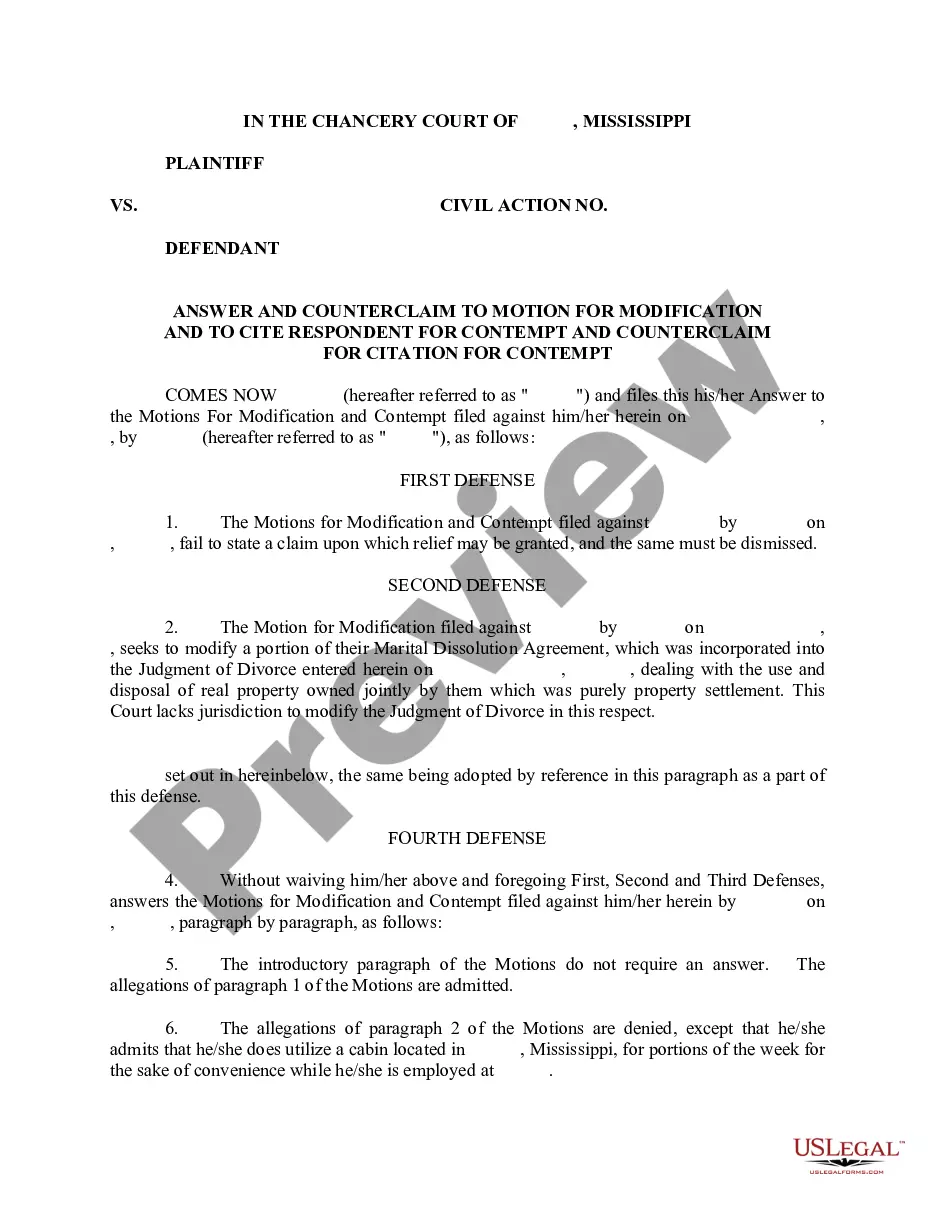
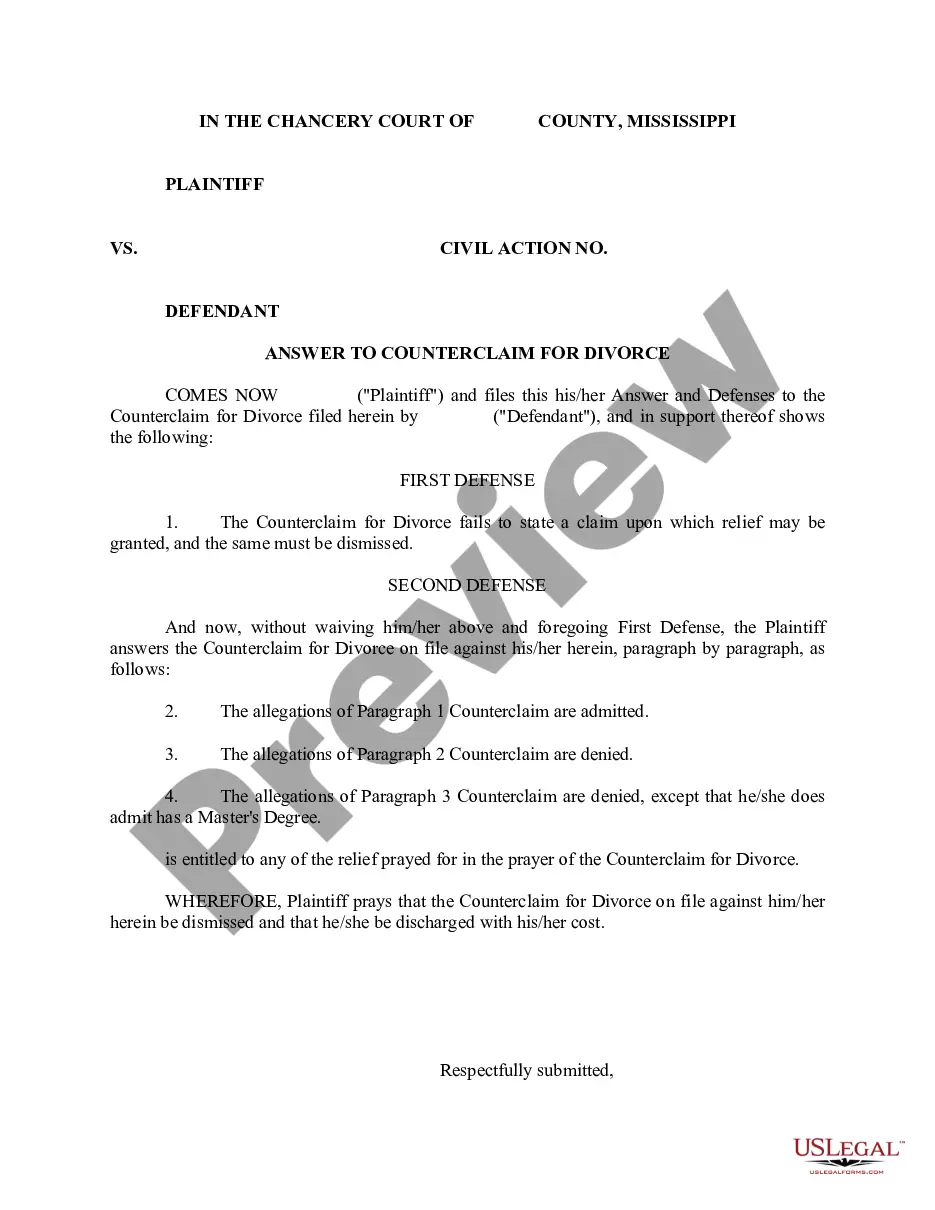
The Answer to Counterclaim for Citation for Contempt is a legal document used by defendants to respond to a counterclaim in contempt proceedings. This form outlines the defendant's admissions, denials, and defenses against allegations made in the counterclaim. It is essential for parties involved in legal disputes concerning contempt to formally address the claims presented against them using this specific form.
Key parts of this document
- Identification of parties involved in the civil action.
- Denial of specific allegations made in the counterclaim.
- Affirmative defenses related to the claims, such as lack of service.
- Requests for dismissal of the counterclaim with legal costs.
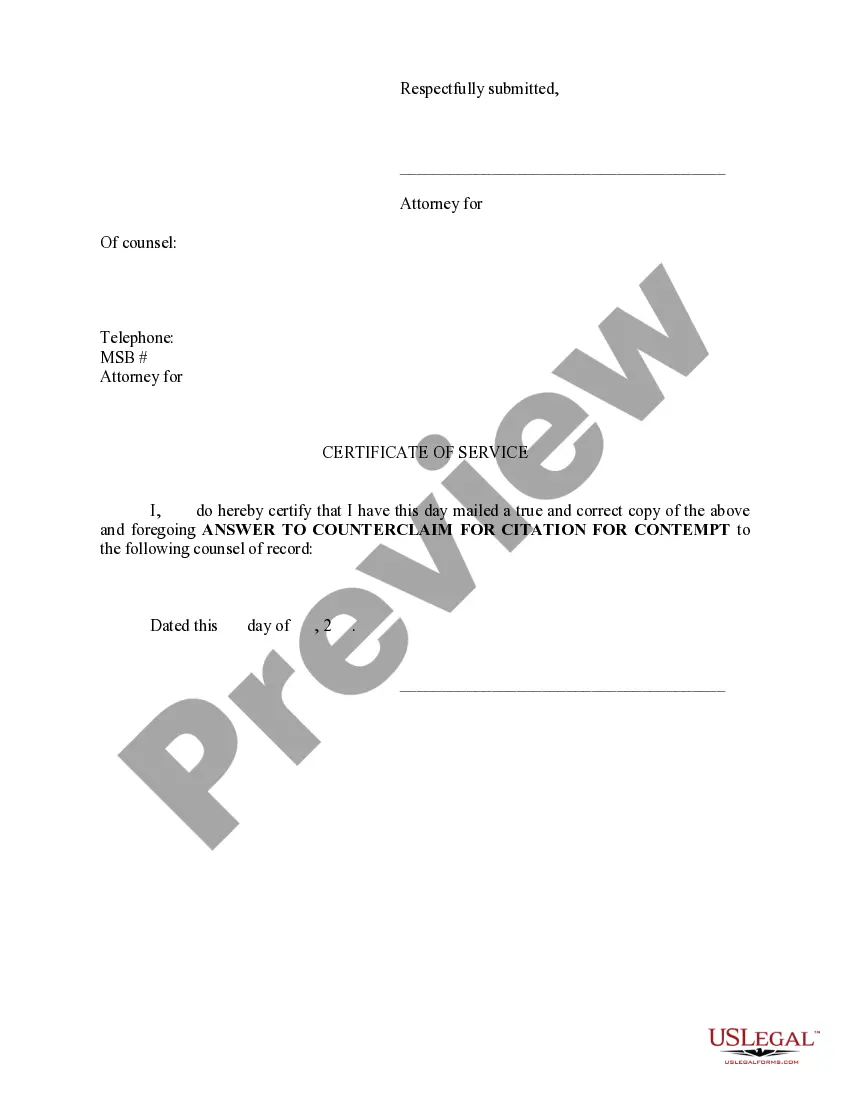
- Signature and contact information of the attorney representing the defendant.
- Certificate of service confirming that all parties have been notified.
When to use this form
This form should be used when a defendant in a contempt proceeding receives a counterclaim against them. It is necessary to respond to the counterclaim to present any defenses or denials regarding the allegations made. This form is crucial in legal situations where someone's compliance with a court order is questioned.
Who can use this document
- Defendants in contempt proceedings facing a counterclaim.
- Individuals seeking to formally contest the allegations made against them.
- Parties involved in legal disputes where compliance with court orders is questioned.
How to complete this form
- Identify the parties involved by filling in the names of the plaintiff and defendant.
- Review each allegation in the counterclaim and state whether you deny or admit each claim as required.
- Clearly articulate any affirmative defenses, such as lack of service, that support your case.
- Sign the document, including your title or position and contact information of your attorney.
- Ensure to prepare and include a certificate of service indicating the date and method of notification to other parties.
Does this document require notarization?
This form does not typically require notarization unless specified by local law. However, confirming local requirements before submitting is advisable to ensure compliance.
Get your form ready online
Our built-in tools help you complete, sign, share, and store your documents in one place.
Make edits, fill in missing information, and update formatting in US Legal Forms—just like you would in MS Word.
Download a copy, print it, send it by email, or mail it via USPS—whatever works best for your next step.
Sign and collect signatures with our SignNow integration. Send to multiple recipients, set reminders, and more. Go Premium to unlock E-Sign.
If this form requires notarization, complete it online through a secure video call—no need to meet a notary in person or wait for an appointment.
We protect your documents and personal data by following strict security and privacy standards.

Make edits, fill in missing information, and update formatting in US Legal Forms—just like you would in MS Word.

Download a copy, print it, send it by email, or mail it via USPS—whatever works best for your next step.

Sign and collect signatures with our SignNow integration. Send to multiple recipients, set reminders, and more. Go Premium to unlock E-Sign.

If this form requires notarization, complete it online through a secure video call—no need to meet a notary in person or wait for an appointment.

We protect your documents and personal data by following strict security and privacy standards.
Common mistakes to avoid
- Failing to respond within the deadline set by the court.
- Incorrectly admitting to allegations without fully understanding the consequences.
- Neglecting to include a proper certificate of service.
- Omitting necessary details in affirmative defenses.
Why use this form online
- Convenience of downloading the form immediately in editable formats.
- Access to templates that are drafted by licensed attorneys, ensuring legal accuracy.
- Ability to customize the form as needed for specific circumstances.
- No need to visit a physical location, saving time and effort.
Looking for another form?

Form popularity
FAQ
Read the summons and make sure you know the date you must answer by. Read the complaint carefully. Write your answer. Sign and date the answer. Make copies for the plaintiff and yourself. Mail a copy to the plaintiff. File your answer with the court by the date on the summons.
Contact the clerk's office of the court where the lawsuit was filed. You'll find a phone number and address for the clerk's office on your summons. The clerk will be able to tell you exactly what documents you should file with your answer and whether any filing fee is required.
There is a valid court order in effect. The other person knows about the court order. The facts show a plain violation of the order. You have given the person notice of the contempt hearing and a chance to be heard. Contempt is an appropriate remedy for the violation.
You file a Complaint for Contempt. In a contempt case, you ask the court to decide that the other parent is in contempt. Contempt means not obeying the child support order even though you are able to.This decision is a Judgment of Contempt.
Read the summons and make sure you know the date you must answer by. Read the complaint carefully. Write your answer. Sign and date the answer. Make copies for the plaintiff and yourself. Mail a copy to the plaintiff. File your answer with the court by the date on the summons.
PETITION FOR CITATION FOR CONTEMPT OF COURT That the defendant is able-bodied, capable of earning adequate funds with which to comply with the orders of this Court, and that said defendant has willfully failed or refused to pay support as ordered by the Court.
If a person is found to be in contempt, the court is able to impose sanctions, which may include the following: jail time (usually 1-30 days) ordering the party held in contempt to pay the money owed. ordering the party held in contempt to pay the other party's attorney's fees.
Depending on the infraction, contempt of court consequences can include fines, compensatory visitation, a modification to the custody arrangement, and in some instances even jail time. In most cases, if someone is held in contempt, the court will first give them the opportunity to make amends for the violation.
Contempt of court is essentially seen as a form of disturbance that may impede the functioning of the court. The judge may impose fines and/or jail time upon any person committing contempt of court. The person is usually let out upon his or her agreement to fulfill the wishes of the court.