Wisconsin Child Care Services Package
What is this form package?
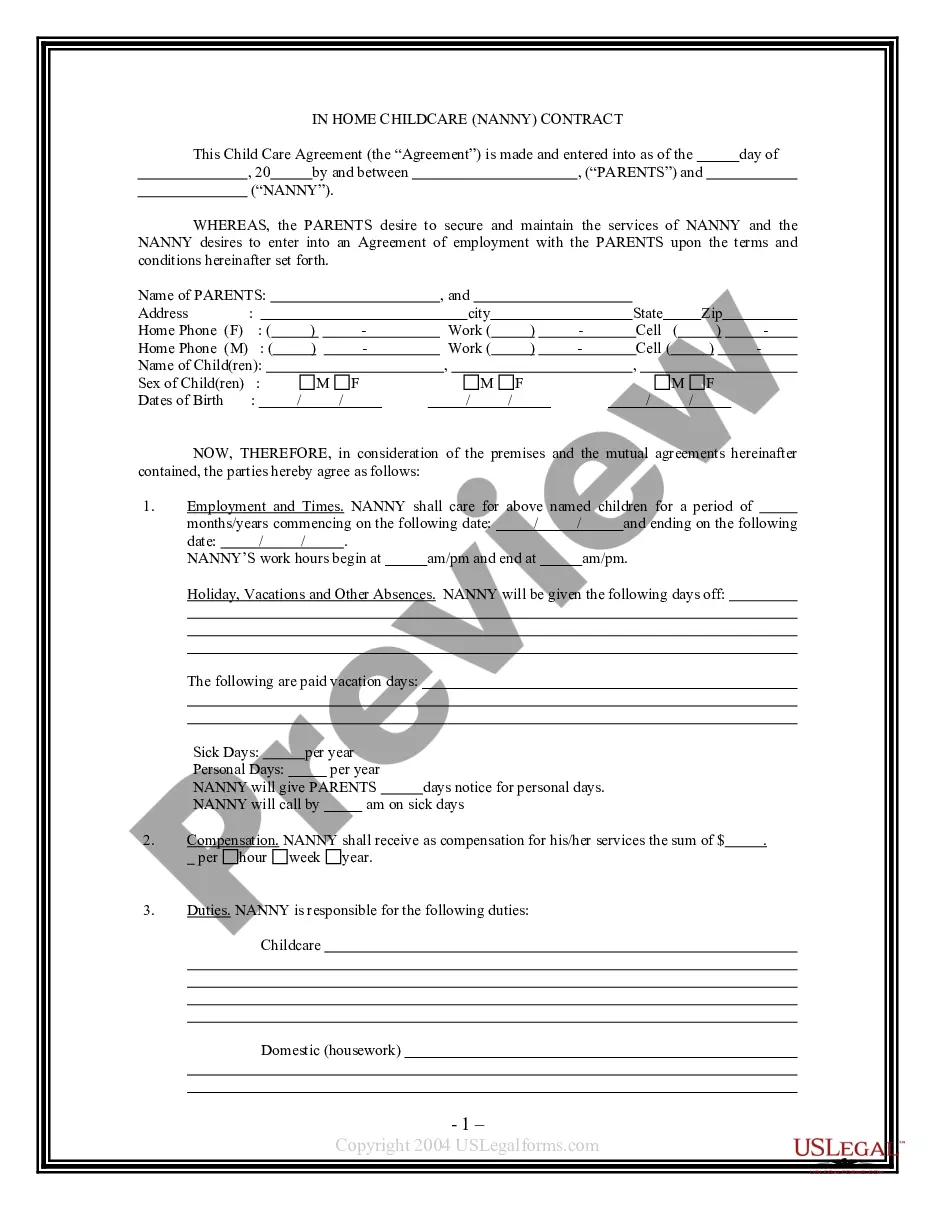
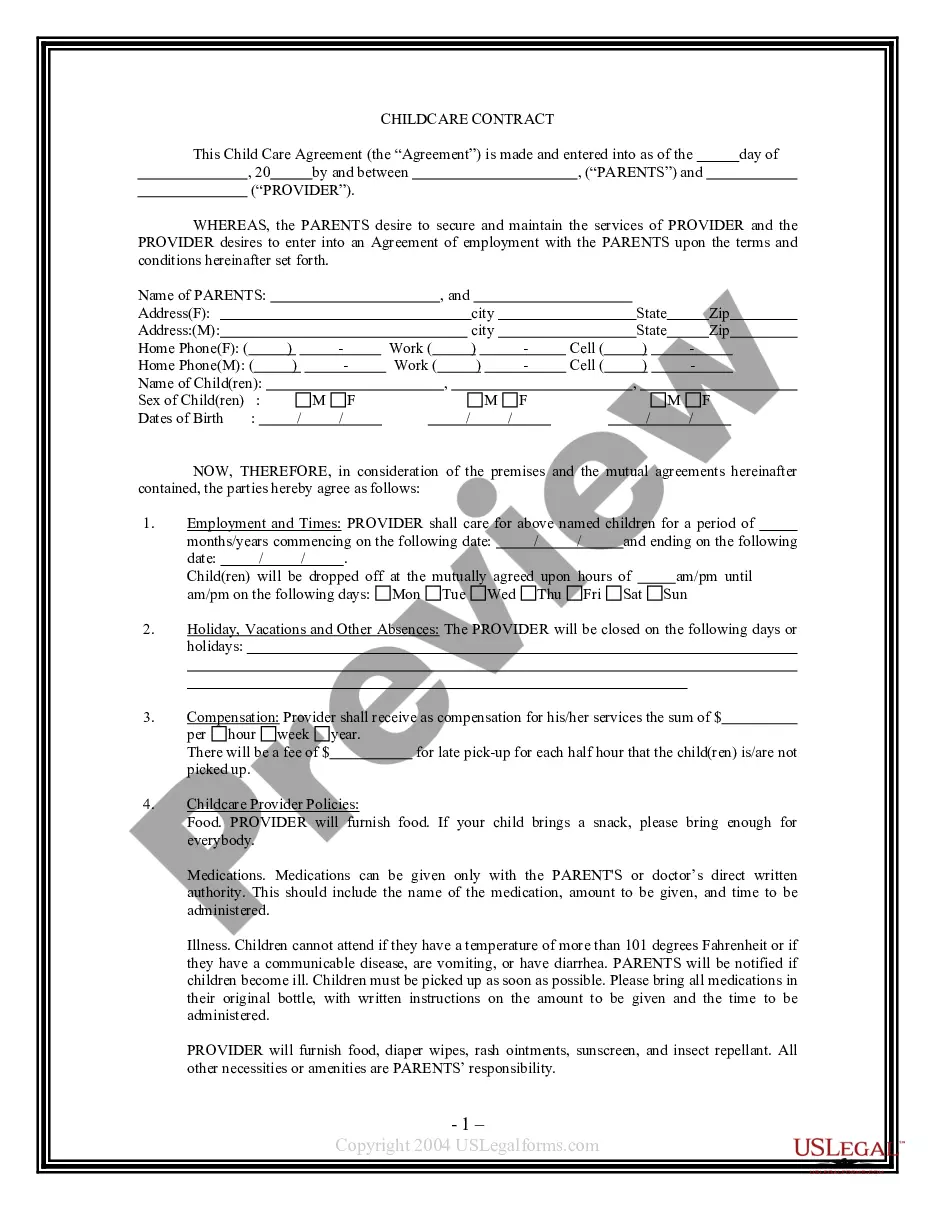
The Wisconsin Child Care Services Package is a comprehensive set of essential legal forms created specifically for child care providers in Wisconsin. This package differentiates itself by focusing on both operational and promotional aspects of running a child care service, ensuring that providers are equipped to minimize liability risks and related litigation. By purchasing this package, users save over 50% compared to buying the forms individually, making it a cost-effective solution for child care providers.
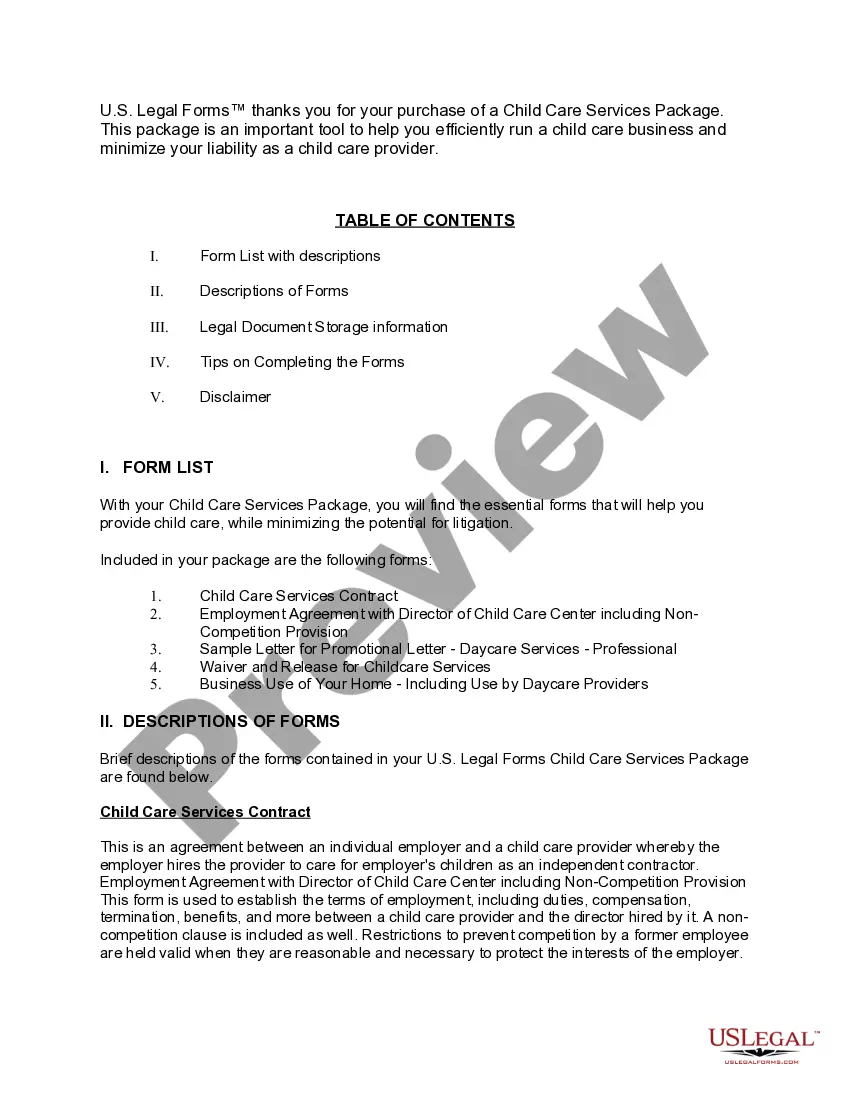
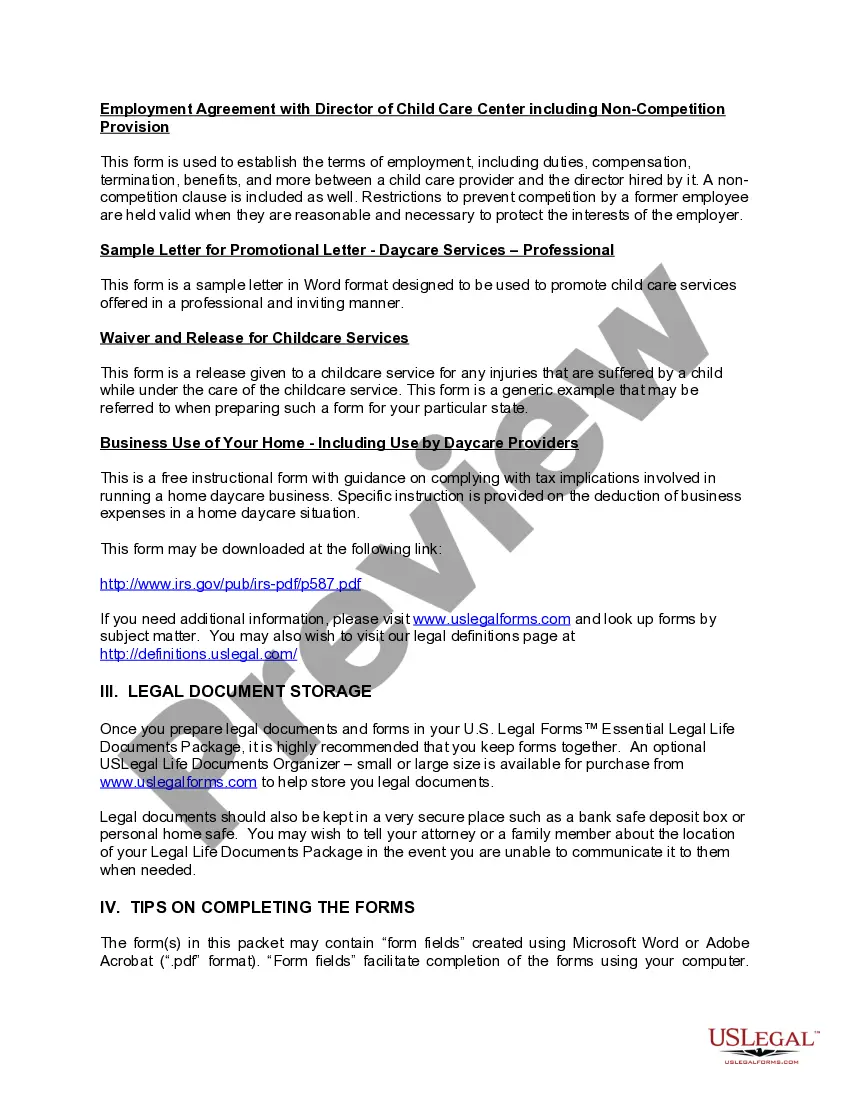
What’s included in this form package


When to use this form package
This package is ideal for various scenarios including:
- Launching a new child care service and needing foundational legal agreements.
- Hiring a director or staff for a child care center and requiring structured employment agreements.
- Promoting child care services through professional correspondence.
- Establishing liability waivers to protect against injuries that may occur during care.
- Complying with home business regulations specific to daycare providers.
Who should use this form package
- Individual child care providers operating as independent contractors.
- Directors of child care centers needing formal employment agreements.
- Business owners promoting their daycare services to potential clients.
- Anyone running a home-based daycare seeking compliance with local regulations.
How to complete these forms
- Review each form included in the package to understand its purpose and requirements.
- Identify the parties involved, including the child care provider and the employer.
- Enter relevant dates, names, and signatures in the appropriate fields.
- Ensure that any necessary agreements, such as non-competition clauses, are included and acknowledged.
- Store completed forms securely and ensure that both parties have signed copies.
Notarization guidance for this package
Notarization is generally not required for forms in this package. However, specific circumstances or local laws may require it. You can complete notarization remotely through US Legal Forms, powered by Notarize, with 24/7 availability.
Get your form ready online
Our built-in tools help you complete, sign, share, and store your documents in one place.
Make edits, fill in missing information, and update formatting in US Legal Forms—just like you would in MS Word.
Download a copy, print it, send it by email, or mail it via USPS—whatever works best for your next step.
Sign and collect signatures with our SignNow integration. Send to multiple recipients, set reminders, and more. Go Premium to unlock E-Sign.
If this form requires notarization, complete it online through a secure video call—no need to meet a notary in person or wait for an appointment.
We protect your documents and personal data by following strict security and privacy standards.

Make edits, fill in missing information, and update formatting in US Legal Forms—just like you would in MS Word.

Download a copy, print it, send it by email, or mail it via USPS—whatever works best for your next step.

Sign and collect signatures with our SignNow integration. Send to multiple recipients, set reminders, and more. Go Premium to unlock E-Sign.

If this form requires notarization, complete it online through a secure video call—no need to meet a notary in person or wait for an appointment.

We protect your documents and personal data by following strict security and privacy standards.
Avoid these common issues
- Failing to ensure all parties read and understand the terms before signing.
- Not keeping copies of signed documents for both the provider and the employer.
- Overlooking the importance of the non-competition provisions in the employment agreement.
- Not customizing the promotional letter to reflect unique services being offered.
Why use this package online
- Convenience of downloading and accessing forms from anywhere at any time.
- Editability allows users to customize forms easily to fit their specific needs.
- Reliability of having documents drafted by licensed attorneys ensures legal soundness.
Looking for another form?




Form popularity
FAQ
Family Child Care Homes. Family Group Home. Residential Certificate Homes. Center Based Care. In-Home Care or Nanny. Shared Care. Before and After School Programs. Head Start.
Family Child Care Homes. In family child care homes, providers care for small groups of children in a residential building. Child Care Centers. Preschool Programs. School-Age Programs. Family, Friend, and Neighbor Care.
Traditional daycare center. Most daycare centers provide child care during standard work hours. In-home daycare. Nanny. Shared nanny. Au pair. Babysitter. Relative care. Preschool.
Family Child Care Homes. Child Care Centers. Head Start and Early Head Start. Preschool Programs. School-Age Child Care. Vacation and Summer Child Care Programs. Care in Your Own Home. Family, Friend, and Neighbor Care.
Wisconsin Child Care Regulation Information. Anyone providing care and supervision for four (4) or more children, under age 7 years, for less than 24 hours a day must be licensed by the Department of Children and Families.Care provided in the home of the child's parent for less than 24 hours per day.
Family care remains the most common type of child-care arrangement across all marital and employment statuses. Three-quarters of full-time employed mothers (75.2 percent) utilize some form of family care at least part of the time, compared to 86.3 percent of part-time employed mothers.
For families earning less than $65,000 per year, the new subsidy will cover up to 85 per cent of their costs. For families earning between $65,000 and $170,000 the rate will gradually taper to 50 per cent of costs.
As of March 2016, the income limit to qualify for assistance was increased to $37,296 (185 percent of poverty), and the exit eligibility limit was increased to $40,320 (200 percent of poverty), to adjust for the 2016 federal poverty level.
Must have 120 days half-time or 80 days full-time experience in direct care; or certification by the Wisconsin department of public instruction as a nursery school teacher or as an exceptional education needs teacher (or be able to show evidence of meeting the qualifications for certification); and 2 years documented