Mississippi Complaint to Contest Will
Overview of this form
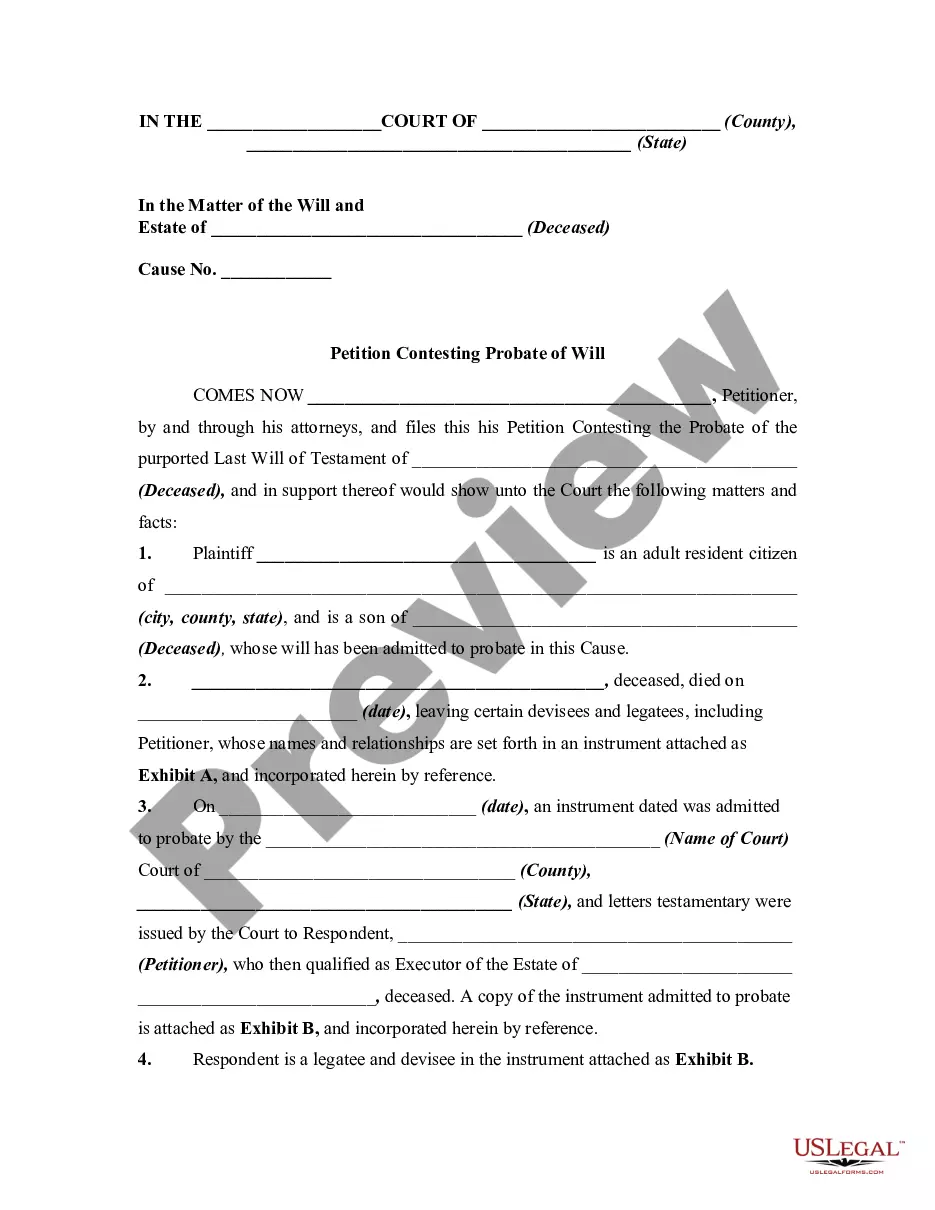
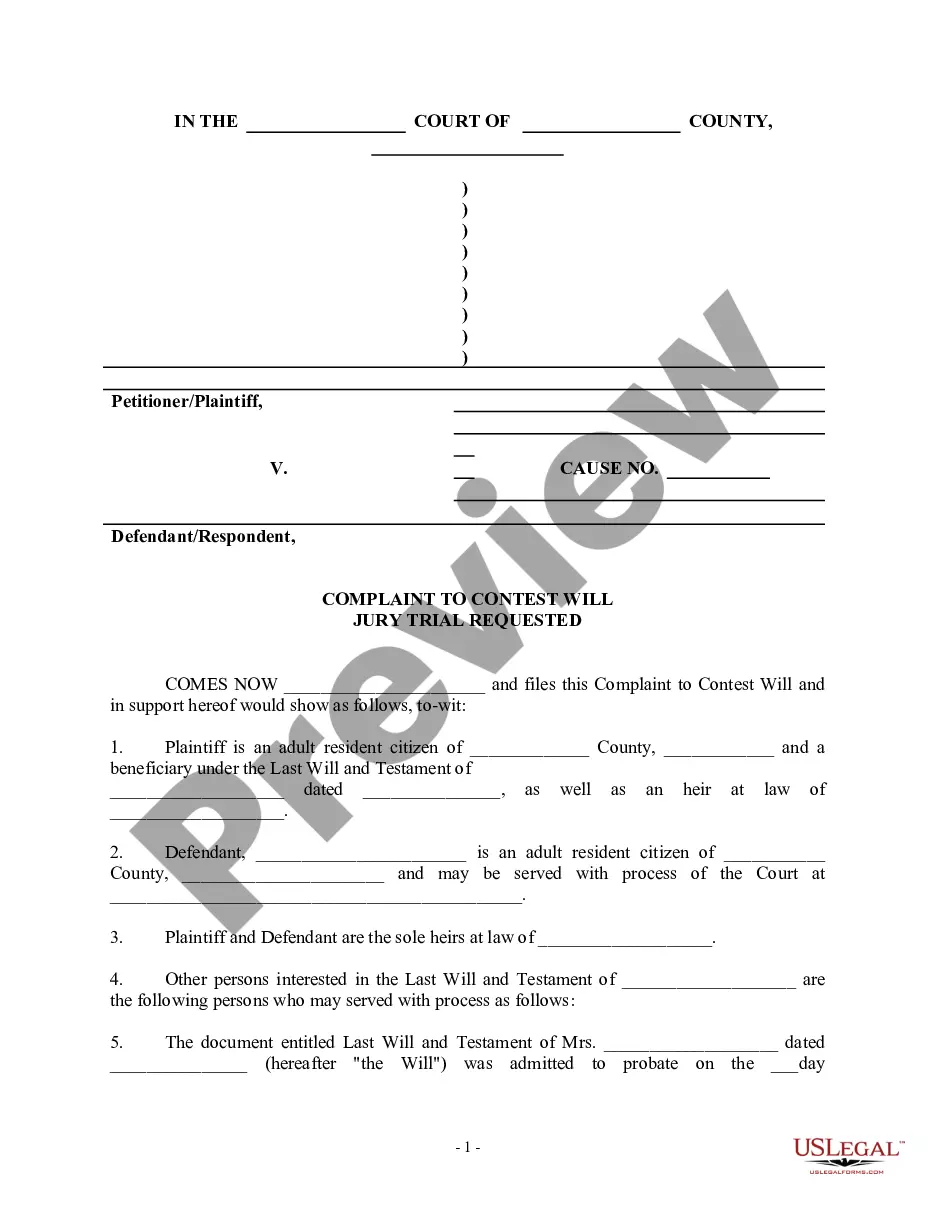
The Complaint to Contest Will is a legal document that initiates a lawsuit regarding the validity of a will. This form allows a plaintiff to formally assert their claims against a defendant who is likely to defend the will's authenticity. Unlike other legal forms, this specific complaint addresses disputes that arise when an individual believes a will may not reflect the true intentions of the deceased due to issues such as lack of capacity, undue influence, or improper execution.
What’s included in this form
- Pleading details that outline the parties involved in the dispute.
- Allegations regarding the validity of the will, including reasons for contesting it.
- Request for specific relief or judgment regarding the will's enforceability.
- Signature fields for the plaintiff and their attorney, if applicable.
- Required information about the estate and the deceased.
Common use cases
This form should be used in situations where an interested party, such as a family member or beneficiary, believes that a will is invalid. Common scenarios include when there are claims of lack of mental capacity, allegations of undue influence by another party, or if the will was not properly signed or witnessed according to state laws. This complaint is necessary for formally contesting the will in court.
Who can use this document
- Individuals seeking to contest a will in a probate proceeding.
- Heirs or beneficiaries who believe their rights under the will have been compromised.
- Someone who has a legitimate interest in the estate of the deceased.
- Legal representatives acting on behalf of a plaintiff in a contestation case.
How to complete this form
- Identify all parties involved, including the plaintiff and defendant.
- Clearly state the grounds for contesting the will, mentioning specific allegations.
- Provide details about the deceased and the estate in question.
- Sign the complaint in the designated areas for authenticity.
- If applicable, include the contact information for legal representation.
Does this form need to be notarized?
To make this form legally binding, it must be notarized. Our online notarization service, powered by Notarize, lets you verify and sign documents remotely through an encrypted video session.
Get your form ready online
Our built-in tools help you complete, sign, share, and store your documents in one place.
Make edits, fill in missing information, and update formatting in US Legal Forms—just like you would in MS Word.
Download a copy, print it, send it by email, or mail it via USPS—whatever works best for your next step.
Sign and collect signatures with our SignNow integration. Send to multiple recipients, set reminders, and more. Go Premium to unlock E-Sign.
If this form requires notarization, complete it online through a secure video call—no need to meet a notary in person or wait for an appointment.
We protect your documents and personal data by following strict security and privacy standards.

Make edits, fill in missing information, and update formatting in US Legal Forms—just like you would in MS Word.

Download a copy, print it, send it by email, or mail it via USPS—whatever works best for your next step.

Sign and collect signatures with our SignNow integration. Send to multiple recipients, set reminders, and more. Go Premium to unlock E-Sign.

If this form requires notarization, complete it online through a secure video call—no need to meet a notary in person or wait for an appointment.

We protect your documents and personal data by following strict security and privacy standards.
Common mistakes
- Failing to fully articulate the grounds for contesting the will.
- Not including all necessary parties in the complaint.
- Leaving out required signatures or contact information.
- Submitting the complaint after the state-imposed deadline.
- Neglecting to follow specific state formatting requirements.
Advantages of online completion
- Convenient access to form templates available for immediate download.
- Editability allows you to customize the content to reflect your situation.
- Reliability, as forms are drafted by licensed attorneys to ensure legal soundness.
- No need for physical paperwork, streamlining the process.
- Guidance throughout the completion process enhances understanding and compliance.
What to keep in mind
- The Complaint to Contest Will is essential for initiating a dispute over a will's validity.
- Careful completion and understanding of state-specific rules are crucial.
- Using this form online offers convenience and access to professional quality.
- Avoid common mistakes for a smoother legal process.
Looking for another form?
Form popularity
FAQ
The will was not signed and witnessed. State law requires that the testator sign the will, and have it attested to by two or more credible witnesses in the presence of the testator: MS Code § 91-5-1; MS Code A§ 91-5-1. Lack of mental capacity. Undue influence. Fraud.
Under California financial elder abuse law, you must prove four elements to establish undue influence: (1) vulnerability of the victim, (2) apparent authority of the wrongdoer, (3) actions and tactics of the wrongdoer, and (4) an inequitable result.
The costs in such cases are almost always paid out of the estate. Where there are reasonable grounds for opposing a Will other than those mentioned above the unsuccessful party though not usually granted his costs out of the estate will not have to pay the other party's costs.
There is no need for embarrassment about that. Sometimes it is simply not worth the risk and expense of contesting a will, however hurt you may be by its terms. DO know your funding options whether Pay As You Go or some form of No Win No Fee or No Win Reduced Fee arrangement.
Lack of testamentary capacity. Undue influence. Insane delusion. Duress. Fraud. Technical flaws. Forgery. Legal inheritance rights.
The Most Important Evidence in an Undue Influence Claim Under California financial elder abuse law, you must prove four elements to establish undue influence: (1) vulnerability of the victim, (2) apparent authority of the wrongdoer, (3) actions and tactics of the wrongdoer, and (4) an inequitable result.
Contesting a Will means applying to the court to have the Will, or parts of the Will, deemed invalid.Furthermore, if there was no prior Will, the deceased will be considered to have died intestate. This means that the estate will be dealt with under provincial intestate laws.
Lack of testamentary capacity. Undue influence. Insane delusion. Duress. Fraud. Technical flaws. Forgery. Legal inheritance rights.
In California, the time limit for filing a motion to contest a will approved by probate is 120 days.