Mississippi Petition for Removal of Minority to Execute Quitclaim Deed - Emancipation
About this form
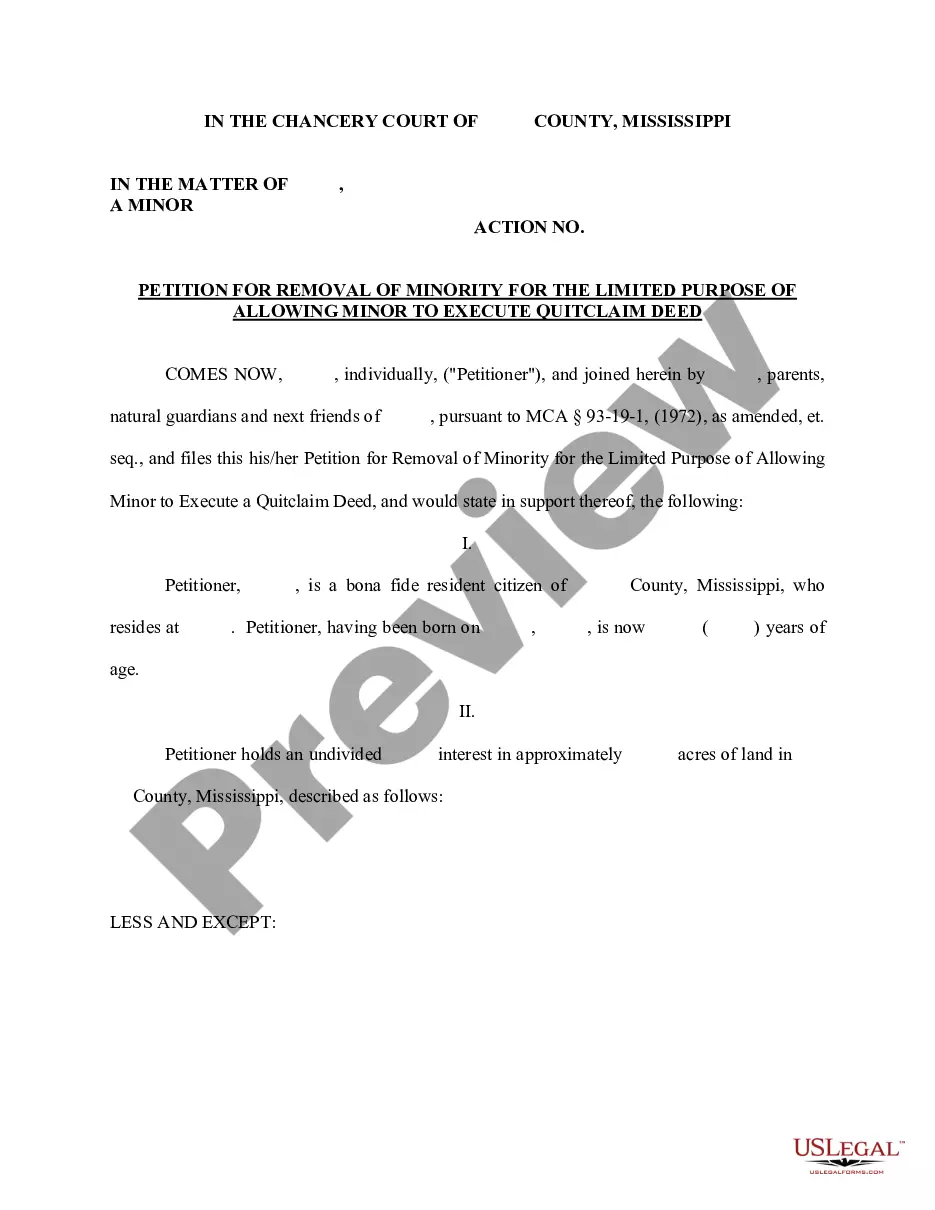
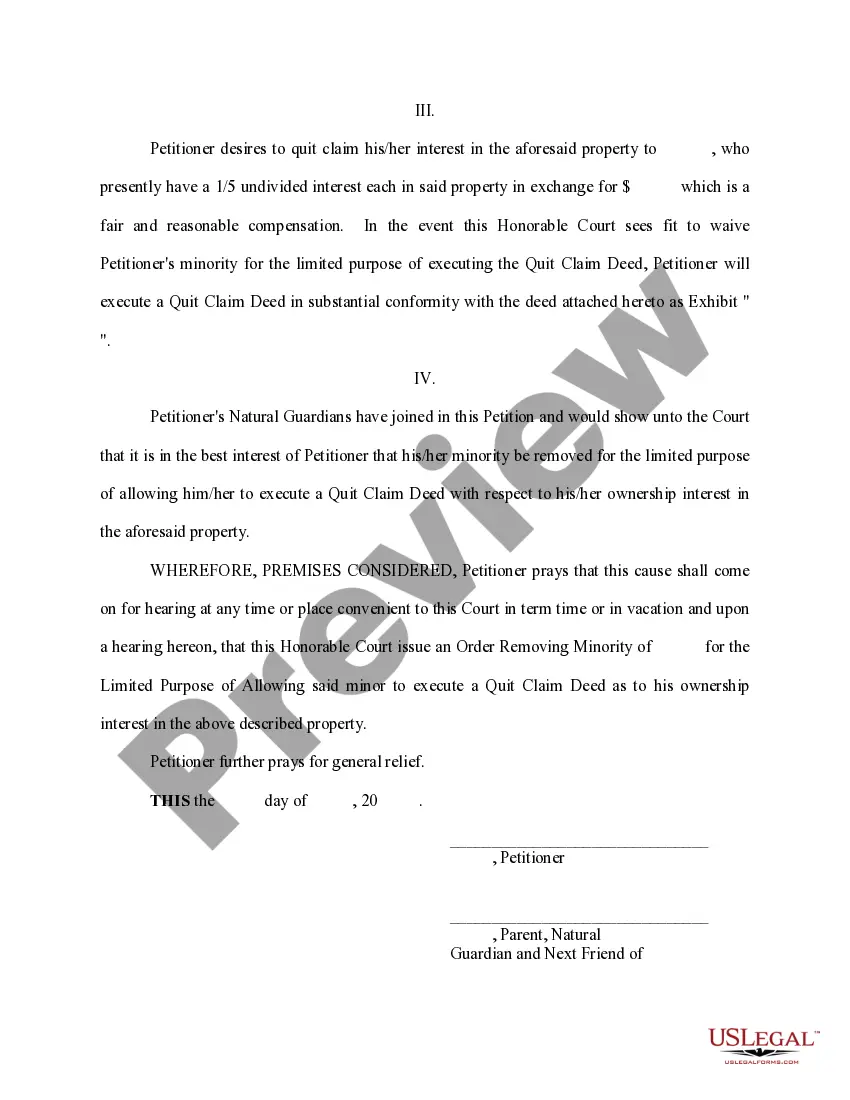
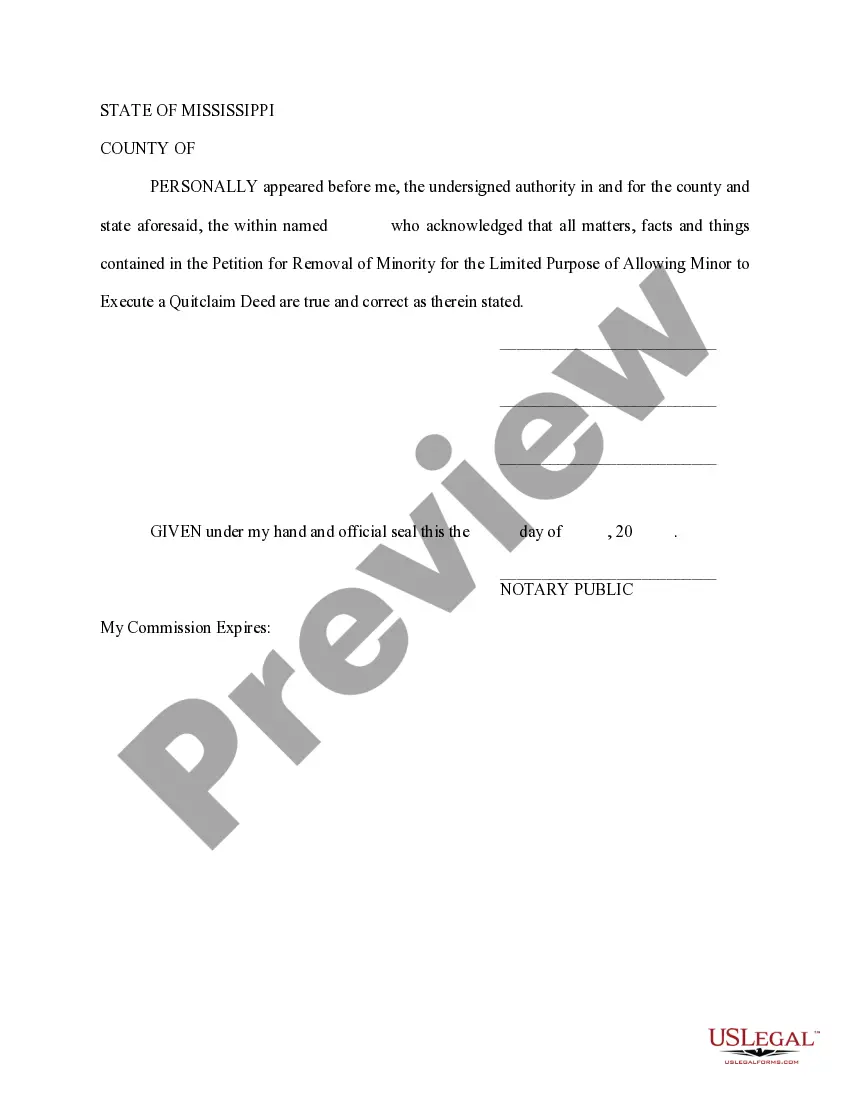
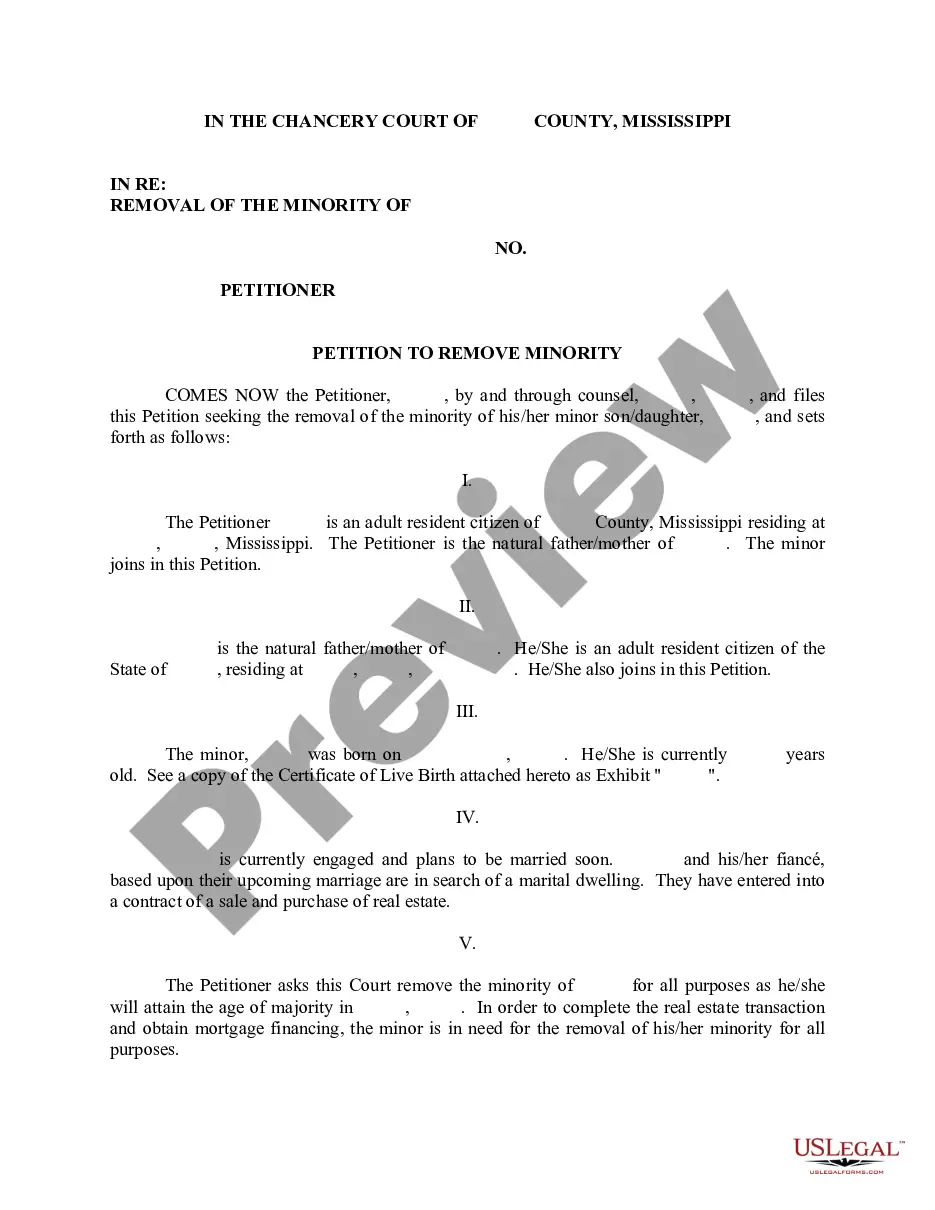
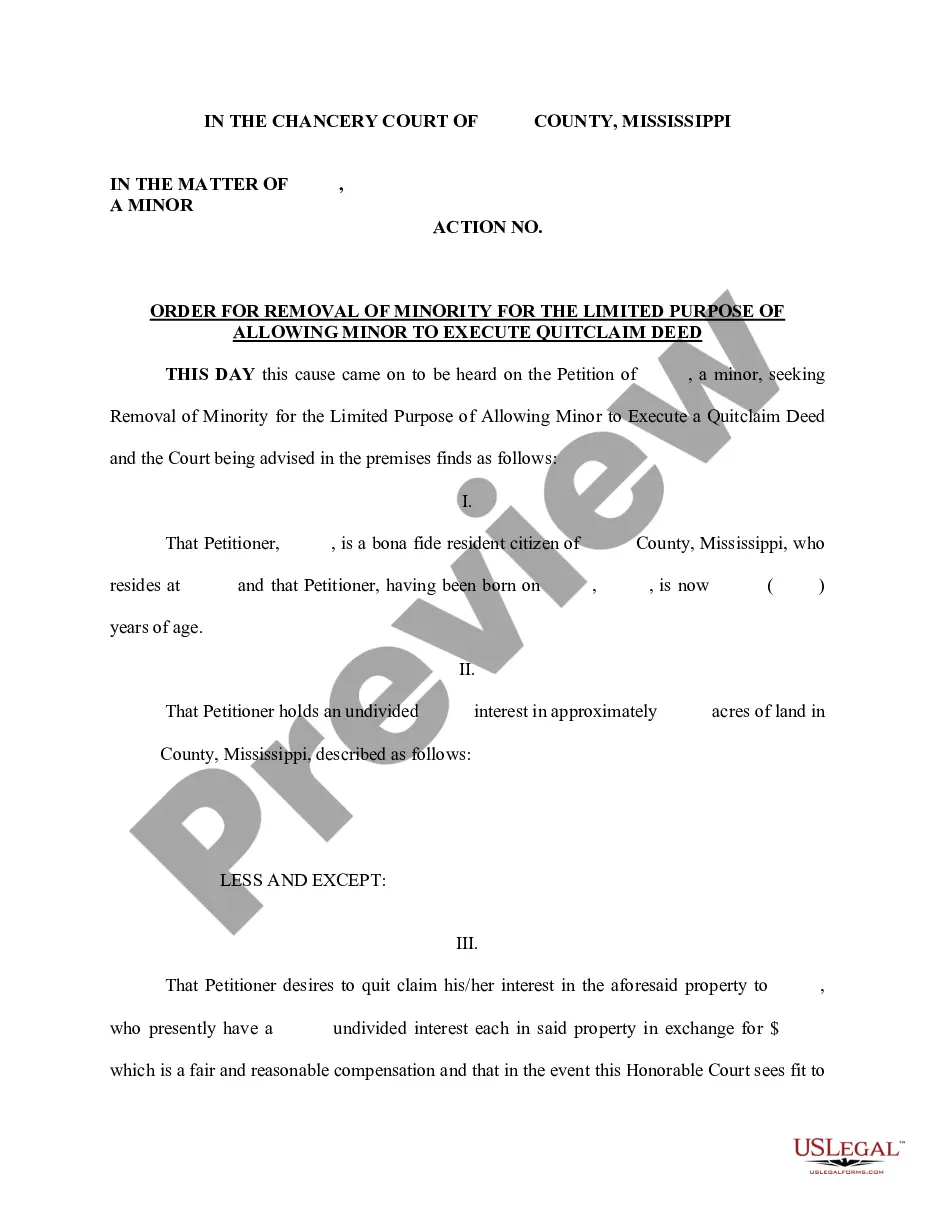
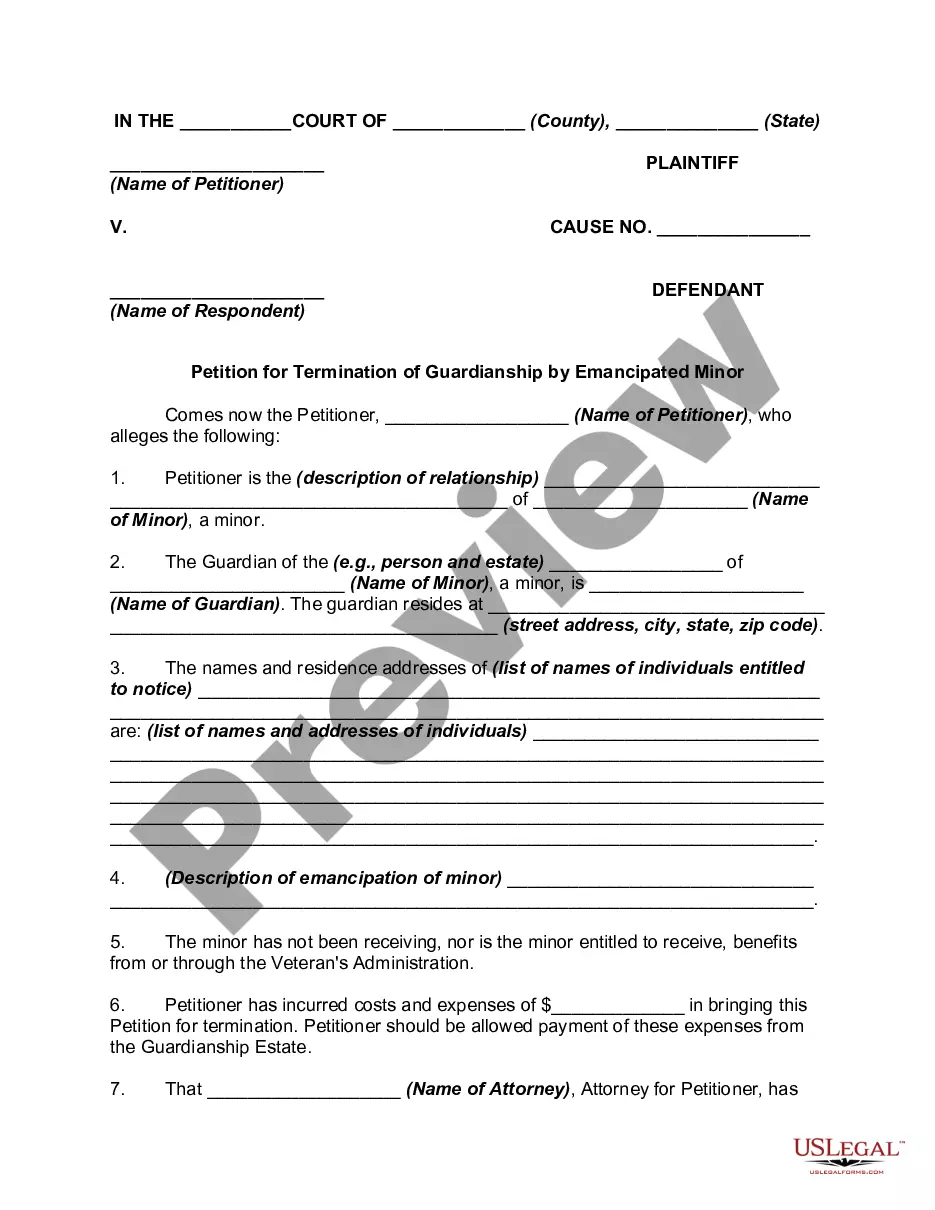
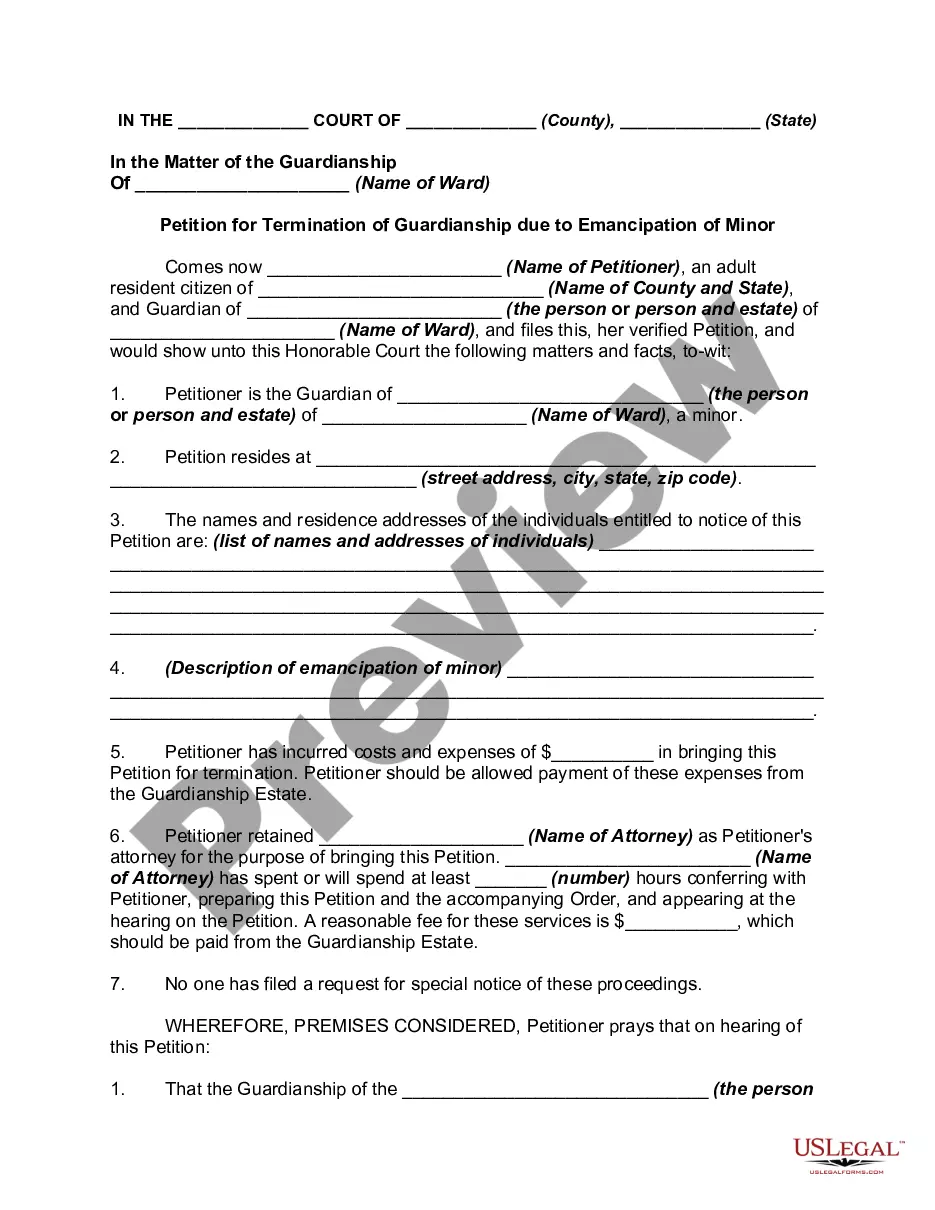
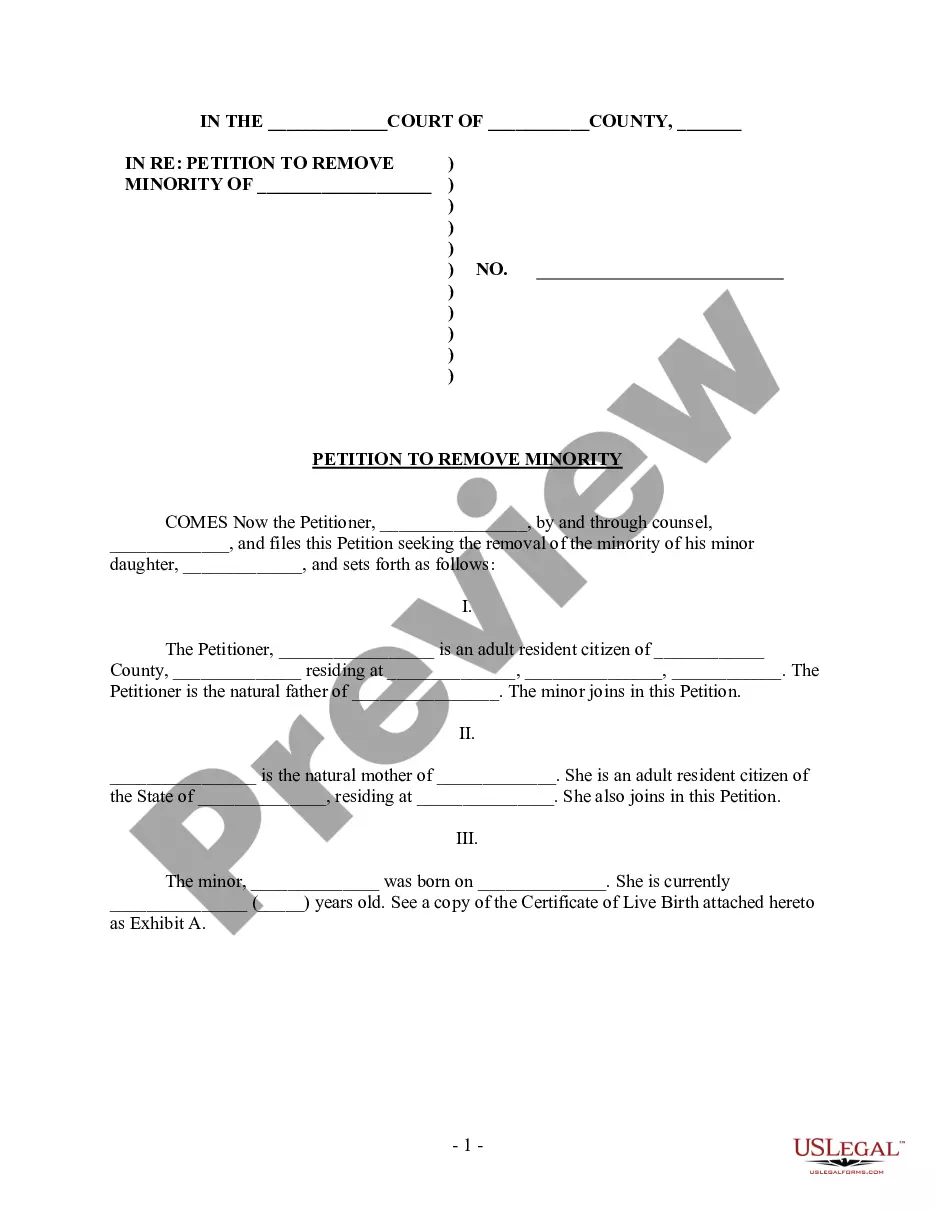
The Petition for Removal of Minority to Execute Quitclaim Deed is a legal document used to petition the court for permission to transfer property ownership from a minor through a quitclaim deed. This form is specifically designed for situations where the minor needs to be legally emancipated to authorize such a deed. Unlike standard quitclaim forms, this petition includes additional legal considerations for minors and their emancipation status.
What’s included in this form
- Information about the petitioner, including their relationship to the minor.
- Details regarding the minor, including their name and age.
- The specific property involved in the quitclaim deed.
- Reason for the petition, demonstrating why emancipation is necessary.
- Signature block for the court and the petitioner.

When to use this document
This form should be used when a minor is required to sign a quitclaim deed to transfer property ownership. Common scenarios include when a minor inherits property or when parents wish to remove a minor's interest in a property for financial or personal reasons. It is also relevant in cases of divorce, where a property needs to be transferred out of a minor's name.
Intended users of this form
- Petitioners who are parents or legal guardians of the minor.
- Individuals seeking to emancipate a minor for property transfer purposes.
- Legal representatives working on behalf of the minor or their guardians.
Completing this form step by step
- Identify the petitioner and provide their information.
- Enter the minor's details, including full name and age.
- Specify the property being transferred in the quitclaim deed.
- Clearly state the reasons for the request to remove minority status.
- Sign and date the form in the appropriate sections.
Does this document require notarization?
This form does not typically require notarization unless specified by local law. It is advisable to check your jurisdiction's requirements to ensure compliance with any additional rules.
Get your form ready online
Our built-in tools help you complete, sign, share, and store your documents in one place.
Make edits, fill in missing information, and update formatting in US Legal Forms—just like you would in MS Word.
Download a copy, print it, send it by email, or mail it via USPS—whatever works best for your next step.
Sign and collect signatures with our SignNow integration. Send to multiple recipients, set reminders, and more. Go Premium to unlock E-Sign.
If this form requires notarization, complete it online through a secure video call—no need to meet a notary in person or wait for an appointment.
We protect your documents and personal data by following strict security and privacy standards.

Make edits, fill in missing information, and update formatting in US Legal Forms—just like you would in MS Word.

Download a copy, print it, send it by email, or mail it via USPS—whatever works best for your next step.

Sign and collect signatures with our SignNow integration. Send to multiple recipients, set reminders, and more. Go Premium to unlock E-Sign.

If this form requires notarization, complete it online through a secure video call—no need to meet a notary in person or wait for an appointment.

We protect your documents and personal data by following strict security and privacy standards.
Avoid these common issues
- Failing to provide complete information about the property.
- Not including the required signatures from all relevant parties.
- Omitting the reasons for the request to remove minority status.
- Using language that is not compliant with local laws.
Why complete this form online
- Convenient access to complete the form at your own pace.
- Editable templates allow for customization to meet specific needs.
- Reliable legal language drafted by licensed attorneys.
Key takeaways
- The Petition for Removal of Minority is crucial for legal property transactions involving minors.
- It requires court approval to ensure the protection of the minorâs interests.
- Accurate completion and adherence to local rules are essential for the petition's acceptance.
Looking for another form?
Form popularity
FAQ
Contesting A Quitclaim Deed Contesting the validity of a quitclaim deed must prove that one of the stipulations described above is invalid, that the deed was filed under false pretenses (e.g., the grantor's signature was forged) or that the grantor signed the deed under duress.
It's usually a very straightforward transaction, but it's possible for a quitclaim deed to be challenged. If a quitclaim deed is challenged in court, the issue becomes whether the property was legally transferred and if the grantor had the legal right to transfer the property.
In some instances, however, quitclaim deeds are used when the grantor has a mortgage. In this case, the grantor remains liable for the mortgage even after ownership has transferred through the execution of a quitclaim deed. Quitclaim deeds transfer title but do not affect mortgages.
Quitclaim deeds are most often used to transfer property between family members. Examples include when an owner gets married and wants to add a spouse's name to the title or deed, or when the owners get divorced and one spouse's name is removed from the title or deed.
Once the transfer is complete, there is no way to nullify or undo a quitclaim deed unless both parties consent to the arrangement. If the original grantor does agree to take back the property, you must draft and file a new quitclaim deed to void the original.
A quitclaim deed transfers title but makes no promises at all about the owner's title.A person who signs a quitclaim deed to transfer property they do not own results in no title at all being transferred since there is no actual ownership interest. The quitclaim deed only transfers the type of title you own.
A quitclaim deed is a deed (proof of ownership) that is passed from a grantor (the existing property owner) to a grantee (the new property owner) that does not have a warranty.It also doesn't guarantee that there are no property claims, liens, zoning law issues, or hunting easements on the land.
Quitclaim deeds are not taxable when they transfer ownership to a spouse or a qualifying charity. Other transactions may be liable to property and gift taxes. The quitclaim process is an easy way to transfer an interest in property where no money changes hands.
The drawback, quite simply, is that quitclaim deeds offer the grantee/recipient no protection or guarantees whatsoever about the property or their ownership of it. Maybe the grantor did not own the property at all, or maybe they only had partial ownership.