Condition of Limitation Clause
What this document covers
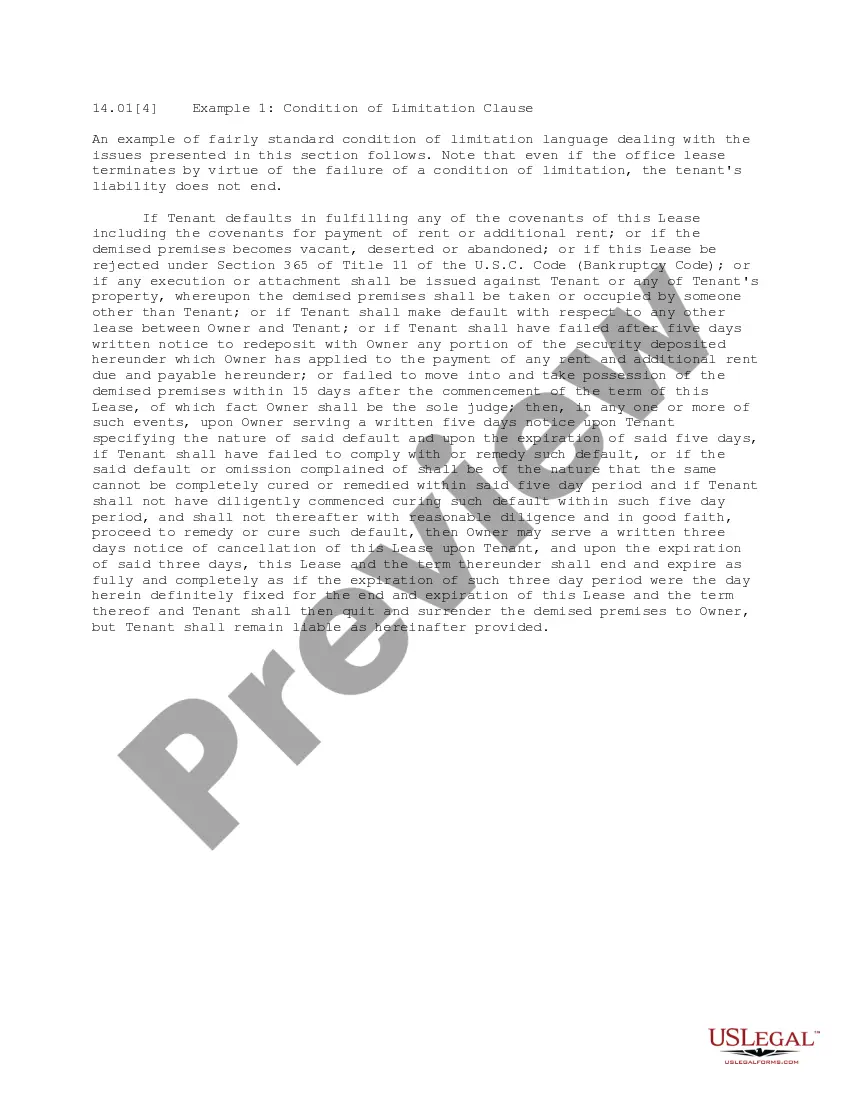
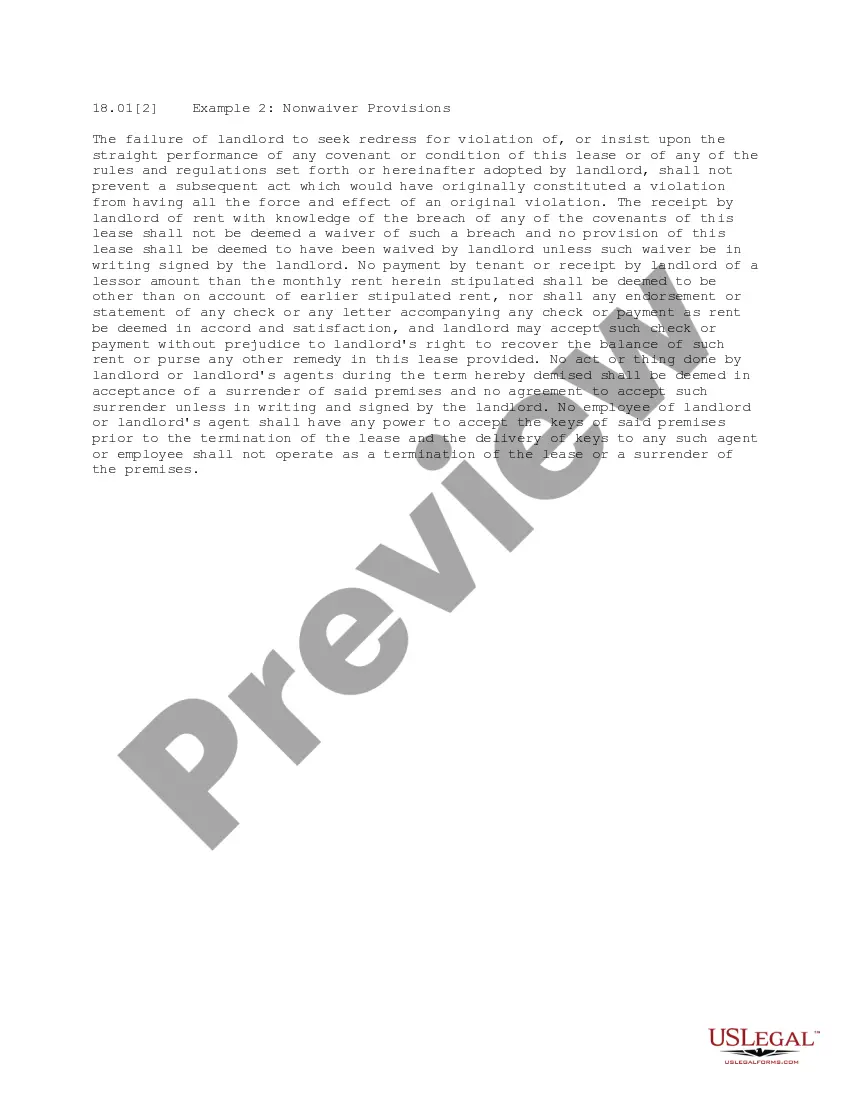
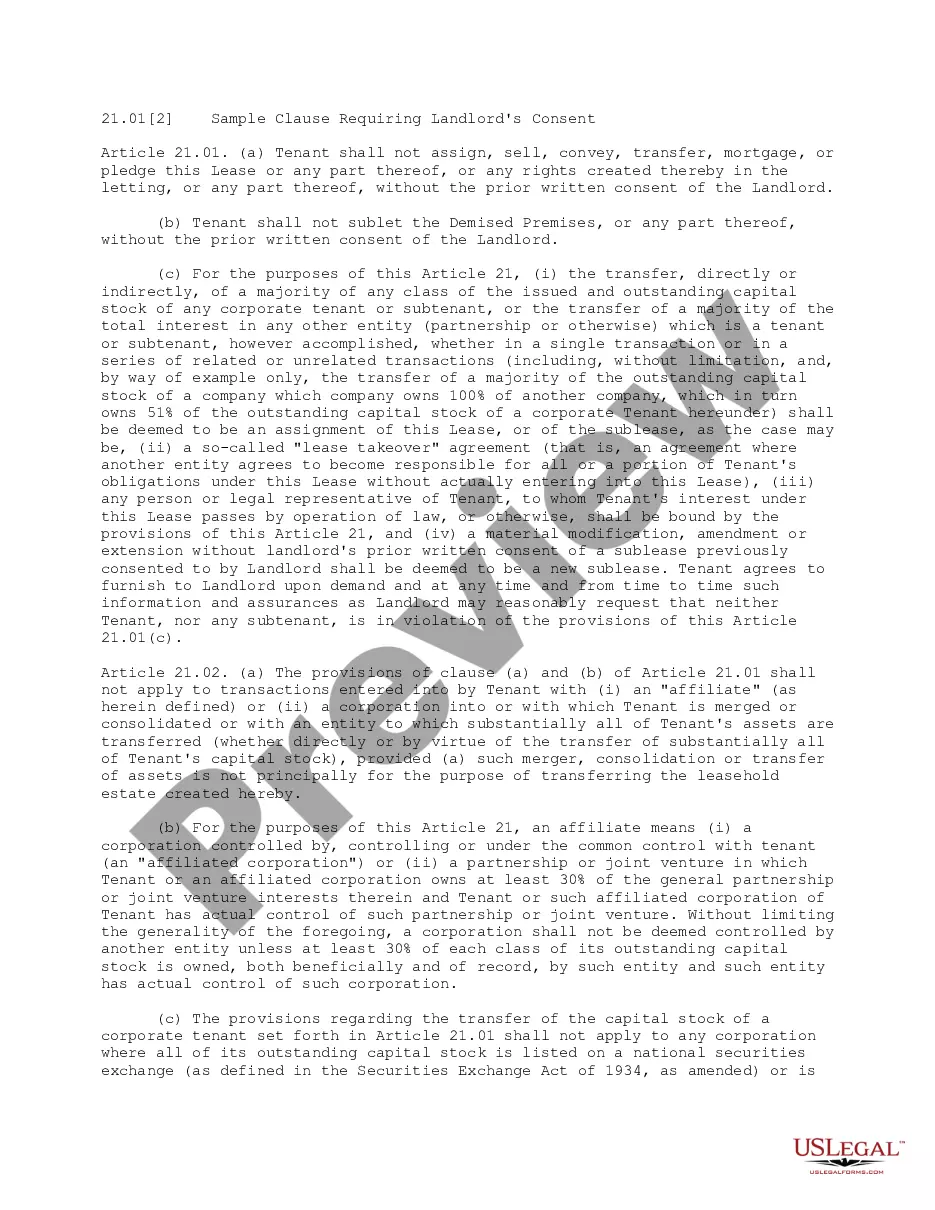
The Condition of Limitation Clause is a specific provision often included in office lease agreements. Its purpose is to outline the conditions under which a tenant may default on lease obligations. This clause differs from other lease forms by focusing specifically on the circumstances leading to potential lease termination due to tenant defaults, ensuring that landlords have a clear legal pathway for addressing such issues.
What’s included in this form
- Definition of tenant defaults related to lease obligations.
- Conditions under which the landlord can terminate the lease.
- Notice requirements for the tenant to remedy defaults.
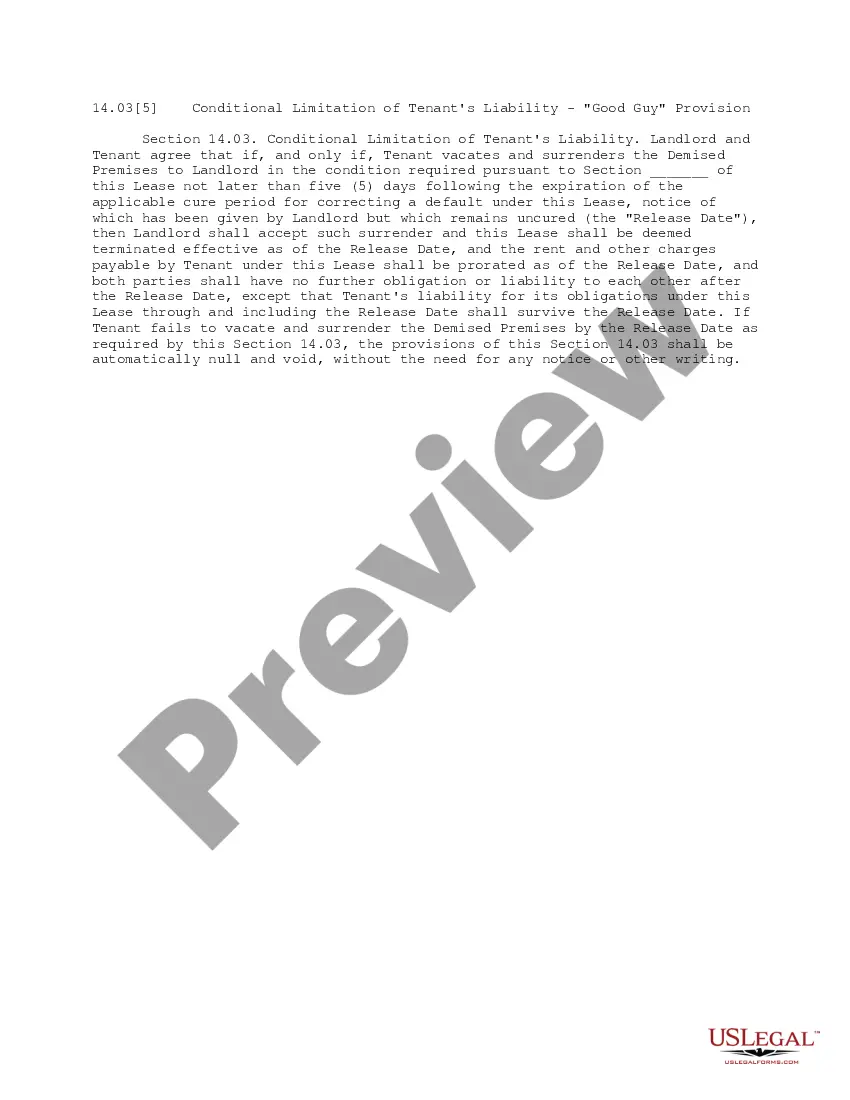
- Provisions on tenant liability even after lease termination.
- Time frames for tenant actions and landlord notifications.
When to use this document
This form should be used in situations where a landlord needs to establish clear conditions for lease termination due to tenant defaults. It is essential in cases involving non-payment of rent, property abandonment, or other breaches of lease terms. Landlords may refer to this clause to ensure they are legally protected should a tenant fail to fulfill their lease obligations.
Who can use this document
- Landlords seeking to protect their rights in the event of tenant defaults.
- Property management companies managing multiple rental properties.
- Real estate attorneys drafting or reviewing lease agreements.
- Tenant representatives wanting to understand their rights under lease agreements.
Instructions for completing this form
- Identify the parties involved in the lease agreement (landlord and tenant).
- Clearly specify the property being leased.
- Include detailed conditions under which defaults may occur.
- Outline the notice requirements and timelines for tenant defaults.
- Have both parties sign and date the form to execute the agreement.
Notarization requirements for this form
This form usually doesn’t need to be notarized. However, local laws or specific transactions may require it. Our online notarization service, powered by Notarize, lets you complete it remotely through a secure video session, available 24/7.
Get your form ready online
Our built-in tools help you complete, sign, share, and store your documents in one place.
Make edits, fill in missing information, and update formatting in US Legal Forms—just like you would in MS Word.
Download a copy, print it, send it by email, or mail it via USPS—whatever works best for your next step.
Sign and collect signatures with our SignNow integration. Send to multiple recipients, set reminders, and more. Go Premium to unlock E-Sign.
If this form requires notarization, complete it online through a secure video call—no need to meet a notary in person or wait for an appointment.
We protect your documents and personal data by following strict security and privacy standards.

Make edits, fill in missing information, and update formatting in US Legal Forms—just like you would in MS Word.

Download a copy, print it, send it by email, or mail it via USPS—whatever works best for your next step.

Sign and collect signatures with our SignNow integration. Send to multiple recipients, set reminders, and more. Go Premium to unlock E-Sign.

If this form requires notarization, complete it online through a secure video call—no need to meet a notary in person or wait for an appointment.

We protect your documents and personal data by following strict security and privacy standards.
Common mistakes
- Failing to clearly define what constitutes a default.
- Not including specific time frames for notice or remedy.
- Overlooking tenant rights when drafting the notice requirements.
- Using vague language that may lead to misunderstandings.
Why complete this form online
- Convenient access to legal forms that can be downloaded at any time.
- Editability allows customization to fit specific lease agreements.
- Reliability of attorney-drafted content ensures compliance with current laws.
Legal use & context
- The Condition of Limitation Clause is enforceable in various jurisdictions, provided it complies with local laws.
- This clause helps establish clear terms around tenant defaults and lease termination, aiding in potential disputes.
- Understanding this clause can help landlords and tenants navigate the complexities of lease agreements more effectively.
Key takeaways
- The Condition of Limitation Clause clearly outlines tenant defaults and resulting actions for landlords.
- It is essential for landlords to include this clause to protect their rights in lease agreements.
- Both parties should understand the implications of this clause before signing the lease.
Definitions you should know
- Default: A failure to fulfill contractual obligations, such as not paying rent.
- Tenant: The individual or entity renting the property from the landlord.
- Lease termination: The official end of a lease agreement, which may occur due to various defaults.
Looking for another form?



Form popularity
FAQ
These types of clauses operate to exclude or restrict the rights of a party. For example, if a party to a contract wishes to limit its liability in the event that it breaches the contract, it will usually include an exclusion clause limiting the amount of damages that the other party can claim to a specified total.
A limitation of liability clause is a provision in a contract that limits the amount of exposure a company faces in the event a lawsuit is filed or another claim is made. If found to be enforceable, a limitation of liability clause can "cap" the amount of potential damages to which a company is exposed.
Limitation of liability clauses are a useful way of balancing the risk between parties to a commercial contract. The parties can seek to limit their liability under the contract in a number of ways, often by excluding liability for certain types of loss or by putting a financial cap on liability for such losses.
A limitation clause is a constitutional provision which enables constitutionally protected rights to be partially limited, to a specified extent and for certain democratically justifiable purposes.
Limitation of liability clauses are a useful way of balancing the risk between parties to a commercial contract. The parties can seek to limit their liability under the contract in a number of ways, often by excluding liability for certain types of loss or by putting a financial cap on liability for such losses.
Limitation of liability clauses limit the amount one party has to pay the other party if they suffer loss because of a contract between them. To be enforceable, limitation of liability clauses need to be reasonable and carefully drafted, so make sure you pay great attention to them whenever you enter into a contract.
Courts should always uphold limitation-of-liability clauses, whether or not the two parties to the contract had equal bargaining power.Without such clauses, sellers would have a difficult time obtaining liability insurance and when such insurance could be obtained, it would be at higher prices.
Although a party can never limit its liability for intentional wrongdoing or willful misconduct (California Civil Code Section 1668), California courts will uphold contractual provisions limiting liability for breach of contract or ordinary negligence so long as the provision does not affect the public interest and
To Benefit from a Limit of Liability, You Have to Breach That doesn't mean the limit of liability does the indemnitor no good. It can take advantage of the limit, but only if it breaches the contract. If it refuses its indemnity obligations, the limit of liability restricts the other party's damages for that breach.