Clause Dealing with Limitations on Use
Overview of this form
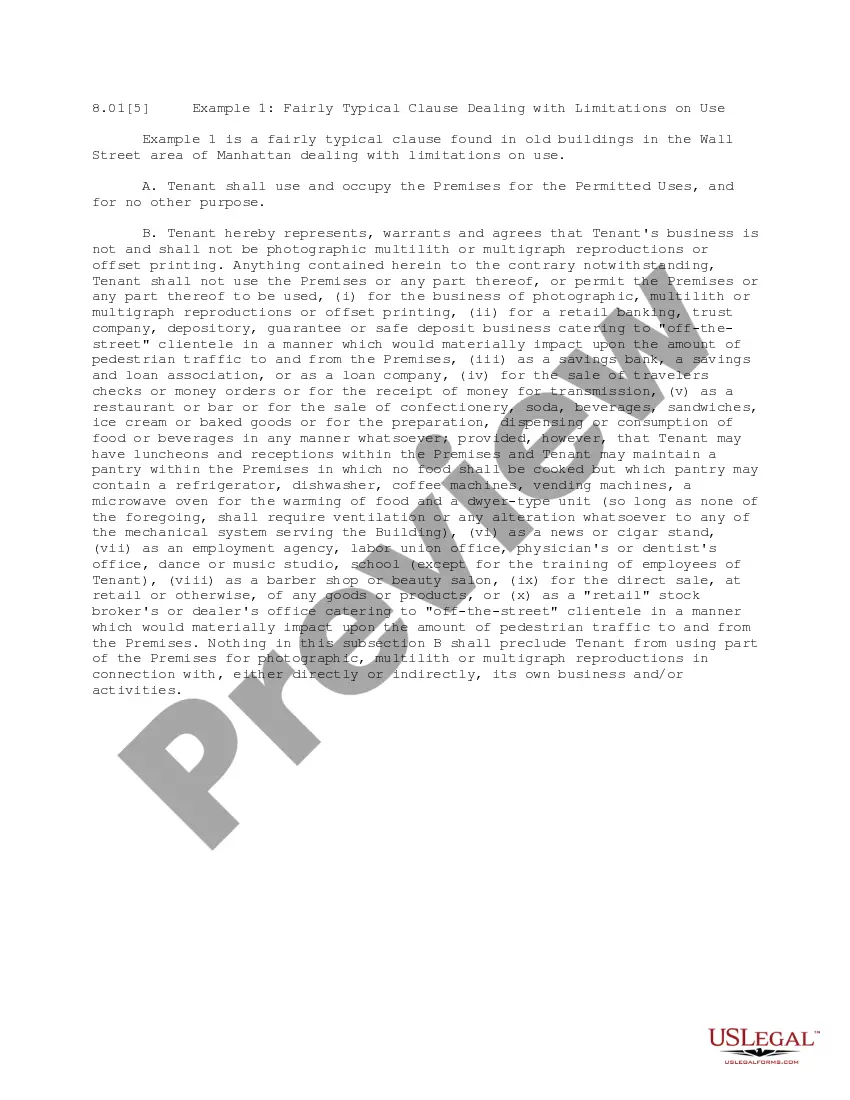
The Clause Dealing with Limitations on Use is a legal document specifically designed for office leases that restrict how tenants can use the rented premises. This form differentiates itself from standard lease agreements by providing detailed limitations on the types of business activities permitted in the space, particularly tailored for older buildings in the Wall Street area of Manhattan. It helps landlords ensure that tenants adhere to specific usage guidelines to maintain the character and functionality of the property.
Form components explained
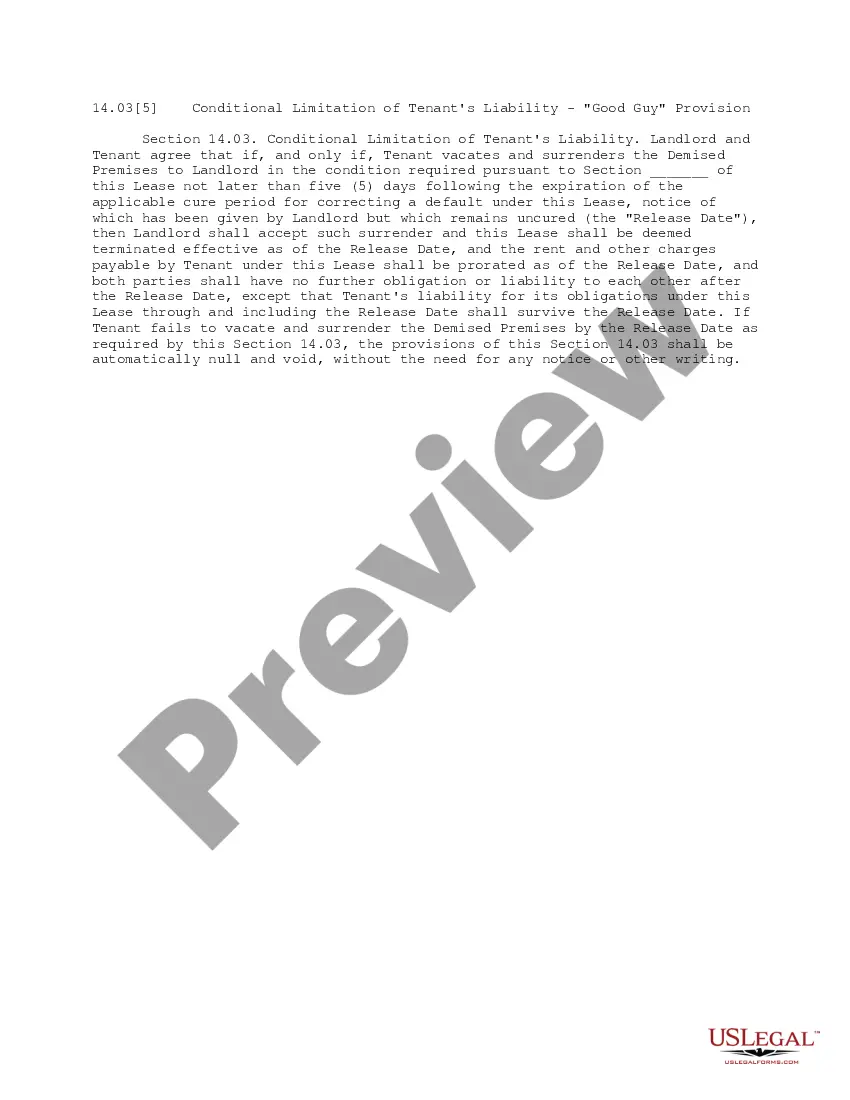
- A statement of permitted uses for the premises.
- Restrictions against certain businesses, including retail banking, printing, and food services.
- Tenants' representations regarding their business activities.
- Conditions for limited allowances, such as the use of pantries for non-cooked food.
- Prohibitions on specific retail and professional services to minimize pedestrian traffic issues.
When this form is needed
This form is typically used when entering into a lease agreement for commercial office space, particularly in older buildings where specific business limitations are relevant. Landlords and commercial tenants should utilize this clause to clarify permissible uses, avoiding misunderstandings about the nature of businesses that can operate within the premises.
Intended users of this form
This form is ideal for:
- Landlords seeking to control the types of businesses that occupy their properties.
- Tenants who want to understand their rights and obligations regarding the use of leased space.
- Real estate professionals involved in preparing or reviewing lease agreements.
How to complete this form
- Identify the parties involved in the lease agreement (landlord and tenant).
- Clearly define the premises that are being leased.
- Specify the permitted uses for the property as described in the form.
- Review and complete sections detailing prohibited business activities.
- Sign and date the document to finalize the lease agreement.
Is notarization required?
This form does not typically require notarization unless specified by local law. However, tenants and landlords should verify regional requirements to ensure compliance.
Get your form ready online
Our built-in tools help you complete, sign, share, and store your documents in one place.
Make edits, fill in missing information, and update formatting in US Legal Forms—just like you would in MS Word.
Download a copy, print it, send it by email, or mail it via USPS—whatever works best for your next step.
Sign and collect signatures with our SignNow integration. Send to multiple recipients, set reminders, and more. Go Premium to unlock E-Sign.
If this form requires notarization, complete it online through a secure video call—no need to meet a notary in person or wait for an appointment.
We protect your documents and personal data by following strict security and privacy standards.

Make edits, fill in missing information, and update formatting in US Legal Forms—just like you would in MS Word.

Download a copy, print it, send it by email, or mail it via USPS—whatever works best for your next step.

Sign and collect signatures with our SignNow integration. Send to multiple recipients, set reminders, and more. Go Premium to unlock E-Sign.

If this form requires notarization, complete it online through a secure video call—no need to meet a notary in person or wait for an appointment.

We protect your documents and personal data by following strict security and privacy standards.
Typical mistakes to avoid
- Failing to clearly specify permitted uses, leading to disputes.
- Neglecting to read and understand all restrictions before signing.
- Using non-compliant language in descriptions of business activities.
Advantages of online completion
- Convenience of instant access and download at any time.
- Ability to easily edit and customize for specific lease agreements.
- Reliability of professionally drafted content by licensed attorneys.
Legal use & context
- This clause is enforceable under New York law, provided it is incorporated into a formal lease agreement.
- Limitations on business activities are designed to protect property interests and maintain the intended use of the leased space.
Summary of main points
- The Clause Dealing with Limitations on Use is essential for defining how a leased property can be utilized.
- Understanding restrictions helps prevent conflicts between landlords and tenants.
- Online access to this form offers significant benefits in ease and reliability.
Looking for another form?
Form popularity
FAQ
A limitation of liability clause (sometimes referred to simply as a liability clause) is the section in a contracted agreement that specifies the damages that one party will be obligated to provide to the other under terms and conditions stipulated in the contract.
A limitation clause, also called a limitation of liability clause, is a stipulation in an agreement that helps ensure that a company is not held liable for more than they agreed to be responsible for.
To Benefit from a Limit of Liability, You Have to Breach That doesn't mean the limit of liability does the indemnitor no good. It can take advantage of the limit, but only if it breaches the contract. If it refuses its indemnity obligations, the limit of liability restricts the other party's damages for that breach.
Limitation of liability clauses are a useful way of balancing the risk between parties to a commercial contract. The parties can seek to limit their liability under the contract in a number of ways, often by excluding liability for certain types of loss or by putting a financial cap on liability for such losses.
In this article, "the limitation of rights" refers to situations in which laws or actions, after the commencement of the Constitution, affect the conduct and interests protected by the constitutional rights. Constitutionally valid limitations must comply with all of the requirements imposed by the Constitution.
A limitation of liability clause is a provision in a contract that limits the amount of exposure a company faces in the event a lawsuit is filed or another claim is made. If found to be enforceable, a limitation of liability clause can "cap" the amount of potential damages to which a company is exposed.
This means that a limitation of a human right may be considered lawful.A person's human rights can be limited if: The limitation applies to all people and not just one or a group of people. There is a good reason to limit the right and the limitation can reasonably be justified in society.
A limitation clause is where a party to the contract seeks to limit his liability for certain breaches of the contract. An exemption clause is the term used where either an exclusion or limitation clause has been upheld by the court.