Mississippi Order for Removal of Minority to Execute Quitclaim Deed - Emancipation
What is this form?
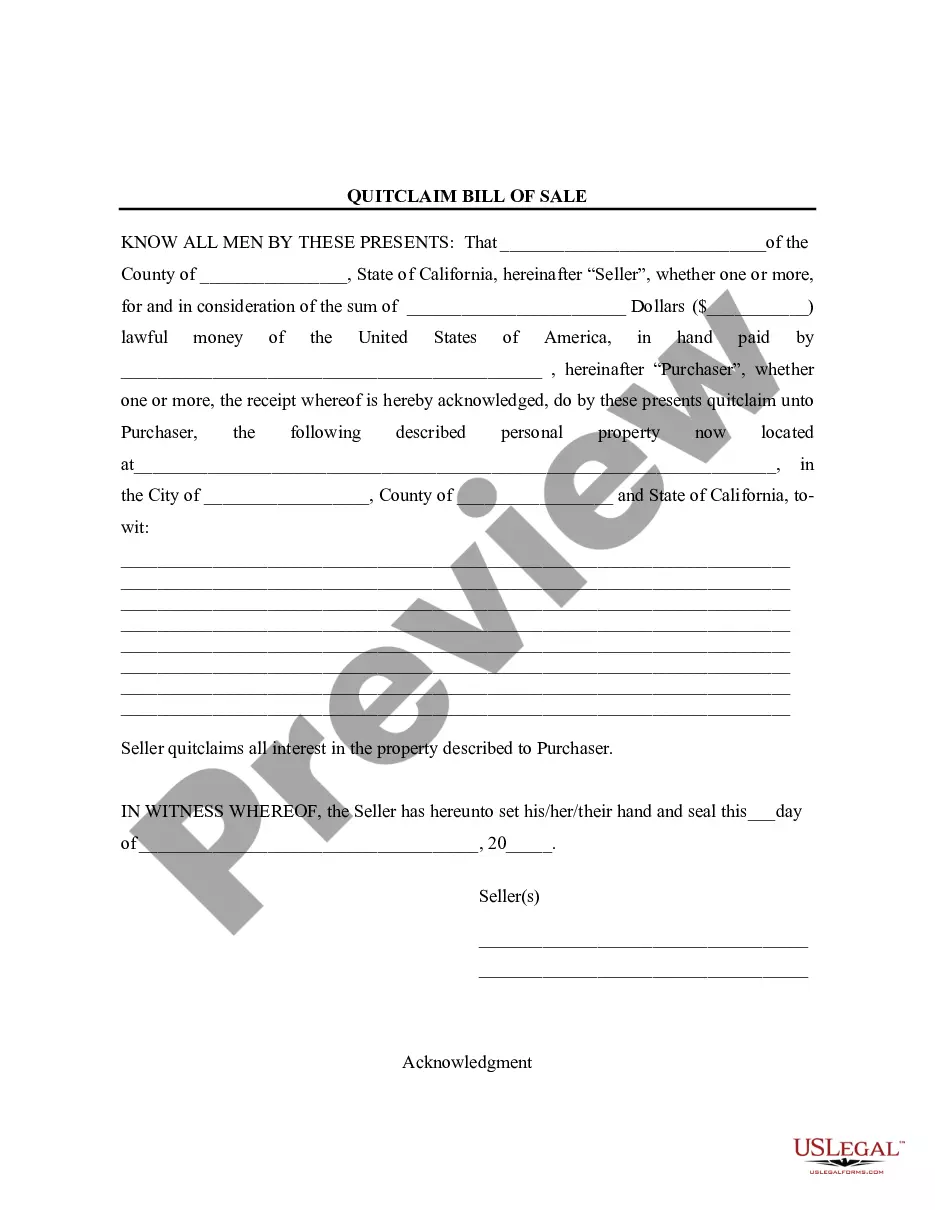
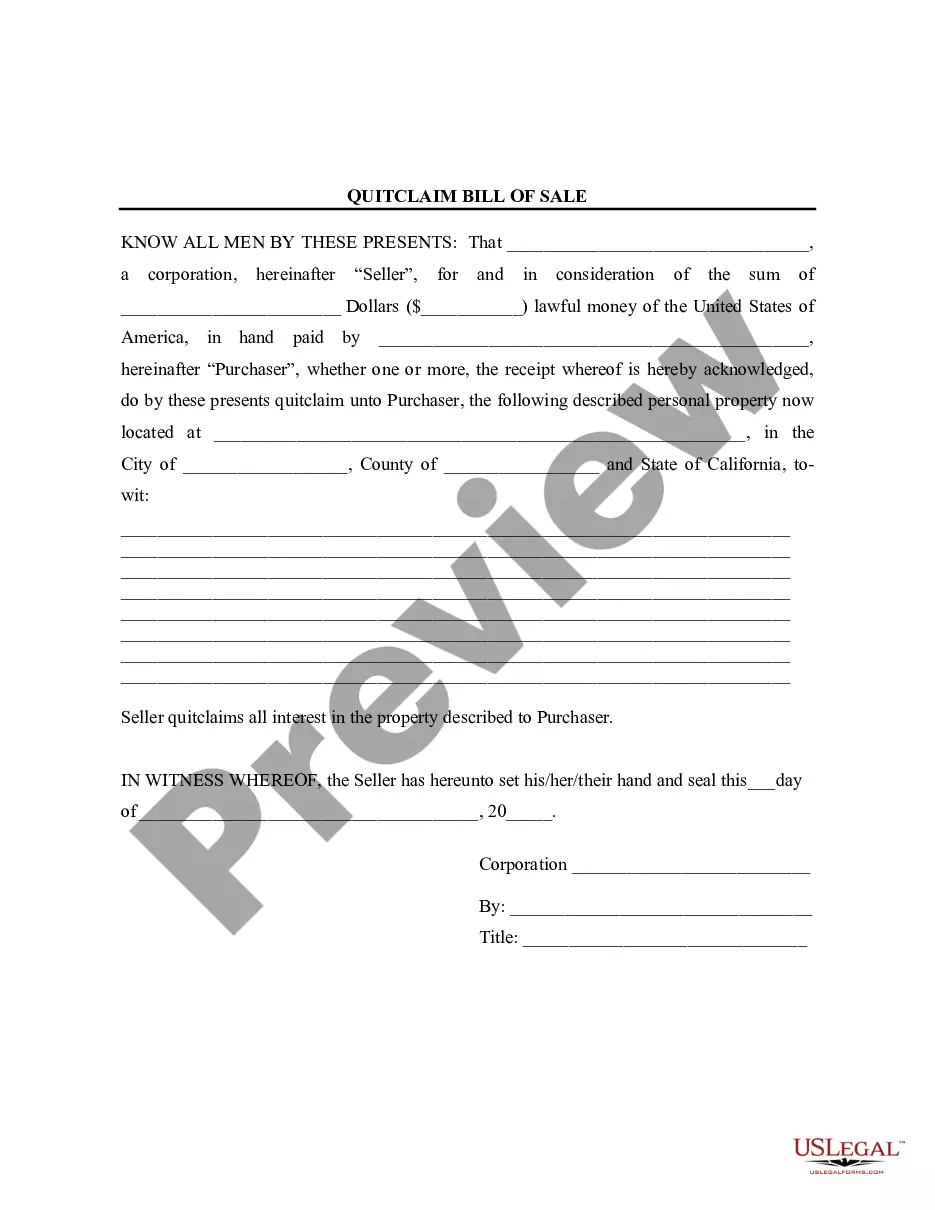
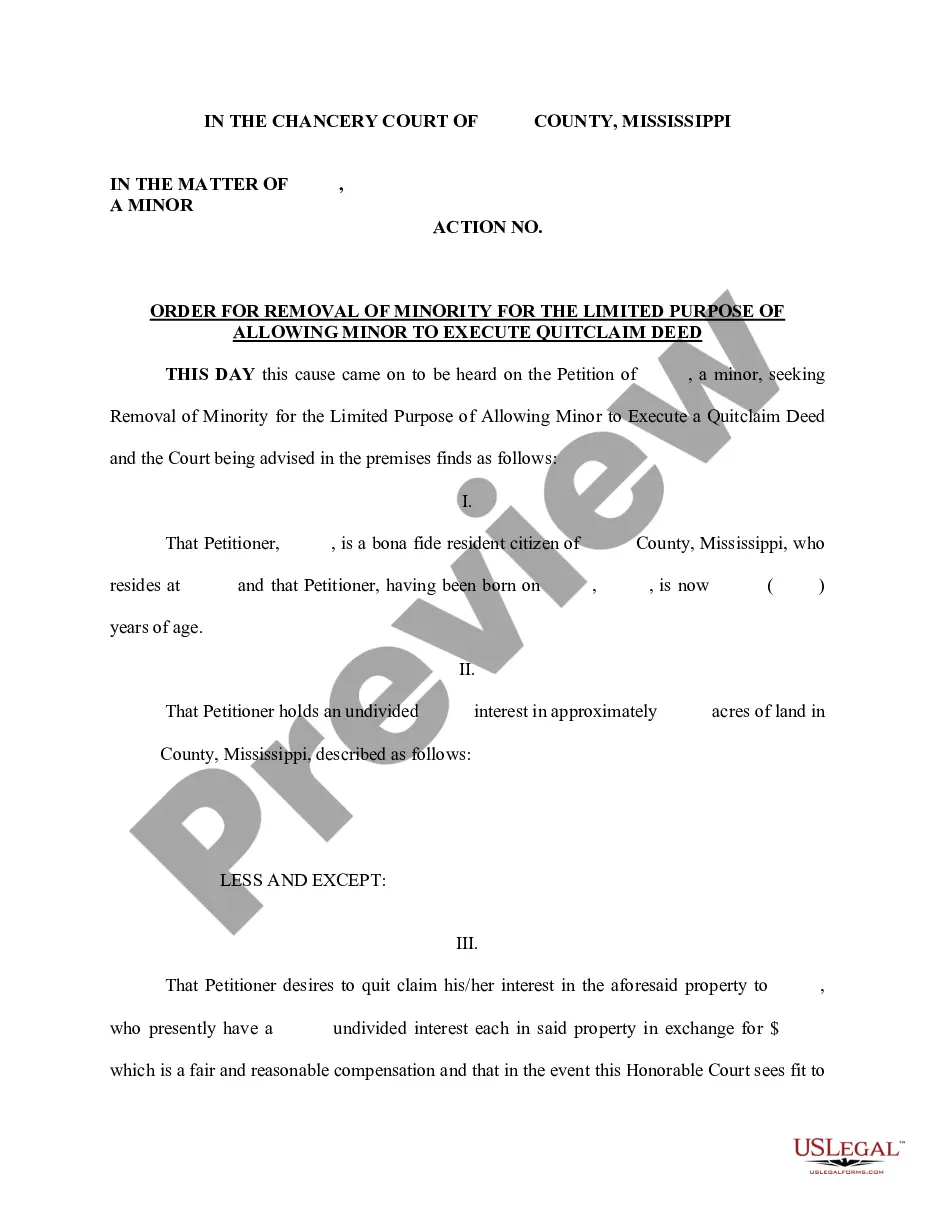
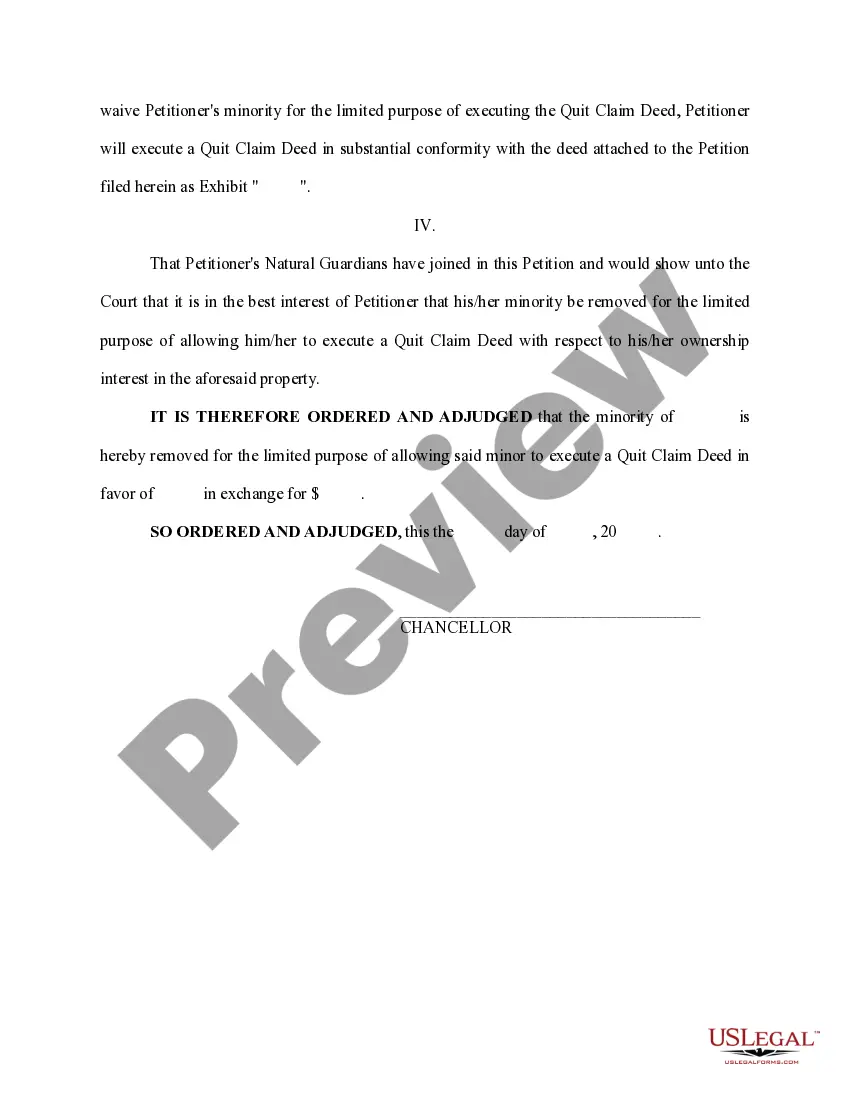
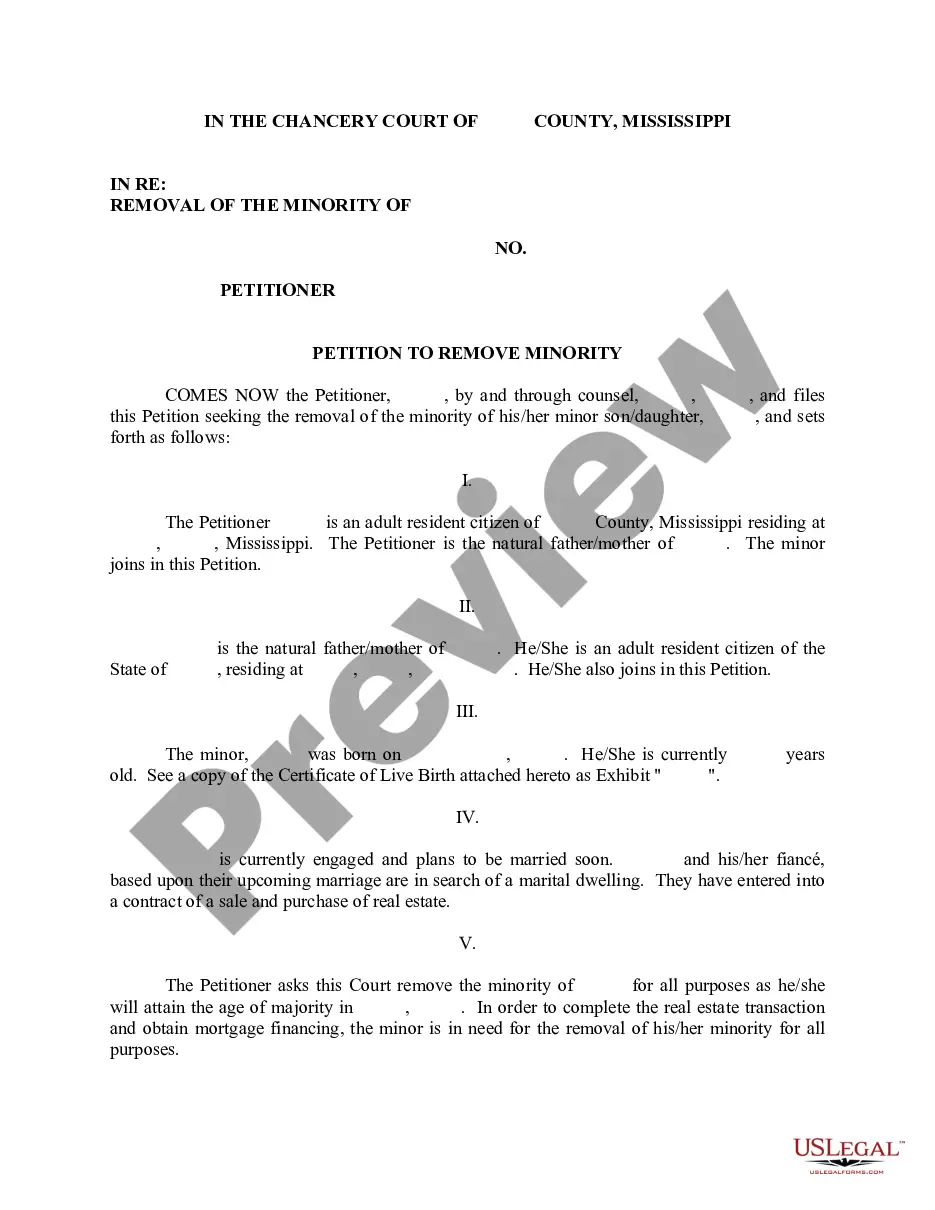
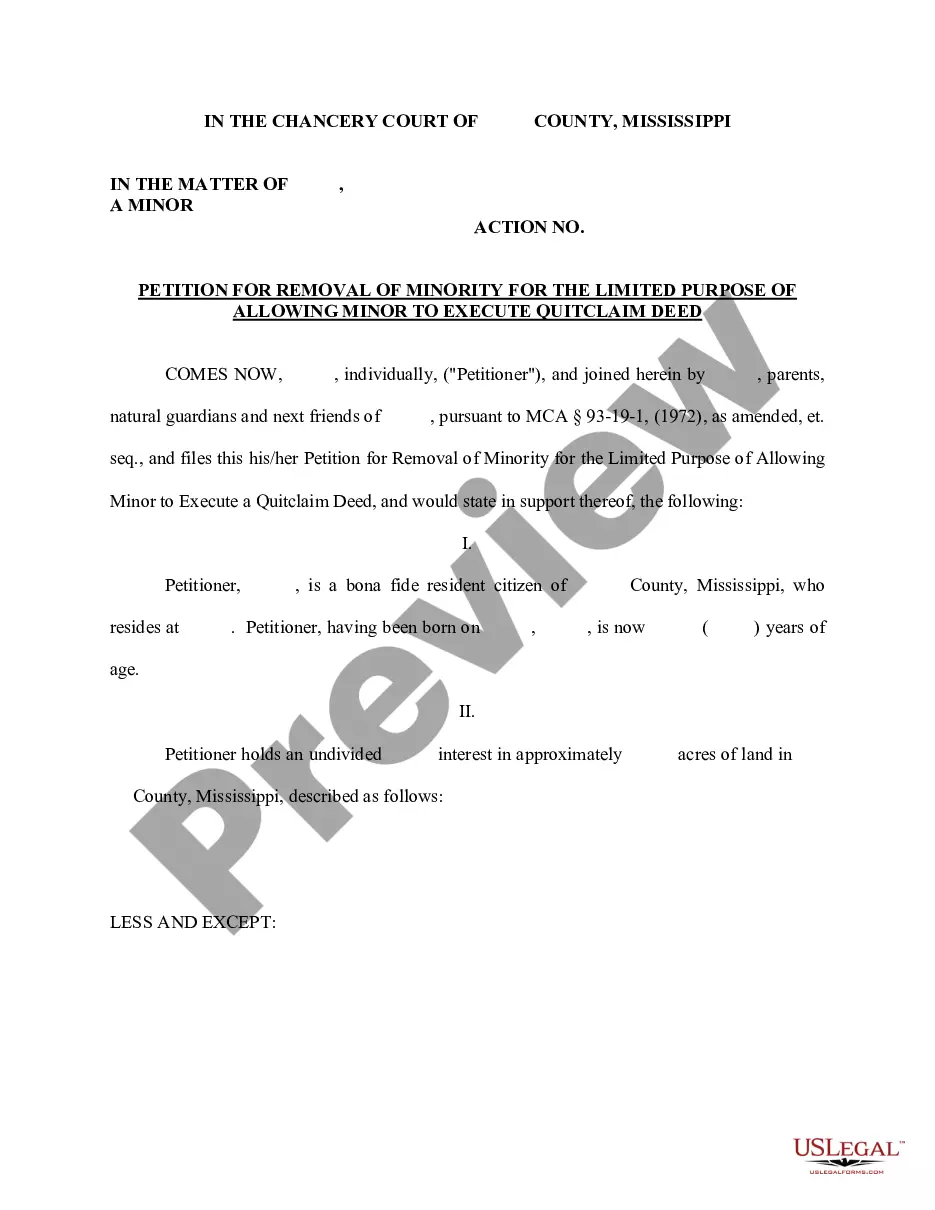
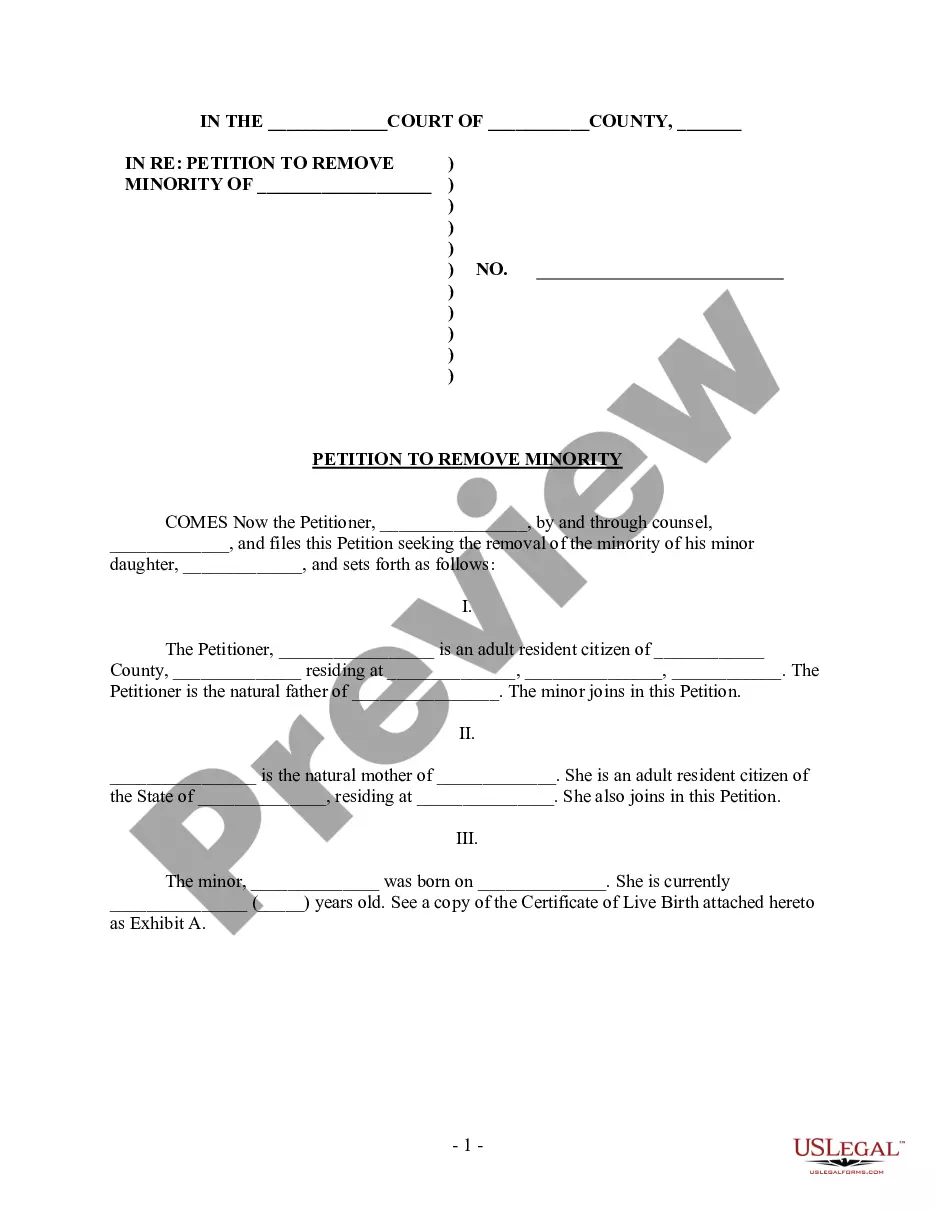
The Order for Removal of Minority to Execute Quitclaim Deed - Emancipation is a legal document issued by the court that allows a minor to execute a quitclaim deed. This form is essential for minors seeking to transfer property rights and is unique in that it specifically provides a pathway for emancipation, which is not commonly found in standard property transfer forms. It is designed to comply with legal requirements while safeguarding the rights of minors involved in real estate transactions.
Key parts of this document
- Case number: Identifier for the court case related to the emancipation.
- Parties involved: Information regarding the minor and any guardians or parties to the deed.
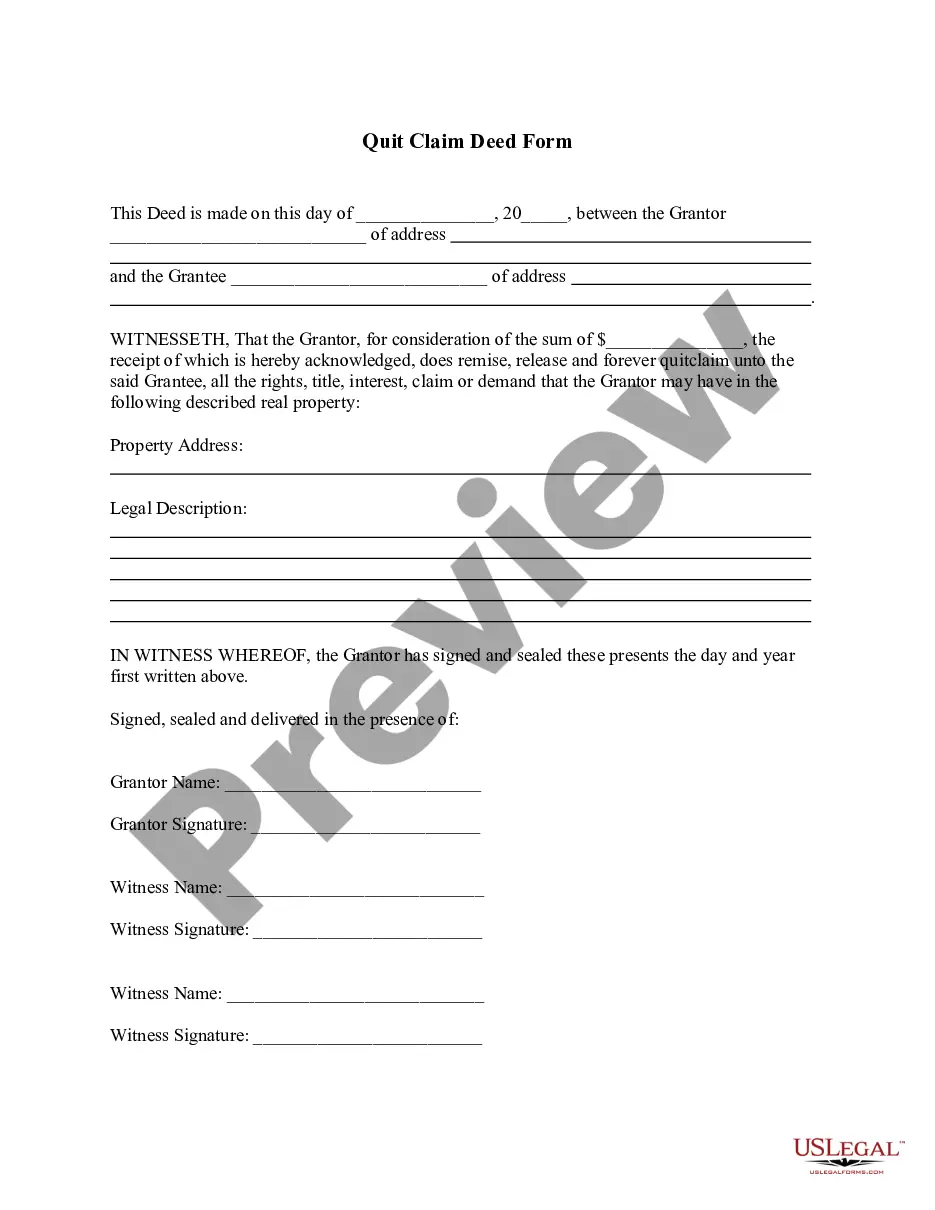
- Property description: Detailed information about the property being transferred.
- Judge's signature: Official endorsement by the presiding judge validating the order.
- Compliance statement: A clause specifying legal obligations following the order.
Common use cases
This form should be used when a minor needs to transfer property ownership through a quitclaim deed and is undergoing the emancipation process. It is often required in situations where the minor has reached a level of maturity and legal independence, allowing them to make significant decisions regarding their property. Scenarios may include inheritance situations, financial autonomy, or other arrangements necessitating the minor's authority over their real estate assets.
Who can use this document
- Minors seeking emancipation who wish to manage their property.
- Guardians or parents acting on behalf of a minor in real estate transactions.
- Legal professionals assisting clients in property transfer processes involving minors.
- Anyone involved in the court process for emancipation related to property rights.
Instructions for completing this form
- Identify the case number associated with the court proceedings.
- Provide accurate details of the parties involved, including their roles.
- Clearly describe the property, including its location and legal description.
- Have the judge review and sign the form to validate the order.
- Ensure all necessary statements and clauses comply with state laws and court instructions.
Notarization requirements for this form
This form needs to be notarized to ensure legal validity. US Legal Forms provides secure online notarization powered by Notarize, allowing you to complete the process through a verified video call, available anytime.
Get your form ready online
Our built-in tools help you complete, sign, share, and store your documents in one place.
Make edits, fill in missing information, and update formatting in US Legal Forms—just like you would in MS Word.
Download a copy, print it, send it by email, or mail it via USPS—whatever works best for your next step.
Sign and collect signatures with our SignNow integration. Send to multiple recipients, set reminders, and more. Go Premium to unlock E-Sign.
If this form requires notarization, complete it online through a secure video call—no need to meet a notary in person or wait for an appointment.
We protect your documents and personal data by following strict security and privacy standards.

Make edits, fill in missing information, and update formatting in US Legal Forms—just like you would in MS Word.

Download a copy, print it, send it by email, or mail it via USPS—whatever works best for your next step.

Sign and collect signatures with our SignNow integration. Send to multiple recipients, set reminders, and more. Go Premium to unlock E-Sign.

If this form requires notarization, complete it online through a secure video call—no need to meet a notary in person or wait for an appointment.

We protect your documents and personal data by following strict security and privacy standards.
Common mistakes to avoid
- Failing to include all relevant parties in the document.
- Leaving out critical details about the property.
- Not obtaining the judge's signature, which is essential for the order's validity.
- Using outdated information or language not compliant with local laws.
Why complete this form online
- Convenience: Access and download the form at your convenience from any location.
- Editability: Customize the form to fit your specific needs.
- Reliability: Ensure you are using a form drafted by licensed attorneys, reducing the risk of errors.
Looking for another form?
Form popularity
FAQ
That dayJanuary 1, 1863President Lincoln formally issued the Emancipation Proclamation, calling on the Union army to liberate all enslaved people in states still in rebellion as an act of justice, warranted by the Constitution, upon military necessity. These three million enslaved people were declared to be then,
With the Emancipation Proclamation, which he viewed as an essential wartime measure to cripple the Confederacy's ability to fight, Lincoln took the first step toward abolition of slavery in the United States.
With the Emancipation Proclamation, which he viewed as an essential wartime measure to cripple the Confederacy's ability to fight, Lincoln took the first step toward abolition of slavery in the United States.
It is in the Lincoln Memorial (constructed 19141922), on the National Mall, Washington, D.C., United States, and was unveiled in 1922. The work follows in the Beaux Arts and American Renaissance style traditions.
Lincoln Memorial Builders. Henry Bacon was the New York architect who designed the Lincoln Memorial, which stands at the west end of the National Mall as a neoclassical tribute to the 16th President of the United States. The construction of the memorial took eight years to complete, from 1914-1922.
The Emancipation Proclamation did not free all slaves in the United States. Rather, it declared free only those slaves living in states not under Union control.It also tied the issue of slavery directly to the war.
President Abraham Lincoln issued the Emancipation Proclamation on January 1, 1863, as the nation approached its third year of bloody civil war. The proclamation declared "that all persons held as slaves" within the rebellious states "are, and henceforward shall be free."
The Emancipation Memorial statue was funded by the wages of freed slaves. The statue originally faced west towards the U.S. Capitol until it was rotated east in 1974 in order to face the newly erected Mary McLeod Bethune Memorial.
That dayJanuary 1, 1863President Lincoln formally issued the Emancipation Proclamation, calling on the Union army to liberate all enslaved people in states still in rebellion as an act of justice, warranted by the Constitution, upon military necessity. These three million enslaved people were declared to be then,