Mississippi Substitute Trustee's Notice of Sale
About this form
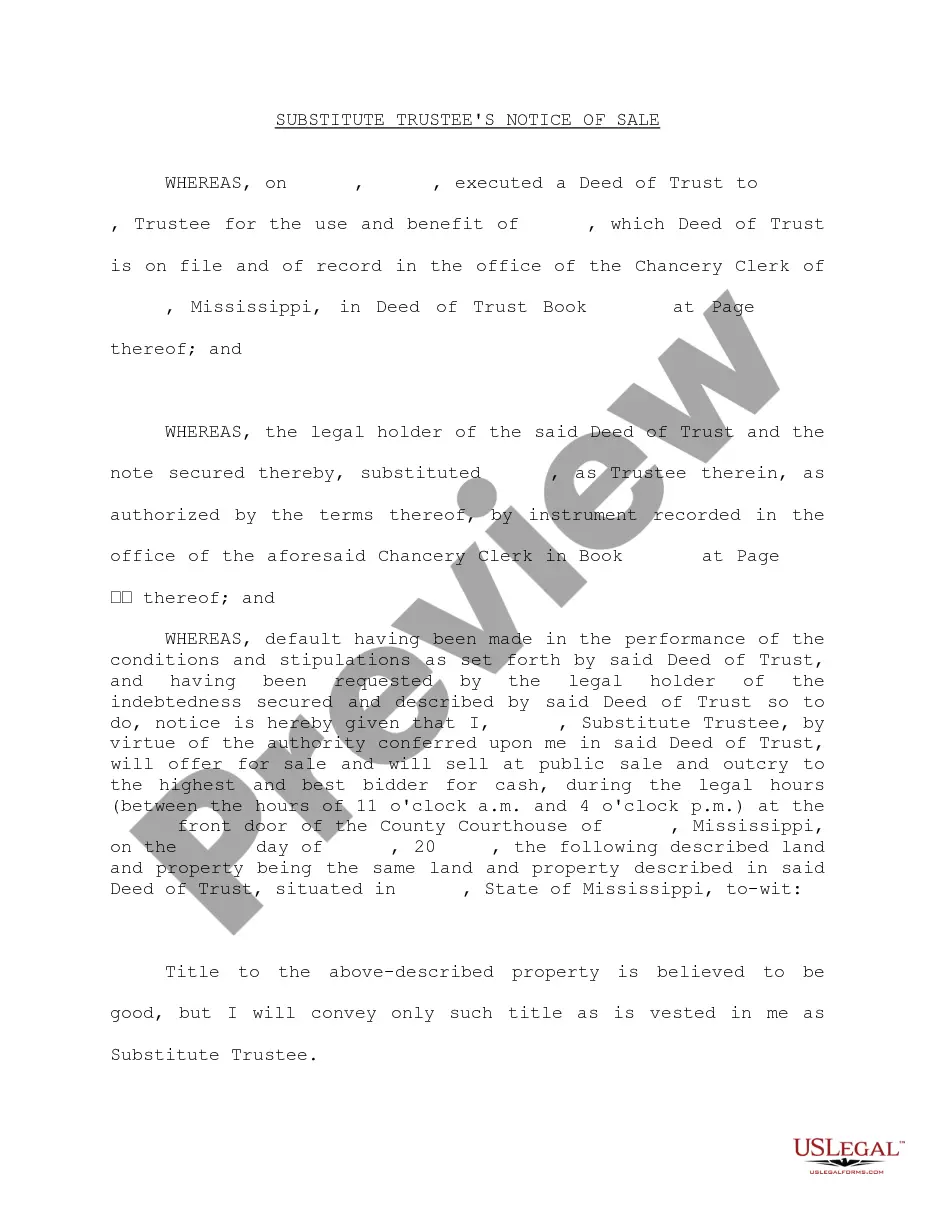
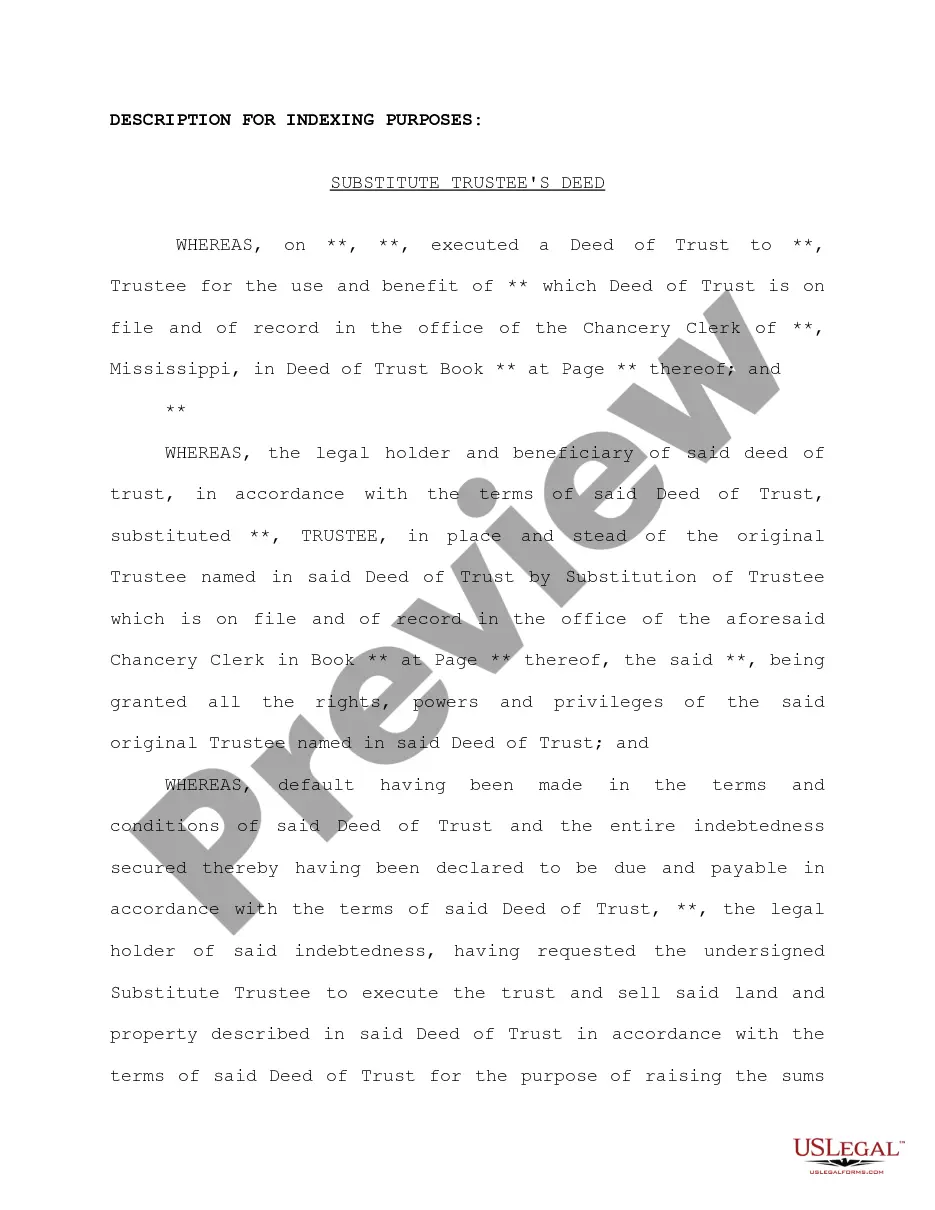
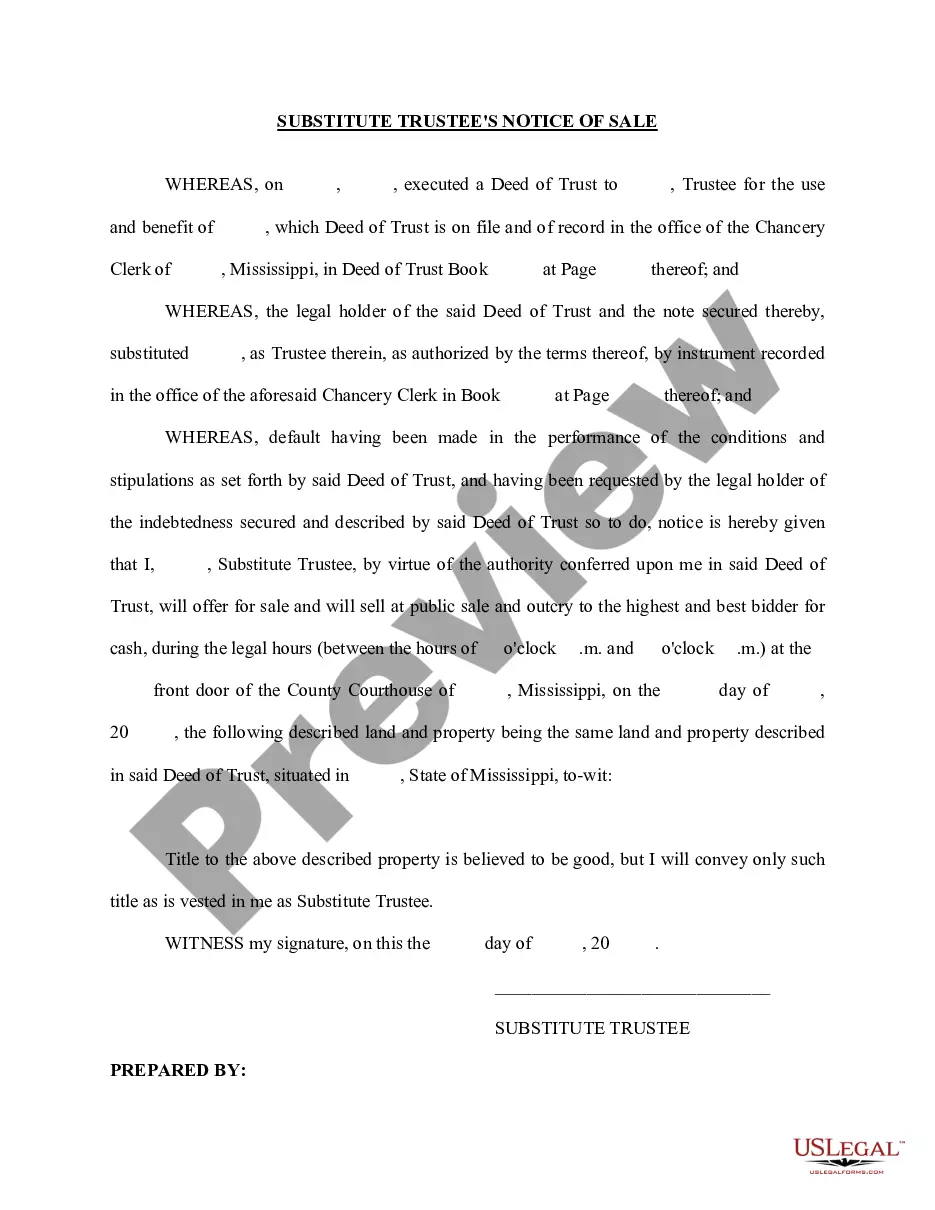
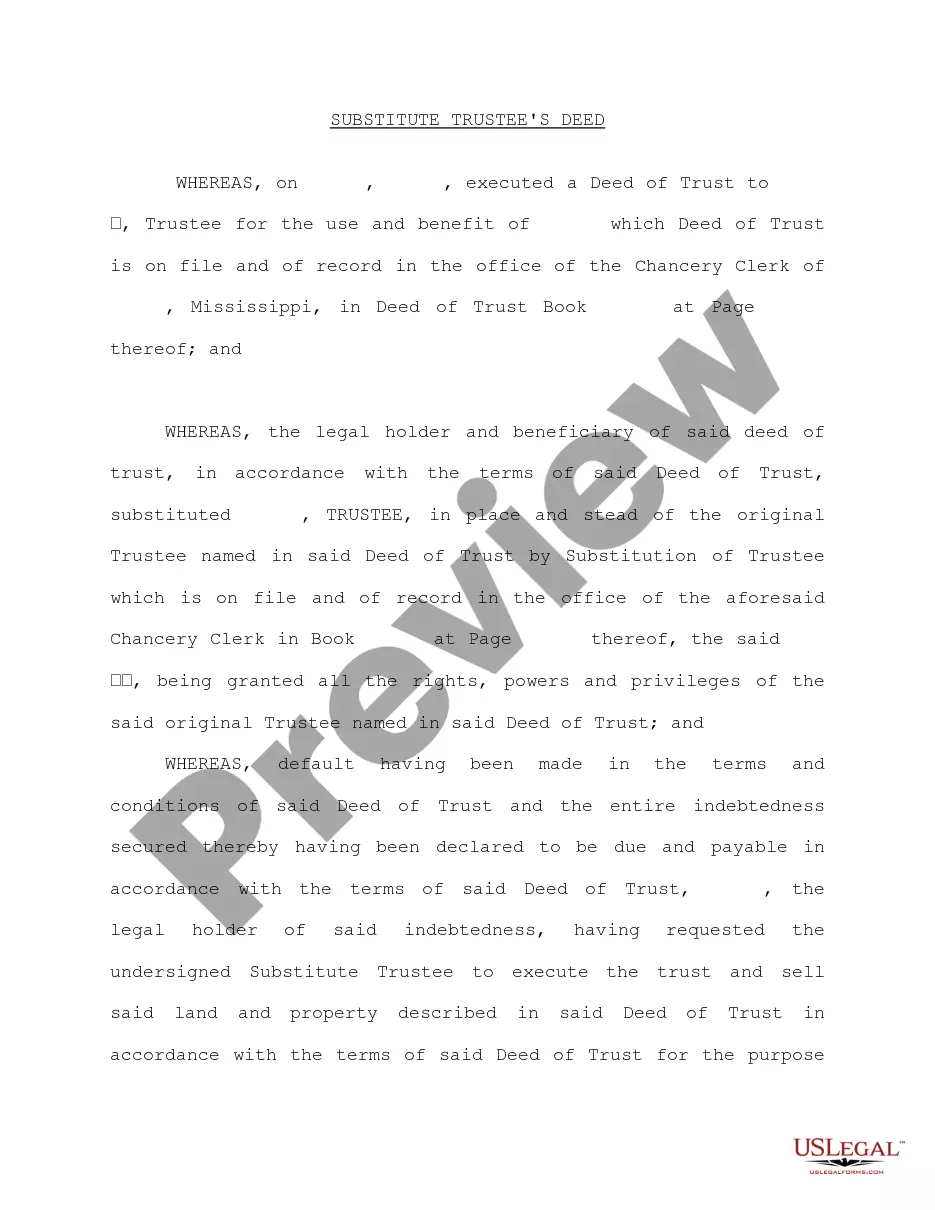
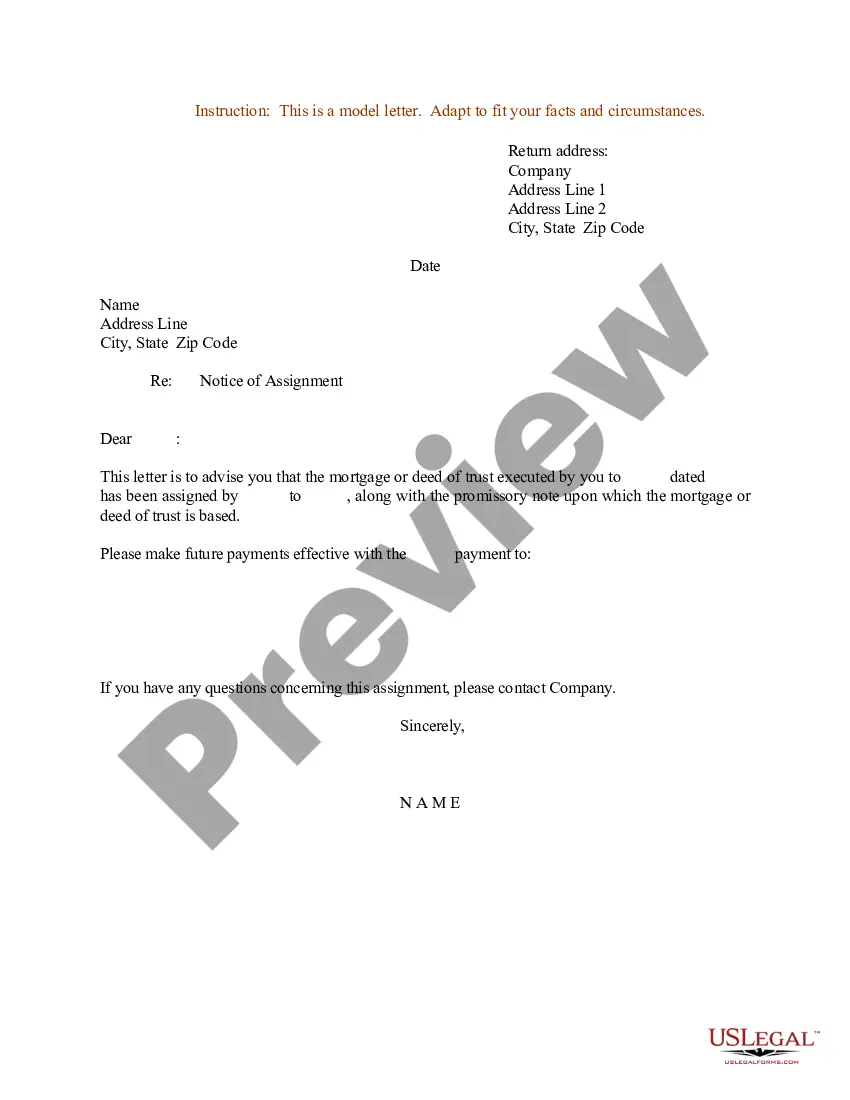
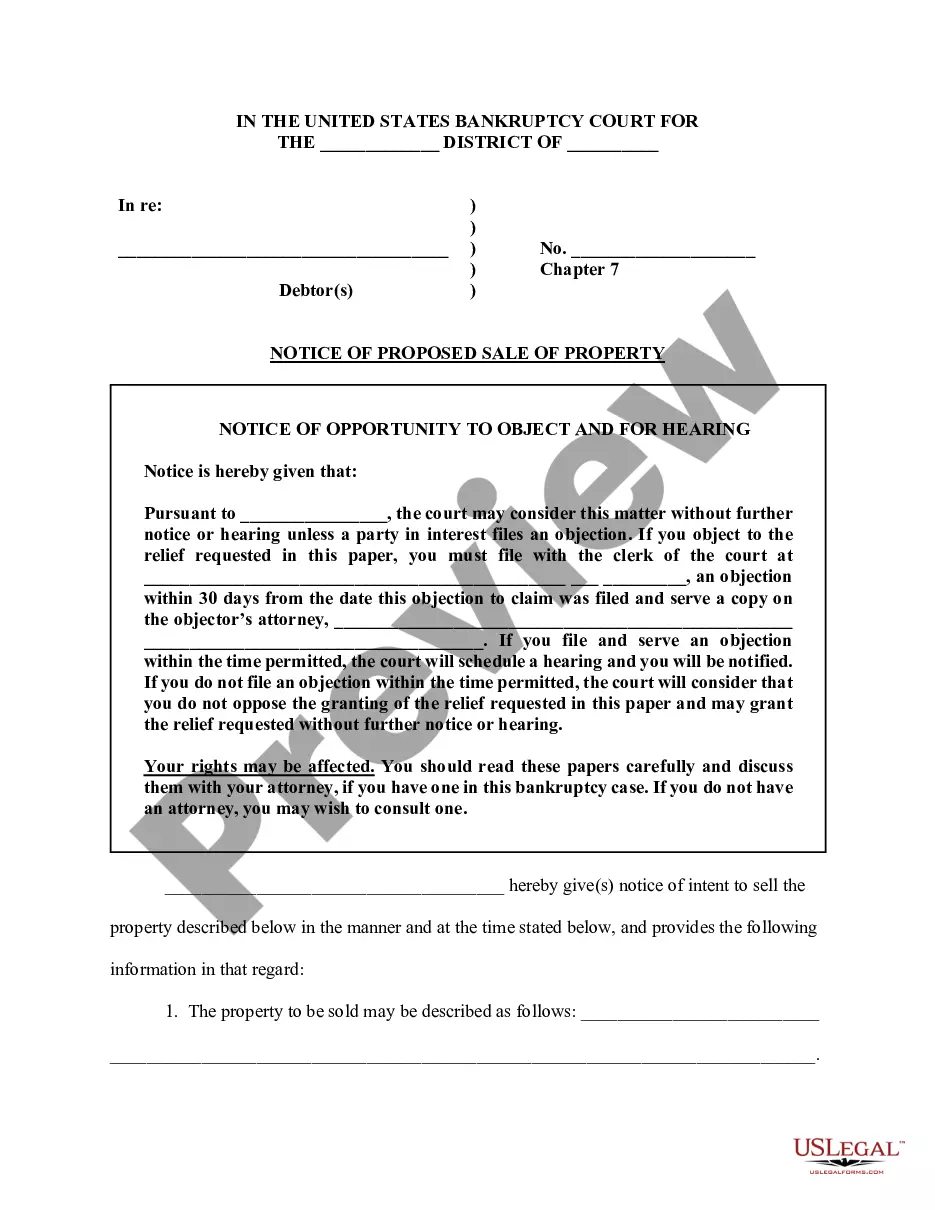
A Substitute Trustee's Notice of Sale is a legal document that notifies interested parties of the sale of property held in a trust. This form is used when the original trustee is replaced due to a conflict of interest regarding the property involved. It ensures that all necessary parties are informed about the impending sale, distinguishing it from other types of notices related to trust property transactions.
Form components explained
- Identification of the substitute trustee and the original trustee.
- Description of the property being sold.
- Date and time of the scheduled sale.
- Statement of the reason for the trustees' substitution.
- Information about the notice distribution to relevant parties.

When this form is needed
This form should be used in situations where a trust's property is slated for sale and the initial trustee must be replaced due to potential conflicts of interest. It is often employed in real estate transactions involving trust assets, where the substitute trustee takes over the responsibilities of conducting the sale.
Who can use this document
- Substitute trustees appointed to oversee the sale of trust property.
- Beneficiaries or heirs of the trust who need to be informed of the sale.
- Legal professionals assisting in the sale of trust-held assets.
How to prepare this document
- Identify and fill in the names of the substitute and original trustees.
- Describe the property, including its address and legal description.
- Specify the date and time of the sale.
- Include the reason for substituting the trustee.
- Distribute the notice to all necessary parties and retain proof of this distribution.
Does this document require notarization?
This form does not typically require notarization unless specified by local law. It is advisable to check state regulations related to trust property sales for additional requirements.
Get your form ready online
Our built-in tools help you complete, sign, share, and store your documents in one place.
Make edits, fill in missing information, and update formatting in US Legal Forms—just like you would in MS Word.
Download a copy, print it, send it by email, or mail it via USPS—whatever works best for your next step.
Sign and collect signatures with our SignNow integration. Send to multiple recipients, set reminders, and more. Go Premium to unlock E-Sign.
If this form requires notarization, complete it online through a secure video call—no need to meet a notary in person or wait for an appointment.
We protect your documents and personal data by following strict security and privacy standards.

Make edits, fill in missing information, and update formatting in US Legal Forms—just like you would in MS Word.

Download a copy, print it, send it by email, or mail it via USPS—whatever works best for your next step.

Sign and collect signatures with our SignNow integration. Send to multiple recipients, set reminders, and more. Go Premium to unlock E-Sign.

If this form requires notarization, complete it online through a secure video call—no need to meet a notary in person or wait for an appointment.

We protect your documents and personal data by following strict security and privacy standards.
Common mistakes
- Failing to provide a complete and accurate property description.
- Not notifying all interested parties of the sale.
- Incorrectly identifying the original or substitute trustee.
Advantages of online completion
- Convenience of downloading and completing at your own pace.
- Editability allows for customization to fit your specific situation.
- Reliable access to legally vetted documents prepared by licensed attorneys.
- The Substitute Trustee's Notice of Sale must comply with applicable state laws to be enforceable.
- Failure to correctly issue and complete this notice may result in legal challenges during the sale process.
- Consulting with a legal professional is advisable to ensure all stipulations are met.
What to keep in mind
- A Substitute Trustee's Notice of Sale is essential for notifying parties of a sale by a new trustee.
- Accurate completion of the form and compliance with local laws is crucial for legal validity.
- Users should familiarize themselves with jurisdiction-specific requirements.
Looking for another form?
Form popularity
FAQ
A substitution of trustee is a legal document that provides public notice regarding a foreclosure. California is one of several states that allows for mortgage foreclosure through a private transaction called a trustee's sale.
Simple Definition A mortgage foreclosure sale initiated by the lender when a borrower defaults on their mortgage. Such sales are overseen by the court.Hence, if the bank moves to foreclose, they name a Substitute Trustee to handle the process.
In real estate, a trustee sale means the sale of real property through public auction. A trustee sale usually occurs when the homeowner is in default on their mortgage, resulting in a foreclosure.In this case, after the auction is over, ownership of the property will be transferred to the highest bidder.
A substitution of trustee under a trust deed is a legal document that allows the mortgage lender to change the person or business entity that will carry out the private trustee's foreclosure sale.
A trustee sale usually occurs when the homeowner is in default on their mortgage, resulting in a foreclosure.A trustee sale is typically the second-to-last step in the foreclosure process in a nonjudicial foreclosure state.
After the Sale Once the trustee sale is complete, the property deed is recorded in the new owner's name. The winning bidder can take immediate possession of the property. If the previous owner or rental tenants are present, they must vacate the property and remove all personal belongings.
Foreclosures are usually nonjudicial in the following states: Alabama, Alaska, Arizona, Arkansas, California, Colorado, District of Columbia (sometimes), Georgia, Idaho, Maryland, Massachusetts, Michigan, Minnesota, Mississippi, Missouri, Montana, Nebraska, Nevada, New Hampshire, New Mexico (sometimes), North Carolina,
Again, the majority of foreclosures in Mississippi are nonjudicial. Because the out-of-court process is more common, those procedures are described below.
Notices are entitled Notice of Trustee's Sale or Notice of Substitute Trustee's Sale. They provide information about the debt, the legal description of the property, and designate a three-hour period during which the sale will be held.