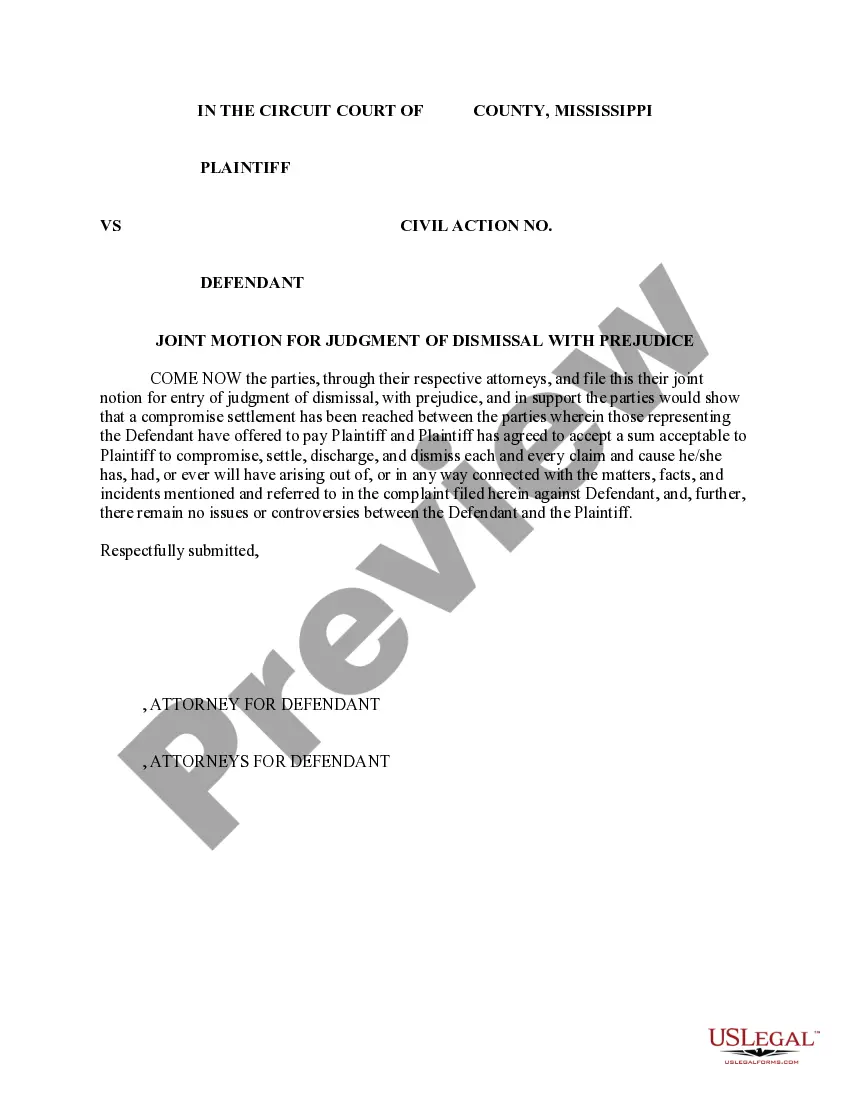
Mississippi Joint Motion for Judgment of Dismissal With Prejudice
Overview of this form
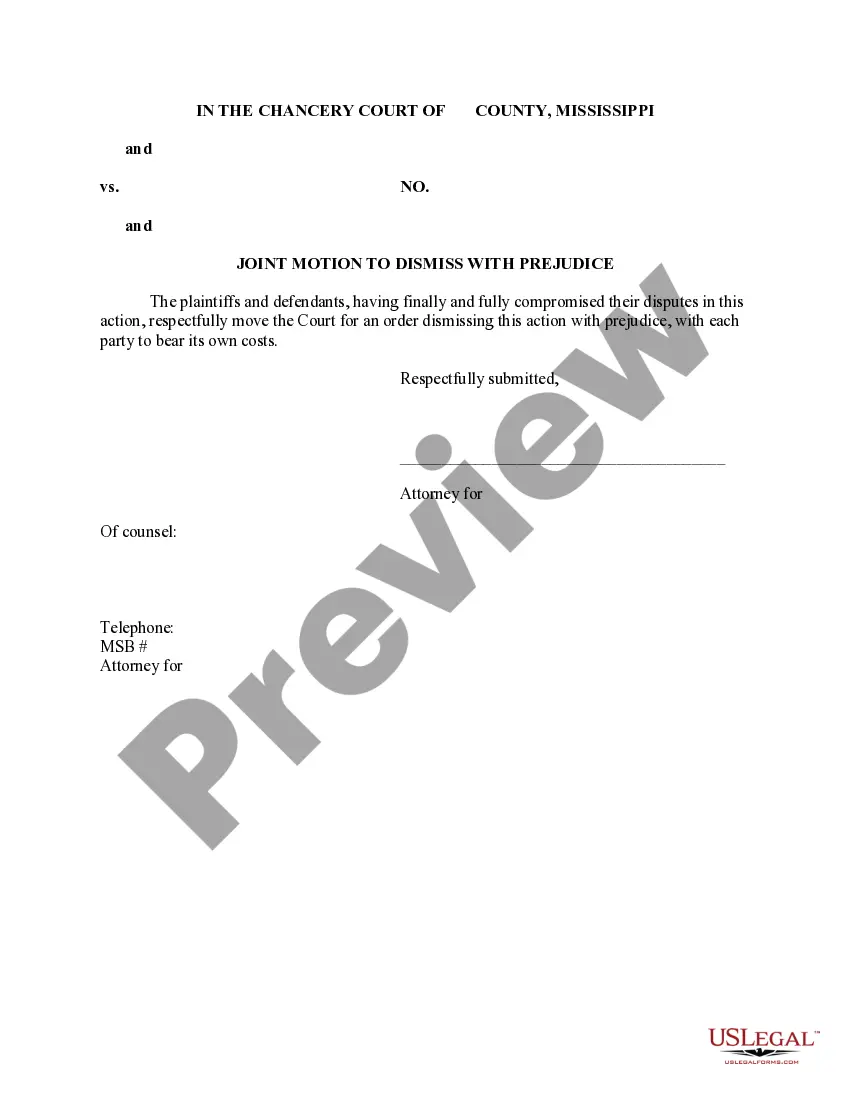
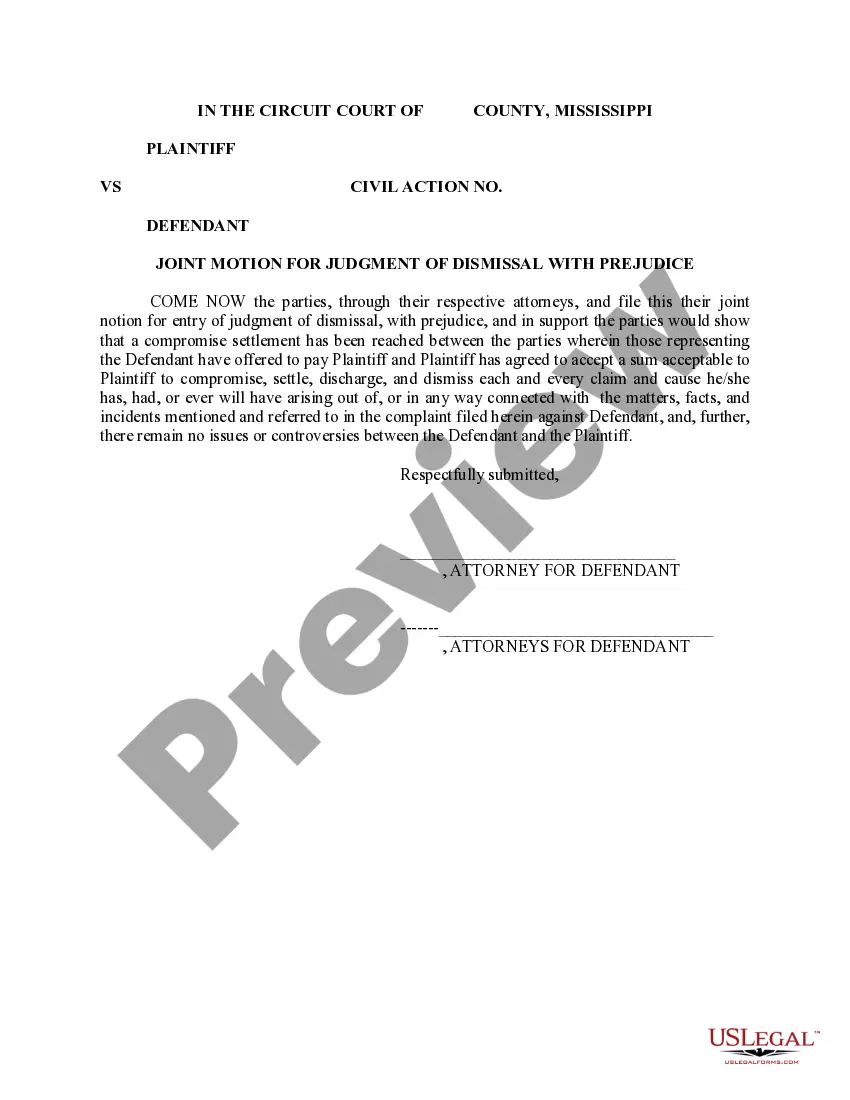
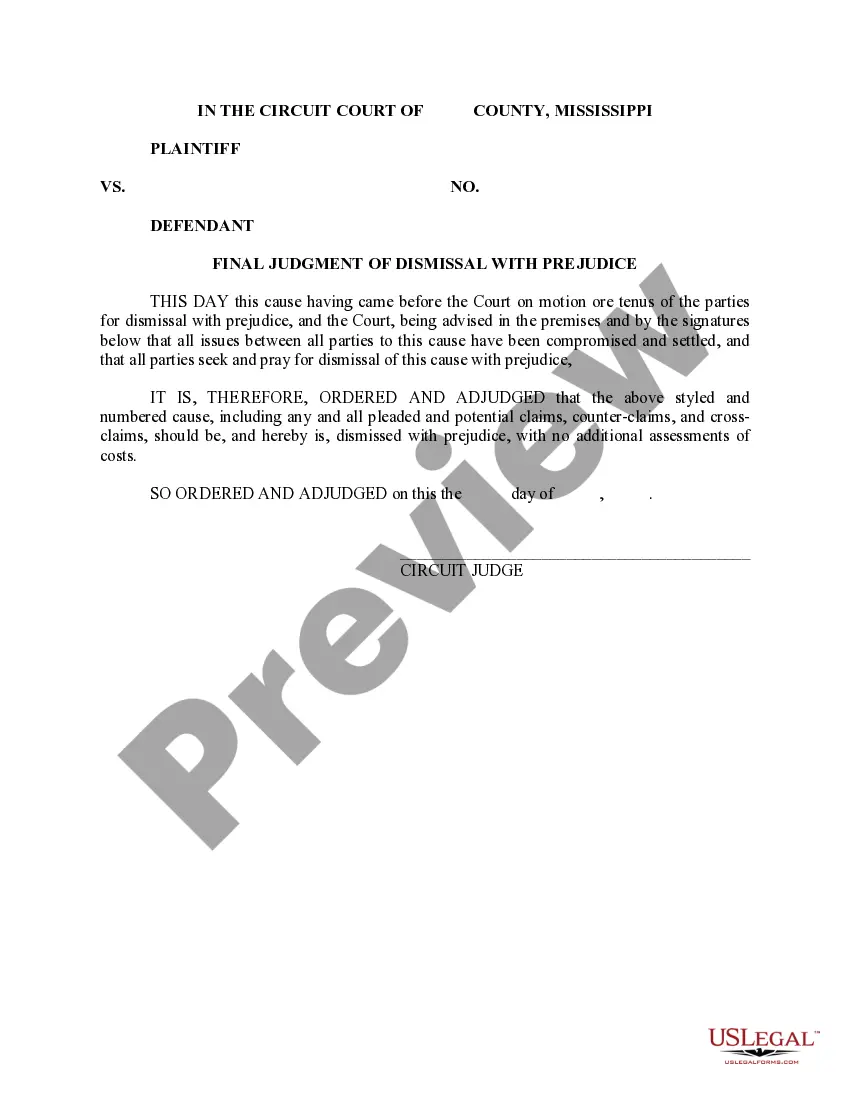
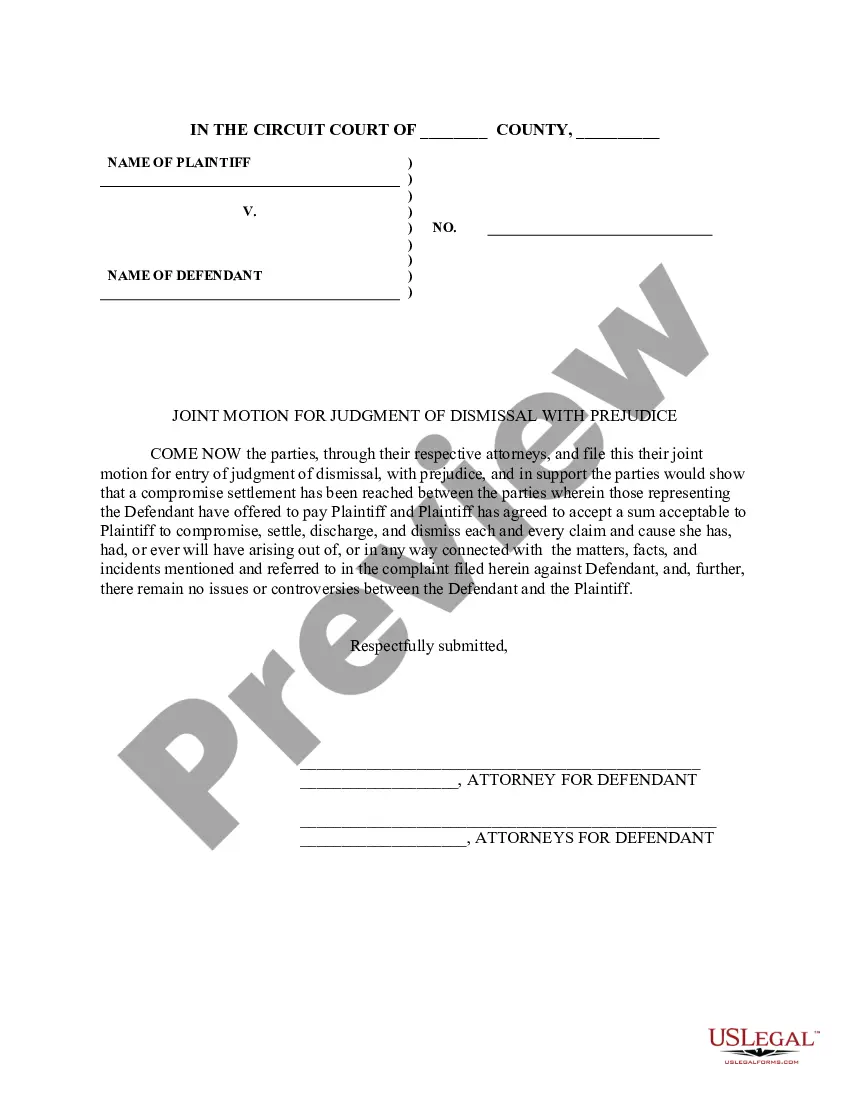
The Joint Motion for Judgment of Dismissal With Prejudice is a formal request made to the court asking for the dismissal of a case where the parties involved agree to terminate the proceedings permanently. This motion ensures that the case cannot be refiled in the future. It is distinct from other motions as it signifies a mutual agreement to end litigation, providing closure for all parties involved.
Form components explained
- Identifying information for all parties involved in the case.
- A clear statement explaining the reasons for the dismissal.
- A declaration that both parties have agreed to the dismissal with prejudice.
- Spaces for signatures of the parties or their legal representatives.
- Relevant court information and case number.
When to use this form
This form is typically used when both parties in a legal dispute have reached an agreement to end the case without further proceedings. Examples of scenarios include a settlement agreement reached before trial or a voluntary decision by both parties to discontinue the litigation. Using this motion effectively concludes the matter with finality, preventing any possibility of the case being reopened in the future.
Who should use this form
- Parties involved in a legal dispute who have reached an agreement to dismiss the case.
- Attorneys representing clients in mutual grievances who wish to formalize the dismissal.
- Individuals seeking to ensure that the court recognizes their agreement to end litigation permanently.
Instructions for completing this form
- Identify all parties involved in the case, including names and contact information.
- Clearly state the reasons for the dismissal in the motion.
- Ensure that all parties consent to the dismissal with prejudice.
- Gather required signatures from all parties or their legal representatives.
- Submit the completed motion to the relevant court along with any required filing fees.
Does this form need to be notarized?
In most cases, this form does not require notarization. However, some jurisdictions or signing circumstances might. US Legal Forms offers online notarization powered by Notarize, accessible 24/7 for a quick, remote process.
Get your form ready online
Our built-in tools help you complete, sign, share, and store your documents in one place.
Make edits, fill in missing information, and update formatting in US Legal Forms—just like you would in MS Word.
Download a copy, print it, send it by email, or mail it via USPS—whatever works best for your next step.
Sign and collect signatures with our SignNow integration. Send to multiple recipients, set reminders, and more. Go Premium to unlock E-Sign.
If this form requires notarization, complete it online through a secure video call—no need to meet a notary in person or wait for an appointment.
We protect your documents and personal data by following strict security and privacy standards.

Make edits, fill in missing information, and update formatting in US Legal Forms—just like you would in MS Word.

Download a copy, print it, send it by email, or mail it via USPS—whatever works best for your next step.

Sign and collect signatures with our SignNow integration. Send to multiple recipients, set reminders, and more. Go Premium to unlock E-Sign.

If this form requires notarization, complete it online through a secure video call—no need to meet a notary in person or wait for an appointment.

We protect your documents and personal data by following strict security and privacy standards.
Avoid these common issues
- Not including all necessary signatures from all parties.
- Failing to clearly articulate the reasons for dismissal.
- Omitting case identification details, such as case number or court name.
Advantages of online completion
- Easy to access and download in various formats.
- Editable templates allow users to tailor the motion to their specific case needs.
- Reliability from professionally drafted forms by licensed attorneys.
Key takeaways
- The Joint Motion for Judgment of Dismissal With Prejudice is a critical document for formally ending a legal case with finality.
- It is essential that all parties agree and sign the motion to ensure enforceability.
- Ensure compliance with local court rules and requirements when submitting the form.
Looking for another form?
Form popularity
FAQ
When a lawsuit is dismissed with prejudice, the court is saying that it has made a final determination on the merits of the case, and that the plaintiff is therefore forbidden from filing another lawsuit based on the same grounds. See also: dismiss, dismissal without prejudice. courts.
Dismissal with prejudice is a final judgment and the case becomes res judicata on the claims that were or could have been brought in it; dismissal without prejudice is not.
A motion to dismiss or motion for dismissal is a motion made in a civil case, where one party asks the court to dismiss or throw out the case without reviewing all of the facts and legal arguments of the case.
When a defendant files a motion to dismiss, he asks the Court to throw out all or part of the plaintiff's case.The parties (well, their lawyers) will come to court, explain their positions on the motion to dismiss, and answer any questions posed by the judge. Finally, the judge will decide to grant or deny the motion.
A case will be dismissed with prejudice if there is reason for the case not to be brought back to court; for example, if the judge deems the lawsuit frivolous or the the matter under consideration is resolved outside of court.