Mississippi Agreed Order Granting Extension of Time Within Which to Serve a Responsive Pleading
About this form
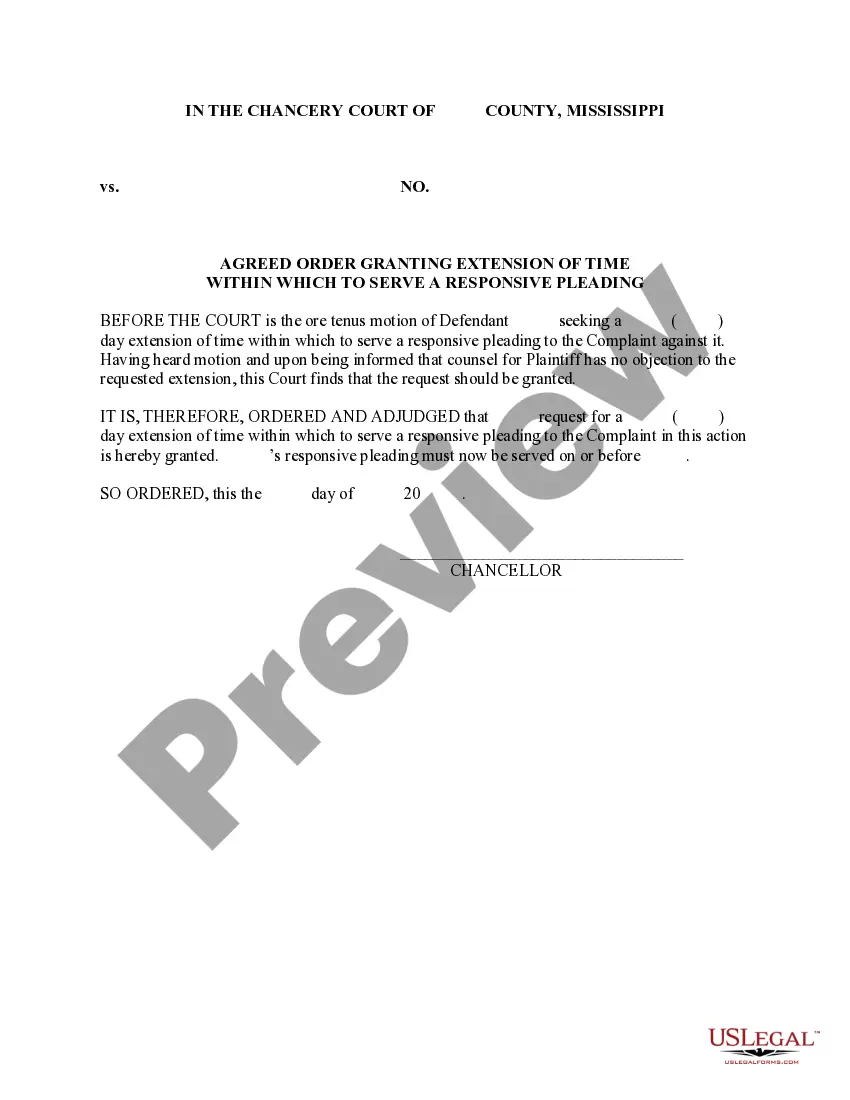
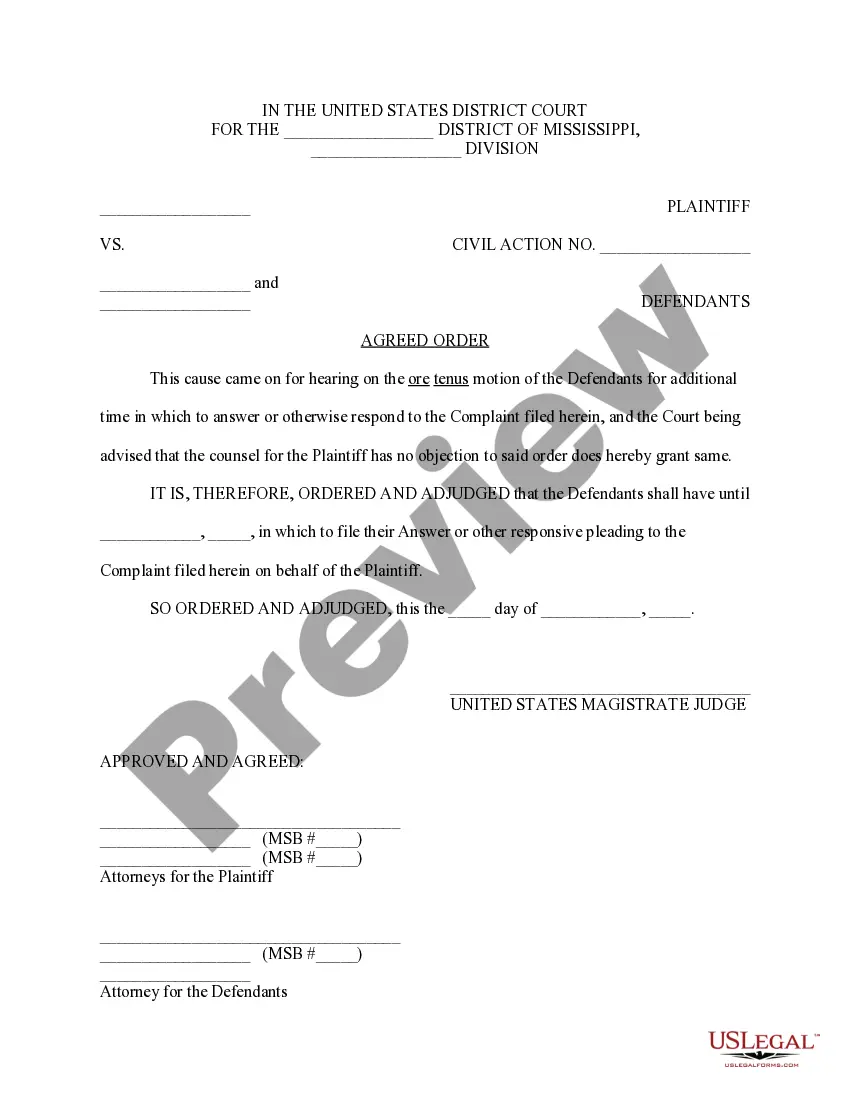
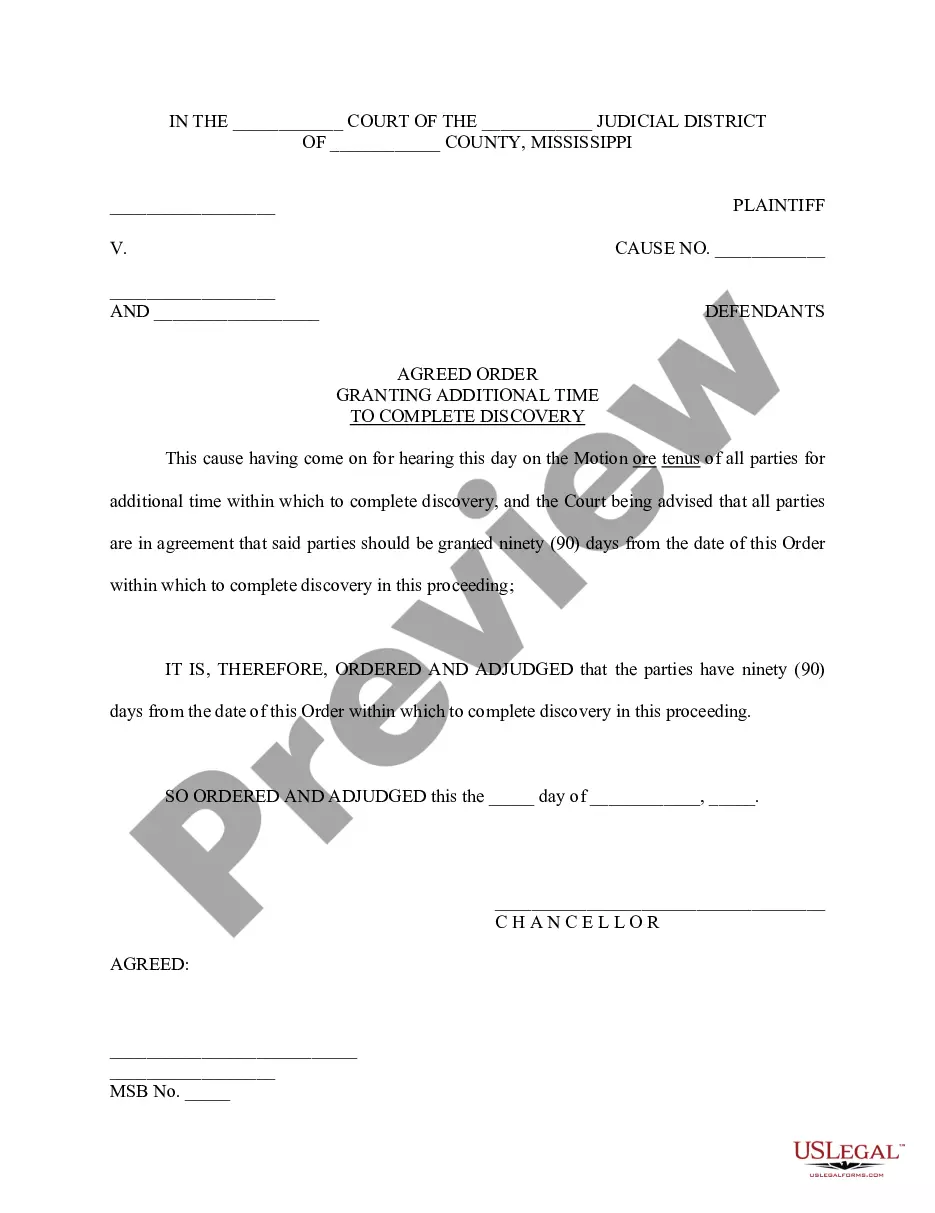
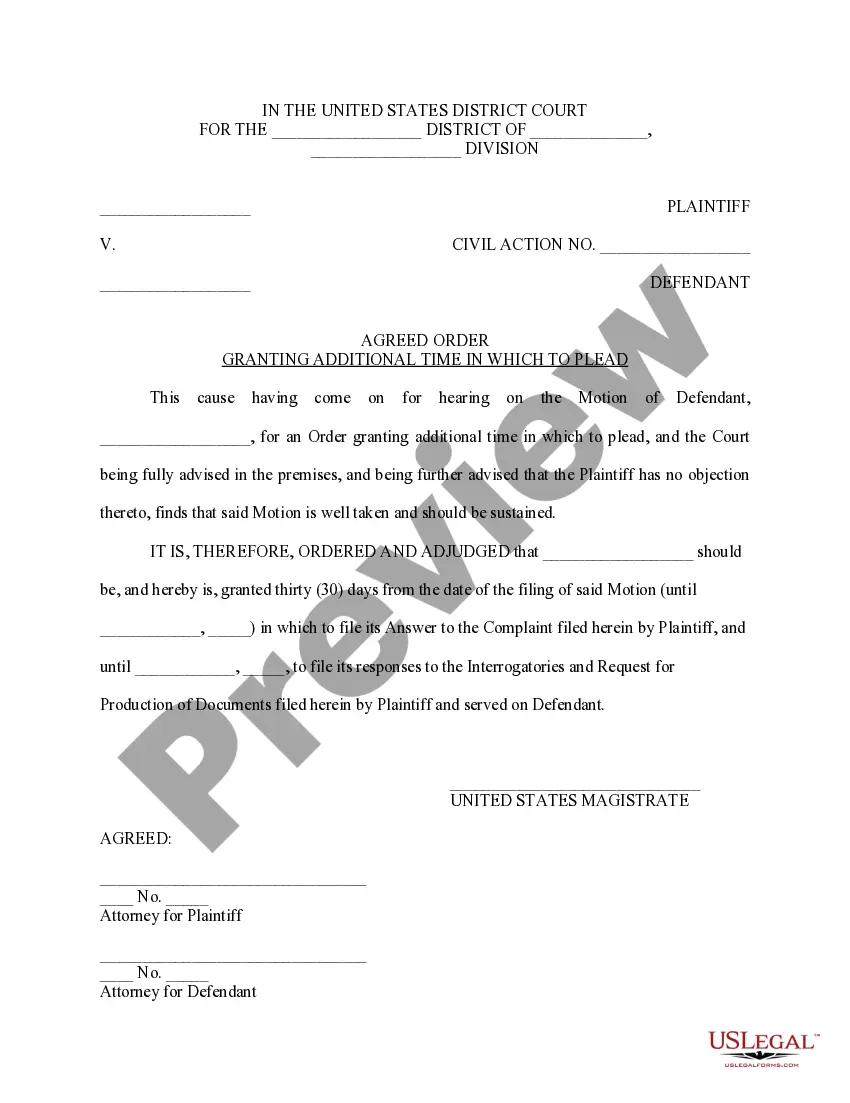
The Agreed Order Granting Extension of Time Within Which to Serve a Responsive Pleading is a legal document used in civil litigation. This form facilitates an agreement between parties involved in a lawsuit, allowing additional time for one party to file their response to a pleading made by the other party. It differs from other legal documents by explicitly recognizing the mutual consent of both parties for an extension, which helps streamline the legal process and avoid potential conflicts.
Form components explained
- Title: Clearly states the purpose of the document.
- Party Information: Identifies the parties involved in the lawsuit.
- Extension Duration: Specifies the new deadline for submitting the responsive pleading.
- Agreement Clause: Confirms that both parties agree to the extension.
- Signatures: Requires signatures from both parties to validate the agreement.
When this form is needed
This form is typically used when one party in a lawsuit needs more time to respond to a pleading filed by another party. It is particularly useful in cases where there may be complex issues to address, or when gathering necessary documentation requires additional time. By formally agreeing to an extension, both parties can avoid unnecessary court motions for extensions and maintain a cooperative legal relationship.
Who this form is for
- Parties involved in civil litigation who have been served with a pleading.
- Attorneys representing clients in lawsuits.
- Individuals seeking to avoid court disputes over deadlines.
Instructions for completing this form
- Identify all parties involved by entering their names and contact information at the top of the form.
- Determine the new deadline for the responsive pleading and write it in the appropriate section.
- Review and confirm that both parties agree to the extension, ensuring mutual consent is documented.
- Sign and date the form to validate the agreement.
- Provide a copy to all parties and file it with the court if required.
Notarization requirements for this form
This form usually doesn’t need to be notarized. However, local laws or specific transactions may require it. Our online notarization service, powered by Notarize, lets you complete it remotely through a secure video session, available 24/7.
Get your form ready online
Our built-in tools help you complete, sign, share, and store your documents in one place.
Make edits, fill in missing information, and update formatting in US Legal Forms—just like you would in MS Word.
Download a copy, print it, send it by email, or mail it via USPS—whatever works best for your next step.
Sign and collect signatures with our SignNow integration. Send to multiple recipients, set reminders, and more. Go Premium to unlock E-Sign.
If this form requires notarization, complete it online through a secure video call—no need to meet a notary in person or wait for an appointment.
We protect your documents and personal data by following strict security and privacy standards.

Make edits, fill in missing information, and update formatting in US Legal Forms—just like you would in MS Word.

Download a copy, print it, send it by email, or mail it via USPS—whatever works best for your next step.

Sign and collect signatures with our SignNow integration. Send to multiple recipients, set reminders, and more. Go Premium to unlock E-Sign.

If this form requires notarization, complete it online through a secure video call—no need to meet a notary in person or wait for an appointment.

We protect your documents and personal data by following strict security and privacy standards.
Avoid these common issues
- Failing to include the signature of both parties.
- Not specifying the new deadline clearly.
- Neglecting to confirm mutual agreement before submitting the form.
Benefits of using this form online
- Immediate access to a professionally drafted form, saving time.
- Editability allows for customization to suit specific circumstances.
- Secure online access simplifies the process of obtaining legal documentation.
Looking for another form?


Form popularity
FAQ
Inmates don't usually serve the entire sentence handed down by a court. Most can and do have their time shortened by as much as a third. Of those released last year and eligible for that 33 percent time off, more than 59 percent received the full reduction.
C : to contribute or conduce to : promote. 8 : to treat or act toward in a specified way he served me ill. 9a : to bring to notice, deliver, or execute as required by law. b : to make legal service upon (a person named in a process)
You get your certificates for your qualifications but 'time served' means you have worked on the job learning and is shown on your work experience. Anyone can go and get qualifications from college but it's not the same as actually doing the job in question and having the experience from it.
Undergo a prison sentence; also, work at a particular task, especially an undesirable one. For example, We couldn't hire him when we learned that he had served time for robbery, or I applied for a transfer after serving time in that chaotic department. Late 1800s
At the time a criminal defendant is sentenced, the amount of time the defendant has already spent in jail awaiting trial or a plea of guilty. When a judge sentences a defendant to "time served," the sentence is the same as the time the defendant has spent in jail, and the defendant is set free.
Time served for state prison sentences: When a person is sentenced to state prison for a crime, they will receive one day credit for every one day served.So a person who is convicted of a violent felony crime as defined by the California penal code, will have to serve out 85% of their time.
At the time a criminal defendant is sentenced, the amount of time the defendant has already spent in jail awaiting trial or a plea of guilty. When a judge sentences a defendant to "time served," the sentence is the same as the time the defendant has spent in jail, and the defendant is set free.
Released in 2016, from initial admission to initial release, was 2.6 years, and the median time served was 1.3 years. an average of 46% of their maximum sentence length before their initial release.
Good time credit may be calculated by multiplying 10 years by 54 days to be earned per year (540 days) and then adding the additional 4 months of credits (54 days per year divided by 12 months = 4.5 days per month), which equals 18 days (4 times 4.5). Therefore, the total potential good time credit equals 558 days.