Agreed Order Granting Additional Time to Plead and Respond to Interrogatories and Requests for Production
Understanding this form
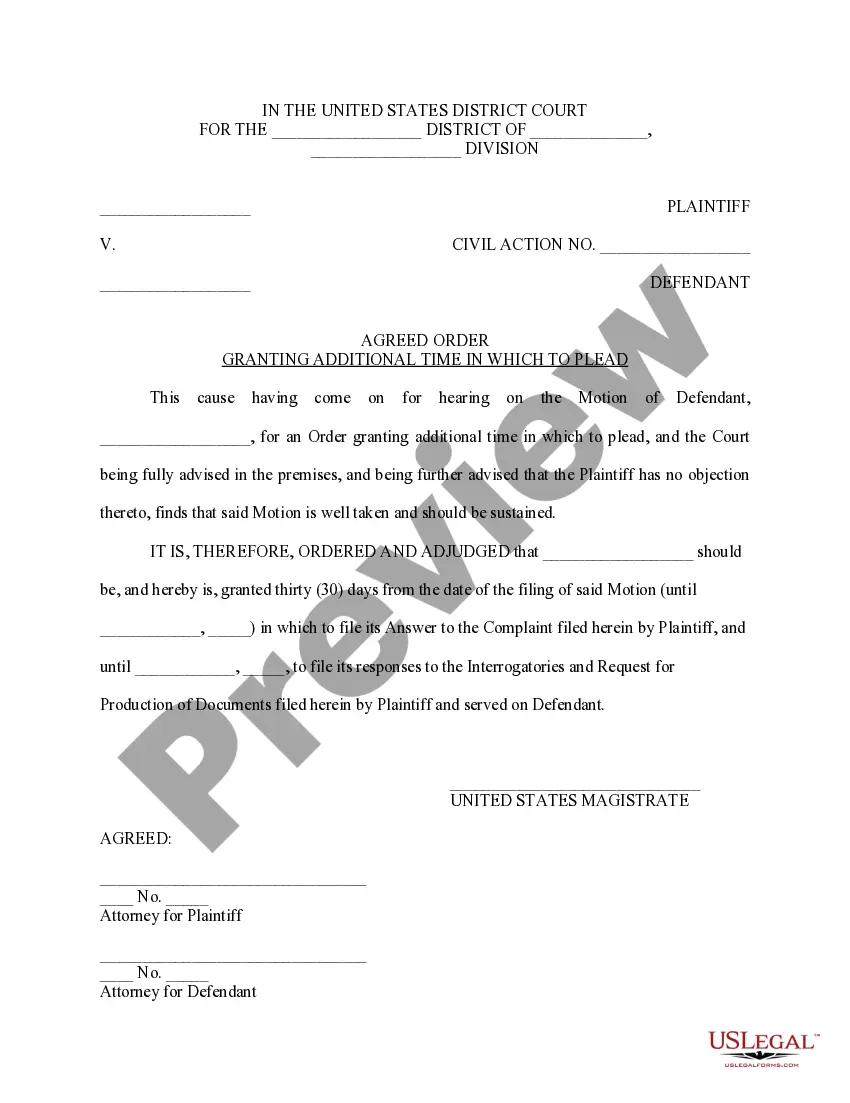
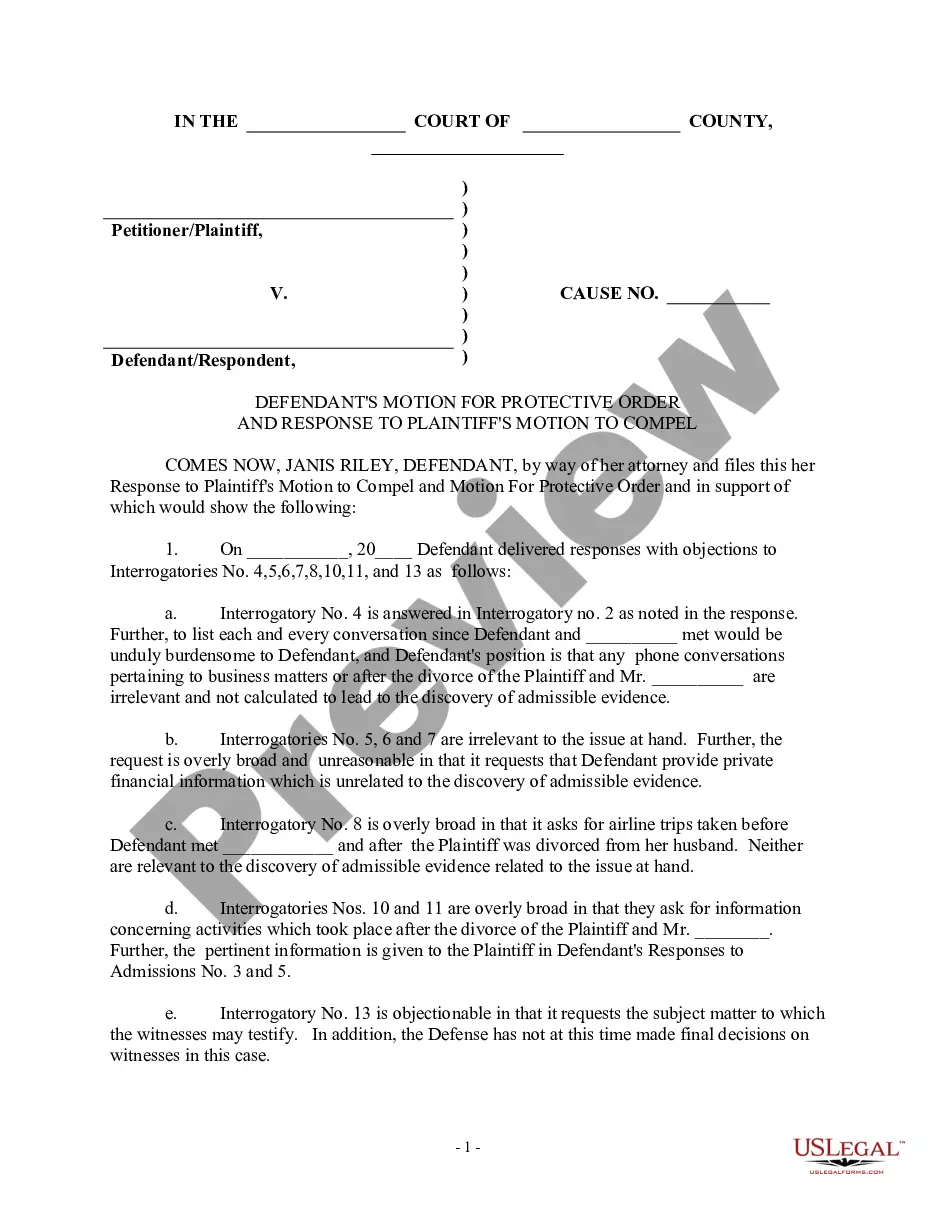
The Agreed Order Granting Additional Time to Plead and Respond to Interrogatories and Requests for Production is a legal document that provides additional time for the defendant to respond to a complaint. This form is used when the defendant requires more time to file an answer or respond to interrogatories and document requests due to various reasons, such as needing more time to prepare or negotiate with the plaintiff. Unlike standard response deadlines, this agreed order requires mutual consent from both parties and court approval to be valid.
Key components of this form
- Identification of the district, division, and parties involved in the case.
- The motion of the defendant requesting additional time and the plaintiff's agreement.
- Specific deadlines for the defendant to file their answer and respond to the interrogatories and document requests.
- Signatures of the magistrate, plaintiff's attorney, and defendant's attorney to validate the agreement.
When this form is needed
This form is appropriate in situations where a defendant is unable to meet the original deadline to respond to a lawsuit. Common scenarios include complexity in the case that demands more thorough preparation, ongoing negotiations with the plaintiff that might affect the response, or other extenuating circumstances that justify a request for additional time.
Who should use this form
- Defendants in a civil lawsuit who need extra time to respond.
- Attorneys representing defendants who are negotiating response deadlines.
- Parties involved in litigation who agree to extend response timelines.
Steps to complete this form
- Identify the court district and division where the case is filed.
- Enter the names of the parties involved in the complaint.
- Specify the new deadlines for responding to the complaint and document requests.
- Ensure the motion is agreed upon by both parties, indicating their consent.
- Sign the document with the appropriate signatures from the magistrate and both attorneys.
Does this document require notarization?
This form does not typically require notarization unless specified by local law. Always check your jurisdiction's rules to confirm if notarization is necessary for enforceability.
Get your form ready online
Our built-in tools help you complete, sign, share, and store your documents in one place.
Make edits, fill in missing information, and update formatting in US Legal Forms—just like you would in MS Word.
Download a copy, print it, send it by email, or mail it via USPS—whatever works best for your next step.
Sign and collect signatures with our SignNow integration. Send to multiple recipients, set reminders, and more. Go Premium to unlock E-Sign.
If this form requires notarization, complete it online through a secure video call—no need to meet a notary in person or wait for an appointment.
We protect your documents and personal data by following strict security and privacy standards.

Make edits, fill in missing information, and update formatting in US Legal Forms—just like you would in MS Word.

Download a copy, print it, send it by email, or mail it via USPS—whatever works best for your next step.

Sign and collect signatures with our SignNow integration. Send to multiple recipients, set reminders, and more. Go Premium to unlock E-Sign.

If this form requires notarization, complete it online through a secure video call—no need to meet a notary in person or wait for an appointment.

We protect your documents and personal data by following strict security and privacy standards.
Avoid these common issues
- Failing to obtain the plaintiff's consent before filing the motion.
- Incorrectly entering the deadlines, leading to confusion or disputes.
- Not securing all necessary signatures before submitting to the court.
Advantages of online completion
- Convenient access to legal forms that are customizable to fit specific needs.
- Reduced errors through guided completion allowing for easier edits.
- Document reliability, ensuring that forms are drafted by licensed attorneys.
Legal use & context
- The form is legally binding once signed by both parties and approved by the court.
- This document protects the rights of both parties by formalizing the agreed extension period.
- Using this form can prevent issues related to missing deadlines for responses.
Summary of main points
- The agreed order provides additional time for defendants to respond to legal complaints.
- Mutual agreement between parties is essential for the motion to be valid.
- Ensure accurate completion and signatures to avoid legal pitfalls.
Looking for another form?


Form popularity
FAQ
Your answers to the interrogatories should usually be short, clear, and direct and should answer only the question that is being asked. This is not the time to set out your entire case or defense to the other side. Take the time to make sure your answers are correct and truthful.
You have 30 days after the form or special interrogatories were served to you (35 days if served by mail from within California) to serve your responses to the interrogatories. Sometimes, rather than answering the interrogatory, you may wish to object to the request on legal grounds.
So, can you refuse to answer interrogatories? The answer is, no, you may not.That answer must either permit inspection of the requested information or object to the production of the information for a specific reason.
Responding to Form InterrogatoriesAnswer each question, being careful to answer each subpart, if one exists. Read the question carefully, and answer only what it asks. You may attach exhibits, if necessary. The response must be verified, meaning you must swear that the responses given are true.
You must answer each interrogatory separately and fully in writing under oath, unless you object to it. You must explain why you object. You must sign your answers and objections.
The plaintiff must give you responses to the request for interrogatories within 45 days of when you mailed the request. If they do not give you a response you can send a final request to the plaintiff. In the final request tell the plaintiff they have another 30 days to give you answers to your interrogatory requests.