Work Permit (Construction of Powerline)
What is this form?
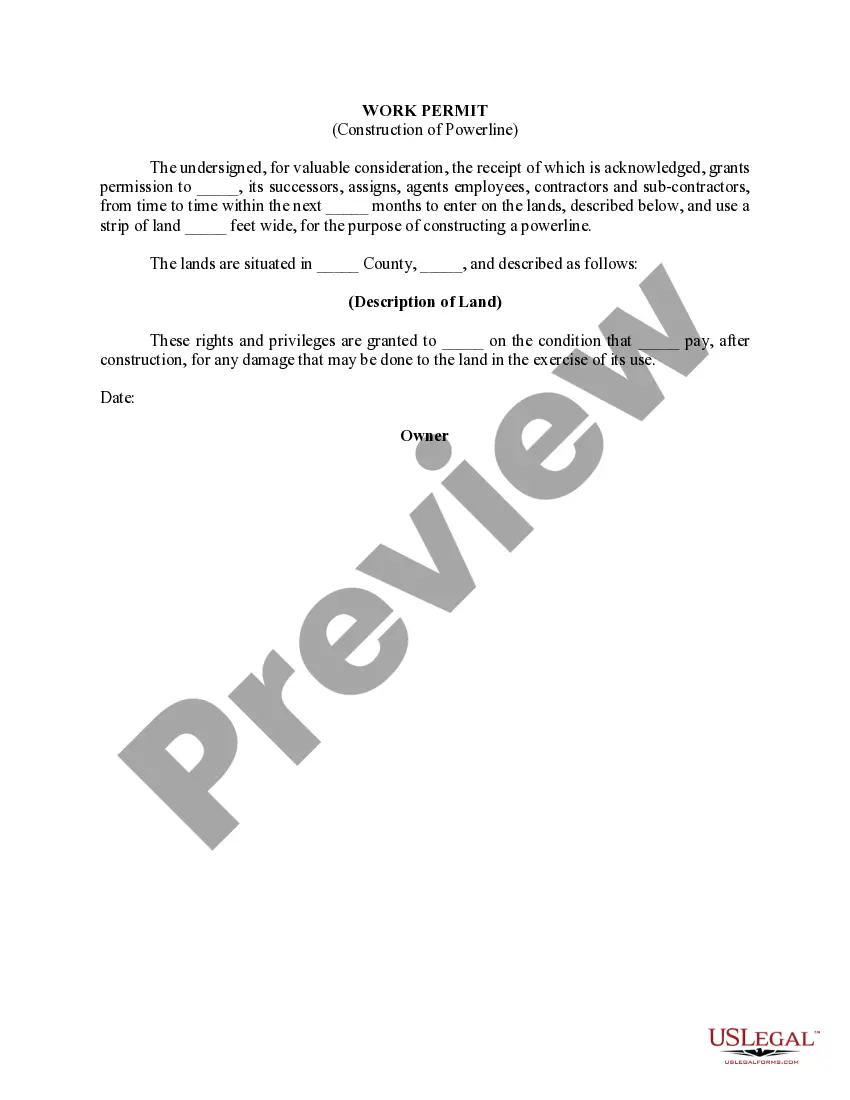
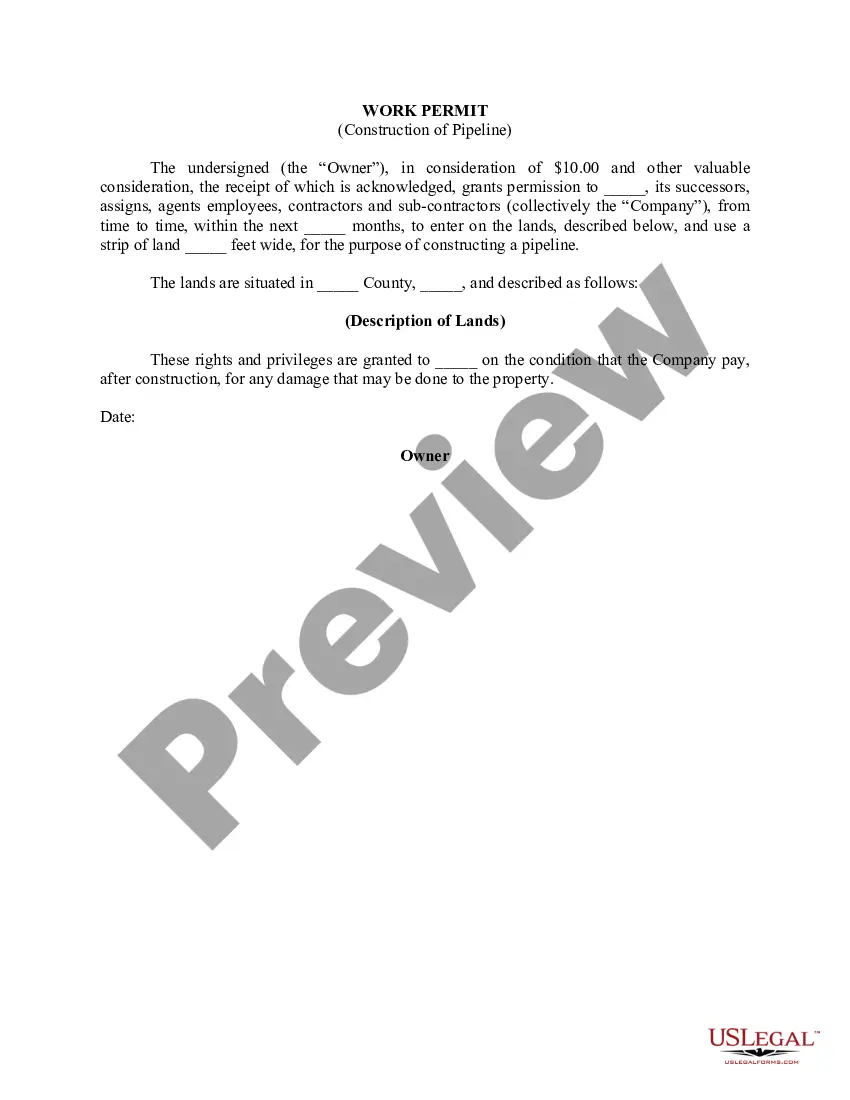
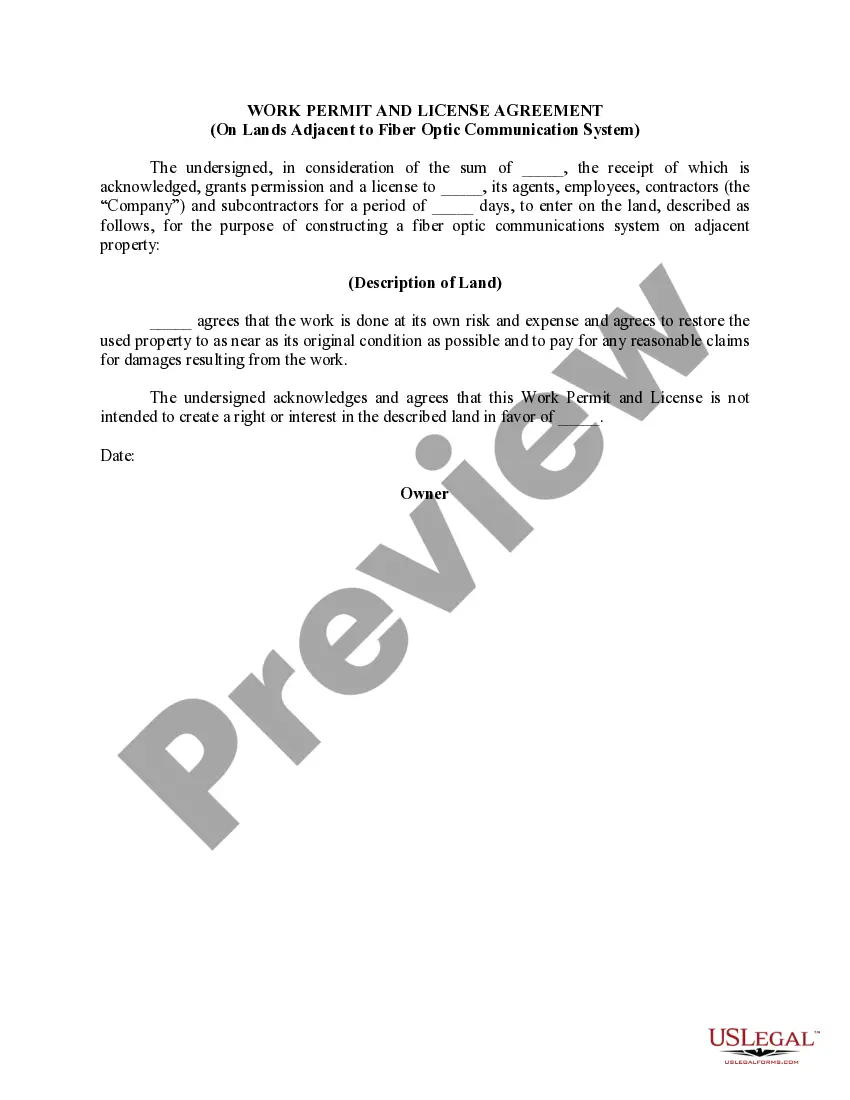
This Work Permit for Construction of Powerline is a legal document that grants permission for a designated entity to access specific land for the purpose of building a powerline. Unlike other work permits, this form specifically outlines rights related to utility construction, making it essential for landowners and utility companies involved in such projects.
Key parts of this document
- The names of the landowners granting permission.
- The name of the entity receiving permission to construct the powerline.
- The width of the land strip designated for construction.
- A description of the land where the powerline will be constructed.
- The duration for which the permit is valid.
- A clause regarding payment for any damage to the property post-construction.

When to use this form
Use this Work Permit for Construction of Powerline when a utility company needs to access private land to construct, maintain, or repair powerlines. This form is particularly important for landowners who want to ensure that they have control over access to their property while also allowing necessary utility work to proceed.
Intended users of this form
- Landowners who wish to permit a utility company to access their property for powerline construction.
- Utility companies needing legal access to private lands for the construction of powerlines.
- Contractors involved in the construction or maintenance of powerlines that require land access agreements.
How to complete this form
- Identify the landowners and enter their names clearly at the top of the form.
- Specify the name of the utility company that will be granted access.
- Fill in the width of the strip of land to be used for construction.
- Provide a detailed description of the property where the powerline will be built.
- Indicate the duration in months for which the permit will be valid.
- Sign and date the form at the designated areas to confirm the agreement.
Is notarization required?
This form usually doesn’t need to be notarized. However, local laws or specific transactions may require it. Our online notarization service, powered by Notarize, lets you complete it remotely through a secure video session, available 24/7.
Get your form ready online
Our built-in tools help you complete, sign, share, and store your documents in one place.
Make edits, fill in missing information, and update formatting in US Legal Forms—just like you would in MS Word.
Download a copy, print it, send it by email, or mail it via USPS—whatever works best for your next step.
Sign and collect signatures with our SignNow integration. Send to multiple recipients, set reminders, and more. Go Premium to unlock E-Sign.
If this form requires notarization, complete it online through a secure video call—no need to meet a notary in person or wait for an appointment.
We protect your documents and personal data by following strict security and privacy standards.

Make edits, fill in missing information, and update formatting in US Legal Forms—just like you would in MS Word.

Download a copy, print it, send it by email, or mail it via USPS—whatever works best for your next step.

Sign and collect signatures with our SignNow integration. Send to multiple recipients, set reminders, and more. Go Premium to unlock E-Sign.

If this form requires notarization, complete it online through a secure video call—no need to meet a notary in person or wait for an appointment.

We protect your documents and personal data by following strict security and privacy standards.
Common mistakes
- Leaving out the specific width of the landstrip needed for the powerline.
- Failing to adequately describe the location of the property.
- Not specifying the duration of the permit correctly.
- Forgetting to have all landowners sign the document.
Why complete this form online
- Convenience of immediate access and download from any location.
- Editability to fill out required fields easily before printing.
- Reliability with templates drafted by licensed attorneys.
Legal use & context
- This form is legally binding once signed by all parties involved.
- It grants specific rights for land use, and any misuse may lead to legal disputes.
- Always retain a copy of the signed permit for your records.
Main things to remember
- The Work Permit for Construction of Powerline is essential for legal access to land for utility work.
- Carefully complete all sections to avoid potential legal issues.
- Consult local laws regarding additional requirements before using the form.
Looking for another form?

Form popularity
FAQ
The most important safe practice is this: Avoid bringing yourself, or any object you are holding, too close to an overhead power line. In other words, do not lift, elevate, build or pass under a power line with any object, equipment, facility or vehicle that could come close to the energized wires.
This is the most important rule: Work at a safe distance from all power lines. The Occupational Safety and Health Administration (OSHA) requires that equipment be kept at least 10 feet away from power lines with voltages up to 50kV.
Lines that have up to 33kV of power must be at least 5.2 m from the ground. Lines with up to 132 kV should be 6.7 m or more from the ground. And lines that have up to 400 kV must have a minimum clearance height of 7 m.
Some requirements employers must do to protect workers from electrical hazards are: ensure overhead power lines safety; supply GFCIs; isolate electrical parts; ensure proper grounding and: Electrical equipment can instantly change from safe to hazardous because of extreme conditions and rough treatment.
Explanation: To prevent electrocution at workplace, employers can ensure that the power company install insulated sleeves (also known as eels) over power lines. 200b Additionally, the employees should wear PPEs which are insulators to prevent electrocution.
Have the power company de-energize and ground the power lines. Wearing PPE is the only way to prevent being electrocuted. Have the power company install insulated sleeves (also known as eels) over power lines. 200b
You should manage the risks if you intend to work within a distance of 10 m, measured at ground level horizontally from below the nearest wire. 12 The most effective way to prevent contact with overhead lines is by not carrying out work where there is a risk of contact with, or close approach to, the wires.
Stay at least 10 feet away from overhead power lines and assume they are energized. De-energize and ground lines when working near them. Use non-conductive wood or fiberglass ladders when working near power lines. Worn cords can expose the wires within, or loosen the connections on the plug end.
NO. Because the power lines always carry large amount of voltages. This power lines make the charge distribution around the conductor it cause the air around the conductor ionized.Normally construction is never recommended beneath a live power line.