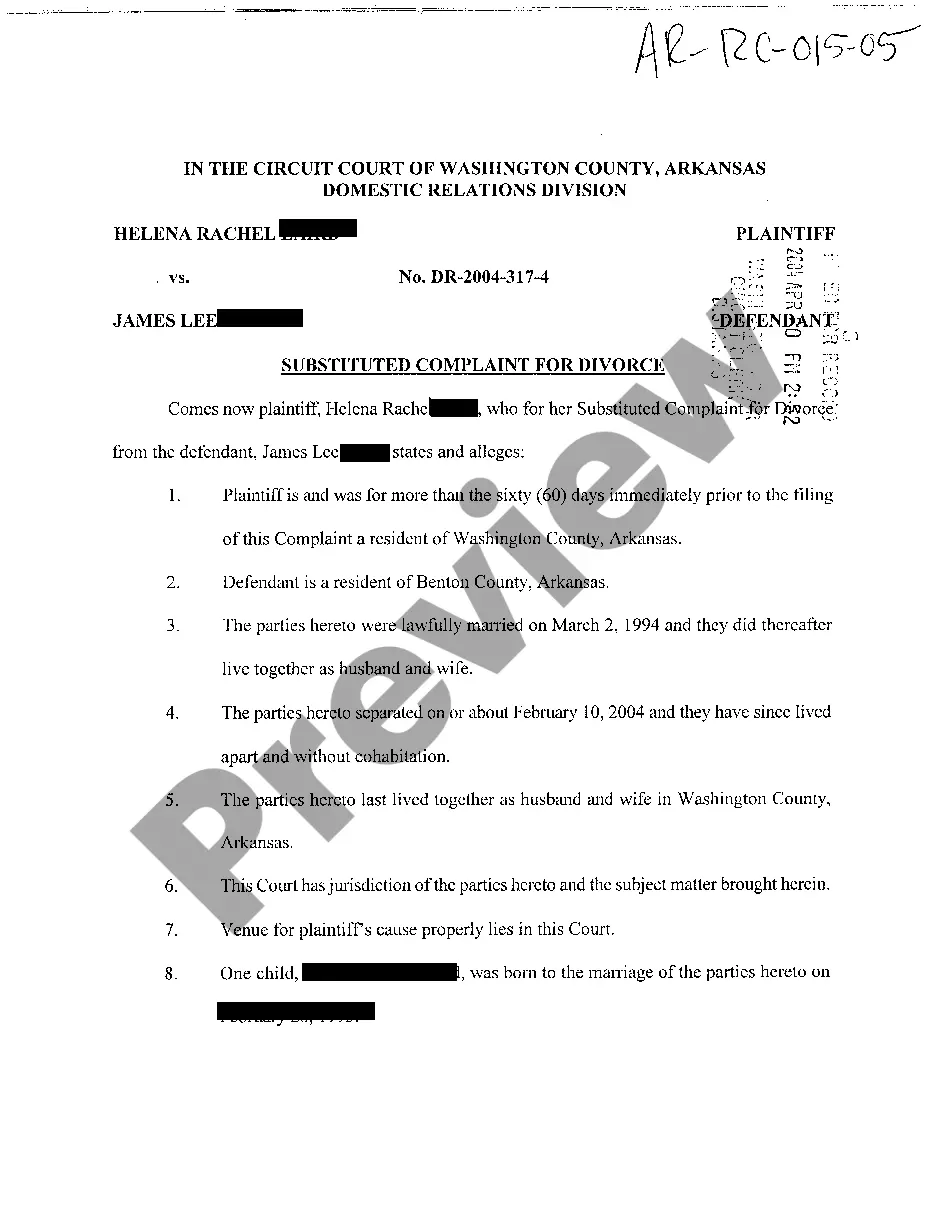
Mississippi Agreed Order Granting Additional Time to Complete Discovery in Chancery Court
About this form
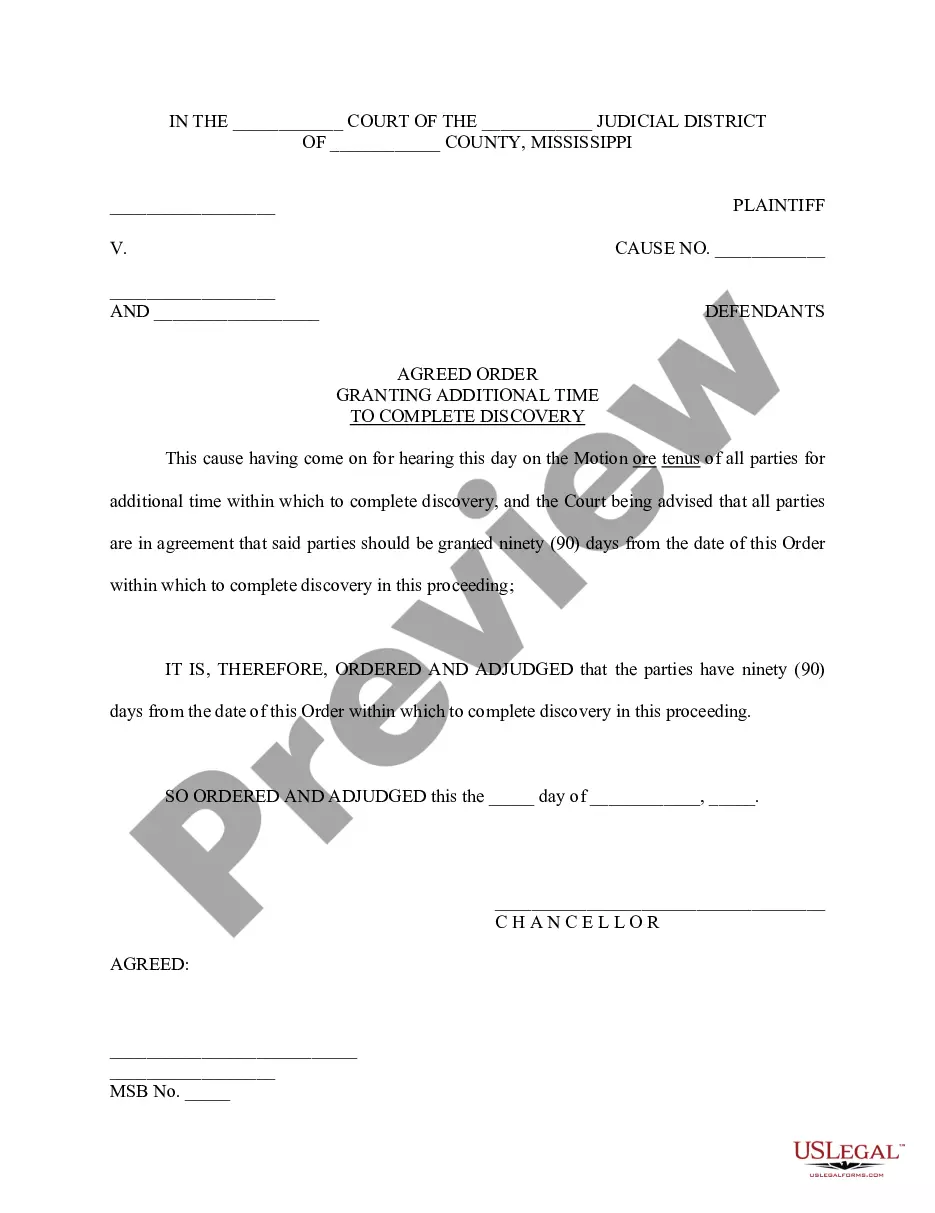
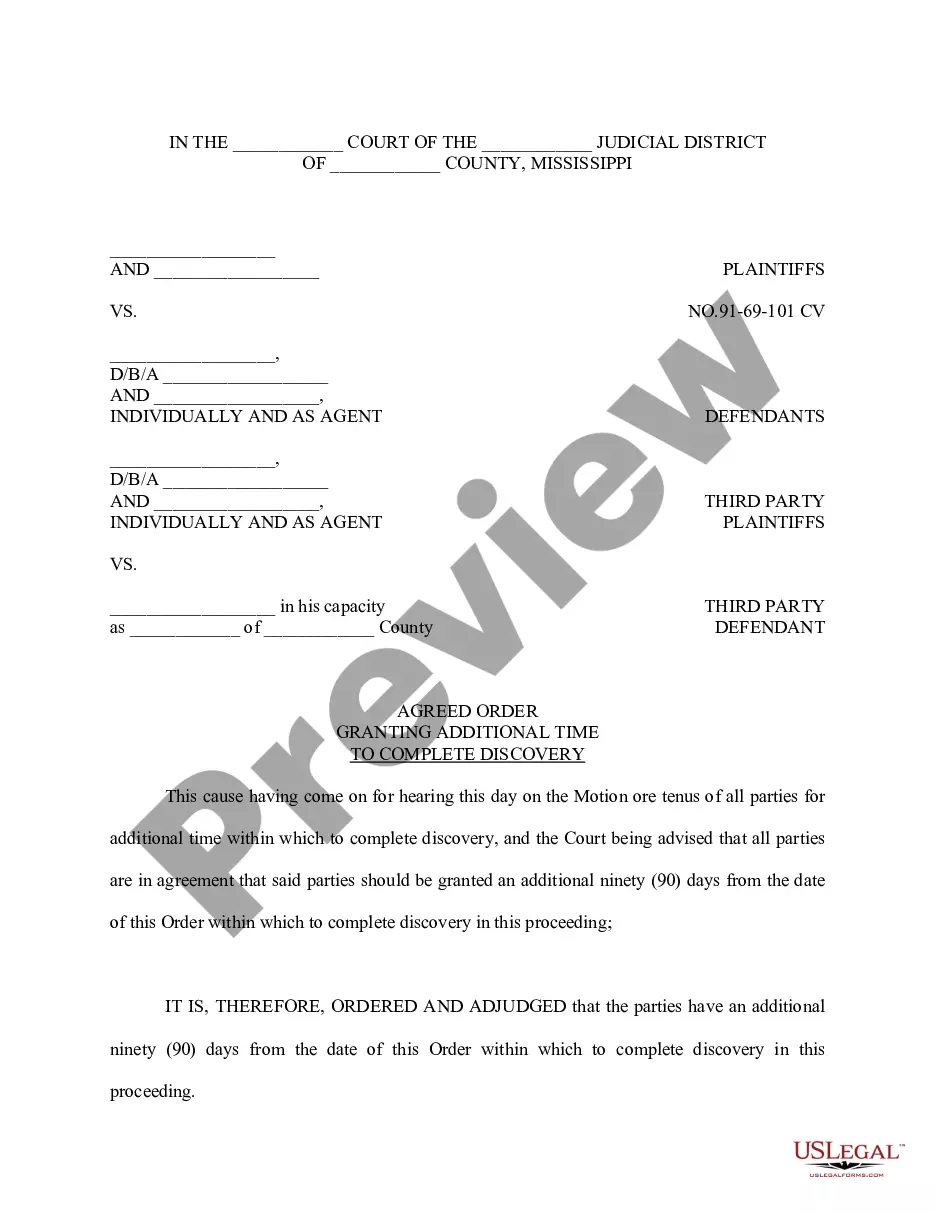
The Agreed Order Granting Additional Time to Complete Discovery in Chancery Court is a legal document that allows both parties in a legal case to extend the time frame for completing discovery. This form is unique in that it reflects mutual consent between parties, ensuring both agree to the additional time, unlike other forms that may require court intervention without agreement. It is available for download in both Word and Rich Text formats for easy editing.
Main sections of this form
- Case information including plaintiffs, defendants, and cause number.
- Statement of agreement by all parties for additional discovery time.
- Specific duration granted for completing discovery (ninety days).
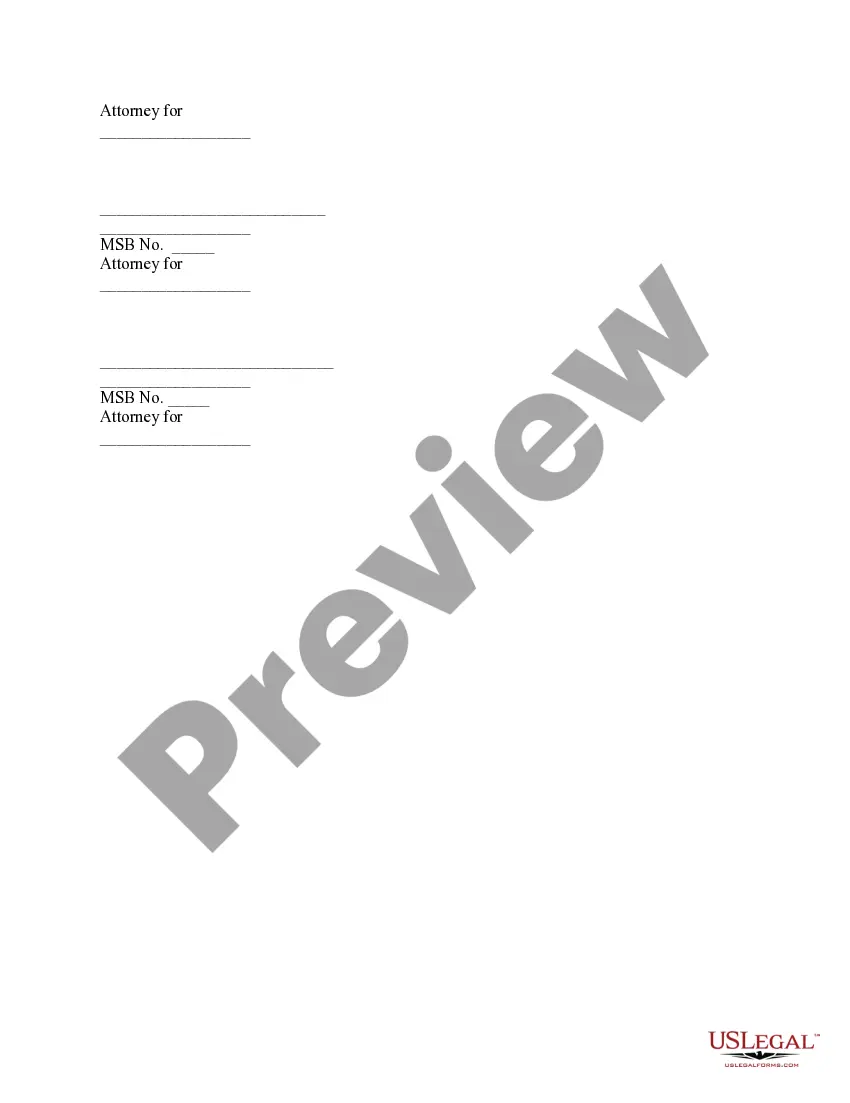
- Signature lines for each party's legal representative.
- Chancellorâs signature and the date of the order.
When to use this document
This form should be used when both parties in a chancery court case agree that they need more time to complete the discovery phase of the litigation process. Discovery is a critical part of legal proceedings, and this order can help ensure that both parties can adequately prepare their cases without facing undue pressure from strict deadlines.
Who this form is for
- Parties involved in a chancery court case.
- Legal representatives of the plaintiffs and defendants who have mutual consent.
- Individuals or entities requiring additional time to gather evidence and respond to discovery demands.
Steps to complete this form
- Identify and fill in the names of the plaintiffs and defendants at the beginning of the form.
- Enter the cause number associated with the case.
- Clearly state that all parties agree to the additional ninety days for discovery.
- Have each party's attorney sign in the designated areas.
- Include the date of the order and obtain the Chancellor's signature.
Is notarization required?
This form does not typically require notarization unless specified by local law. It is advisable to check jurisdictional requirements to confirm if notarization is necessary for your particular case.
Get your form ready online
Our built-in tools help you complete, sign, share, and store your documents in one place.
Make edits, fill in missing information, and update formatting in US Legal Forms—just like you would in MS Word.
Download a copy, print it, send it by email, or mail it via USPS—whatever works best for your next step.
Sign and collect signatures with our SignNow integration. Send to multiple recipients, set reminders, and more. Go Premium to unlock E-Sign.
If this form requires notarization, complete it online through a secure video call—no need to meet a notary in person or wait for an appointment.
We protect your documents and personal data by following strict security and privacy standards.

Make edits, fill in missing information, and update formatting in US Legal Forms—just like you would in MS Word.

Download a copy, print it, send it by email, or mail it via USPS—whatever works best for your next step.

Sign and collect signatures with our SignNow integration. Send to multiple recipients, set reminders, and more. Go Premium to unlock E-Sign.

If this form requires notarization, complete it online through a secure video call—no need to meet a notary in person or wait for an appointment.

We protect your documents and personal data by following strict security and privacy standards.
Typical mistakes to avoid
- Failing to obtain signatures from all parties.
- Not accurately entering the cause number or case information.
- Ignoring the requirement for the Chancellor's signature.
Why use this form online
- Convenient access to customizable templates anytime.
- Easy editing and filling directly on your computer.
- Reliable forms created by licensed attorneys to ensure compliance with legal standards.
Legal use & context
- The form is recognized by the Chancery Court and aids in upholding the rights of both parties during discovery.
- Utilizing this order ensures that the court is informed of any agreed-upon changes to discovery timelines.
What to keep in mind
- This form enables both parties to extend discovery timelines effectively.
- Legal representation is important for ensuring the form is completed accurately.
- Be mindful of local court rules when using this form.
Looking for another form?


Form popularity
FAQ
A court order is an official proclamation by a judge (or panel of judges) that defines the legal relationships between the parties to a hearing, a trial, an appeal or other court proceedings. Such ruling requires or authorizes the carrying out of certain steps by one or more parties to a case.
A hearing order, when issued by the governing body of a certain area, is essentially the outline of what the hearing is to include, where it is to be held, who is expected to attend, and the legal ramifications of any decision rendered at that time. In law, a judge enters and signs a hearing order.
An agreed judgment is a judgment which is typically entered after a memorandum of understanding, which is a written agreement shared with counsel who then incorporate it into an agreed order signed by a magistrate, the parties, and their attorneys, if applicable.
As nouns the difference between order and ruling is that order is (uncountable) arrangement, disposition, sequence while ruling is an order or a decision on a point of law from someone in authority.
It's when all the testimony has finished. It's after the attorneys have given their closing arguments. It is after the judge has given his legal instructions to the jury. It is after the jury leaves the courtroom to go back and deliberate.
Issue Order means a written request or order on behalf of the Company by an Officer of the Company.
Direction of a court or judge normally made or entered in writing, and not included in a judgment, which determines some point or directs some step in the proceedings. The decision of a court or judge is made in the form of an order.
Breaching a consent order. Once the Court has approved a draft consent order it is legally binding and cannot be changed unless an appeal is upheld by a judge.However, having an order approved by a judge does not always make the contents final.
An Agreed Order refers to a written agreement submitted by the parties to a case resolving the issues between them.Rule 22, most civil matters within the jurisdiction of the juvenile court may be resolved by a written agreement between the parties, submitted to the court in the form of an agreed order.