Mississippi Order Probating Will and Granting Letters Testamentary
What this document covers
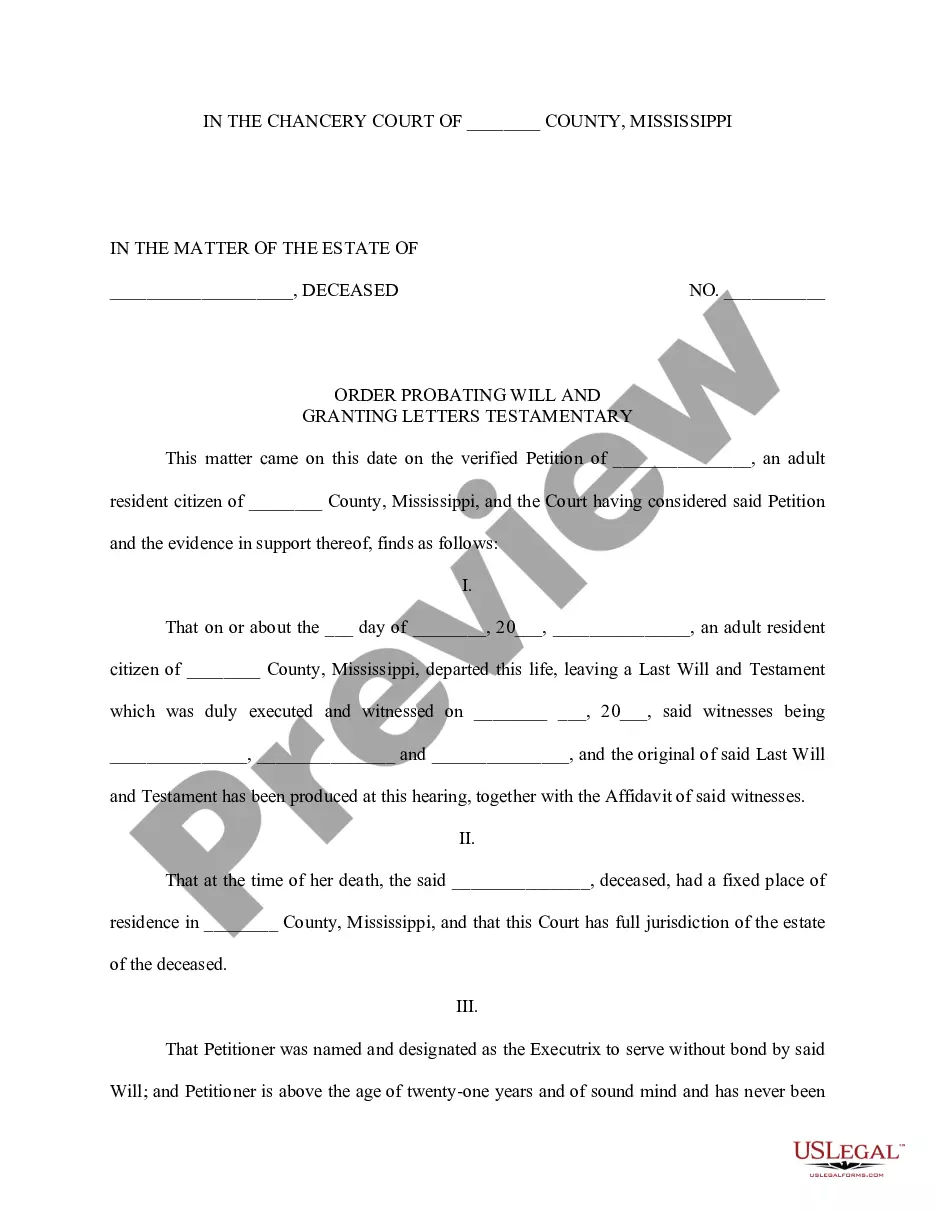
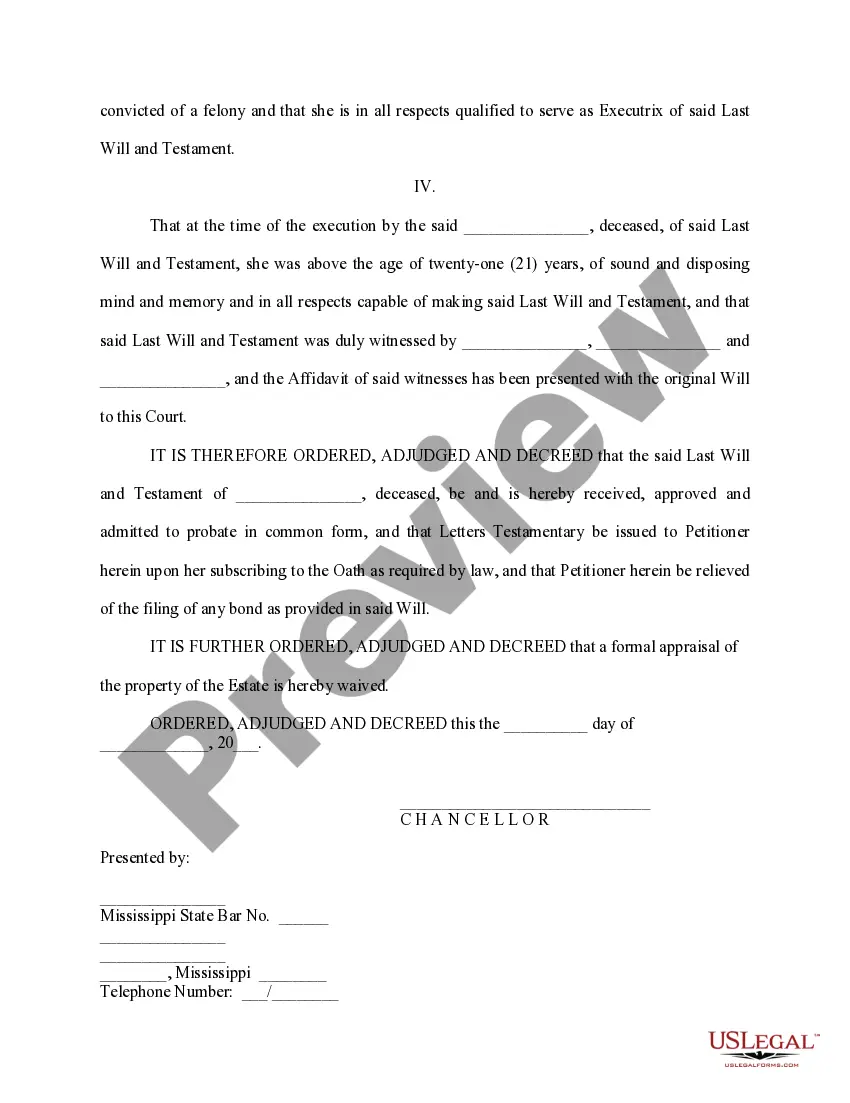
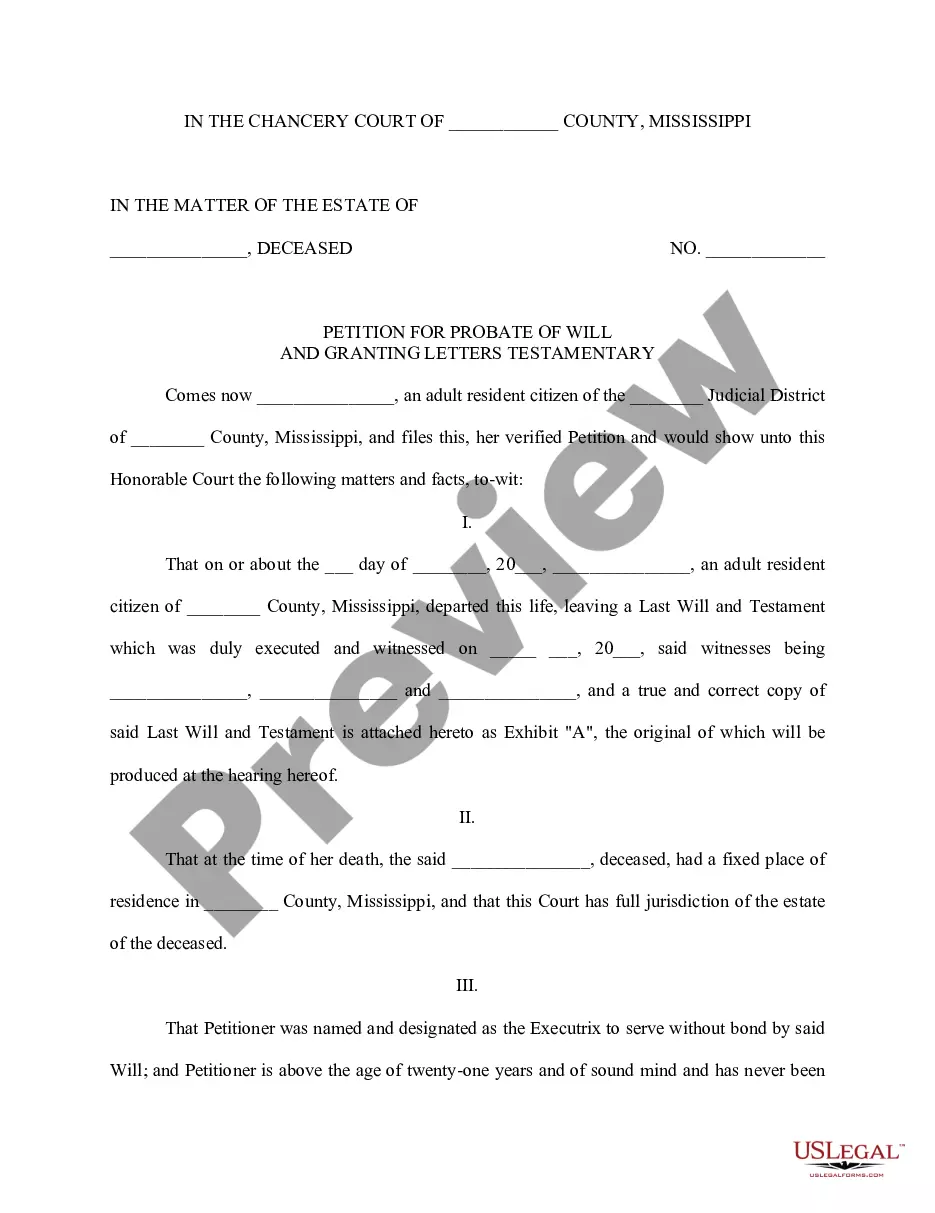
This Order Probating Will and Granting Letters Testamentary is a legal document used in Mississippi to validate a deceased person's will and appoint an executor or executrix to manage the estate. This form effectively establishes the will as legitimate and confirms the executor's authority to act on behalf of the estate, distinguishing it from other similar documents that may not include such direct authorization.
Key components of this form
- Information about the deceased, including their name and date of death.
- Petitioner's details, confirming their residency and relationship to the deceased.
- Court findings regarding the validity of the will and the qualifications of the executor/executrix.
- Acceptance of the original will and witness affidavits by the court.
- Order for Letters Testamentary to be issued to the named executor/executrix.
- Waiver of bond requirements and formal appraisal of the estate's property.

When to use this document
This form should be used when a person has passed away and there is a valid will that requires legal recognition to manage and distribute the deceasedâs estate. It is essential when the named executor needs official authority to carry out their duties, such as paying debts, distributing assets, and handling estate matters in accordance with the will.
Who should use this form
This form is intended for:
- Executors or executrices named in a will who need to be formally appointed by the court.
- Family members or interested parties seeking to validate a will after a death.
- Legal representatives assisting in estate management and administration.
How to prepare this document
To complete this form, follow these steps:
- Enter the name of the deceased and the case number at the top of the form.
- Provide details about the petitioner, including their name and county of residence.
- Fill in the date of death and relevant information about the will, including witness names and execution dates.
- Confirm that the petitioner is eligible to serve as the executor/executrix, meeting the age and legal standards.
- Sign and date the form once all sections are complete, ensuring compliance with the required legal formalities.
Does this document require notarization?
This form does not typically require notarization unless specified by local law. However, it is advisable to check local requirements for additional compliance.
Get your form ready online
Our built-in tools help you complete, sign, share, and store your documents in one place.
Make edits, fill in missing information, and update formatting in US Legal Forms—just like you would in MS Word.
Download a copy, print it, send it by email, or mail it via USPS—whatever works best for your next step.
Sign and collect signatures with our SignNow integration. Send to multiple recipients, set reminders, and more. Go Premium to unlock E-Sign.
If this form requires notarization, complete it online through a secure video call—no need to meet a notary in person or wait for an appointment.
We protect your documents and personal data by following strict security and privacy standards.

Make edits, fill in missing information, and update formatting in US Legal Forms—just like you would in MS Word.

Download a copy, print it, send it by email, or mail it via USPS—whatever works best for your next step.

Sign and collect signatures with our SignNow integration. Send to multiple recipients, set reminders, and more. Go Premium to unlock E-Sign.

If this form requires notarization, complete it online through a secure video call—no need to meet a notary in person or wait for an appointment.

We protect your documents and personal data by following strict security and privacy standards.
Common mistakes to avoid
- Failing to provide complete identifying information for the deceased.
- Omitting witness information or failing to include proper affidavits.
- Not confirming the petitioner's eligibility requirements as an executor/executrix.
Advantages of online completion
- Convenience of downloading and filling out the form at your own pace.
- Editability allows you to make corrections before finalizing the document.
- Instant access to professional legal templates drafted by licensed attorneys, ensuring accuracy and compliance.
Looking for another form?

Form popularity
FAQ
Probate is required when an estate's assets are solely in the deceased's name. In most cases, if the deceased owned property that had no other names attached, an estate must go through probate in order to transfer the property into the name(s) of any beneficiaries.
Simply having a last will does not avoid probate; in fact, a will must go through probate. To probate a will, the document is filed with the court, and a personal representative is appointed to gather the decedent's assets and take care of any outstanding debts or taxes.
Mississippi has a simplified probate process for small estates. To use it, an executor files a written request with the local probate court asking to use the simplified procedure. The court may authorize the executor to distribute the assets without having to jump through the hoops of regular probate.
When probating a will, it is necessary for one person to be appointed as the executor.Generally speaking, the executor must obtain a letter of testamentary, which provides legal documentation and proof that they are in fact the executor of the estate.
If you are named in someone's will as an executor, you may have to apply for probate. This is a legal document which gives you the authority to share out the estate of the person who has died according to the instructions in the will. You do not always need probate to be able to deal with the estate.
If you are named in someone's will as an executor, you may have to apply for probate. This is a legal document which gives you the authority to share out the estate of the person who has died according to the instructions in the will. You do not always need probate to be able to deal with the estate.
Avoid Probate in California Altogether In such case, there is no need for letters testamentary or letters of administration to distribute the assets of a trust.
To obtain your letter of testamentary, you will need to file the will and death certificate in the probate court, along with forms asking for the letter of testamentary. You'll need to provide your information, as well as some basic information about the value of the estate and the date of death.
Yes, an estate can be settled without probate.In California, for example, estates valued at less than $166,250 may not have to go through probate.