Minnesota New Resident Guide
What this document covers
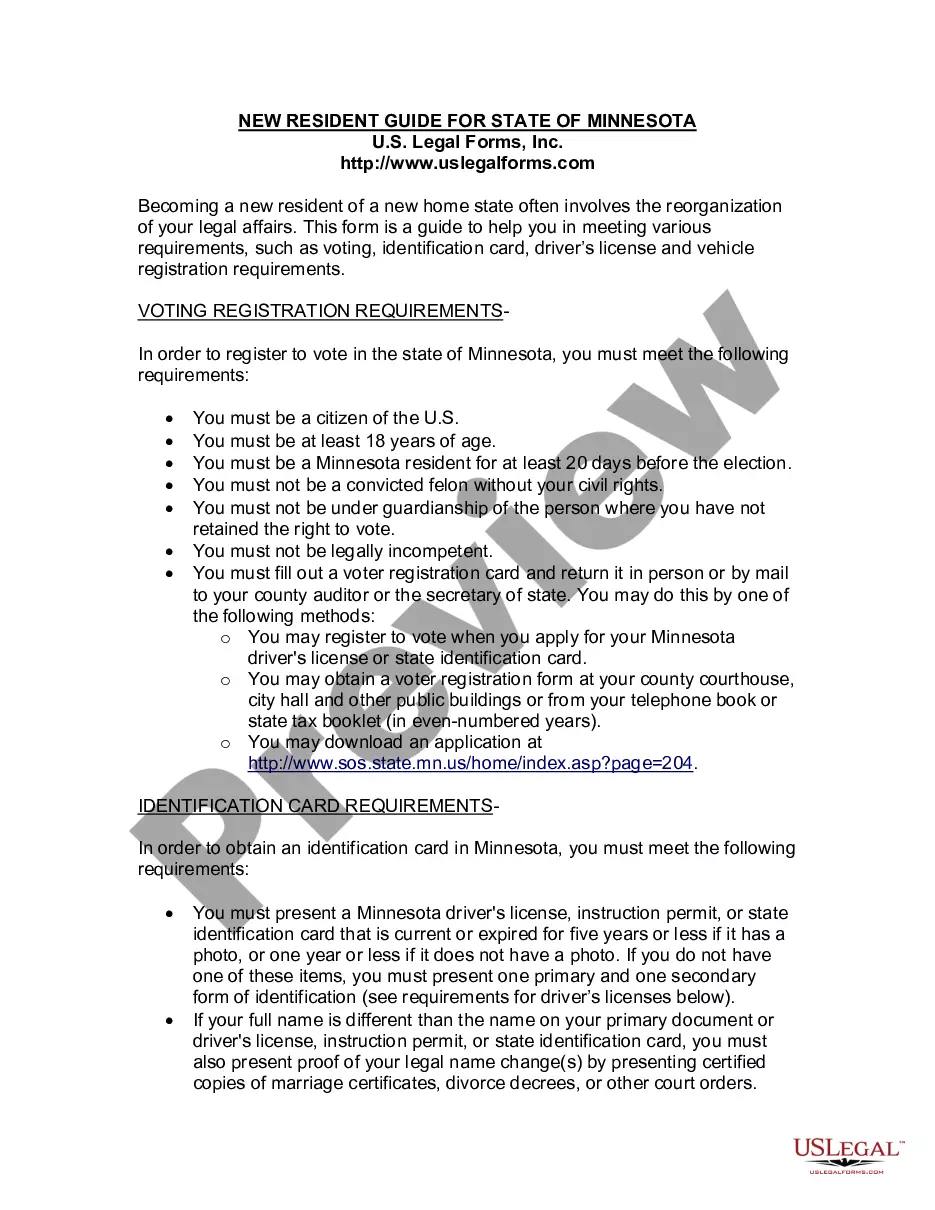
The New Resident Guide is an informational resource designed to assist individuals who have recently moved to a new state. It outlines essential state requirements for residency, voter registration, identification cards, driver's licenses, and vehicle title and registration. This guide aims to simplify the transition into a new state by providing clear and structured information about legal and practical steps necessary for settling in. Unlike other forms that may focus on specific legal situations, this guide serves as a comprehensive overview for new residents.
Form components explained
- Voter registration requirements, including eligibility criteria and application methods.
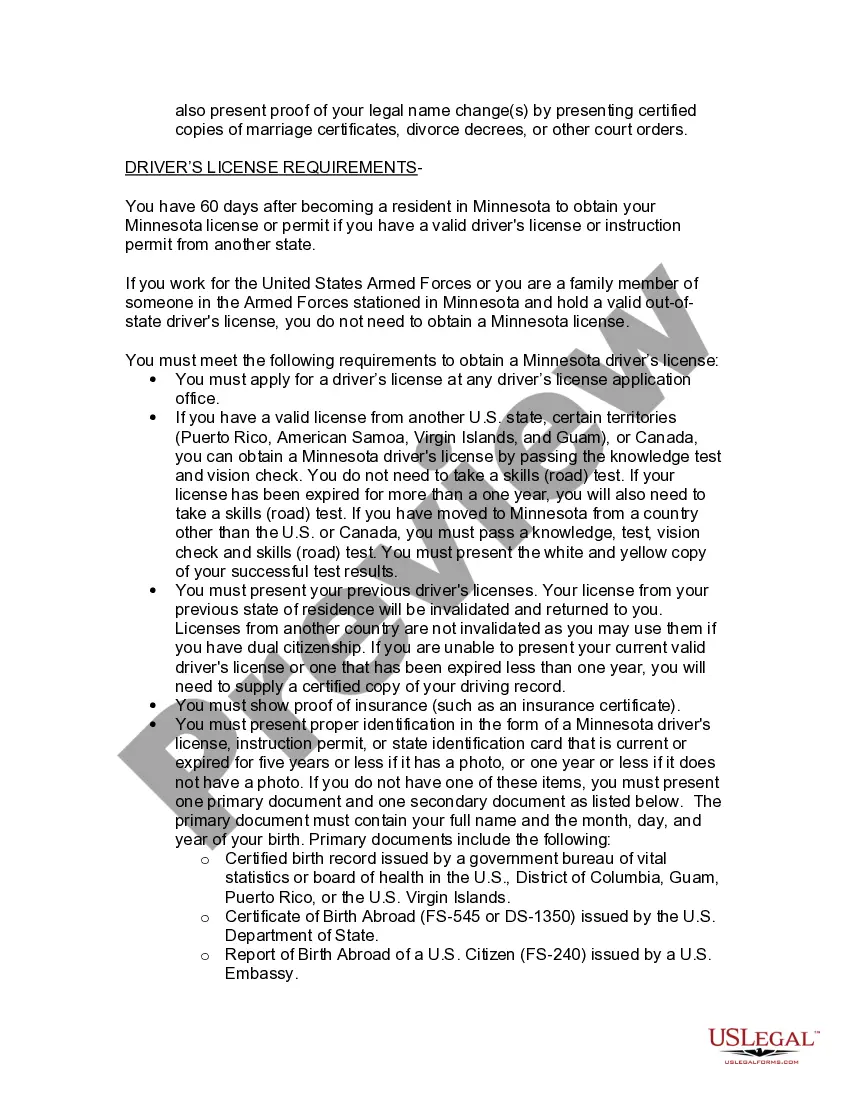
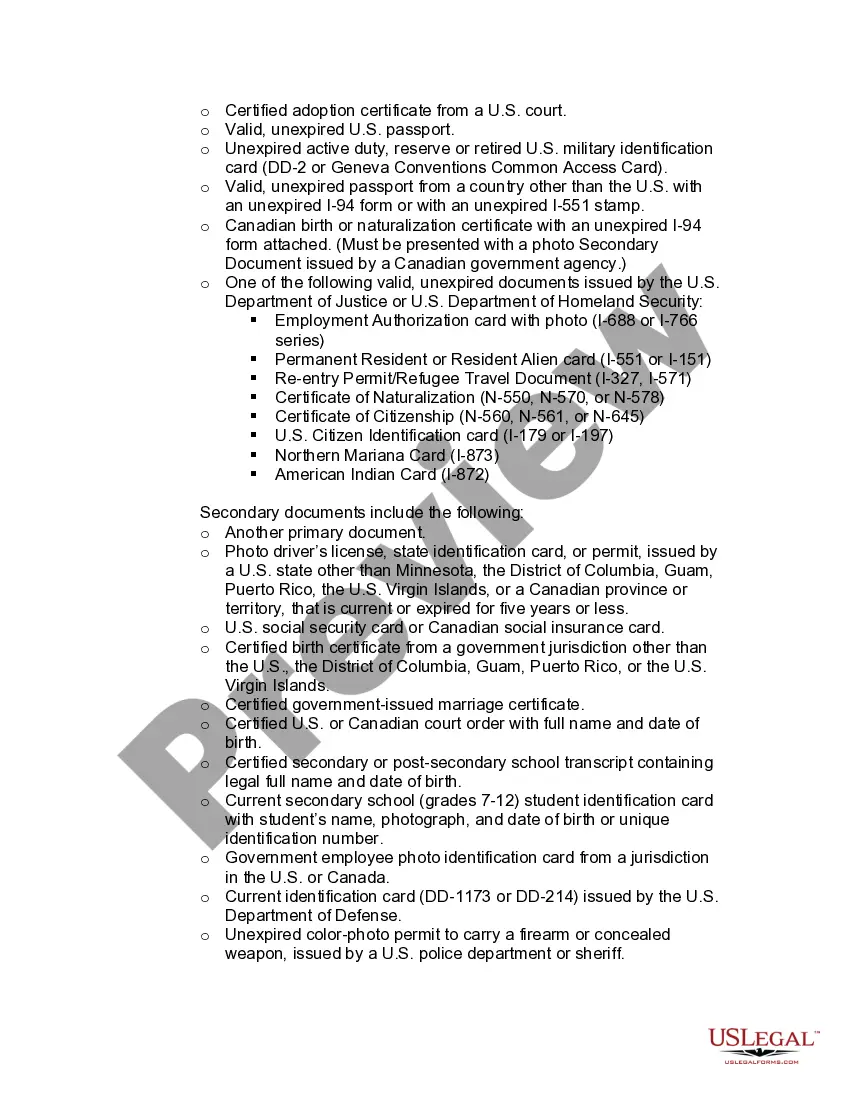
- Identification card requirements and acceptable forms of ID.
- Driver's license application processes and essential documentation needed.
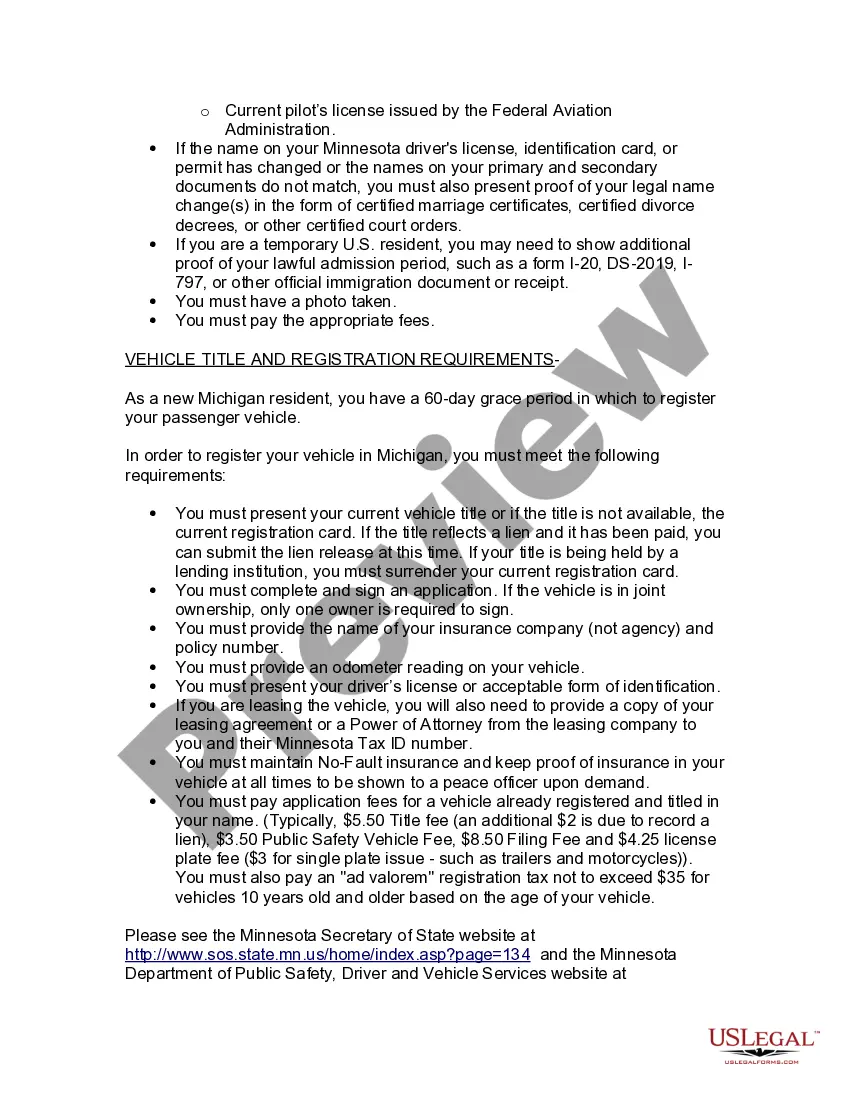
- Vehicle registration guidelines, including the necessary documents and fees.
Common use cases
This guide is essential when you have moved to a new state and need to align your legal status with the local requirements. Use it to understand how to register to vote, obtain identification, acquire a driver's license, and register your vehicle efficiently. It's particularly useful during your first few weeks after relocating, as it provides a clear roadmap for managing your legal affairs in your new state.
Who should use this form
This form is intended for:
- Individuals and families relocating to a new state.
- First-time residents looking to understand state-specific regulations.
- Students moving for school purposes.
- Military personnel and their families who have recently changed their state of residence.
Instructions for completing this form
- Review the residency requirements and confirm eligibility for each section.
- Gather the necessary documentation for voter registration, such as proof of residence and identification.
- Follow the steps outlined for obtaining a state identification card or driver's license.
- Complete the vehicle registration application by providing details about your car and insurance.
- Submit all forms and applications to the appropriate state agencies by the specified deadlines.
Does this form need to be notarized?
In most cases, this form does not require notarization. However, some jurisdictions or signing circumstances might. US Legal Forms offers online notarization powered by Notarize, accessible 24/7 for a quick, remote process.
Get your form ready online
Our built-in tools help you complete, sign, share, and store your documents in one place.
Make edits, fill in missing information, and update formatting in US Legal Forms—just like you would in MS Word.
Download a copy, print it, send it by email, or mail it via USPS—whatever works best for your next step.
Sign and collect signatures with our SignNow integration. Send to multiple recipients, set reminders, and more. Go Premium to unlock E-Sign.
If this form requires notarization, complete it online through a secure video call—no need to meet a notary in person or wait for an appointment.
We protect your documents and personal data by following strict security and privacy standards.

Make edits, fill in missing information, and update formatting in US Legal Forms—just like you would in MS Word.

Download a copy, print it, send it by email, or mail it via USPS—whatever works best for your next step.

Sign and collect signatures with our SignNow integration. Send to multiple recipients, set reminders, and more. Go Premium to unlock E-Sign.

If this form requires notarization, complete it online through a secure video call—no need to meet a notary in person or wait for an appointment.

We protect your documents and personal data by following strict security and privacy standards.
Common mistakes to avoid
- Failing to check specific state deadlines for voter and vehicle registration.
- Not gathering all required documentation before applying for a driver's license or ID.
- Inaccurately completing forms, which can delay processing.
- Overlooking local regulations that may differ from general national guidelines.
Benefits of using this form online
- Easy access to comprehensive and organized information in one place.
- Convenient downloading and printing options for quick reference.
- Up-to-date guidelines and requirements based on the latest state laws.
- Streamlined process for completing forms with clear instructions.
Legal use & context
- The New Resident Guide is designed to comply with state laws governing residency requirements.
- It serves as an authoritative source for understanding the legal obligations of new residents.
- Using this guide helps ensure that you are legally registered to vote and compliant with state regulations.
Key takeaways
- The New Resident Guide helps navigate state-specific legal requirements upon relocation.
- Understand voter registration, identification, driver's license, and vehicle registration processes clearly.
- Gather necessary documents before starting any applications to streamline the process.
Looking for another form?
Form popularity
FAQ
Many new residents make mistakes during the MN road test that can easily be avoided. Common errors include not checking mirrors frequently, failing to signal turns or lane changes, and misunderstanding road signs. To prepare effectively, refer to the Minnesota New Resident Guide for tips and practice routes. Using resources from uslegalforms can also help you understand the requirements and avoid pitfalls during your test.
To establish residency in Minnesota, you need to take specific steps outlined in the Minnesota New Resident Guide. Start by obtaining a Minnesota driver's license or ID, which requires proof of your new address. You should also register your vehicle in Minnesota, and consider updating your voter registration. Additionally, maintaining documents like utility bills and lease agreements can help confirm your residency.
You will need to: Complete a Minnesota driver's license application and provide your social security number. Present one primary and one secondary form of identification (see back). Present your driver's license from your previous state, this will be invalidated and returned to you if the road test is waived.
REAL ID is available from the state of Minnesota for the same price as a standard ID; Enhanced ID costs an additional $15.
Complete a Minnesota driver's license application and provide your social security number. Present one primary and one secondary form of identification. Present your driver's license from your previous state; this will be invalidated and returned to you if the road test is waived.
Under this rule, you are considered a Minnesota resident for tax purposes if both of the following conditions apply: You spend at least 183 days in Minnesota during the year. Any part of a day counts as a full day. You or your spouse rent, own, maintain, or occupy an abode.
Complete a Minnesota driver's license application and provide your social security number. Present one primary and one secondary form of identification. Present your driver's license from your previous state; this will be invalidated and returned to you if the road test is waived.
A person must be a state resident to be eligible. A state resident is a person who has lived in Minnesota for at least 30 days with the intent of making Minnesota his/her home. There are certain EXCEPTIONS to this requirement. See 0011.06.
One document proving identity, date of birth and legal presence in the United States. One document proving social security number. Two different documents proving current residency in Minnesota.
It's okay to drive in MN with a valid out-of-state Driver's license as long as you are not a resident and do not plan to become a resident.However, you will need to pass the written test and a vision exam to replace your out-of-state license for a MN Driver's License.