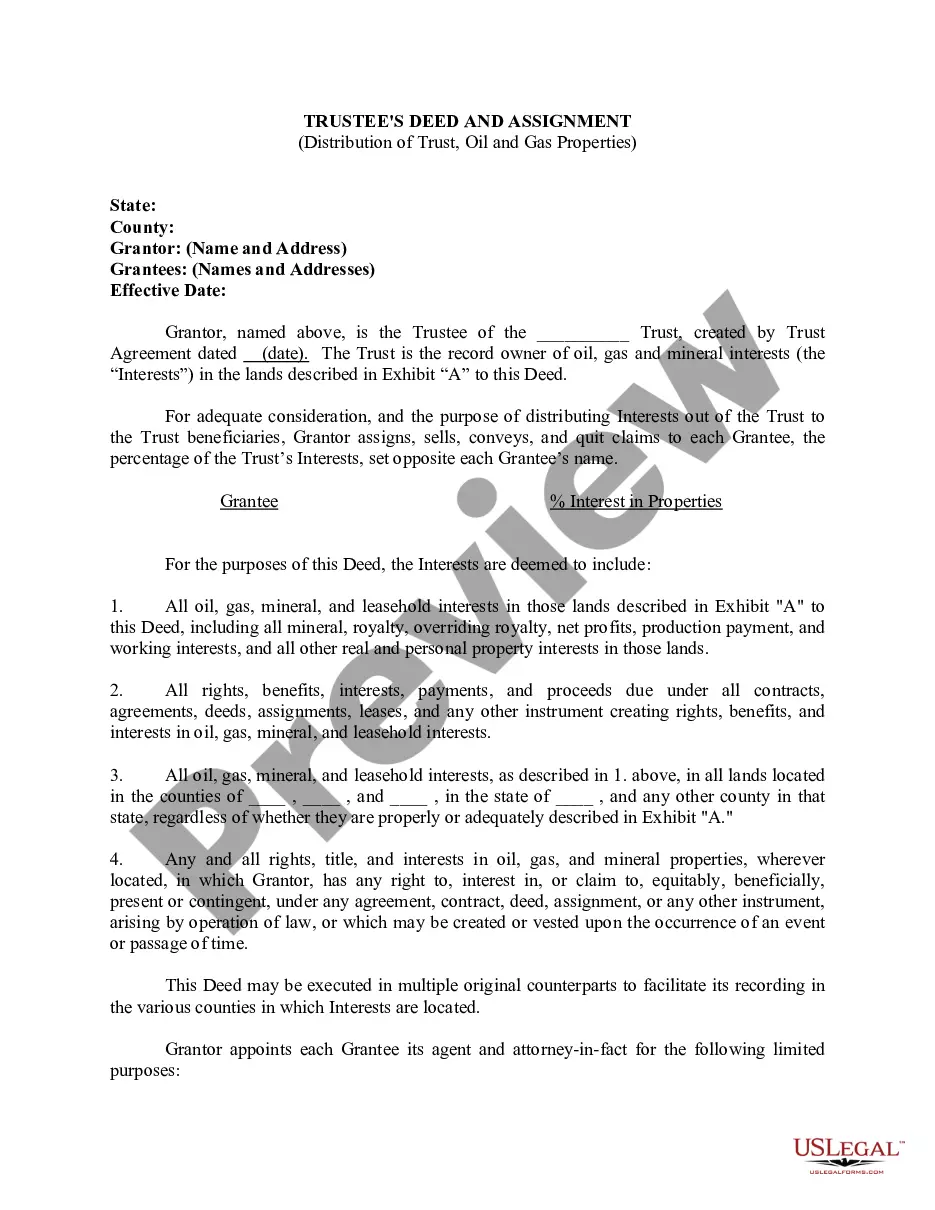
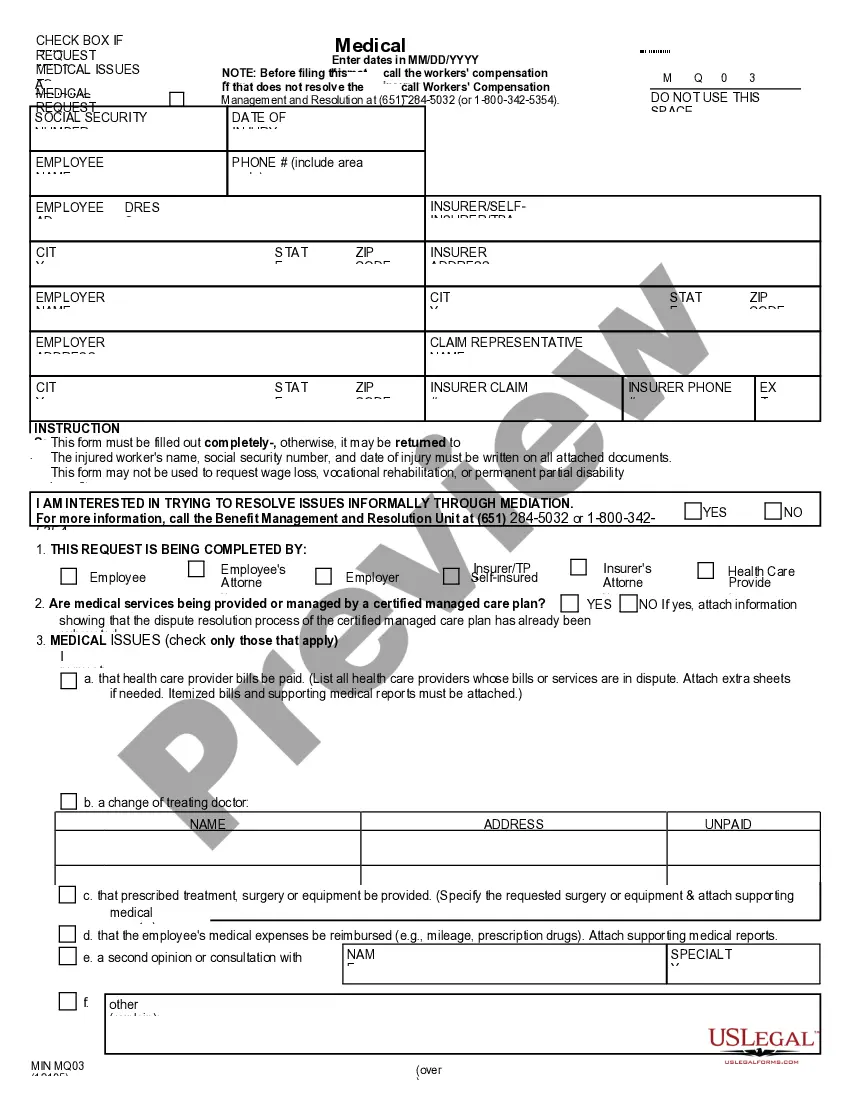
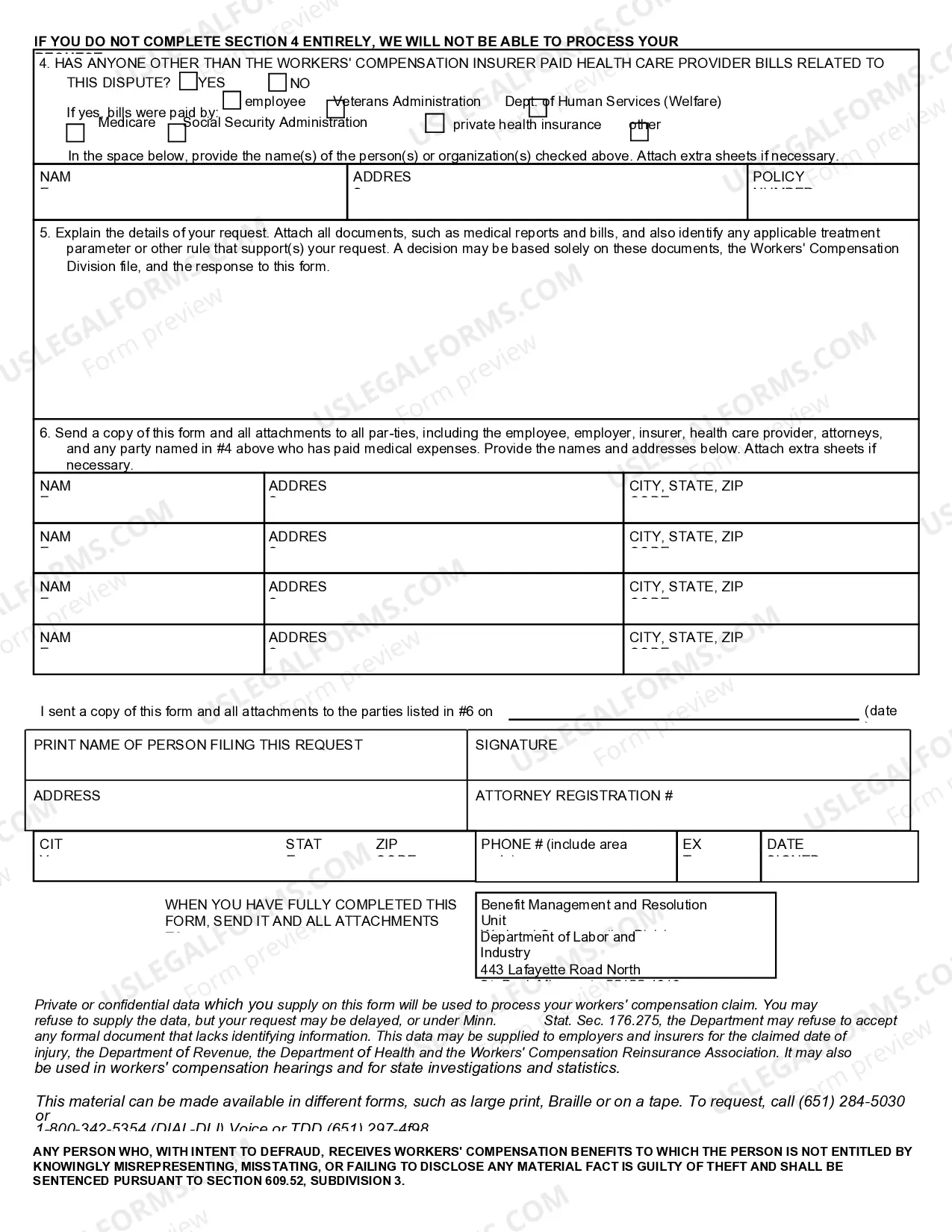
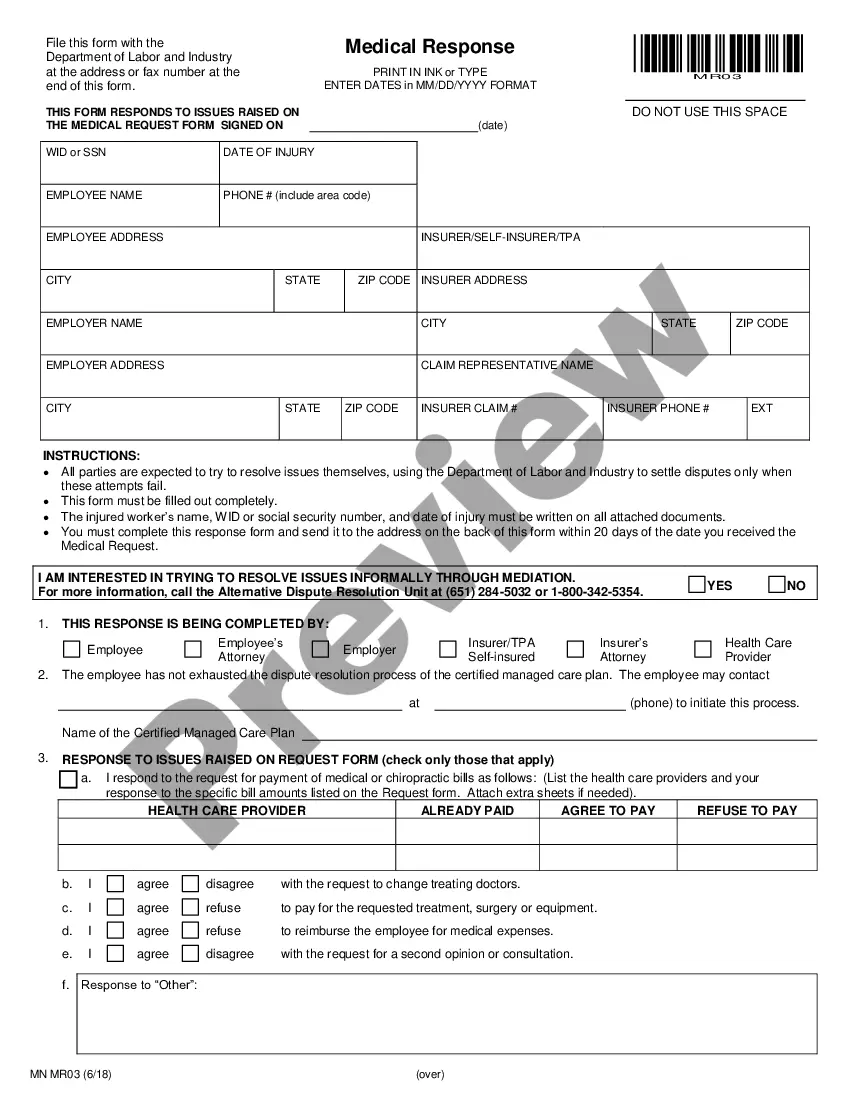
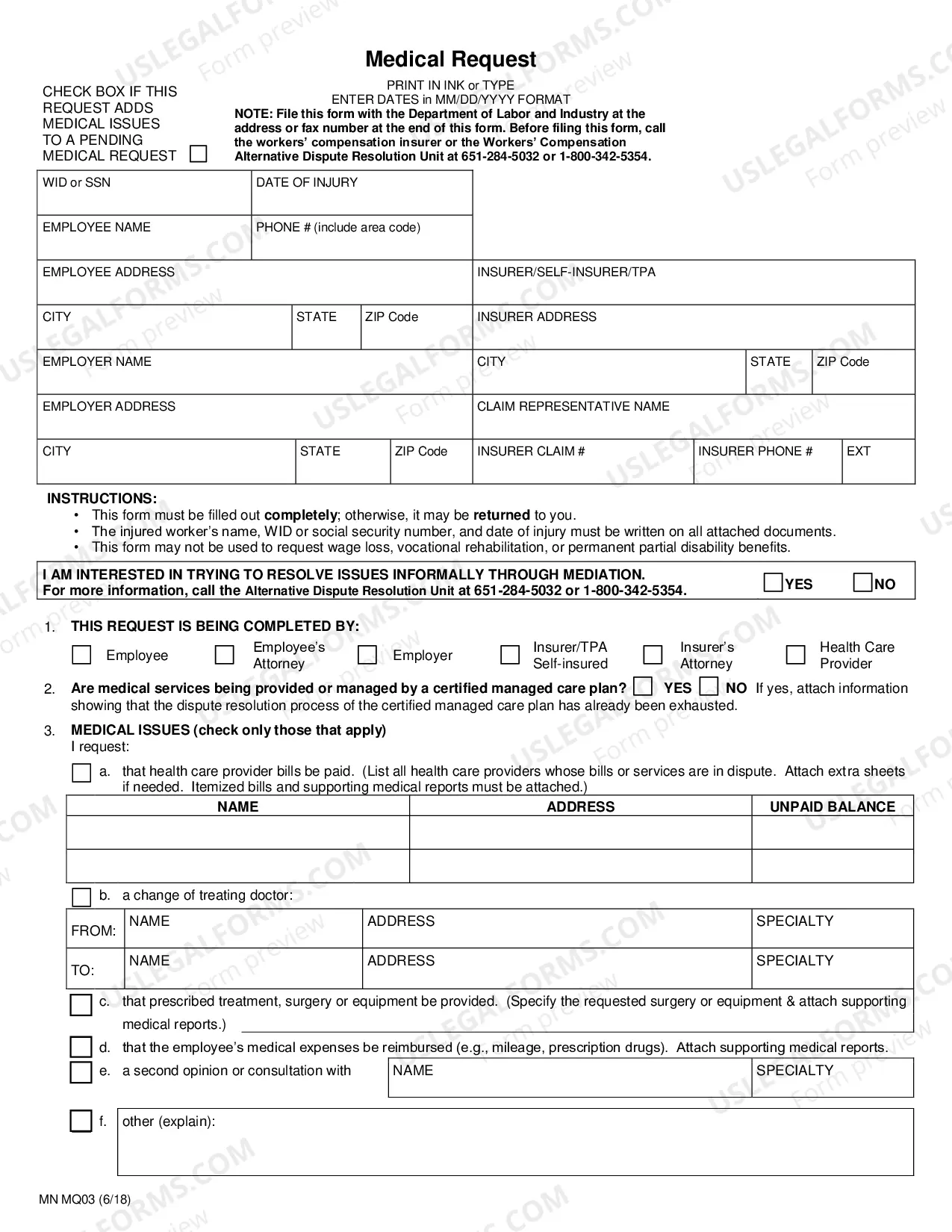
This is one of the official Workers' Compensation forms for the state of Minnesota.
Minnesota Medical Request for Workers' Compensation
State:
Minnesota
Category:
Control #:
MN-MQ03-WC
Format:
PDF;
Rich Text
Instant download
This website is not affiliated with any governmental entity
Public form
Description
Free preview
Get your form ready online
Our built-in tools help you complete, sign, share, and store your documents in one place.
Built-in online Word editor
Make edits, fill in missing information, and update formatting in US Legal Forms—just like you would in MS Word.
Export easily
Download a copy, print it, send it by email, or mail it via USPS—whatever works best for your next step.
E-sign your document
Sign and collect signatures with our SignNow integration. Send to multiple recipients, set reminders, and more. Go Premium to unlock E-Sign.
Notarize online 24/7
If this form requires notarization, complete it online through a secure video call—no need to meet a notary in person or wait for an appointment.
Store your document securely
We protect your documents and personal data by following strict security and privacy standards.

Make edits, fill in missing information, and update formatting in US Legal Forms—just like you would in MS Word.

Download a copy, print it, send it by email, or mail it via USPS—whatever works best for your next step.

Sign and collect signatures with our SignNow integration. Send to multiple recipients, set reminders, and more. Go Premium to unlock E-Sign.

If this form requires notarization, complete it online through a secure video call—no need to meet a notary in person or wait for an appointment.

We protect your documents and personal data by following strict security and privacy standards.
Looking for another form?

How to fill out Minnesota Medical Request For Workers' Compensation?
Obtain any version from 85,000 legal records like the Minnesota Medical Application for Workers' Compensation online with US Legal Forms. Each template is created and revised by state-certified lawyers.
If you already possess a subscription, sign in. Once you’re on the form’s page, click on the Download button and navigate to My documents to gain access to it.
If you haven’t subscribed yet, follow the steps outlined below.
With US Legal Forms, you'll consistently have quick access to the appropriate downloadable template. The platform provides access to forms and organizes them into categories to enhance your search. Utilize US Legal Forms to acquire your Minnesota Medical Application for Workers' Compensation swiftly and effortlessly.
- Review the state-specific criteria for the Minnesota Medical Application for Workers' Compensation you wish to utilize.
- Examine the description and preview the example.
- Once you’re certain the template is what you require, click on Purchase Now.
- Select a subscription plan that truly fits your financial situation.
- Establish a personal account.
- Pay using one of two convenient methods: by credit card or through PayPal.
- Choose a format to download the document in; two formats are available (PDF or Word).
- Download the file to the My documents section.
- When your reusable form is prepared, print it out or save it to your device.
Form popularity
FAQ
A worker is disqualified where the injury: (1) is caused by the worker's own intoxication (alcohol or other controlled substance as defined by the Health and Safety Code; (2) is intentionally self-inflicted; (3) occurs out of an altercation (mutual combat) where the claimant was the initial physical aggressor; (4)
Workplaces must prioritise your health and safety. They must facilitate your return to work. They must balance this against your privacy rights. This means that access to medical records may be necessary, but your employer has an obligation to request and access only the information required and nothing more.
No, you should not sign the HIPAA authorization for the release of your medical records. Often, the insurance company will act as though they cannot begin to decide how much money to offer you until they have all of your medical records.
Get your weekly disability check started, if you're not receiving it already. Maximize your weekly benefit check. Report all super-added injuries. Seek psychological care, when appropriate. Seek pain management care, when appropriate. Don't refuse medical procedures. Be very careful what you tell the doctor.
Many insurance companies use generic forms that are broad in scope and grant blanket access to all of your medical records. The Medical Authorization form may even give the claims adjuster or insurance defense attorney permission to speak with your doctors and nurses without you present.
Workers' comp insurance provides coverage to help your employee pay for medical expenses related to a work-related injury or illness. This can include emergency room visits, necessary surgeries and prescriptions.
As a general rule of thumb, you should never discuss anything except the basic facts of the accident, including where it occurred, the date and time it occurred, what type of accident it was, and which body parts were injured.
Always ask what the net amount will be after deducting lawyers' fees. A good California Workers' Compensation attorney should make sure that all medical expenses for your treatment are taken care of by the insurance company either prior to settlement or included in the settlement. You should not owe anyone.
Yes, you are required to release your medical records if requested when you file a workers' compensation claim after a workplace injury.