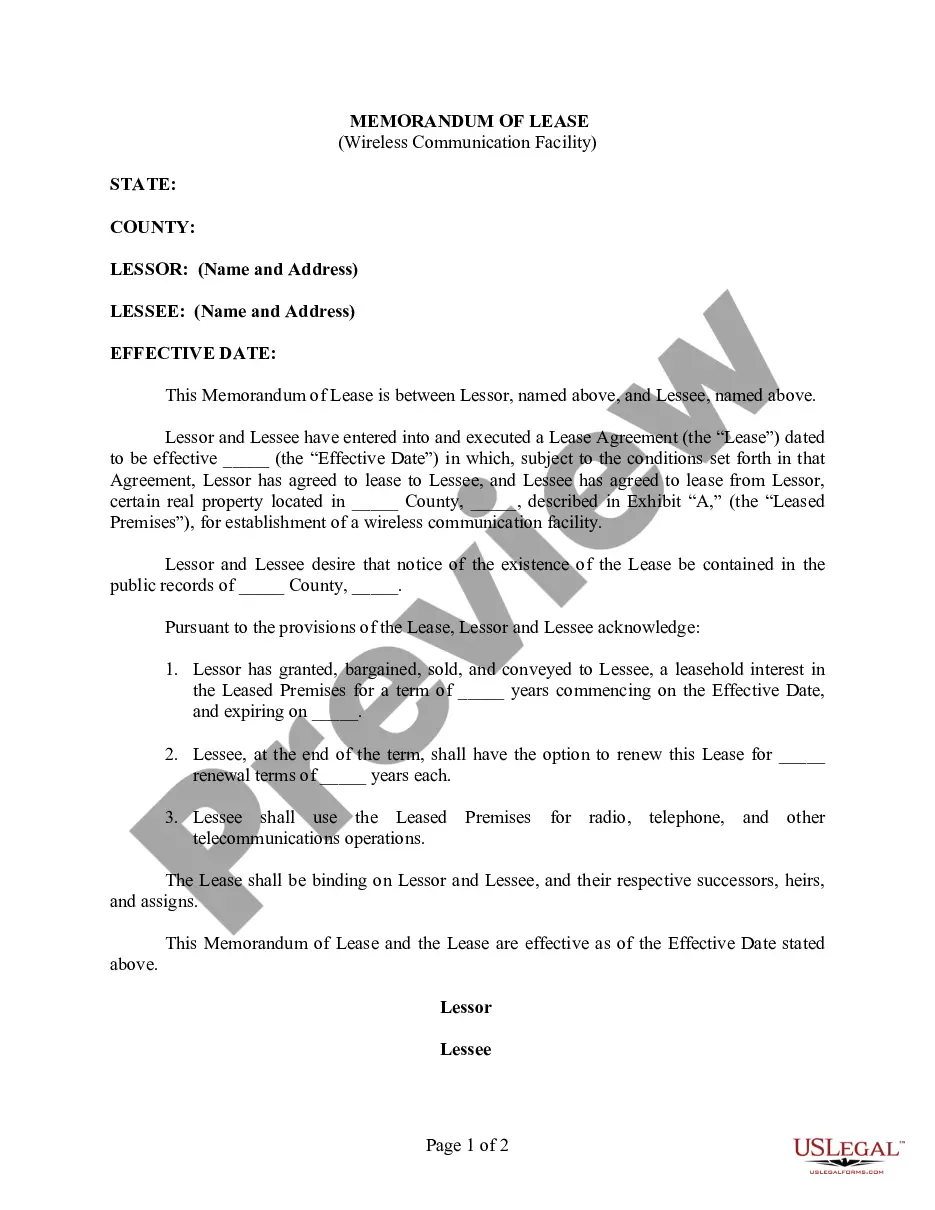
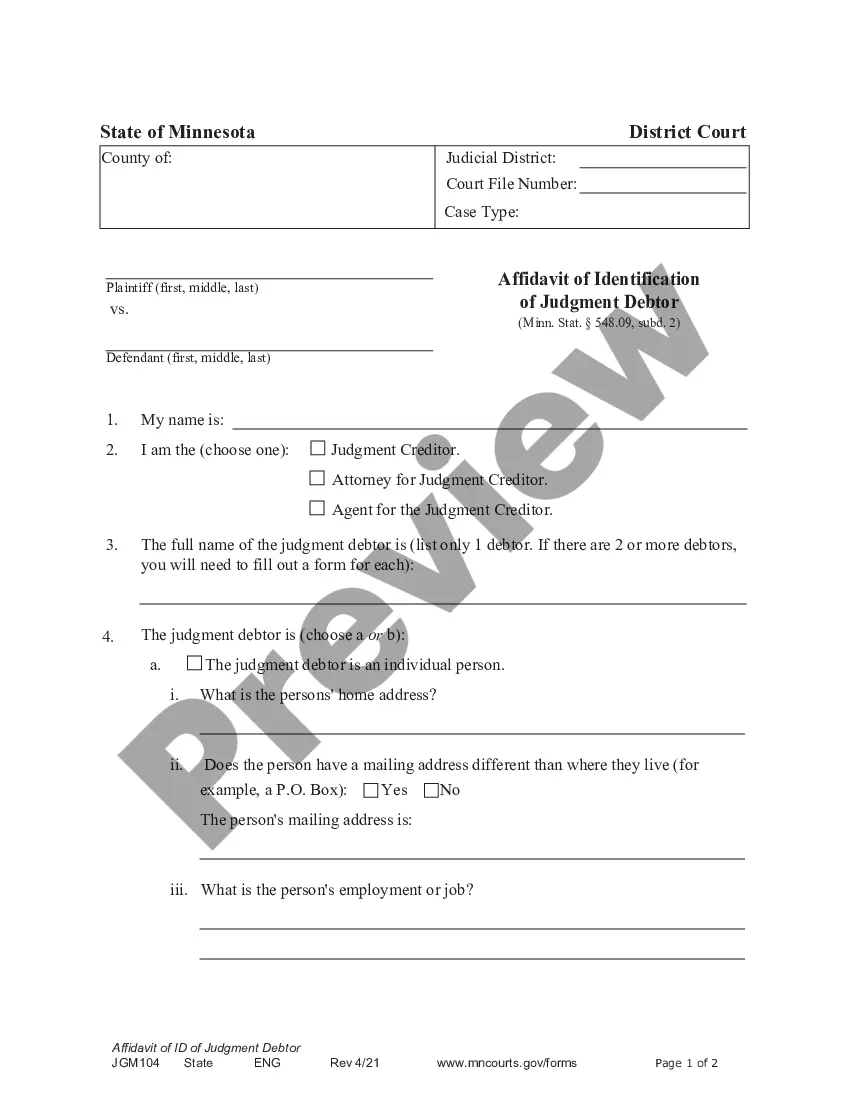
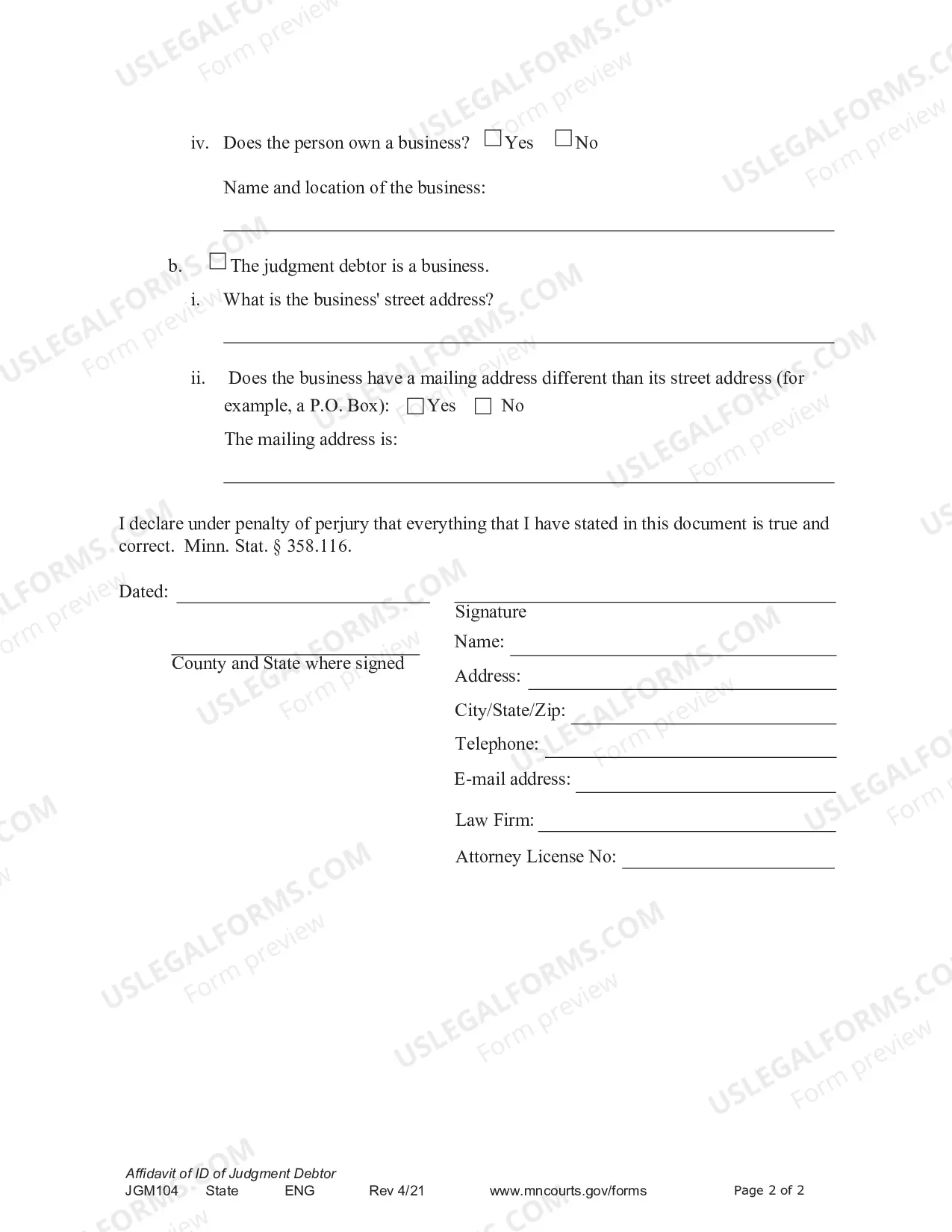
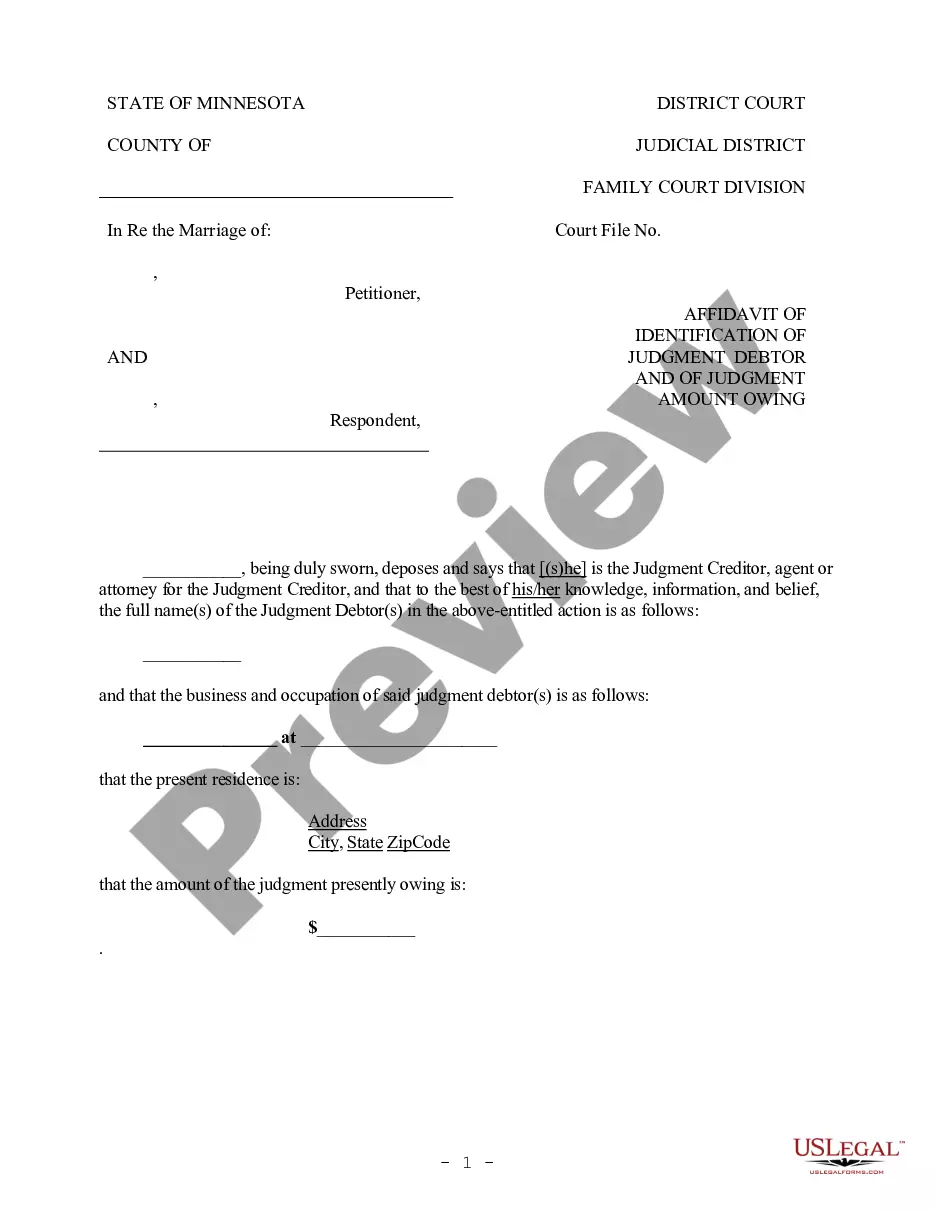
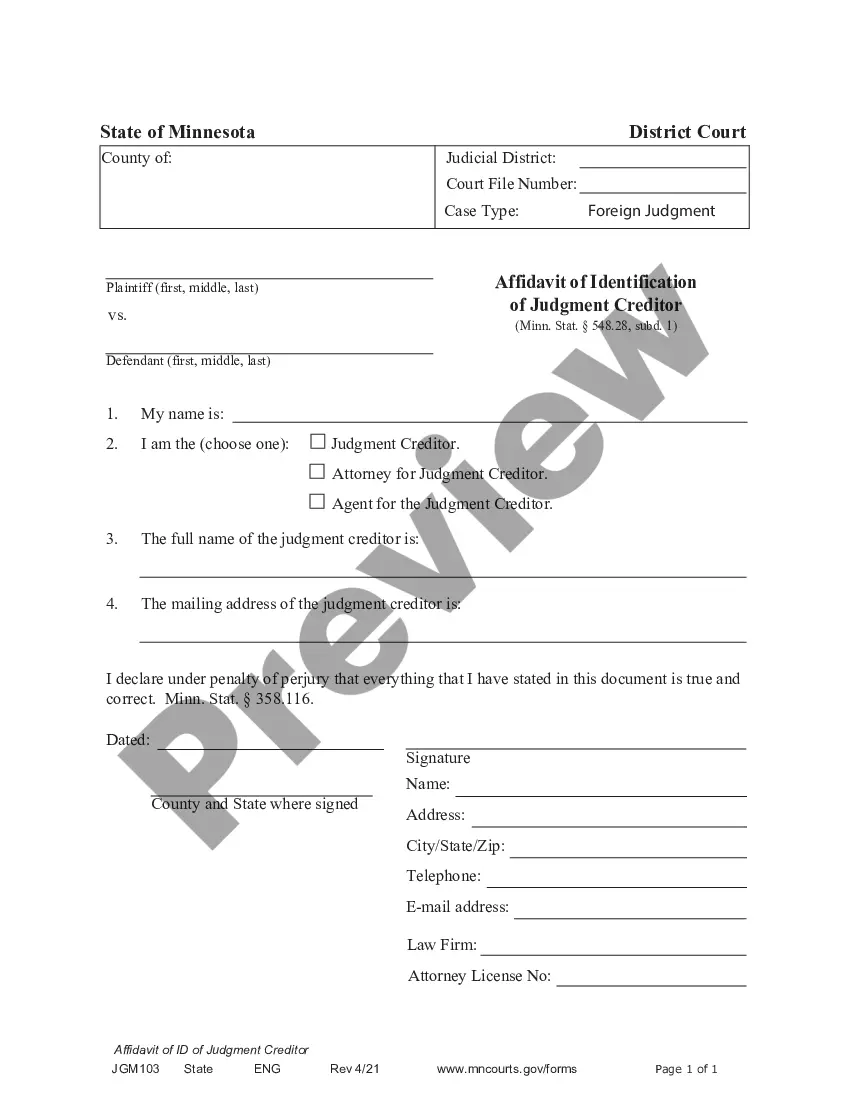
This is an official Minnesota court form for use in a civil case, an Affidavit of Identification of Judgment Debtor. USLF amends and updates these forms as is required by Minnesota Statutes and Law.
Minnesota Affidavit of Identification of Judgment Debtor
State:
Minnesota
Control #:
MN-JGM104
Format:
PDF
Instant download
This website is not affiliated with any governmental entity
Public form
Description
Free preview
Get your form ready online
Our built-in tools help you complete, sign, share, and store your documents in one place.
Built-in online Word editor
Make edits, fill in missing information, and update formatting in US Legal Forms—just like you would in MS Word.
Export easily
Download a copy, print it, send it by email, or mail it via USPS—whatever works best for your next step.
E-sign your document
Sign and collect signatures with our SignNow integration. Send to multiple recipients, set reminders, and more. Go Premium to unlock E-Sign.
Notarize online 24/7
If this form requires notarization, complete it online through a secure video call—no need to meet a notary in person or wait for an appointment.
Store your document securely
We protect your documents and personal data by following strict security and privacy standards.

Make edits, fill in missing information, and update formatting in US Legal Forms—just like you would in MS Word.

Download a copy, print it, send it by email, or mail it via USPS—whatever works best for your next step.

Sign and collect signatures with our SignNow integration. Send to multiple recipients, set reminders, and more. Go Premium to unlock E-Sign.

If this form requires notarization, complete it online through a secure video call—no need to meet a notary in person or wait for an appointment.

We protect your documents and personal data by following strict security and privacy standards.
Looking for another form?
How to fill out Minnesota Affidavit Of Identification Of Judgment Debtor?
Access any template from 85,000 legal documents, including the Minnesota Affidavit of Identification of Judgment Debtor, online with US Legal Forms. Each template is created and updated by state-certified attorneys.
If you already have a subscription, Log In. Once you’re on the form’s page, click the Download button and navigate to My documents to retrieve it.
If you haven’t subscribed yet, follow the steps outlined below.
With US Legal Forms, you’ll always have instant access to the relevant downloadable sample. The service provides access to forms and categorizes them to streamline your search. Use US Legal Forms to acquire your Minnesota Affidavit of Identification of Judgment Debtor quickly and efficiently.
- Verify the state-specific requirements for the Minnesota Affidavit of Identification of Judgment Debtor you wish to utilize.
- Review the description and preview the template.
- When you are certain that the sample meets your needs, click Buy Now.
- Select a subscription plan that fits your budget.
- Establish a personal account.
- Make a payment in one of two suitable methods: by credit card or through PayPal.
- Choose a format to download the document in; two options are available (PDF or Word).
- Download the file to the My documents section.
- After your reusable form is downloaded, print it out or save it to your device.
Form popularity
FAQ
To collect a judgment on someone in Minnesota, start by filing the necessary documents, including the Minnesota Affidavit of Identification of Judgment Debtor. This affidavit helps identify the debtor and their assets. Utilizing the resources available on uslegalforms can simplify the process, making it easier to navigate the legal requirements for collection.
The Minnesota Affidavit of Identification of Judgment Debtor is a legal document that identifies the individual who owes the judgment. This affidavit helps creditors pinpoint the debtor's assets, facilitating the collection process. It plays a critical role in enforcing court judgments and ensuring that creditors receive what is owed to them.
An affidavit of identification of judgment creditor is a document that identifies the individual or entity entitled to receive payment on a judgment. It is essential for establishing the legitimacy of the creditor's claim. This document may complement the Minnesota Affidavit of Identification of Judgment Debtor during the collection process.
Yes, in Minnesota, an affidavit typically must be notarized to be considered valid. This requirement affirms the authenticity of the signatures and the accuracy of the statements provided. When using the Minnesota Affidavit of Identification of Judgment Debtor, ensuring notarization adds credibility to the document in legal proceedings.
The main purpose of an affidavit is to provide a written statement of facts that is sworn to be true. In the context of the Minnesota Affidavit of Identification of Judgment Debtor, it serves as a legal document that identifies the debtor and supports the creditor's efforts to collect a judgment. This ensures that the process is documented and recognized by the court.
Rule 69 in Minnesota outlines the procedures for enforcing a judgment. It allows a creditor to collect what is owed by utilizing various methods, including the Minnesota Affidavit of Identification of Judgment Debtor. By following this rule, creditors can identify the debtor's assets and effectively pursue collection.