Minnesota Affidavit of Identification of Judgment Debtor and of Judgment Amount Owing
About this form
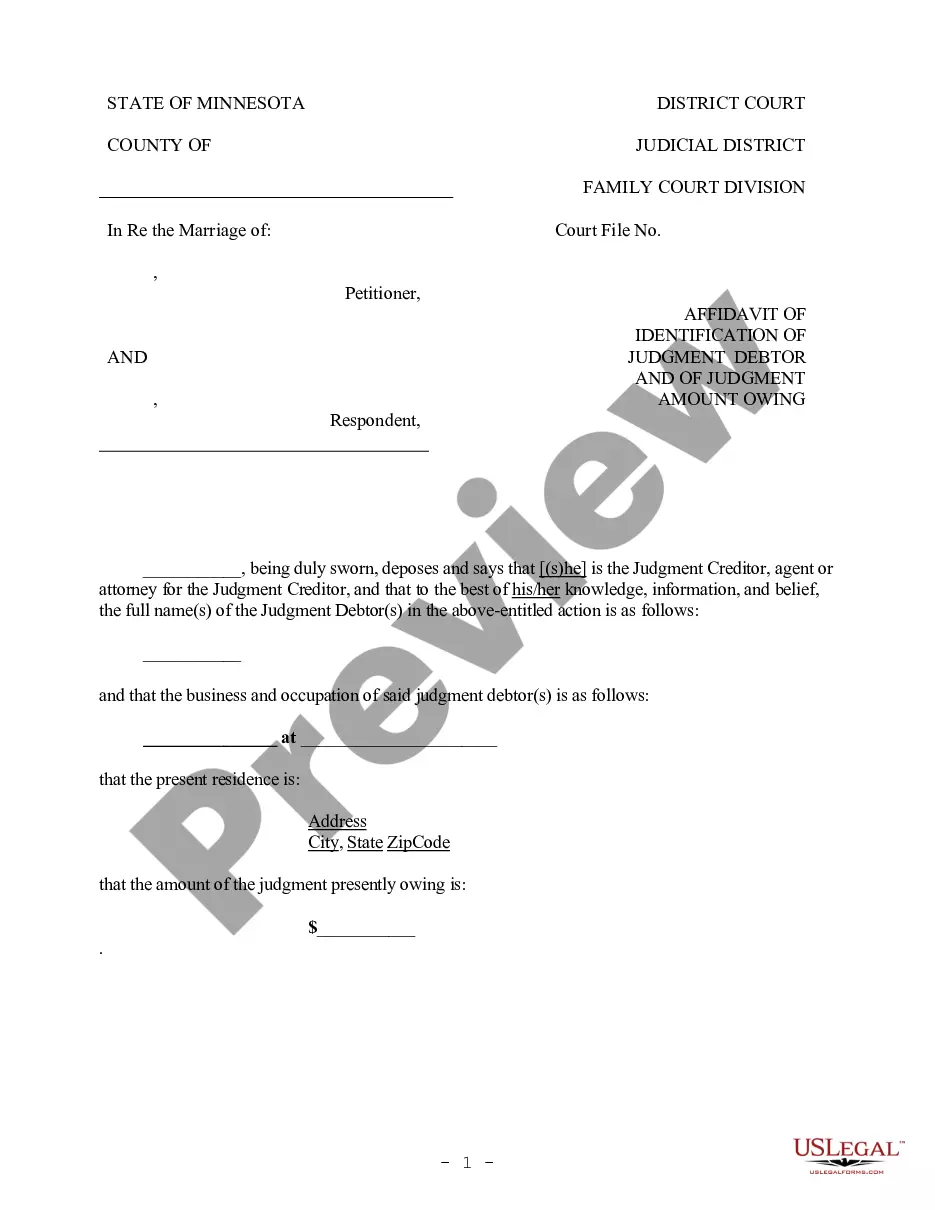
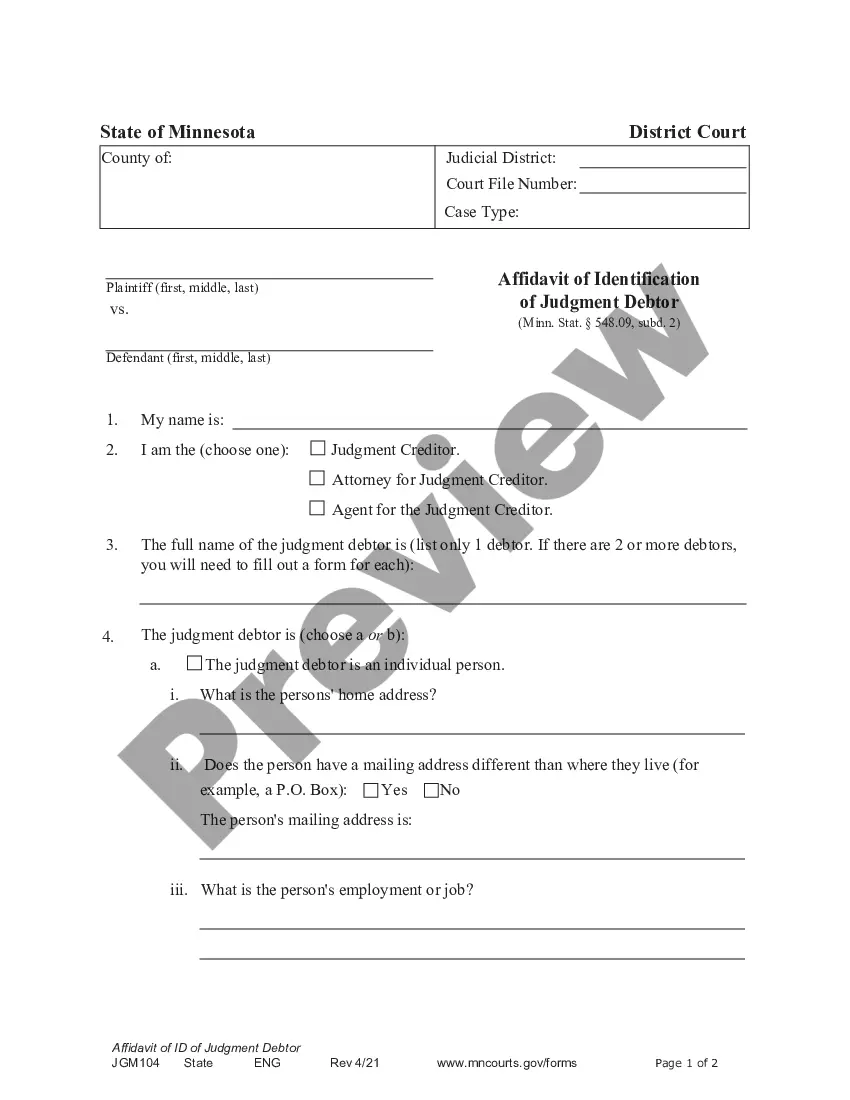
The Affidavit of Identification of Judgment Debtor and of Judgment Amount Owing is a legal document used by a judgment creditor to formally identify the judgment debtor and specify the amount that is owed. This form serves as an official declaration, distinct from other types of affidavits, by providing essential details that can facilitate the collection of a judgment. It is crucial for verifying the debtor's identity and the amount they owe, ensuring proper records are maintained in legal proceedings.
Key parts of this document
- Name and business details of the judgment debtor
- Current residence address of the judgment debtor
- Amount of judgment currently owed
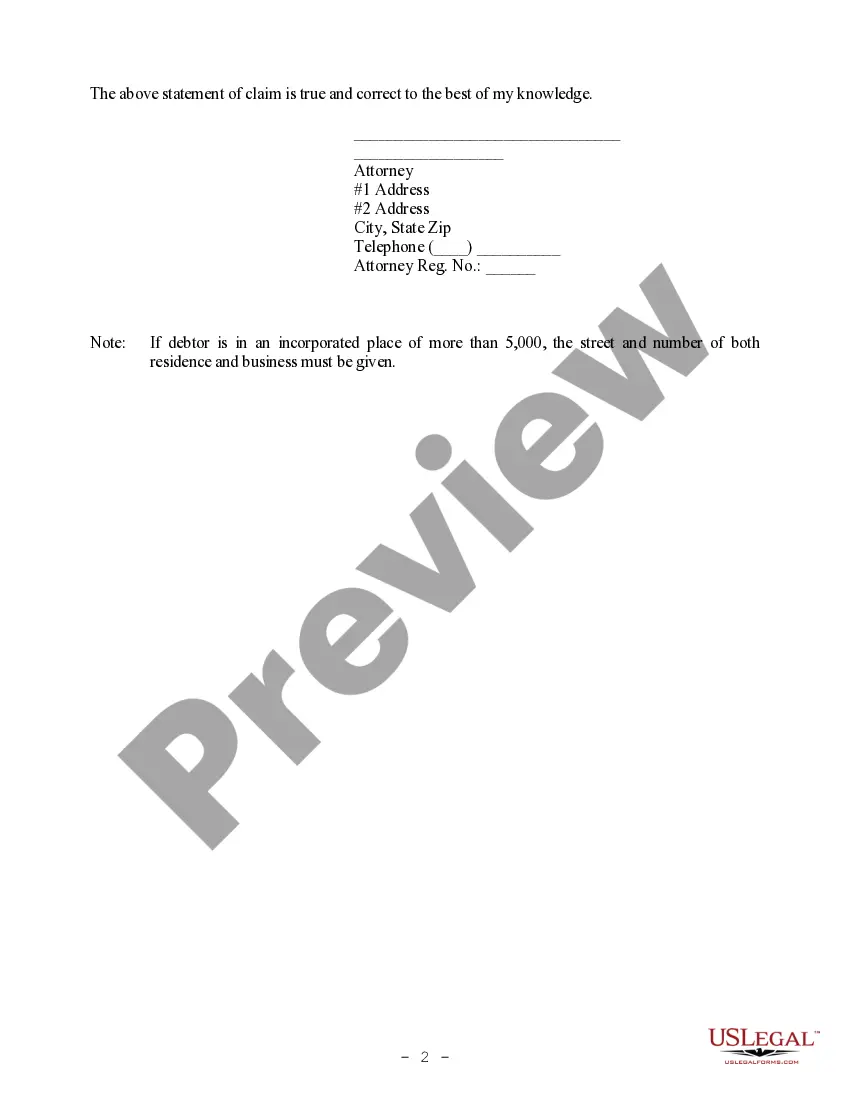
- Affirmation of truthfulness by the creditor
- Attorney contact information and registration number
When to use this form
This form should be used when a judgment creditor needs to formally identify the debtor and document the outstanding judgment amount for purposes of collection. It is essential to file this affidavit in situations where additional actions are required to enforce the judgment, such as garnishment or liens on property. Completing this form can be an important step in proceeding with legal enforcement measures.
Who needs this form
- Individuals or entities functioning as judgment creditors seeking to collect debts
- Attorneys representing creditors in collection matters
- Business owners pursuing unpaid judgments against other businesses or clients
How to prepare this document
- Identify the judgment debtorâs full name and business information.
- Provide the complete current residence address of the debtor.
- Enter the total amount currently owed from the judgment.
- Sign the affidavit, affirming that the information provided is accurate.
- Include attorney contact details, including registration number, if applicable.
Does this document require notarization?
This form does not typically require notarization unless specified by local law. However, verifying the authenticity of the document might still be important in certain instances. Always check with local legal requirements to confirm.
Get your form ready online
Our built-in tools help you complete, sign, share, and store your documents in one place.
Make edits, fill in missing information, and update formatting in US Legal Forms—just like you would in MS Word.
Download a copy, print it, send it by email, or mail it via USPS—whatever works best for your next step.
Sign and collect signatures with our SignNow integration. Send to multiple recipients, set reminders, and more. Go Premium to unlock E-Sign.
If this form requires notarization, complete it online through a secure video call—no need to meet a notary in person or wait for an appointment.
We protect your documents and personal data by following strict security and privacy standards.

Make edits, fill in missing information, and update formatting in US Legal Forms—just like you would in MS Word.

Download a copy, print it, send it by email, or mail it via USPS—whatever works best for your next step.

Sign and collect signatures with our SignNow integration. Send to multiple recipients, set reminders, and more. Go Premium to unlock E-Sign.

If this form requires notarization, complete it online through a secure video call—no need to meet a notary in person or wait for an appointment.

We protect your documents and personal data by following strict security and privacy standards.
Common mistakes to avoid
- Failing to include the debtorâs complete address, especially in large cities.
- Not providing an accurate judgment amount owed.
- Leaving sections blank that require personal or business identification details.
- Not having the affidavit signed and dated correctly.
Why use this form online
- Convenient access to legally drafted forms anytime.
- Editable templates allow for easy inputting of relevant information.
- Reliable format ensures compliance with legal standards.
- Instant download capability saves time and effort.
Legal use & context
- This affidavit is essential for enforcing a judgment in court.
- Accurate completion contributes to the effectiveness of debt collection efforts.
- Helps protect creditors' rights by providing legal proof of the debtorâs obligations.
Key takeaways
- The Affidavit of Identification of Judgment Debtor is crucial for debt collection.
- Proper completion of this form ensures legal enforceability of judgments.
- Be aware of potential state-specific requirements and notarization rules.
Looking for another form?
Form popularity
FAQ
Yes, in Minnesota, an affidavit typically must be notarized to be considered valid. Notarization adds a layer of authenticity, as it verifies the identity of the signer and ensures that the statement is made voluntarily. This requirement is crucial for the legal weight of documents like the Minnesota Affidavit of Identification of Judgment Debtor and of Judgment Amount Owing. For assistance with notarization and preparing affidavits, you can explore resources on the USLegalForms platform.
The main purpose of an affidavit is to provide a written statement of facts that can be used as evidence in legal matters. Affidavits are sworn statements, meaning they carry a legal obligation to be truthful. They help to clarify facts and support claims made in court or other legal proceedings. In the context of the Minnesota Affidavit of Identification of Judgment Debtor and of Judgment Amount Owing, affidavits serve to document the necessary details for effective judgment enforcement.
An affidavit of identification of judgment debtor is a document used to formally identify the debtor responsible for the judgment. This affidavit provides essential information about the debtor, ensuring that the correct individual or entity is named in the legal proceedings. It plays a critical role in the collection process by establishing clear identification. For anyone needing to complete this process, the Minnesota Affidavit of Identification of Judgment Debtor and of Judgment Amount Owing is a key resource.
An affidavit of identification of judgment creditor is a legal document that identifies the individual or entity that holds the judgment. This affidavit serves to clarify who is entitled to enforce the judgment and collect the owed amount. By properly documenting the creditor's identity, it helps in streamlining the collection process. Utilizing the Minnesota Affidavit of Identification of Judgment Debtor and of Judgment Amount Owing can assist in this identification.
Rule of Practice 521 in Minnesota governs the procedures for filing an affidavit of identification of judgment debtor and of judgment amount owing. It outlines the necessary steps to ensure the correct identification of the debtor and the outstanding judgment amount. This rule is essential for creditors seeking to enforce their judgments effectively. Understanding this rule can simplify the process of obtaining the Minnesota Affidavit of Identification of Judgment Debtor and of Judgment Amount Owing.
To enforce a judgment in Minnesota, you can start by filing a Minnesota Affidavit of Identification of Judgment Debtor and of Judgment Amount Owing. This document helps identify the debtor and confirms the amount they owe. Once filed, you can pursue various enforcement methods such as wage garnishment, bank levies, or property liens. Utilizing the US Legal Forms platform can simplify this process, providing you with the necessary forms and guidance for effective judgment enforcement.
To look up judgments in Minnesota, you can access the online court records through the Minnesota Judicial Branch website. This platform allows you to search by name, case number, or other identifying information. Additionally, obtaining a Minnesota Affidavit of Identification of Judgment Debtor and of Judgment Amount Owing can help clarify details about any outstanding judgments. If you need assistance navigating the process, US Legal Forms offers resources and templates to streamline your search and documentation.
To collect a judgment on someone in Minnesota, start by obtaining the Minnesota Affidavit of Identification of Judgment Debtor and of Judgment Amount Owing. This document helps you identify the debtor and the amount they owe you. Once you have this affidavit, you can pursue collection methods such as wage garnishment or bank levies. Additionally, using resources like US Legal Forms can simplify the process by providing you with the necessary forms and guidance.