Minnesota Discovery - Request to Inspect and Copy the Designated Documents
About this form
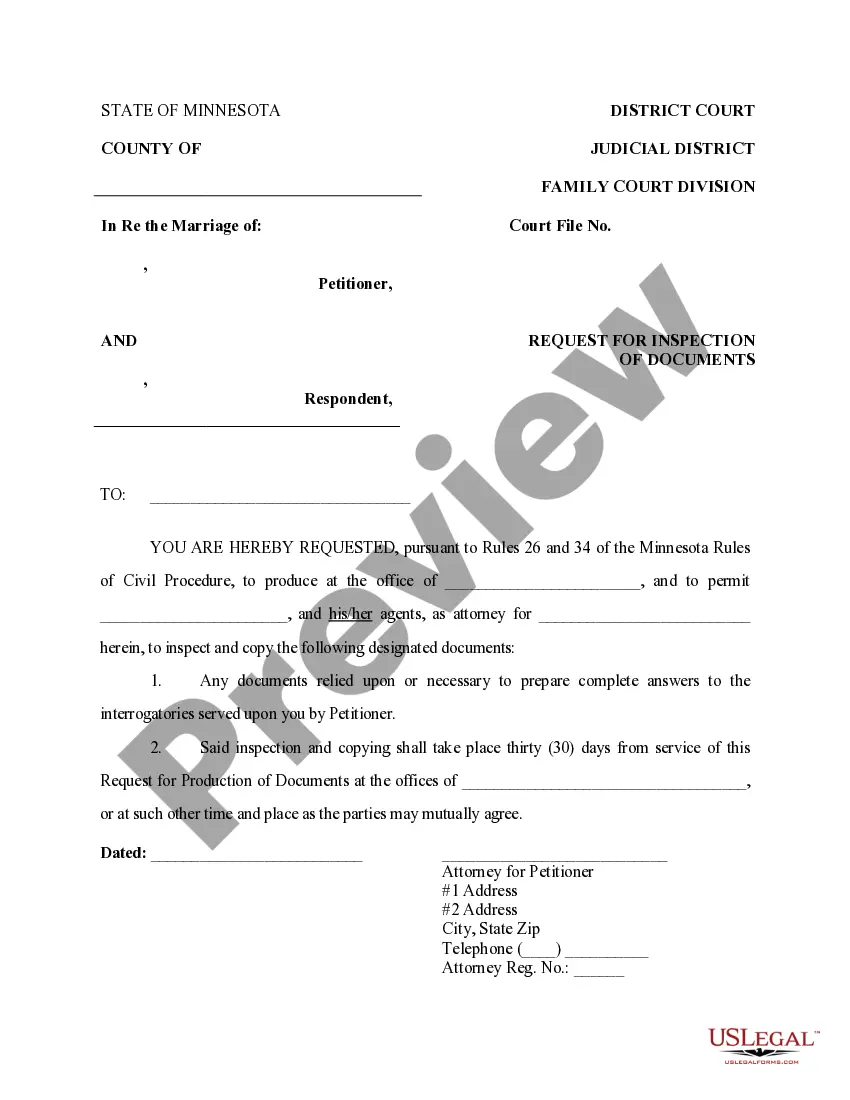
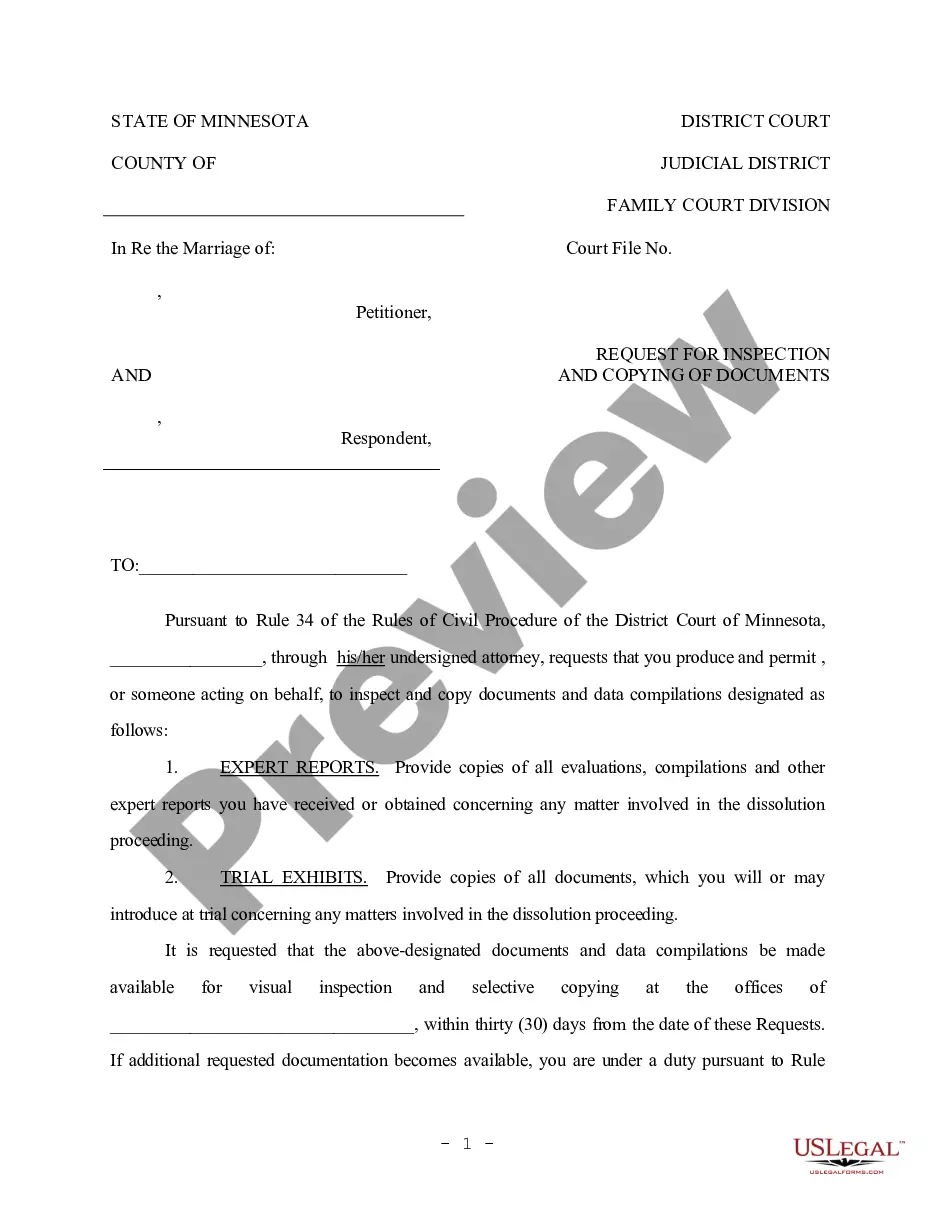
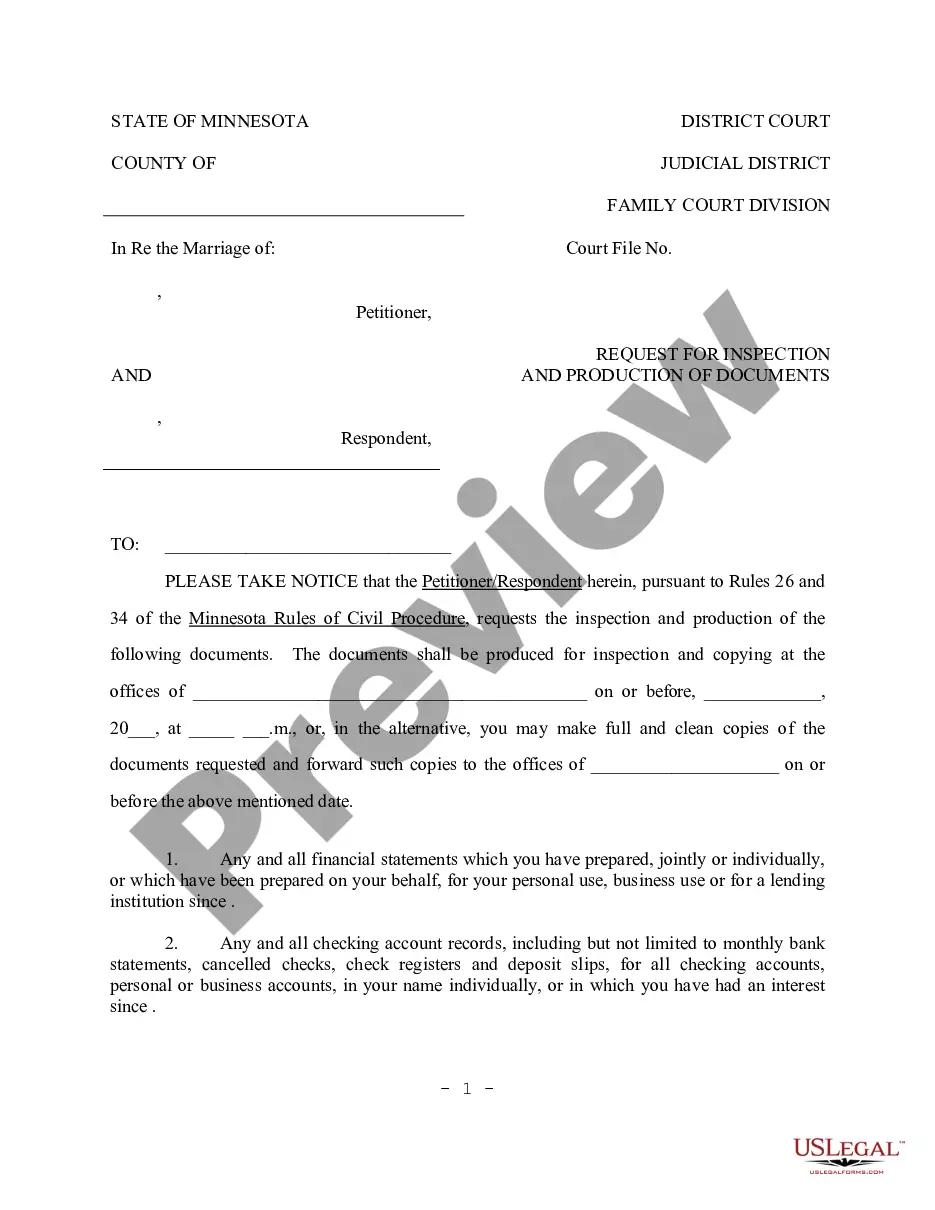
The Discovery - Request to Inspect and Copy the Designated Documents form allows a party involved in a dissolution proceeding to request the inspection and copying of specific evidentiary documents. This form is essential for ensuring that both parties have access to pertinent information necessary for preparing their case. Unlike other discovery forms, this one specifically focuses on document retrieval within a designated timeframe and location, facilitating transparency and collaboration between parties.
What’s included in this form
- A request for inspection and copying of documents relevant to the case.
- Details on the timing of the document inspection, typically set to occur within thirty days.
- Specification of the location where the document inspection will take place.
- Identification of the attorney representing the petitioner and their contact information.
- Space for the date and signatures required to formalize the request.
When to use this form
This form should be used when a party in a dissolution proceeding wishes to obtain access to documents that are critical for answering interrogatories or for the case itself. It is appropriate to use this form when you need to ensure the other party complies with document production requests as part of the discovery phase in the legal process.
Who needs this form
This form is intended for:
- Individuals involved in dissolution proceedings seeking to gather evidence.
- Attorneys representing clients in family law cases.
- Any party required to respond to discovery requests from the opposing party.
Steps to complete this form
- Identify the petitioner and the respondent in the dissolution proceeding.
- Specify the documents you wish to inspect and copy as necessary for your case.
- Enter the agreed-upon date and location for the document inspection.
- Provide your attorney's information, including their name, address, and registration number.
- Date the document and ensure it is signed by your attorney.
Notarization requirements for this form
This form does not typically require notarization unless specified by local law. It is advisable to consult with your attorney to ensure compliance with specific jurisdiction requirements.
Get your form ready online
Our built-in tools help you complete, sign, share, and store your documents in one place.
Make edits, fill in missing information, and update formatting in US Legal Forms—just like you would in MS Word.
Download a copy, print it, send it by email, or mail it via USPS—whatever works best for your next step.
Sign and collect signatures with our SignNow integration. Send to multiple recipients, set reminders, and more. Go Premium to unlock E-Sign.
If this form requires notarization, complete it online through a secure video call—no need to meet a notary in person or wait for an appointment.
We protect your documents and personal data by following strict security and privacy standards.

Make edits, fill in missing information, and update formatting in US Legal Forms—just like you would in MS Word.

Download a copy, print it, send it by email, or mail it via USPS—whatever works best for your next step.

Sign and collect signatures with our SignNow integration. Send to multiple recipients, set reminders, and more. Go Premium to unlock E-Sign.

If this form requires notarization, complete it online through a secure video call—no need to meet a notary in person or wait for an appointment.

We protect your documents and personal data by following strict security and privacy standards.
Mistakes to watch out for
- Failing to specify the documents clearly, leading to confusion about what is being requested.
- Not adhering to the 30-day timeline for inspection and copying, which could affect your case.
- Leaving out important attorney contact information or failing to sign the form.
Why complete this form online
- Easy download and editing options to tailor the request to your specific needs.
- Secure access to legal forms that are drafted by licensed attorneys.
- Convenience of filling out and submitting forms without the need for physical appointments.
Summary of main points
- The Discovery - Request to Inspect and Copy the Designated Documents is crucial for evidence collection in dissolution proceedings.
- Accuracy and clarity are essential when completing the form to avoid complications.
- Using this form online saves time and ensures access to professionally prepared documents.
Looking for another form?


Form popularity
FAQ
The Rule 26 conference typically occurs soon after the initial pleadings in a case. During this conference, parties discuss their discovery plan, including the Minnesota Discovery - Request to Inspect and Copy the Designated Documents. Proper timing ensures that all parties are aligned and that the discovery process proceeds smoothly. U.S. Legal Forms offers resources to help you prepare for the Rule 26 conference, ensuring you are ready to engage effectively.
Rule 26 of the Federal Rules of Civil Procedure outlines the disclosure and discovery process. It requires parties to exchange information relevant to the claims and defenses in a case, including the Minnesota Discovery - Request to Inspect and Copy the Designated Documents. This rule aims to promote transparency and reduce surprises in litigation. U.S. Legal Forms can help you understand and implement Rule 26 effectively in your legal strategy.
Demand and discovery for inspection refer to the legal request to examine documents relevant to a case. In the context of the Minnesota Discovery - Request to Inspect and Copy the Designated Documents, this process allows you to access important evidence. Understanding this procedure is crucial for building a strong case. U.S. Legal Forms provides templates to streamline your discovery requests, ensuring compliance with legal standards.
Documents produced during the Minnesota Discovery - Request to Inspect and Copy the Designated Documents process can be confidential. Parties often agree to protective orders to keep sensitive information private. It is essential to understand the scope of confidentiality agreements to ensure that your information is safeguarded. U.S. Legal Forms can guide you in navigating these agreements effectively.
Rule 69 in Minnesota governs the enforcement of judgments and the discovery of assets. It provides guidelines for parties seeking to identify and retrieve assets to satisfy a judgment, ensuring compliance with legal obligations. This rule is an important aspect of the broader Minnesota Discovery - Request to Inspect and Copy the Designated Documents framework, as it ensures that all relevant information is accessible.
Rule 26 in Minnesota addresses the general provisions regarding discovery, including the scope of discovery and methods of obtaining information. This rule allows parties to request relevant documents, ensuring that all essential evidence is available for review. By understanding Rule 26, you can effectively navigate the Minnesota Discovery - Request to Inspect and Copy the Designated Documents process.
To file a discovery request in Minnesota, you must prepare a written request that specifies the documents you wish to inspect and copy. You should serve this request on the opposing party and ensure it is clear and concise to facilitate compliance. Using the US Legal Forms platform can simplify this process, providing you with templates and guidance tailored for the Minnesota Discovery - Request to Inspect and Copy the Designated Documents.
Rule of practice 521 in Minnesota outlines the procedures and requirements for discovery, specifically focusing on the inspection and copying of designated documents. It establishes the rights of parties to access relevant materials necessary for their case. This rule supports the Minnesota Discovery - Request to Inspect and Copy the Designated Documents process, ensuring transparency and fairness in legal proceedings.