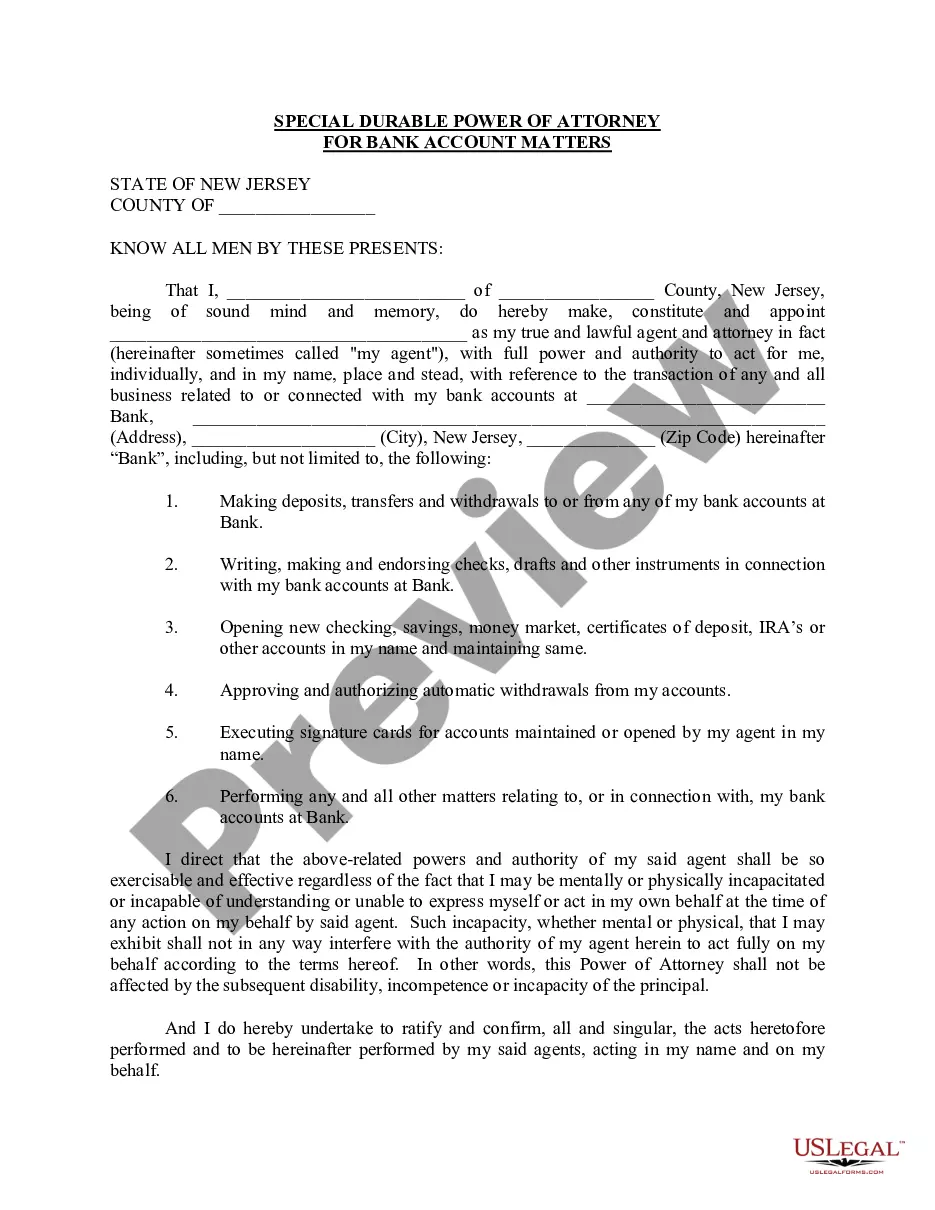
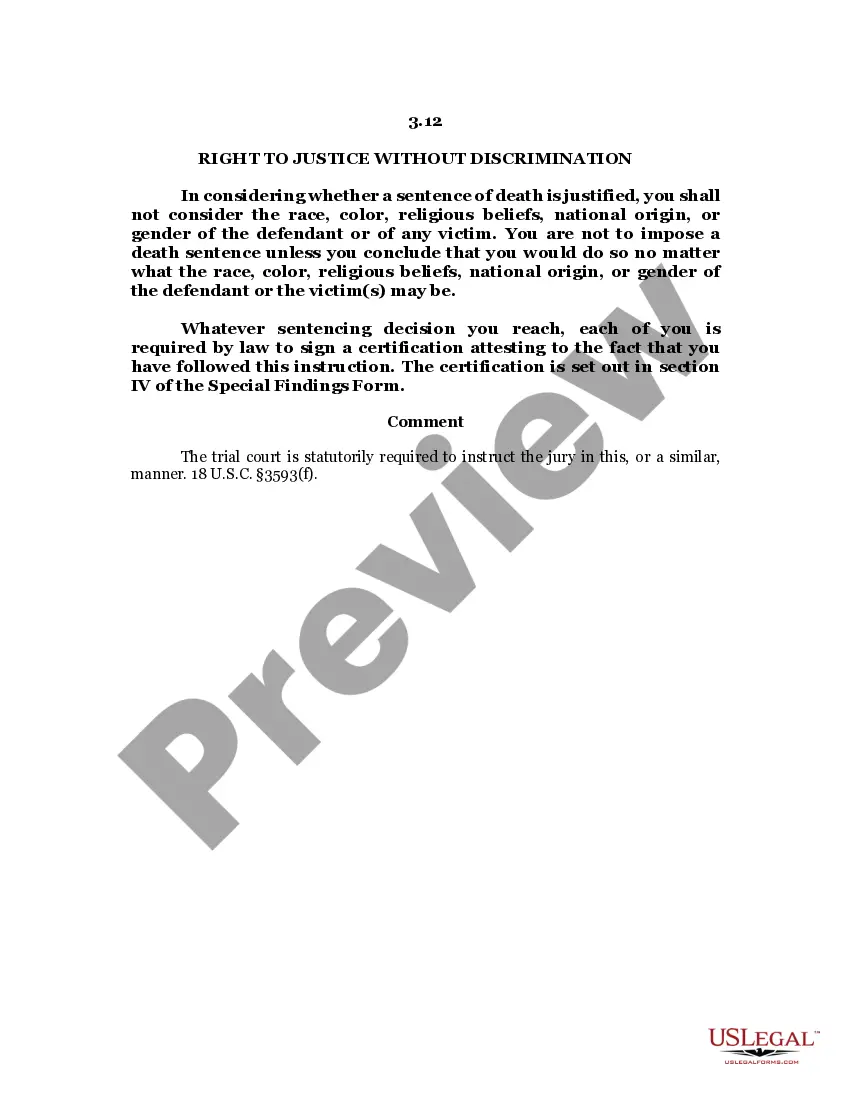
RIGHT TO JUSTICE WITHOUT DISCRIMINATION
Understanding this form
The Right to Justice Without Discrimination form is a legal document aimed at ensuring that a sentence of death is imposed without considering the race, color, religious beliefs, national origin, or gender of either the defendant or the victim. This form is essential in maintaining justice and equality within the legal system, particularly during capital sentencing. By using this form, jurors certify that their sentencing decisions are free from discrimination, aligning with federal requirements for fair justice practices.
What’s included in this form
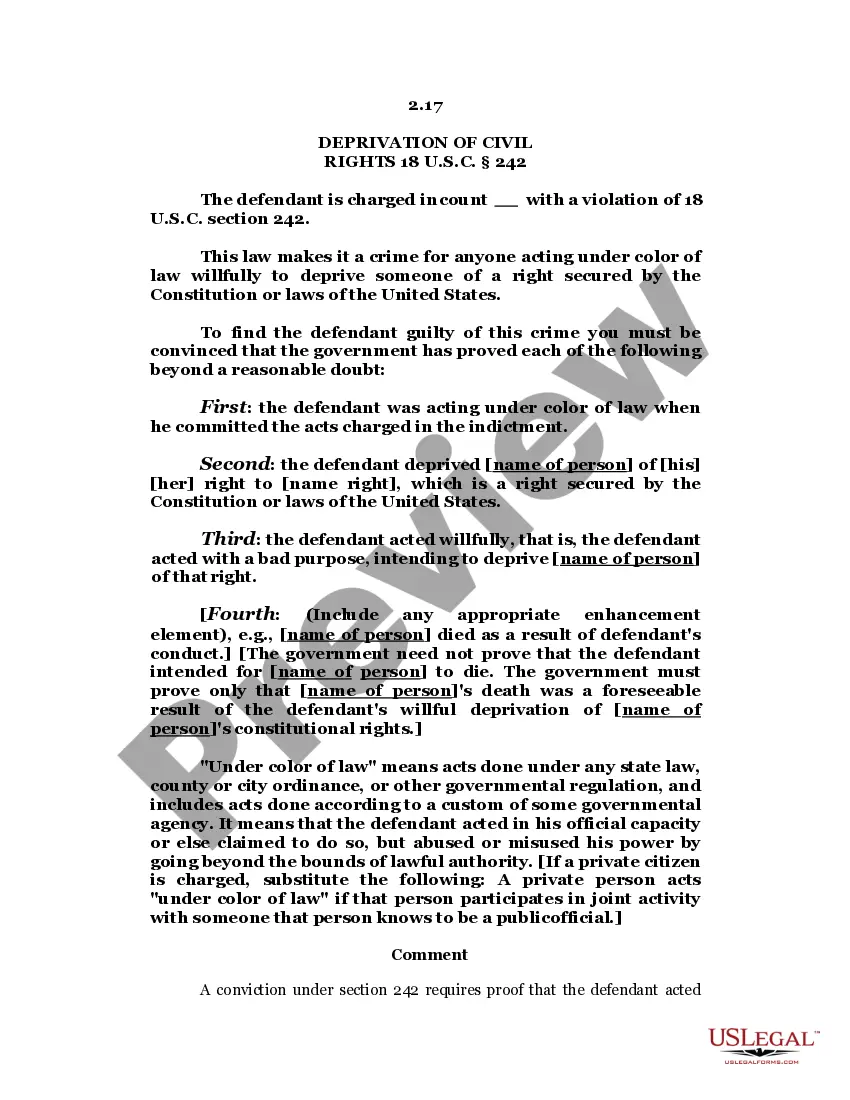
- Instructions for the jury to refrain from considering personal characteristics such as race or gender in sentencing.
- Certification section for jurors to attest to their compliance with the discrimination-free directive.
- Reference to federal law stipulating the requirement for these instructions (18 U.S.C. §3593(f)).
When to use this form
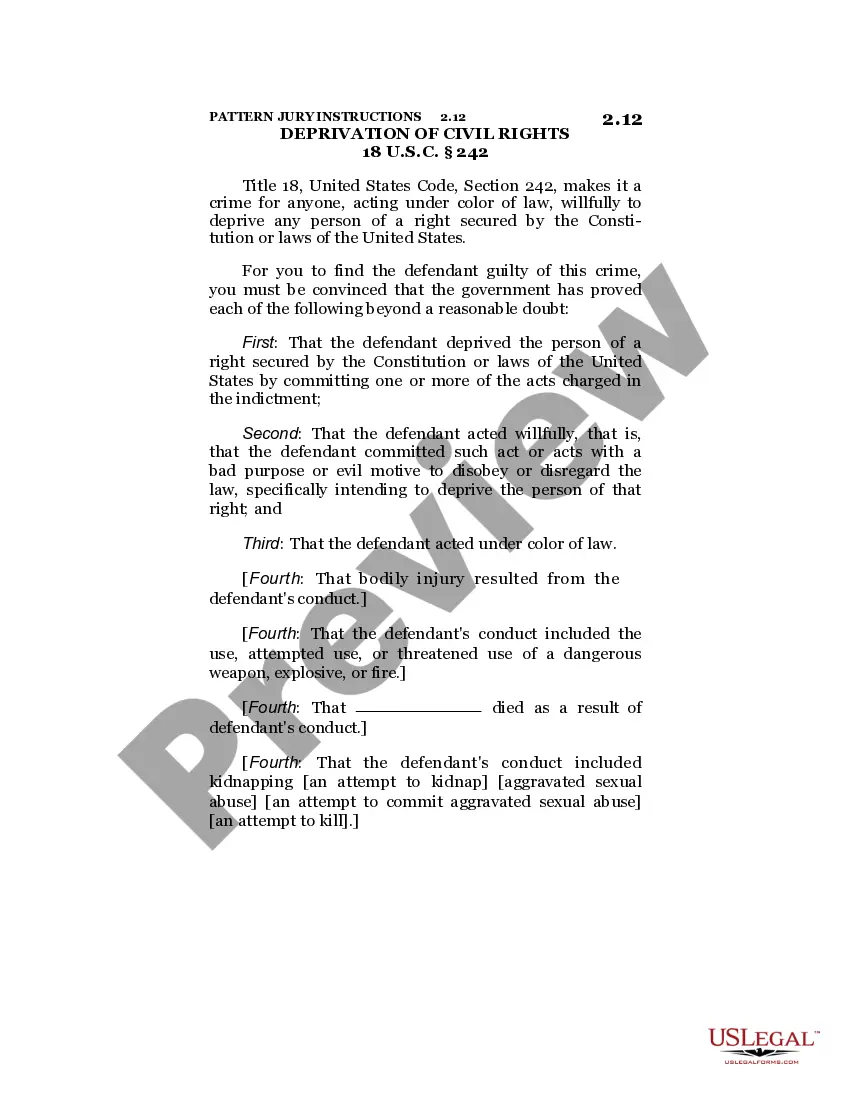
This form is used during capital trial proceedings when jurors are tasked with deciding whether to impose a death sentence. It is critical in jury instructions to ensure fairness and avoid any bias in judgment based on irrelevant personal characteristics of the parties involved.
Who should use this form
- Jurors involved in capital trial cases.
- Trial judges who must provide jury instructions related to sentencing.
How to prepare this document
- Understand the instructions provided regarding the prohibition of bias in sentencing.
- As a juror, review the case facts without considering the race, color, religion, national origin, or gender of the parties.
- When a decision is reached, neatly sign the certification section to affirm compliance with the instruction.
Is notarization required?
This form does not typically require notarization to be legally valid. However, some jurisdictions or document types may still require it. US Legal Forms provides secure online notarization powered by Notarize, available 24/7 for added convenience.
Get your form ready online
Our built-in tools help you complete, sign, share, and store your documents in one place.
Make edits, fill in missing information, and update formatting in US Legal Forms—just like you would in MS Word.
Download a copy, print it, send it by email, or mail it via USPS—whatever works best for your next step.
Sign and collect signatures with our SignNow integration. Send to multiple recipients, set reminders, and more. Go Premium to unlock E-Sign.
If this form requires notarization, complete it online through a secure video call—no need to meet a notary in person or wait for an appointment.
We protect your documents and personal data by following strict security and privacy standards.

Make edits, fill in missing information, and update formatting in US Legal Forms—just like you would in MS Word.

Download a copy, print it, send it by email, or mail it via USPS—whatever works best for your next step.

Sign and collect signatures with our SignNow integration. Send to multiple recipients, set reminders, and more. Go Premium to unlock E-Sign.

If this form requires notarization, complete it online through a secure video call—no need to meet a notary in person or wait for an appointment.

We protect your documents and personal data by following strict security and privacy standards.
Common mistakes
- Failing to understand the importance of impartiality in the decision-making process.
- Inadvertently allowing personal biases to influence the sentencing decision.
- Not signing the certification section after arriving at a verdict.
Why complete this form online
- Convenience of accessing the form from anywhere at any time.
- Editability allows for corrections and modifications before finalizing.
- Ensures you are using the most current version of the form, meeting legal standards.
Legal use & context
- Imposes a requirement for juries to act without bias under federal law.
- Enforces accountability among jurors through the signing of a certification.
- Provides protection against discrimination, promoting equality in the legal system.
Main things to remember
- The Right to Justice Without Discrimination form ensures fair sentencing in capital cases.
- Jurors must certify their decisions are free from bias regarding personal characteristics.
- This form aligns with federal legal requirements to uphold justice.
Looking for another form?

Form popularity
FAQ
Appendix 5: The Universal Declaration of Human Rights (abbreviated) Article 1Right to EqualityArticle 2Freedom from DiscriminationArticle 3Right to Life, Liberty, Personal SecurityArticle 4Freedom from SlaveryArticle 5Freedom from Torture and Degrading Treatment25 more rows
Article 14 of the UDHR grants the right to seek and enjoy asylum from persecution. This right, in addition to the right to leave one's own country (Article 13), and the right to nationality (Article 15), can be traced directly to events of the Holocaust.
Article 12 No one shall be subjected to arbitrary interference with his privacy, family, home or correspondence, nor to attacks upon his honour and reputation. Everyone has the right to the protection of the law against such interference or attacks.
Every human being has the right to life, liberty and the security of his person. Right to life, liberty and personal security. Article II. All persons are equal before the law and have the rights and duties established in this Declaration, without distinction as to race, sex, language, creed or any other factor.
Abductions, arbitrary arrests, detentions without trial, political executions, assassinations, and torture often follow. In cases where extreme violations of human rights have occurred, reconciliation and peacebuilding become much more difficult.
Non-discrimination is an integral part of the principle of equality. It ensures that no one is denied their rights because of factors such as race, colour, sex, language, religion, political or other opinion, national or social origin, property or birth.
Human rights include the right to life and liberty, freedom from slavery and torture, freedom of opinion and expression, the right to work and education, and many more. Everyone is entitled to these rights, without discrimination.
Denying services and information about health (the right to health) Discriminating at work based on traits like race, gender, and sexual orientation (The right to work) Failing to provide maternity leave (protection of and assistance to the family) Not paying a sufficient minimum wage (rights at work)