Minnesota Discovery - Plaintiff's Request for Production of Documents
Understanding this form
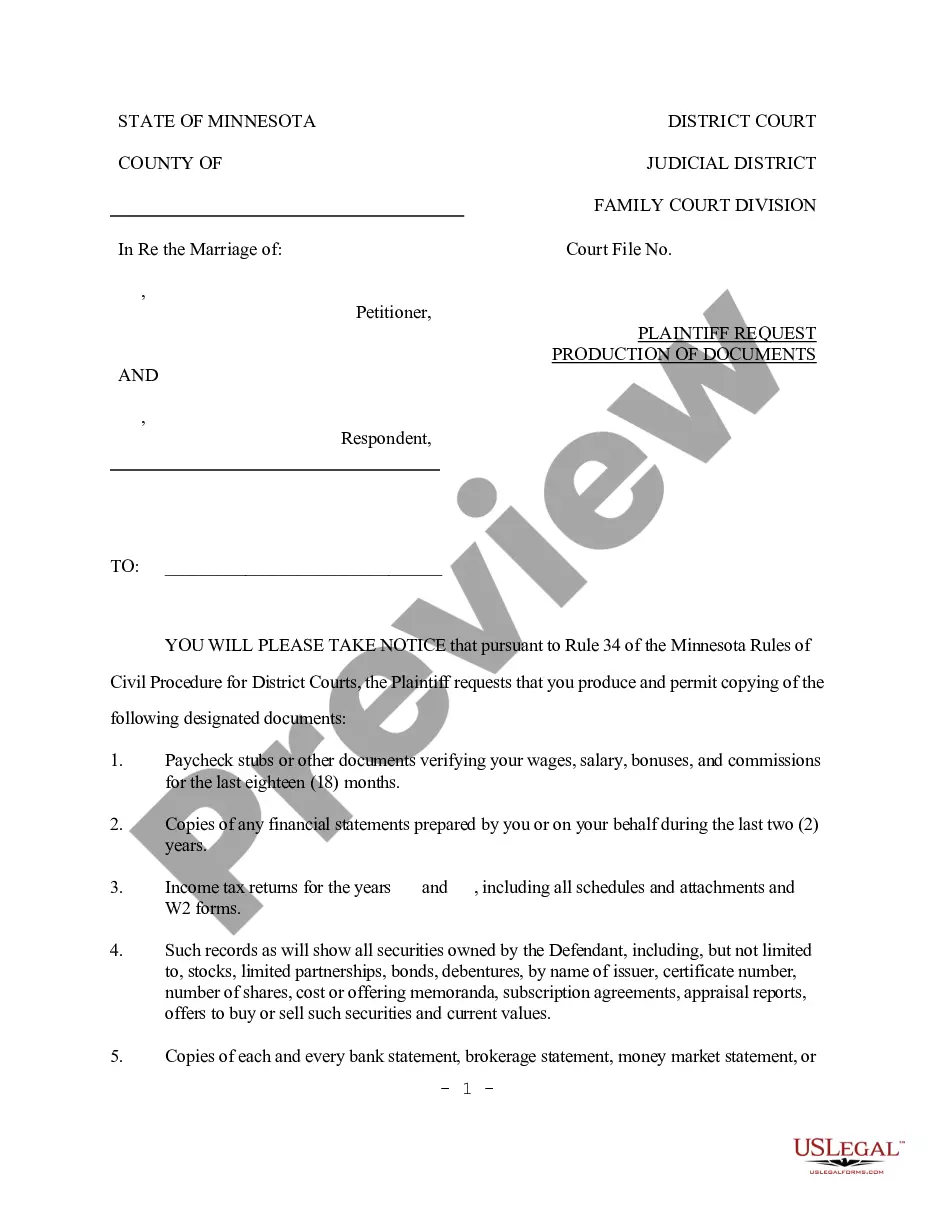
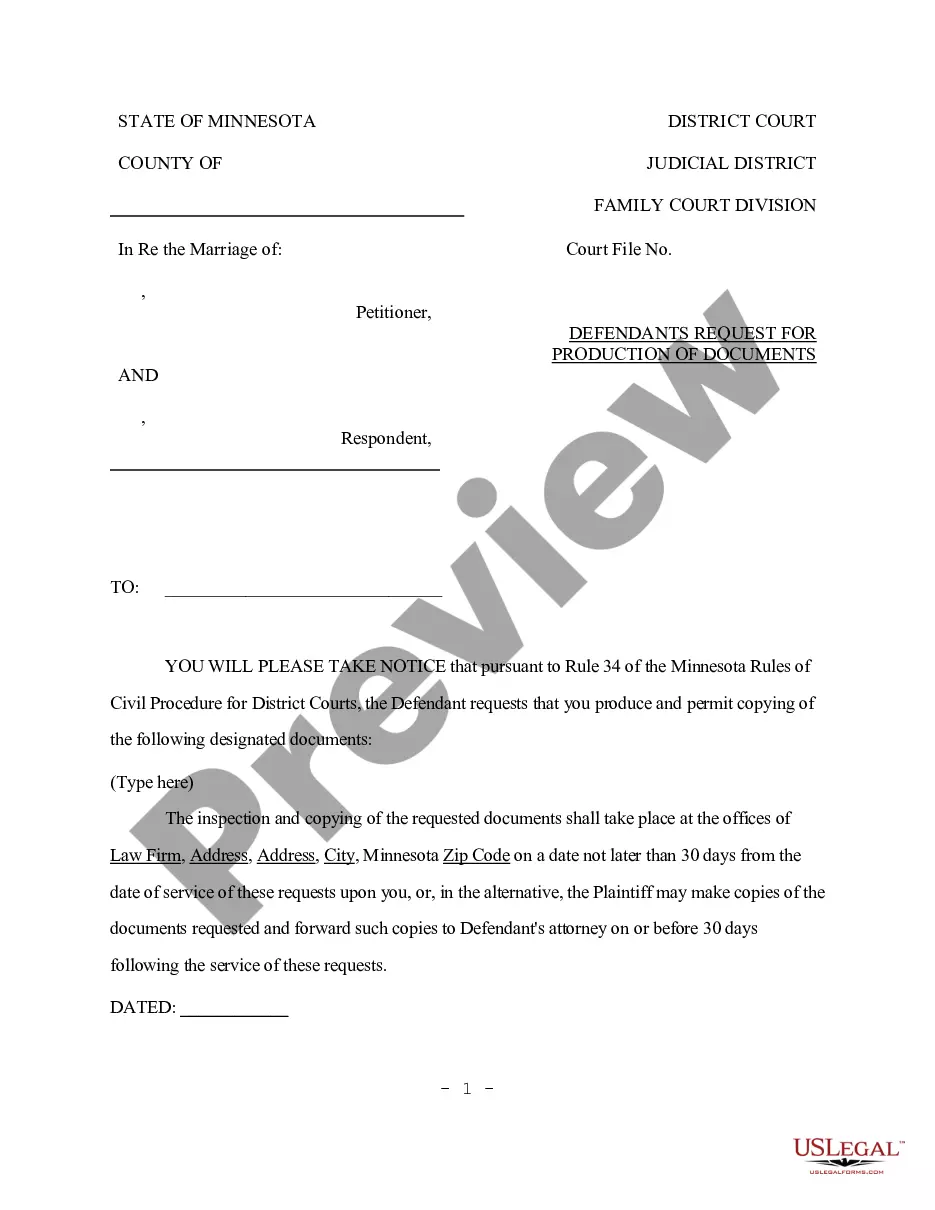
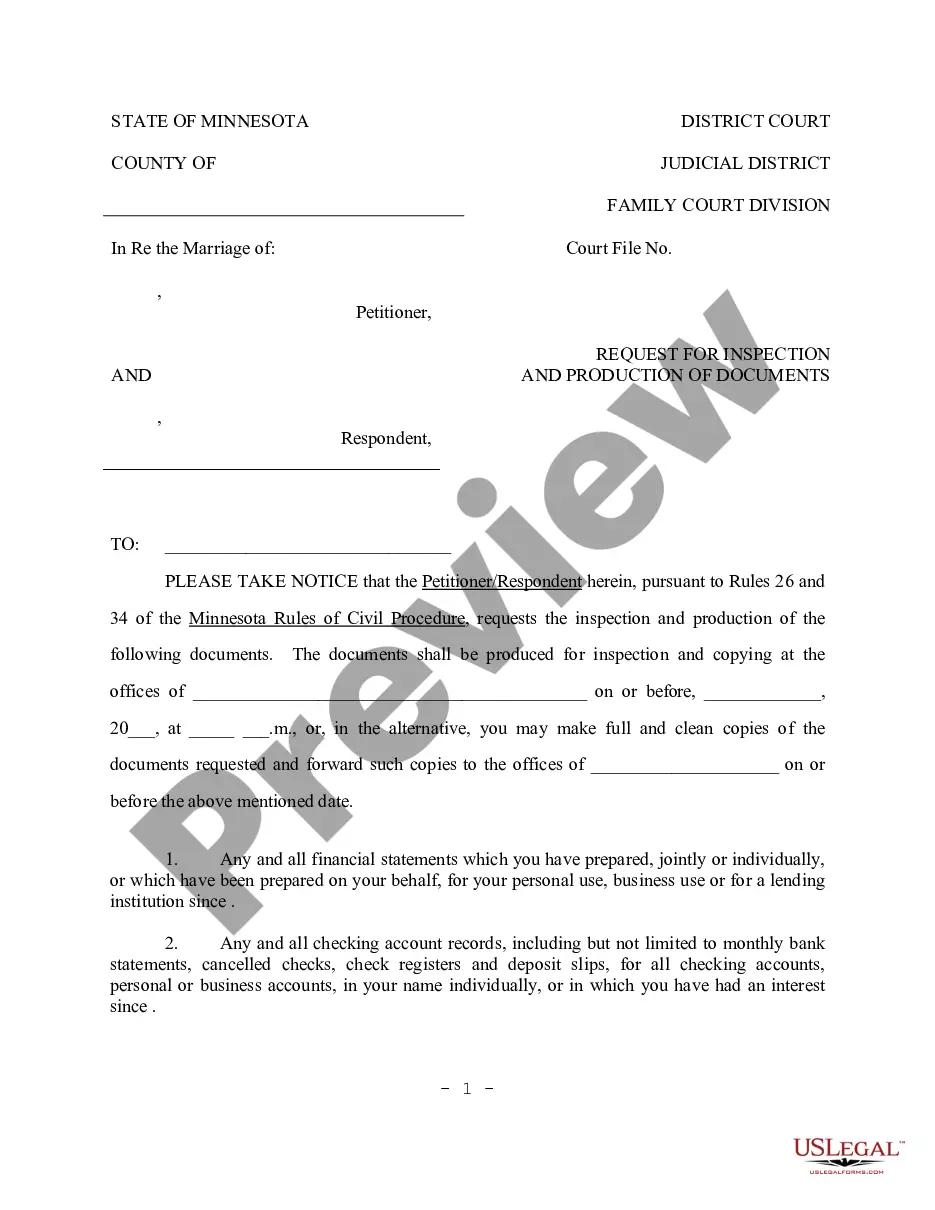
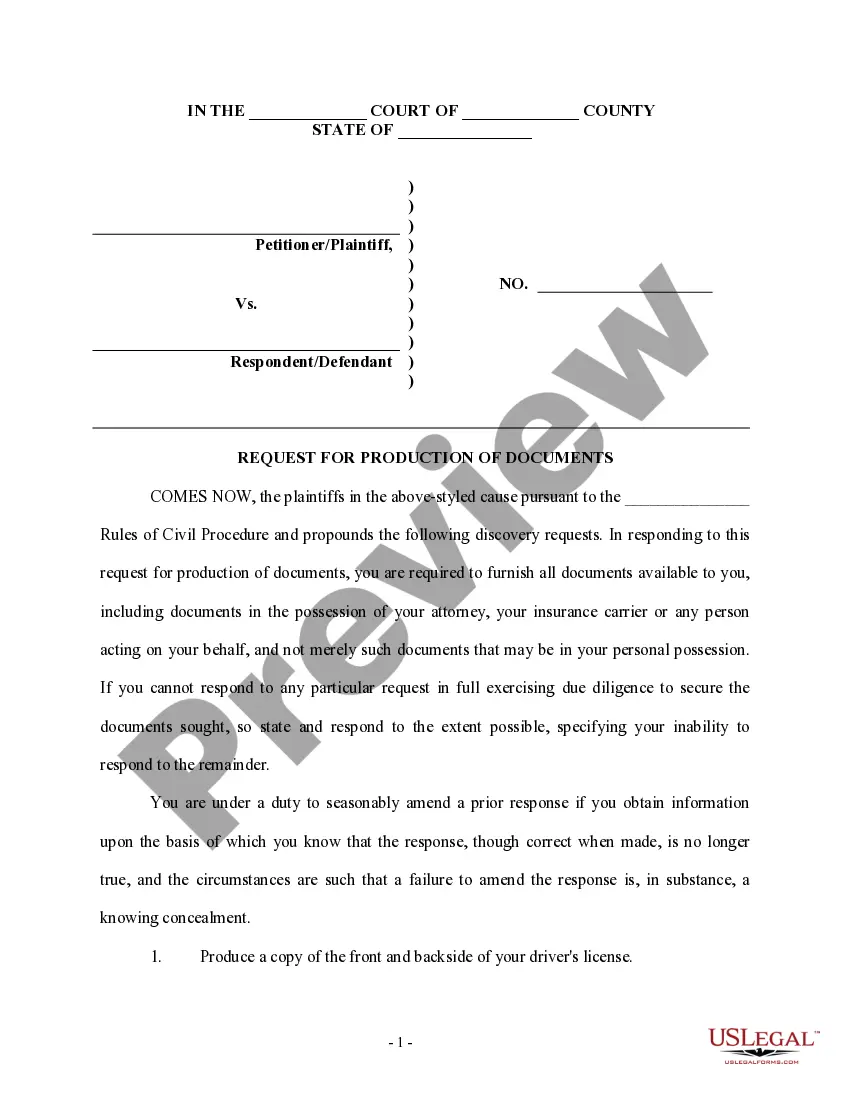
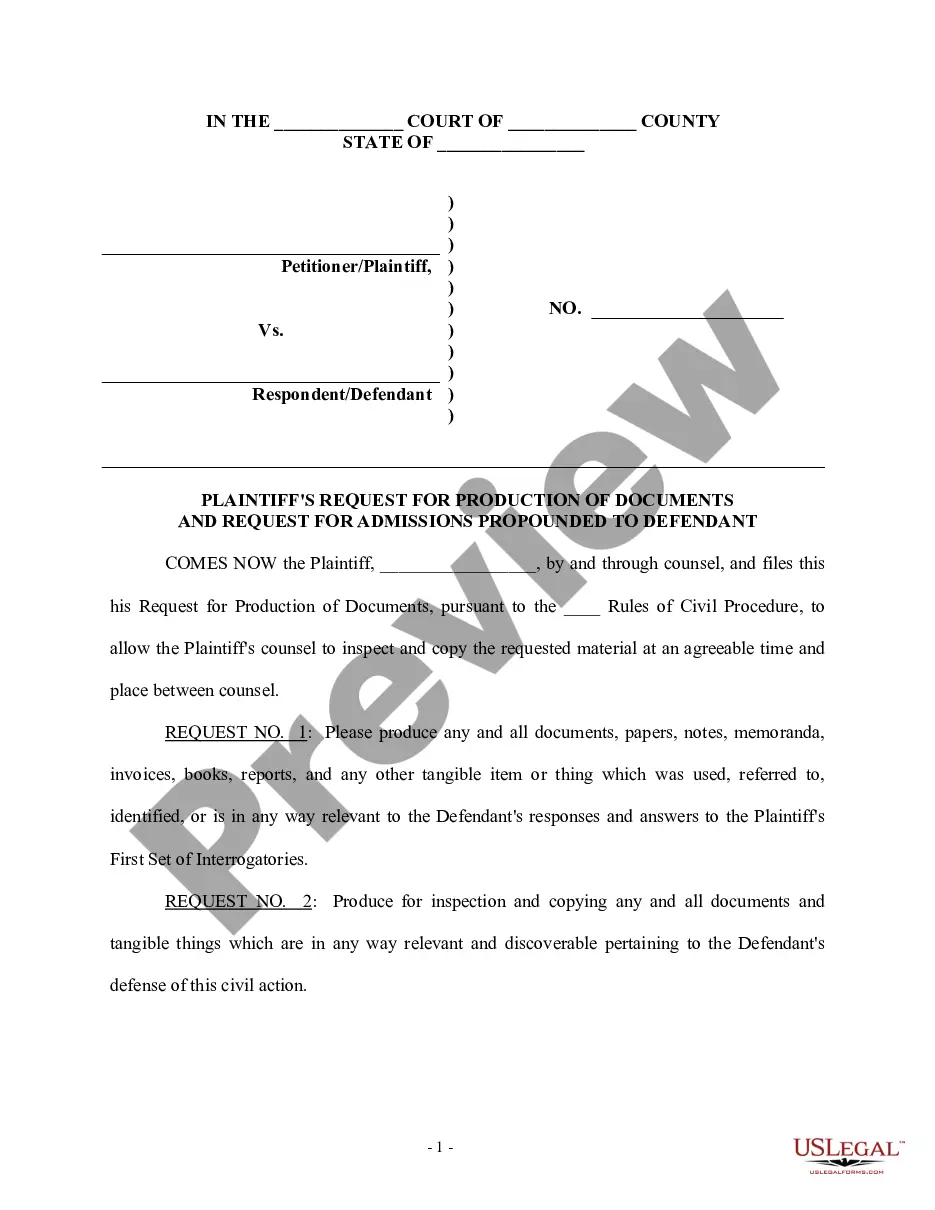
The Discovery - Plaintiff's Request for Production of Documents is a legal document used in court proceedings, particularly in dissolution or related cases. This form allows the plaintiff to request specific documents from the defendant, which are crucial for establishing the financial status and assets of the defendant. This request is distinct from other discovery forms, as it focuses specifically on obtaining documentation related to income, assets, and financial statements.
Form components explained
- Request for production of paycheck stubs and wage documentation for the past eighteen months.
- Copies of any financial statements from the past two years.
- Income tax returns for specified years, including attachments and W2 forms.
- Records showing all securities owned by the defendant.
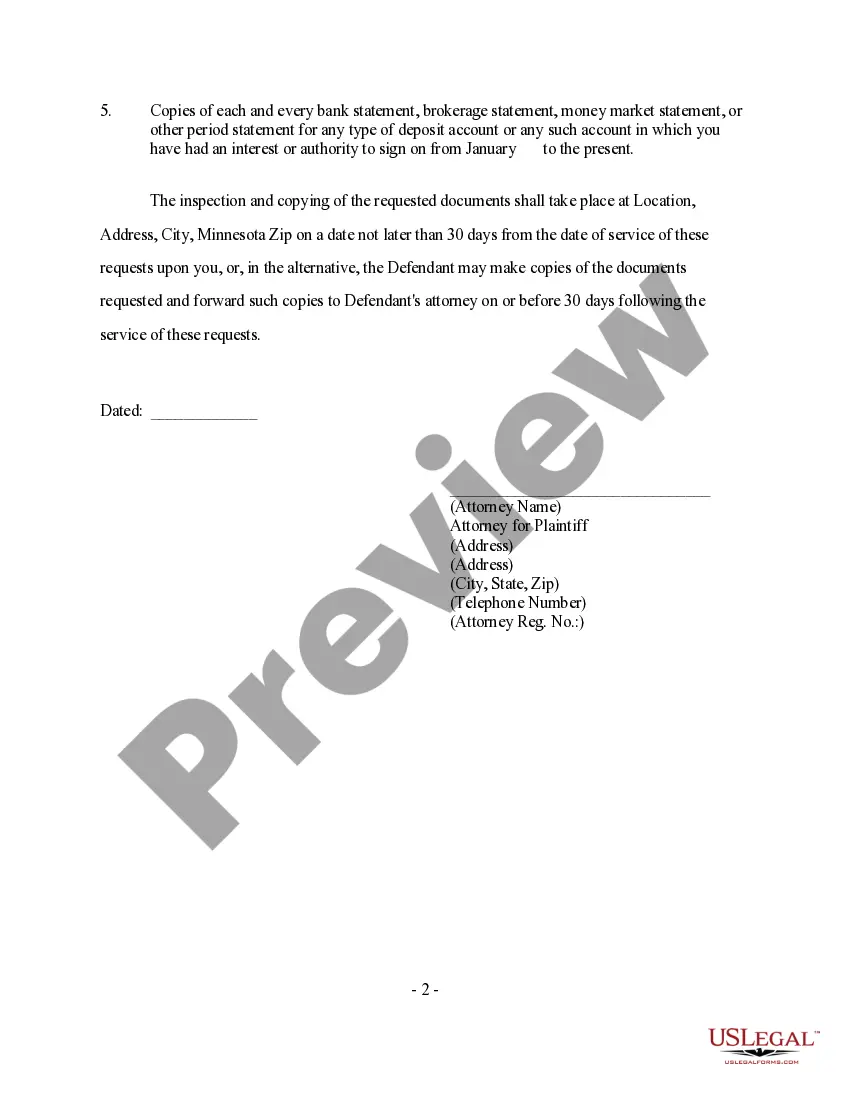
- Copies of bank and brokerage statements from a specified date range.
- Details on the location and timing of document production.
Common use cases
This form is typically used during legal proceedings where the financial standing of the defendant is in question. It is particularly relevant in divorce cases or other litigation where understanding income and asset distribution is necessary. Utilizing this form helps ensure that all relevant financial documents are disclosed and can facilitate a fair resolution in court.
Intended users of this form
This form is intended for:
- Plaintiffs in dissolution or divorce proceedings.
- Individuals involved in legal disputes regarding financial issues.
- Anyone needing to request critical financial documents from a defendant in a legal context.
How to complete this form
- Identify and fill in the name of the defendant and other parties involved.
- List the specific documents you are requesting clearly and concisely.
- Specify the relevant dates for the production of documents.
- Fill in the location and address where the documents should be produced or sent.
- Sign the form and include your attorney's information if applicable.
Does this document require notarization?
This form does not typically require notarization unless specified by local law. Always check local regulations to confirm.
Get your form ready online
Our built-in tools help you complete, sign, share, and store your documents in one place.
Make edits, fill in missing information, and update formatting in US Legal Forms—just like you would in MS Word.
Download a copy, print it, send it by email, or mail it via USPS—whatever works best for your next step.
Sign and collect signatures with our SignNow integration. Send to multiple recipients, set reminders, and more. Go Premium to unlock E-Sign.
If this form requires notarization, complete it online through a secure video call—no need to meet a notary in person or wait for an appointment.
We protect your documents and personal data by following strict security and privacy standards.

Make edits, fill in missing information, and update formatting in US Legal Forms—just like you would in MS Word.

Download a copy, print it, send it by email, or mail it via USPS—whatever works best for your next step.

Sign and collect signatures with our SignNow integration. Send to multiple recipients, set reminders, and more. Go Premium to unlock E-Sign.

If this form requires notarization, complete it online through a secure video call—no need to meet a notary in person or wait for an appointment.

We protect your documents and personal data by following strict security and privacy standards.
Common mistakes to avoid
- Failing to specify the correct time frame for the documents requested.
- Omitting necessary details about the types of documents being requested.
- Not including the required signatures or attorney information.
Benefits of using this form online
- Convenient access to the form at any time, allowing for efficient preparation.
- Editability enables you to customize the form as needed.
- Reliable templates drafted by licensed attorneys ensure legal compliance.
Legal use & context
- This form is legally binding when correctly completed and served to the opposing party.
- It can be essential for establishing financial disclosures in divorce proceedings.
- Failure to comply with document requests may lead to legal consequences.
Main things to remember
- The form is essential for obtaining important financial documents from the defendant.
- It is specifically tailored for use in Minnesota court proceedings.
- Proper completion and submission can facilitate the resolution of financial disputes in litigation.
Looking for another form?

Form popularity
FAQ
The rules of practice require that responses to interrogatories are provided under oath, which in your case, would be taken by a Notary. If it is not done, the other side can compel you to do it this way, so doing it now would be best.
A request for production is a legal request for documents, electronically stored information, or other tangible items made in the course of litigation.The responding party is required to furnish copies of any documents that are responsive to the request, except for those that are legally privileged.
What Is a Request for Production of Documents? A request for production is a discovery device used to gain access to documents, electronic data, and physical items held by an opposing party in a legal matter. The aim is to gain insight into any relevant evidence that the opposing party holds.
Requests for the Production of Documents are a discovery device used by a party to enable the individual to learn the facts that are the basis for, or support, a pleading with which he or she has been served by the opposing party.These documents might also be evidence in a hearing or a trial.
The motion to compel is used to ask the court to order the non-complying party to produce the documentation or information requested, and/or to sanction the non-complying party for their failure to comply with the discovery requests.
If a request asks for a document, make a copy of the document; in your response, describe the document and say that a copy is attached; and attach a copy of the document to the responses you send back to the other side.
The process of delivering, or making available for review, documents in response to a request for documents, such as a request for production and a subpoena. A request for documents may call for the production of paper (hard copy) documents and electronically stored information (ESI).
In certain cases, you might be able to write a letter to the other side and request the documents that you need. However, in more formal cases, you will likely have to draft more formal discovery demands. There are usually forms available for this in local law libraries, from the court clerk's office, or online.
A motion to compel asks the court to enforce a request for information relevant to a case.The requesting party files a motion to compel discovery responses if the opposing party continues to deny the discovery request.